Skip to content

Värdet av att gå på läger som “nybörjare”.

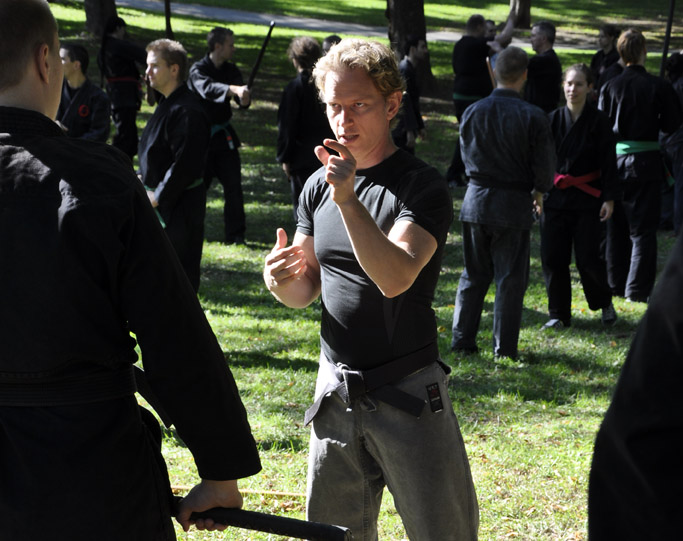
From Sweden Taikai 2012 by Sweden Taikai 2012

Ibland får jag frågor från nybörjare som undrar om det är värt att gå på läger, kommer man att kunna hänga med? Kommer jag att förstå någonting? Jag kan förstå att det tyckas vara lite skrämmande att gå på träningsläger för första gången när det är så många högt graderade som också tränar.

Men jag måste poängtera att även de som är högre graderade är “nybörjare” när man går på träningsläger! Det finns kanske de som tar på sig en hjälpinstruktörsroll, befogat eller obefogat. Men de flesta går på träningsläger för att utvecklas, träna, ha kul och få inspiration.

Vad man kan ta åt sig är givetvis olika beroende på tidigare erfarenheter. Har man tränat en kortare period så kommer man att få med sig väldigt mycket i bagaget som räcker till flera års inspiration.

Jag vet att det finns instruktörer som sällan eller nästan aldrig går på träningsläger, det kan finnas flera anledningar till det (jag vill inte döma ut dom). Om instruktören inte uppmuntrar sina elever att gå på träningsläger så kan det också bero på någonting. Han kanske inte vet om lägret, kanske inte själv kan gå och är rädd att balansen i dojon rubbas om eleverna lär sig något nytt.

Vad jag vill säga är att det är du som är nybörjare som är framtiden! Det är du själv som måste se till ditt eget bästa, bry dig inte om att dina icke tränande kompisar vill ta med dig på fest just denna helg. Om du har bra kompisar så förstår dom att just denna helg ska du träna. Du måste själv bestämma dig för vad som är viktigt, varken din kontrollerande instruktör eller tjatande kompisar får hindra dig att träna om det verkligen är det du vill.

De instruktörer du ser upp till har kommit till denna nivå och färdighet genom att just själva välja att deras egen träning går före kontrollerande instruktörer, flickvänner, pojkvänner och kompisar. Dom var också nybörjare en gång och lärde sig att sätta prioriteringar. Frågar du dom så kan jag nästan lova att dom ser sig fortfarande som nyfikna nybörjare. Det är därför dom är duktiga utövare och ingenting annat.

Jag kom ihåg en diskussion för en tio år sedan med Soke i Honbu dojo. Soke pratade om olika nivåer, dimensioner och dylikt i Mikkyo. Någon frågade vad den högsta nivån var, jag kommer ihåg Sokes reaktion. Han sade att han inte visste, men att han var ganska säker på att det alltid finns en högre nivå (än den man befinner sig på) och att det är därför vi måste fortsätta träna.

Det är detta som jag tycker gör Bujinkan så underbart jämfört med många andra budoarter, det är bara att kasta sig in i träningen försöka ha så kul som möjligt under tiden, utan att bry sig om att det är svårt eller enkelt.

Jag hoppas detta har uppmuntrat några nybörjare att ta steget och komma på detta fantastiska träningsläger nästa helg.

Ganbatte kudasai!

/Mats

Purifying the Senses with Less Muscle

From Bujinkan Santa Monica by Michael

photo by davco9200
There are different ways to consider the words rokkon shoujou.  When Hatsumi Sensei put this idea out for us as a theme for 2010, many of us gave the concept a lot of thought and smiles (he did say it was the purification of the senses through laughter). But it is not only about thinking. To succeed with rokkon shoujou, we need to include it in our everyday practice and training for it to have any effect.

Our training consists of fighting and combat. How does one purify the spirit while fighting?

I can give you something to work on in every training session that will get you started. But first please consider how training reflects your spirit. Maybe you've heard a song of the gokui that says,
"If you possess a heart like clear water, the opponent is reflected as though in a mirror."
Well the opposite of this is also true: if your heart is muddled and confused it will be reflected and magnified in your taijutsu. Another gokui reflects this idea,
"Bottomless waves that reflect on the water's surface, it is humiliating for my mind to be known."
One of the easiest ways to spot this in yourself or an opponent is the over reliance on strength or force. I know you've heard this from your teachers before. "don't use force," or "do it without muscle…"

So you seek to remove force. This is an act of purification. Overuse of strength and muscle in training reflects something about the spirit of the forceful. There is something in your personality or in your heart that seeks that release of power (or fear).

Hatsumi Sensei says,
"In the case of any technique you are practicing, it is necessary to absolutely eradicate any excess strength or power from your technique - in essence you must purify yourself of these ways."
If you do this every class - focus on this one simple aspect of training - then you will be living the practice of rokkon shoujou. And you may discover that one natural way to remove too much strength is to train with laughter and a light heart.


嵐 Arashi: Don’t Get Caught in Your Own Storm

From Bujinkan Santa Monica by Bujinkan Santa Monica

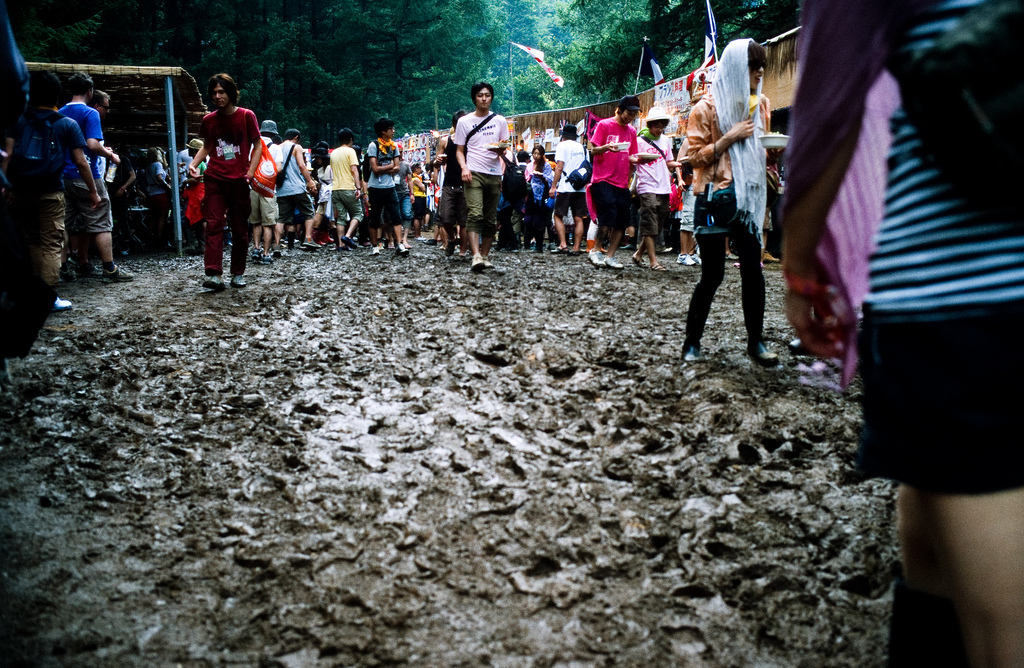
when it rains in HK, photo by rocksee
I read a curious poem this morning in a story from Saigyō.
The Japanese poet Saigyō (1118-1190) was a Buddhist monk and lived most of his life as a traveling mendicant and hermit. His poems often relate the tension he felt between renunciatory Buddhist ideals and his love of natural beauty.
In the story I read this morning, he was caught in a rainstorm during his travels through Osaka. He tried to take shelter at a brothel. Yet he was turned away by a prostitute. But this was no ordinary prostitute. In the legend, she was an incarnation of the Bodhisattva Fugen who symbolizes meditation and practice. Knowing this, Saigyō was frustrated that someone so enlightened would  force him back out into the rain. He wrote:

How difficult I suppose,
    to reject
This world of ours.
    And yet you begrudge me
        a temporary stay.

In his frustration, Saigyō could get angry at this teacher in disguise and miss an important lesson. Do you ever get angry at your teachers? What happens after the storm fades?

I have been angry at my teachers. Or at least, thought they were wrong about something. The worst is when someone shows me something about myself I do not wish to see.

In Bujinkan training I have seen many students get angry. I have seen them quit training over it. I have had my own students angry at me. And Hatsumi Sensei has had many critics and ex students who got stuck on some point of contention.

When we get angry at our teachers, an inflection point occurs where learning stops cold. Or, if we are ready, learning explodes forward from that point to even greater understanding.

Anger at teachers happens for many reasons:
  • The teacher is flat wrong or in error.
  • You think teacher is wrong even though he is right.
  • You want your teacher to be wrong because you don't like what he is showing you.
  • You don't feel acknowledged for how well you are doing.
  • Your teacher focuses only on how badly you are doing.
  • You don't like the way a teacher runs his class or handles other students.
  • Your teacher sets a bad example.
  • The teacher fails at something.
  • What the teacher is teaching doesn't match your view of reality.
  • The teacher reflects something in you that you don't wish to see.
If you get angry at your teacher, first look at these reasons and decide what they say about YOU before you dismiss the teaching. And then, if you still think your teacher is bad, you should try to consider your history with them. Is it a history based on trust and respect? Has the teacher taught you well in the past, and is there hope of learning and growing more in the future?

For Saigyō, the prostitute in his poem responded in this way,

Having heard you were one
    who rejected this world,
My thought is only this:
    Do not stop your mind
        in this temporary stay.

A deep lesson if Saigyō was ready to hear it. Admittedly difficult to hear in the middle of a rainstorm. But the most profound lessons often show up when we are most uncomfortable.

The rainstorm symbolizes something temporary that will not last. In Japanese there is a play on words: a rainstorm - 嵐 arashi, but it will not stay あらじ araji.

For us Bujinkan students, in our training, this means we can't let our minds stop or get stuck on technique. But also, don't get stuck on points of disagreement with teachers. If you stop to argue you might miss the learning that never stops. Keep going.

It doesn't matter if you think your teacher is wrong, because your only teacher is yourself. 


training shuko

From Paart Budo Buki by buki stolar

Hello Buyu's, 
here is older pictures of my new improved Plastic Shuko for training,
tested plastic, rubber spikes, original look, safe for training, 
makes this new Shuko claws ideal 

When I create a weapons for training, the most important to me that this weapon looks like the original as faithfully as possible,
maintaining the original appearance, it is possible to get a realistic feeling during practice, as permitted by technology of making, and characteristics of a material

normally, rubber spikes in this case it would not do what they do steel spikes, but during the practice it is not their purpose anyway.
Since each weapon has a physical aspect, it has also psychological aspect, in this case the mental aspect is met,
if you ask yourself how, in moment when  rubber spikes touch your skin,  
especially facial
you will realize that neither the physical (material), aspect is not neglected, because it will be clear to you what would happen to you with metal spikes in this case.
From my humble point of view, meet the  substantive and mental, it is very important in the development of weapons of practice.
Otherwise, it lacks an essential part of practice.
Dose of reality, even an imaginary one, it is important that our training would not be turned into a children's play.
Therefore, equipment designed in this way, helps our awareness during training, because Budo and Sport are not the same thing,
So I hope you understand the difference between cheap equipment, streamlined appearance, mass-made, which some Budoshop's sell,
and this what me and few others are make to improve the quality of practice.


It's also good to know that type of plastic ​​from these Shuko are made, was tested to the pressure of 10 bar=145 psi, which makes them unbreakable

If someone of you visit Hombu Dojo or if you be on Daikomyosai 2009,  you could see that Soke Hatsumi also have one of this shuko, which I gave him as a gift during my visit to Japan 2004, it is one of first versions, but still in one piece

here is video from this Daikomyosai (on 0:30 you could see shuko)


on picture above you could see that wrist ring could be in one piece, or cut it so could fit one anybody's hand, which historically also correct, because there was many variations of this weapon,
also wrist ring could be adapted to your hand if you have bigger hand


News update, August 16′th

From Sweden Taikai 2011 by Sweden Taikai 2011

Stockholm Tai Kai 2011

It is only one month until this great TAI KAI in Stockholm city, if you haven’t signed up on our web site please do that now! Right now we have 73 people from 12 countries signed up. 

It is not too late to sign up if you don’t know if you can come. If you decide late, you can just show up and pay the training fee at the door (no extra cost!).

There is no change of plans really, the instructors got their tickets, we got the venue, and we are excited! But here is a few news…

T-shirt’s, yes we will make a seminar T-shirt. We can’t show you how it will look right now, but it will be black shirts, the front chest will have the viking with the text “Sweden Tai Kai 2011″ under it. The back will have a big painting done by Hatsumi Soke. More info about this next week.

Seminar DVD will be filmed. Pre-orders will only be available during the seminar, the cost will be 350 SEK and it will probably be four discs. DVD will be region free and NTSC system. Payment is done at the booking, and the DVD-set will be sent by mail when it is done (usually within 3-4 weeks).

Saturday dinner and Party. We will have a closed party for participants and friends at Kaigozan Dojo close by. If you want to participate you have to sign up on Friday or latest at Saturday lunch time. You can participate without dinner, but you still have to sign up and we ask you to come little later when people have finished eating. If you want the dinner it will cost around 200-250 SEK paid in advance.

Things to bring with you, we have given the instructors freedom to teach what they want. They will probably build the training’s on what has been done in Japan this year. As usual it is mostly Taijutsu, but do bring small training weapons such as knife, rope etc, also swords (no sharp weapons will be allowed in training!). We have quite a big dojo booked, but we might split the group in two and train outside in the park (bring tabi, extra sweatshirt).

Accomodation will be offered by Stockholm Dojo’s. We will use Kaigozan Dojo for the party, so it will not be very comfortable for sleeping in unless you are prepared to go to sleep late, plus that we will remove all tatami. More information later on this…

Sponsored by Svenska BujinkanförbundetIf I forgot something please contact me.

/Mats Hjelm – Seminar organizer
kabuto bujinkan se (that’s with an @ and a . in between)

Sweden Tai Kai 2011 is sponsored by Svenska Bujinkanförbundet