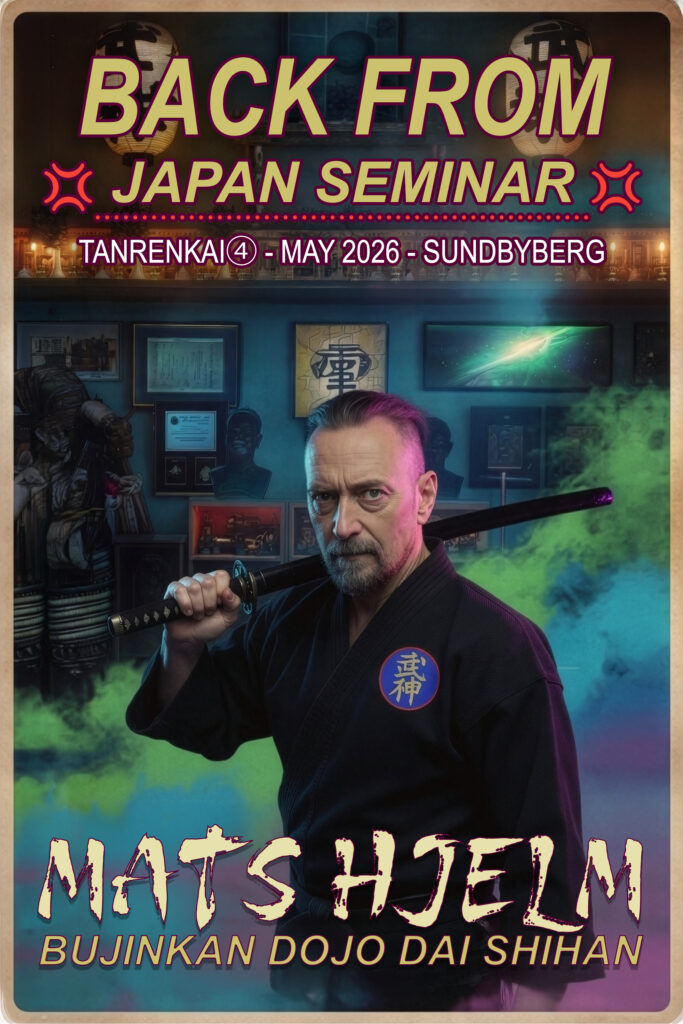
Shortly after his 54th training journey to Japan, he conducted a one-day seminar featuring Taijutsu, sword, naginata, and bisentō techniques. The training opened with Kihon Happō, followed by fresh, previously unnamed Taijutsu techniques and principles he had just brought back from his Japanese instructors.
The techniques covered at the seminar.
#
Chapter Title
Time Stamp
1.
Start
00:00:00.00
2.
KIHON HAPPO
00:00:55.28
3.
TAKAGIYOSHIN-RYU ATEKOMI
00:25:25.20
4.
TAKAGIYOSHIN-RYU GYAKUDORI
00:27:35.72
5.
TAKAGIYOSHIN-RYU KERIKOMI
00:30:18.60
6.
KUKISHIN-RYU BISENTO OSHIN
00:33:48.28
7.
KUKISHIN-RYU BISENTO KAKUGYAKU
00:38:03.84
8.
OSHIN (KENJUTSU)
00:40:43.24
9.
KAKUGYAKU (KENJUTSU)
00:41:17.96
10.
UDEORI
00:42:18.64
11.
KIHON HAPPO HENKA
00:48:00.08
12.
JODAN UKE NAGASHI
00:49:09.48
13.
End
00:51:22.00
51 Minutes. The language is Swedish with English, Japanese, German and Spanish subtitles. 1920×1080. QuickTime Text, Subtitle, MPEG-4 AAC, H.264 Stereo. Download size 1.41 GB.
Filmed from two camera angles with high-quality audio and tasteful groovy background music that supports rather than distracts from the instructions.
Short Movie Trailer
About the instructor
Mats Hjelm started training in Bujinkan for the first time around 1983. It wasn’t until 1986 when he had the opportunity to start training more seriously under a Shidōshi. He has taught at numerous seminars all around the world, gone to Japan 3-5 times every year. After he started training he never had a training break. He takes his budo training very seriously! If you want to sponsor a seminar or course, please don’t hesitate to contact him. For more information see his web site toryu.se or come and train with him at Kaigozan Dojo.
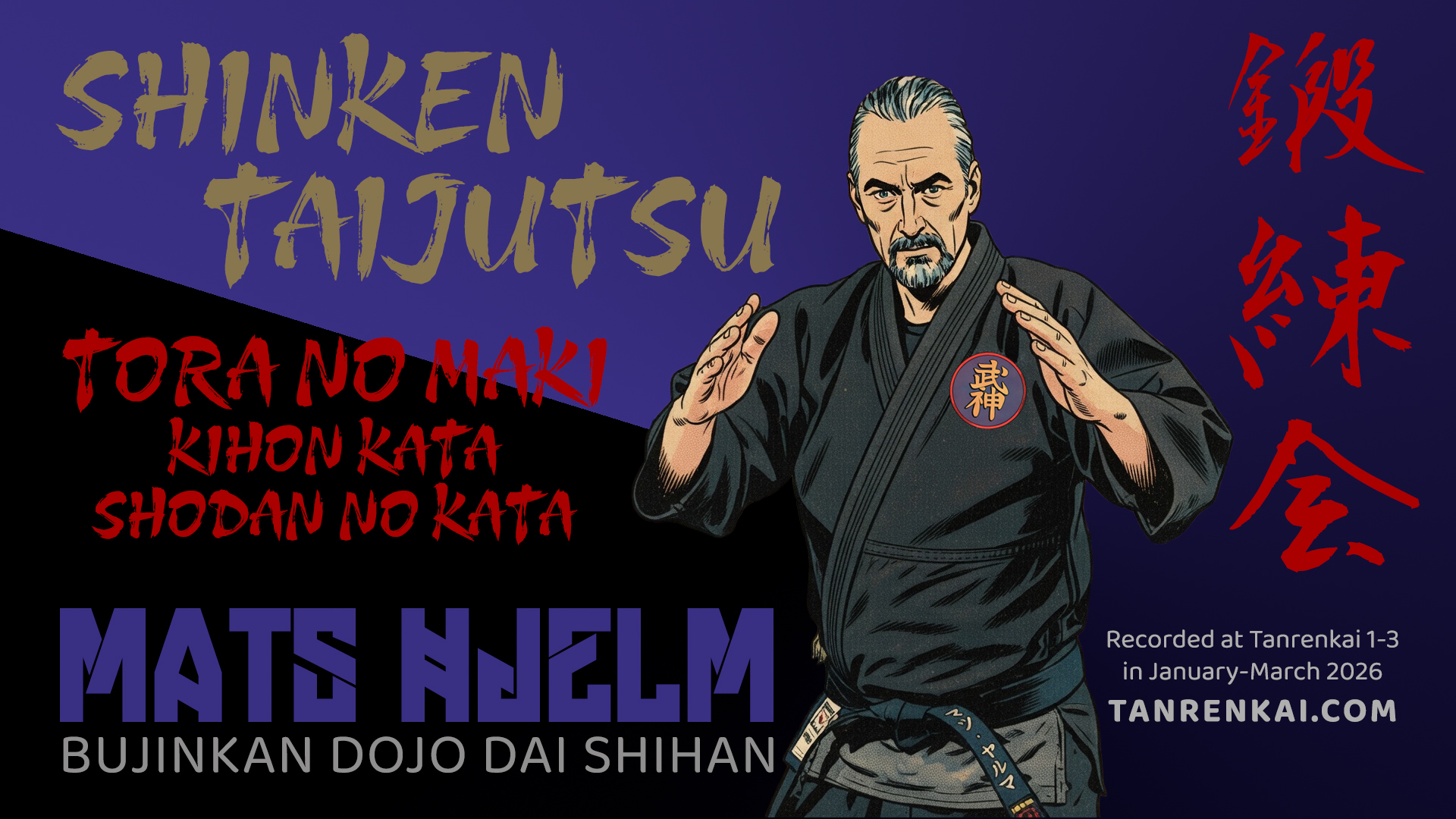
SHINKEN TAIJUTSU TORA NO MAKI – SHODAN NO KATA with MATS HJELM was filmed at TANRENKAI 1-3 Workshops in January-March 2026 in Sundbyberg.
In the early 1800’s 一柳数馬 Ichiyanagi Kazuma the 18’th Sōke of 九鬼神流柔術 Kukishin-ryu Jūjutsu and his successor 一柳織部 Ichiyanagi Oribe from the Ichiyanagi clan had also trained other arts such as Shindenfudō-ryū. With the structure of Kukishin-ryū they also incorporated elements from Shindenfudō-ryū. They Modified the old Dakentaijutsu techniques to be more suitable for the modern age without the Yoroi.
They called it 真剣体術虎の巻 Shinken Taijutsu Tora no Maki. This new system was transmitted to Ishitani, Takamatsu and Hatsumi.
This Video Highlights Include: – Kamae (5 postures/stances) – Ukemi (3 blocks/receptions) – Suwari Kata (3 seated techniques) – Shodan Kata (12 first level techniques)
45 Minutes. The language is Swedish with English subtitles. 1920×1080. QuickTime Text, MPEG-4 AAC, H.264. Stereo. Download size 1.17 GB.
If you don’t see the promo video below go to BUJINKAN.TV
About the instructor
Mats Hjelm started training in Bujinkan for the first time around 1983. It wasn’t until 1986 when he had the opportunity to start training more seriously under a Shidōshi. He has taught at numerous seminars all around the world, gone to Japan 3-5 times every year. After he started training he never had a training break. He takes his budo training very seriously! If you want to sponsor a seminar or course, please don’t hesitate to contact him. For more information see his web site toryu.se or come and train with him at Kaigozan Dojo.
九鬼天眞兵法心劔活機論 Kuki Tenshin Heihō Shinken Kappō-ron (Kuki Tradition Thesis on the Living Mechanisms of the Heart Sword in the Heavenly True Art of War) (Page 143-144, 154-155, 156) from the book 九鬼文書の研究 Kuki Bunsho no Kenkyū by 三浦一郎 Miura Ichirō.
TENSHIN HEIHŌ SHINKEN KAPPŌ-RON ①
天眞兵法心劔活機論(一) Tenshin Heihō Shinken Kappō-ron (Thesis on the Living Mechanisms of the Heart Sword in the Heavenly True Art of War – Part 1)
At the head of the volume, in remarkably skilled calligraphy, twenty-six lines of divine generation characters totaling three hundred twenty-seven characters are lined up, and at the very end it states:
“In the thirteenth year of 舒明 Jōmei (A.D. 641), year kinoe-ushi, month ki-shi day, re Atsu, small virtue crown bearer (kaō).”
This is a copy from approximately one thousand three hundred years ago, but likely a re-copying of an earlier version. The main text appears to be considerably ancient, though at the end there are traces of separate paper having been attached midway to list the names of successive transmitters. This form is common across all volumes.
Up to
“second year of Genkō (A.D. 1332), third month auspicious day, Kuki Yakushi-maru Takazane (kaō)”
and
“second year of Jōji (A.D. 1366), fifth month auspicious day, Kuki Umanosuke Takayoshi (kaō)”
the signatures are on the same paper as the main text. However, from
“second year of Kentoku (A.D. 1451), year kanoto-i, second month auspicious day, Kuki Yamashiro-no-kami Takamoto”
onward, the nine clans signed successively on attached paper. For reference, listing the names of successive transmitters after the first three:
薙刀妙風遍 Naginata Myōfū Hen (Naginata Wonderful Wind Complete / All)
棒之眞論 Bō no Shinron (True Thesis of the Staff)
半棒 Hanbō (Half Staff)
眞之心妙剣 Shin no Shin Myōken (True Heart Wonderful Sword)
閃鋒 Senpō (Flash Edge / Sudden Point)
TENSHIN HEIHŌ SHINKEN KAPPŌ-RON ②
天眞兵法心劔活機論(二) Tenshin Heihō Shinken Kappō-ron (Thesis on the Living Mechanisms of the Heart Sword in the Heavenly True Art of War – Part 2)
This is something like a detailed explanation of the aforementioned twenty-first volume. To the single sentence lining up several hundred characters of divine generation script, kana has been added and annotations provided. There are signatures of the small virtue crown bearer and Yakushi-maru. At the volume end, the names of about ten successive transmitters are listed. The content generally explains what is raised below (whereas the volume raised in the twenty-first contains no explanations, only the catalog).
秘想劍遍 Hishōken Hen (Secret Idea Sword Complete / All)
護身術數遍 Goshinjutsu sūhen (Body Protection Technique Several All)
長透貫 Chō tōkan (Long Penetrate Through)
眞妙劍 Shin Myōken (True Wonderful Sword)
閃鋒 Senpō (Flash Edge)
遠撃淵 En-geki-en (Distant Strike Abyss)
獅子飛躍 Shishi hiyaku (Lion Leap)
TENSHIN HEIHŌ SHINKEN KAPPŌ-RON ③
天眞兵法心劔活機論(三) Tenshin Heihō Shinken Kappō-ron (Thesis on the Living Mechanisms of the Heart Sword in the Heavenly True Art of War – Part 3)
This is a sister volume to the aforementioned twenty-first and twenty-eighth. The first three lines at the beginning are recorded in divine generation characters. Next follows the evidence and explanation of the small virtue crown bearer’s reverent copying. Then, the imperial oath texts of the two deities Amatsuhikone-no-mikoto and Ame no Oshihi-no-mikoto are recorded in divine generation characters, two segments of two lines each. Next again is the evidence and explanation of the small virtue crown bearer’s reverent copying. Then comes the record of Yakushi-maru Takazane, followed by the same Yakushi-maru’s “reverent writing” explanation of the “Three Treasures Three Heavens,” as well as the evidence and explanation of this volume’s heading, the Heavenly True Military Method Heart Sword Living Opportunity Thesis (in divine character text). Next, a catalog similar to the previous volume is presented, and at the volume end a long passage of martial way ultimate intent is recorded, concluding with one song, after which Yakushi-maru’s reverent copying is repeatedly inscribed.
三浦一郎 Miura Ichirō (1914 – 2006 ) was a Japanese scholar of Western history and essayist. He was a former professor at Ibaraki University and a professor emeritus at Sophia University.
After attending the elementary school attached to Toshima Normal School in Tokyo and the former Musashino High School , he graduated from the Department of Western History at the University of Tokyo .
After the war , he worked as a teacher at the new Seikei High School , then became an assistant professor at Ibaraki University , a professor at the same university in 1966 , a professor at Sophia University in 1970, a special professor at the same university in 1980, and a professor emeritus at the same university after retiring in 1985. He specializes in ancient Greek and Western history, and his book “World History Anecdotes” was published in the Kadokawa Bunko series and became popular.
九鬼文書の研究 Kuki Bunsho no Kenkyū by 三浦一郎 Miura Ichirō.
Publisher : 八幡書店 Publication date : 1 February 1999
The 九鬼文書 Kuki Documents (Kukami Monjo) are a collection of ancient Japanese texts (often classified as koshi kodensho or ancient historical transmissions) preserved by the Kuki family, tracing back to the 中臣 Nakatomi and 藤原 Fujiwara clans. They encompass cosmology, genealogy, Shinto rituals, martial arts, medicine, and historical narratives from creation to the Meiji era, originally in 神世文字 kamiyo moji (divine era script) and later transcribed into kanbun by 藤原不比等 Fujiwara no Fuhito. The texts have been annotated across generations, with additions noted via signatures 花押 kao.
The documents are not a single book but a corpus expanded over time. Based on the provided text, the core research compilation is 天津蹈鞴秘文遍 Amatsu-tatara-hibumi Hifumi (lit. “Secret Text of the Heavenly Bellows Hifumi”), a 36-volume work by 高松寿嗣 Takamatsu Toshitsugu, who added prefaces and commentary. This draws from the broader Kuki corpus, including historical, esoteric, and technical sections.
In the 1930s, Takamatsu was permitted to copy all the scrolls from the Kuki family. During World War II, the original Kuki documents were destroyed in U.S. bombing raids. In 1947, Takamatsu returned a complete set of his copies to the Kuki family. Because the surviving documents cannot be carbon-dated earlier than 1947, many historians consider them forgeries. In all honesty, we don’t really know for certain. What is well documented is that Takamatsu copied genuine old scrolls that were subsequently destroyed in the war and then returned his copies to the family.
External sources confirm the Kuki Documents as a multi-volume archive (e.g., ~55 volumes total across Shintoism, martial arts, and Shugendo; or grouped into 34 volumes under “国体歴史篇” [National Polity History], “神殿秘宝篇” [Shrine Treasures], and “兵法武教篇” [Military Strategy and Martial Teachings]). However, the text focuses on the 36-volume Amatsu-tatara-hibumi Hifumi, so the index below prioritizes that, structured hierarchically like a book table of contents. I’ve listed all named volumes/sections with original kanji, romaji (Hepburn style), volume counts, and brief notes from the text for context. Subsections are inferred where described.
天津蹈鞴秘文遍 Amatsu-tatara-hibumi Hifumi
Total Volumes: 36 Overview: A comprehensive exegesis of Kuki secrets, blending history, mysticism, martial arts, and healing. Divided into thematic volumes.
Document Name
Volumes
Description
九鬼秘文史論 Kuki Hifumi Shiron
3
Historical discourse on Kuki secret texts
九鬼宗門神秘観静遍 Kuki Shūmon Shinpi Kanjō Hen
2
Mystical views of the Kuki sect ・The divination and prophetic rites of the great deity Konjin of the Ushitora direction) ・Esoteric yin-yang divination of the highest order, plus Shinto spells, curses, and binding/repelling rituals said to have been handed down directly from the storm god Susanoo
九鬼神籬遍 Kuki Himorogi Hen
3
On temporary sacred enclosures ・Diagnosis of diseases, their causes, and medicinal treatments using herbs, minerals, etc. ・Methods of applying moxa cautery, detailed locations and functions of acupuncture/meridian points
鍼灸法・薬草 (Shin Kyū Hō · Kusuri Gusa): Acupuncture/moxibustion and herbs.
熊野修験道 (Kumano Shugendō): Kumano ascetic paths.
渡来秘法 (Toraibi Hihō): Immigrant secret rites.
金剛秘法 (Kongō Hihō): Vajra (diamond) esoterics.
This index captures all explicitly named elements from the text, formatted as a hierarchical table of contents. The 7-period historical framework (第一期: 造化準備時代 / Daiichi-ki: Zōka Junbi Jidai, etc.) spans the corpus but isn’t volume-specific. For deeper study, referenced books like Kiyohiko Wagō’s 九鬼神伝全書 (Kuki Shinden Zensho) compile further details.
雜賀忍者 Saika Ninja (Page 136-139) from the book Bessho Rekishi Dokuhon Vol. 72 – Shinobi no Mono 132-nin Data File. Written by 鈴木眞哉 Suzuki Shinya (Historical Writer).
The Mysterious Kii Group Skilled in Fire Techniques and Seamanship
▽ Were There Ninjas Among the Saika?
One of the schools of ninjutsu is the 雜賀流 Saika-ryū School, said to have been transmitted in 紀州 Kii Province. The name suggests a clear connection to the 雜賀 Saika region. Besides this, Kii Province also had other ninjutsu schools such as the 紀州流 Kii-ryū School and the 根来流 Negoro-ryū School.
織田信長 Nobunaga Oda (illustrated by Motohide Kano, owned by Chokoji Temple , important cultural property)
The Kii School, also called the 新楠流 Shinan-ryū School, is said to have been transmitted when 伊賀忍者 Iga ninjas, defeated in 織田信長 Oda Nobunaga’s attack on Iga in 1581 (天正九年 Tenshō 9), fled to 根来 Negoro. Some of these ninjas apparently escaped to Saika as well, so if this account is accepted at face value, all three schools would be part of the 伊賀流 Iga-ryū School lineage.
However, the credibility of this tradition is questionable, and it’s hard to believe that Saika (or Negoro) had no ninja-like techniques until taught by Iga. The need to approach enemies covertly or hide from them must have existed since ancient times.
It’s uncertain what the Saika School’s ninjutsu was like or whether it originated with the Saika people themselves. Nevertheless, techniques akin to ninjutsu must have existed in the Saika region for a long time.
顕如 Kennyo was a Jodo Shinshu monk from the Sengoku period to the Azuchi-Momoyama period.
Viewing ninjutsu from this perspective, it’s certain that ninja-like figures existed among the 雜賀衆 Saika-shū crowd. However, since such individuals inherently valued anonymity, it’s impossible to identify who among the Saika was a ninja or what position they held within the group.
Some claim the Saika crowd itself was a ninja collective, but that’s clearly not the case. In the 戦国時代 Sengoku period, Saika, in a narrow sense, referred to the lower reaches of the 紀ノ川 Kino River, and in a broader sense, included parts of present-day 和歌山市 Wakayama City and 海南市 Kainan City. The local landowning warriors there formed the Saika group.
That said, since Iga and Koga groups, also considered ninja collectives, were similarly gatherings of landowners, there might not have been a significant difference in that regard.
Iga and Koga are often imagined as groups wielding mysterious, superhuman techniques, but this seems largely a fabricated image created at desks in times of peace.
Looking at their actual actions, it’s evident they excelled in surprise attacks and guerrilla warfare, yet there are numerous instances where they were discovered by ordinary samurai and failed to infiltrate.
Nevertheless, while Iga and Koga landowners were known for ninja techniques, the Saika group’s strength lay in 鉄砲 teppō (firearms) and 水軍 suigun (naval forces). They used this power to challenge successive 天下人 tenka-bito (rulers). They fought Nobunaga for ten years and 豊臣秀吉 Toyotomi Hideyoshi for three, leading to their destruction, though some remnants plotted uprisings against 徳川家康 Tokugawa Ieyasu.
Evidence of the Saika group’s ninja-like traits can be confirmed from various angles. First, their occupational composition was highly complex. Given the era, agriculture was a given, but since that alone couldn’t sustain the economy, they engaged in 交易業 bōeki-gyō (trade), 海運業 kaun-gyō (shipping), 漁業 gyogyō (fishing), 製造業 seizō-gyō (manufacturing), and even mercenary work. This wasn’t always divided by specialization; individuals often took on multiple roles.
With such a lifestyle, it’s certain they mastered various skills and techniques, including 火術 kajutsu (fire techniques) and 操船術 sōsenjutsu (seamanship), which undoubtedly aided their ninja-like methods.
九鬼嘉隆 Yoshitaka Kuki (1542-1600) was the 11th head of the Kuki clan.
Their ninja-like nature becomes even clearer when examining their combat style. For instance, in 1577 (天正五年 Tenshō 5), when facing Nobunaga’s large army, the Saika group first advanced to 貝塚 Kaizuka in 泉州 Izumi Province (Osaka Prefecture) to set up camp. When Nobunaga’s forces approached, they retreated overnight, leaving the enemy empty-handed. This seems to have been a plan to lure Nobunaga’s army toward Kii Province, allowing allied 毛利勢 Mori-zei (Mori forces) to attack from behind.
Though the Mori forces’ arrival was delayed, the Saika group devised an ingenious defense for their base. They temporarily drained the Wakagawa River, buried numerous 壷や桶 tsubo ya oke (pots and barrels) in the riverbed, and then let the water flow back. Unaware, Nobunaga’s troops stepped into the river, got caught in the pots and barrels, fell into chaos, and were shot down one by one.
During this battle, Nobunaga was meticulous about maintaining communication between his main camp and frontline units, allocating many troops to secure Kino River crossing points. This indicates the Saika group’s guerrilla tactics frequently threatened Nobunaga’s 補給路 hokyū-ro (supply lines). Nobunaga’s forces, in response, burned houses and killed men and women indiscriminately across the region, likely out of frustration with the Saika group’s active guerrilla activities.
It’s well known that the Saika crowd possessed large quantities of firearms and excelled in their collective use. Individually, many were skilled marksmen, and a key trait of a marksman in that era was the ability to fire at close range whenever possible. A Saika figure, 佐武伊賀守 Satō Iga-no-kami, was notably skilled with a gun, and his personal records show he typically fired within ten 間 ken (about 18 meters).
To lure enemies or approach them, hiding was necessary, often using 硝煙 shōen (smoke), 地物 jimotsu (terrain), or disguises. These aspects undoubtedly reflected the Saika group’s ninja-like qualities.
In 江戸時代の小説 Edo-jidai no shōsetsu (Edo-period novels), a military advisor named 鈴木飛騨守 Suzuki Hida-no-kami is often depicted infiltrating enemy ranks to snipe Nobunaga. Though Hida-no-kami is fictional, he’s believed to be modeled on real figures like 鈴木源左衛門 Suzuki Genzaburō or Saika leader 鈴木孫一 Suzuki Sonichi. It’s plausible they engaged in similar actions.
Indeed, in the Battle of 石山城下 Ishiyama-jōka (Ishiyama Castle Town) in May 1576 (天正四年 Tenshō 4), Nobunaga was shot in the foot. This might have been the work of a Saika member who infiltrated his ranks.
Note: Actually Ryushin Yakushimaru, the founder of Kukishin-ryū, was born to Dōyu Shirōhōgan at Kumano-Hongu in Wakayama prefecture on January 1, 1318. So from this point on there was a family line with cunning and strategies that might have been involved here that explains what the author didn’t understand.
雜賀忍者 Saika Ninja (Page 136-139) from the book Bessho Rekishi Dokuhon Vol. 72 – Shinobi no Mono 132-nin Data File. Written by 鈴木眞哉 Suzuki Shinya (Historical Writer).
I could not find much information about this book, who wrote it or the publisher. It looks like it was published as a history book/magazine published monthly.
Being the 72’nd book I guess it has been around for many years, the web site jinbutsu.co.jp is dead so I don’t know much about the publisher.
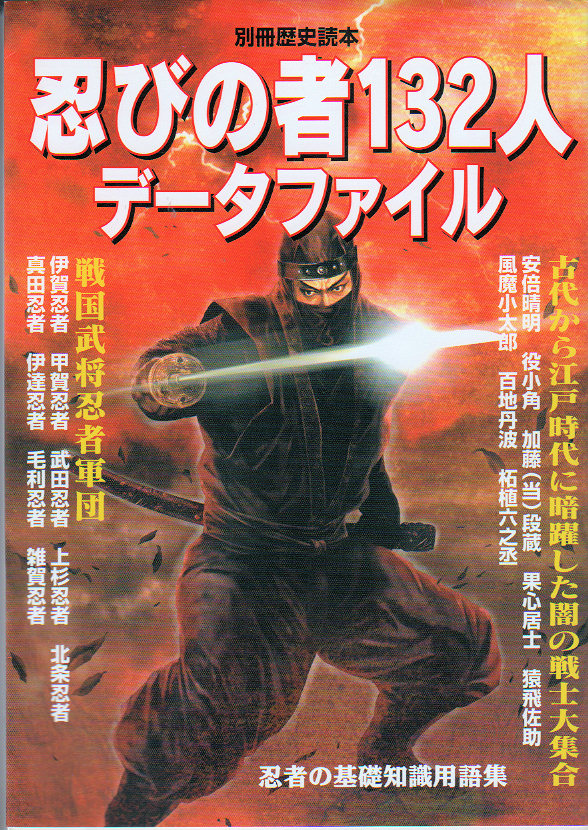
別冊歴史読本❼❷ Bessho Rekishi Dokuhon 72 忍びの者132人データファイル Shinobi no Mono 132-nin Data File
Published May 2001 228 pages ISBN-10 : 4404027729 ISBN-13 : 978-4404027726
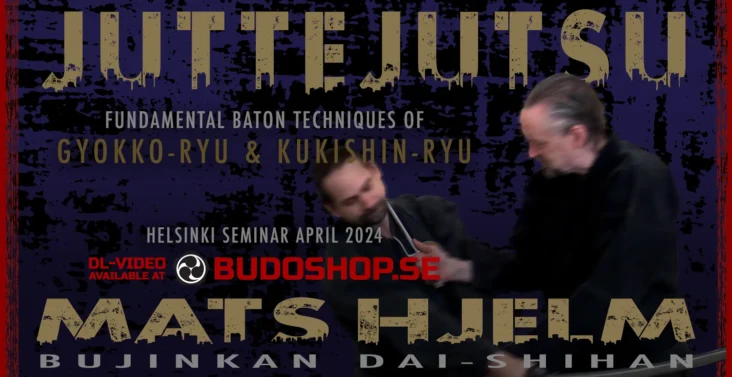
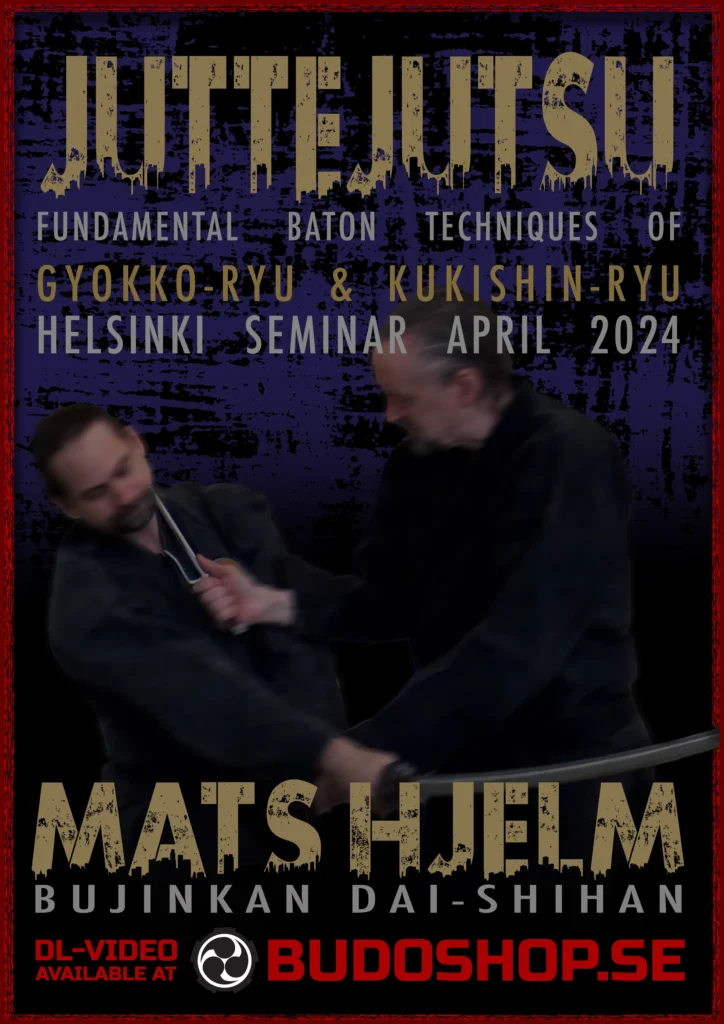
BATON FIGHTING Techniques with Mats Hjelm. In April 2024, Mats Hjelm conducted an enlightening seminar on Jutte techniques in Helsinki, Finland, organized by Bujinkan Sakura Dojo.
In this video, Mats Hjelm explores the art of Jutte-jutsu through the lens of Gyokkō-ryū Sanshin no Kata and Kukishin-ryū Jutte techniques. He demonstrates fundamental “Kōda” techniques, designed for countering both unarmed and armed opponents, alongside Kata specifically tailored for sword attacks. Additionally, Mats adapts ten techniques from Kodachijutsu for use with the Jutte.
Highlights Include:
5 Jutte techniques from Gyokkō-ryū (Sanshin no Kata)
5 “Kōda” techniques for countering both unarmed and armed opponents
7 Jutte techniques from Kukishin-ryū within the Bujinkan system
10 Kodachi techniques from Kukishin-ryū within the Bujinkan system
Download BATON FIGHTING techniques with MATS HJELM
Experience the essence of Jutte-jutsu and its applications within the Bujinkan system, as demonstrated and explained by Mats Hjelm.
十手術 JUTTEJUTSU
Techniques shown on this video
JUTTE SANSHIN NO KATA
5 techniques shown and explained
JUTTE KIHON UGOKI
Basic movement shown and explained
JUTTE KIHON YŌHŌ (“KŌDA”)
5 basic techniques shown and explained
JUTTE KATA
7 basic techniques shown and explained
JUTTE (KODACHI KATA)
10 basic techniques shown and explained
This video is from a Seminar in 2024. Recorded in Helsinki, Finland in April 6-7’th 2024. The seminar was organised by Bujinkan Sakura Dojo.
About the instructor
Mats Hjelm started training in Bujinkan for the first time around 1983. It wasn’t until 1986 when he had the opportunity to start training more seriously under a Shidōshi. He has taught at numerous seminars all around the world, gone to Japan 3-5 times every year. After he started training he never had a training break. He takes his budo training very seriously! If you want to sponsor a seminar or course, please don’t hesitate to contact him. For more information see his web site toryu.se or come and train with him at Kaigozan Dojo.…
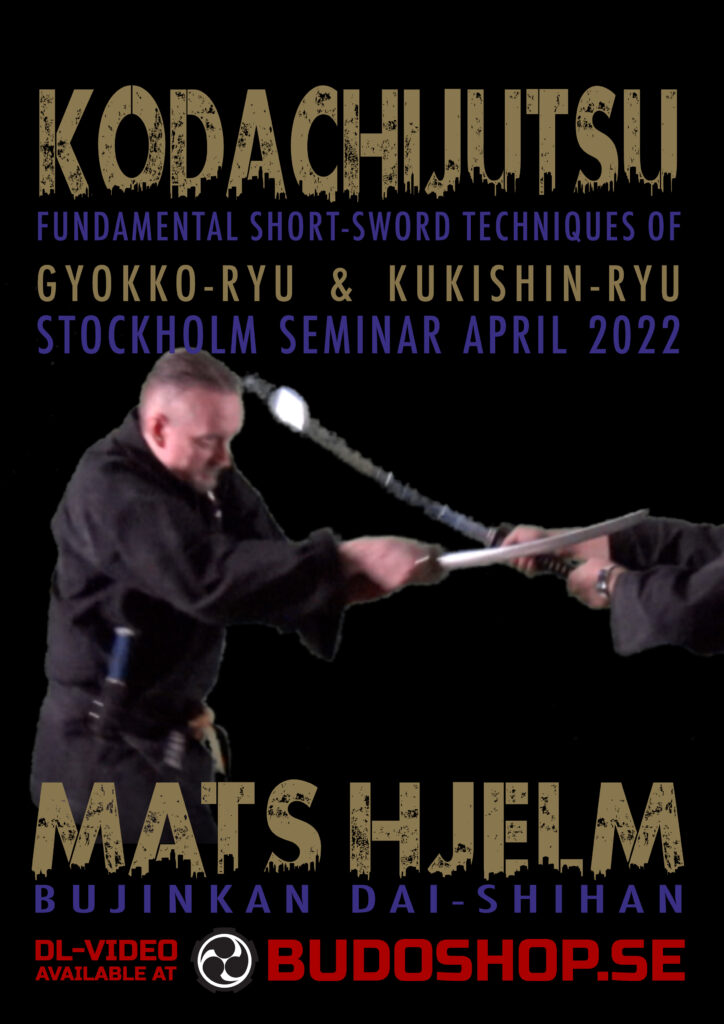
SHORT SWORD FIGHTING techniques with MATS HJELM. During March and April of 2022, we at Kaigozan Dojo studied the “short sword techniques” within our Bujinkan Dojo system transmitted from Masaaki Hatsumi Sōke to Mats Hjelm.
小太刀術 Kodachi-jutsu (Short Sword Techniques). There is three fundamental sword techniques from the Kukishin-ryū, school in the Bujinkan Dojo. Then we also have the Sanshin no Kata from Gyokko-ryu which all the weapons is connected to.
The Kodachi has been neglected by most Budō-ka and masters since it was a weapon carried by the higher ranked officials.
Masaaki Hatsumi
Download SHORT SWORD FIGHTING techniques with MATS HJELM
On this video Mats show all 5 Sword techniques from the Gyokko-ryu and the 3 techniques from the Kukishin-ryu in the Bujinkan system. We studied the basic forms with variations. We also studied Muto-dori and Tanto (knife fighting).
小太刀術 KODACHI-JUTSU
SHORT SWORD FIGHTING techniques with MATS HJELM. Each technique is demonstrated and explained from different camera angles. The instructions are in Swedish.
Gyokko-ryu
Click on the button above to buy the 32 minute video download
HD1280x720, MP4, QuickTime Text, AAC, H.264. Download size 823Mb
This video is from a Seminar in 2022. Recorded in Sundbyberg, Stockholm in April 9’th 2022. The seminar was organised by Bujinkan Kaigozan Dojo.
About the instructor
Mats Hjelm started training in Bujinkan for the first time around 1983. It wasn’t until 1986 when he had the opportunity to start training more seriously under a Shidōshi. He has taught at numerous seminars all around the world, gone to Japan 3-5 times every year. After he started training he never had a training break. He takes his budo training very seriously! If you want to sponsor a seminar or course, please don’t hesitate to contact him. For more information see his web site kesshi.com or come and train with him at Kaigozan Dojo.…
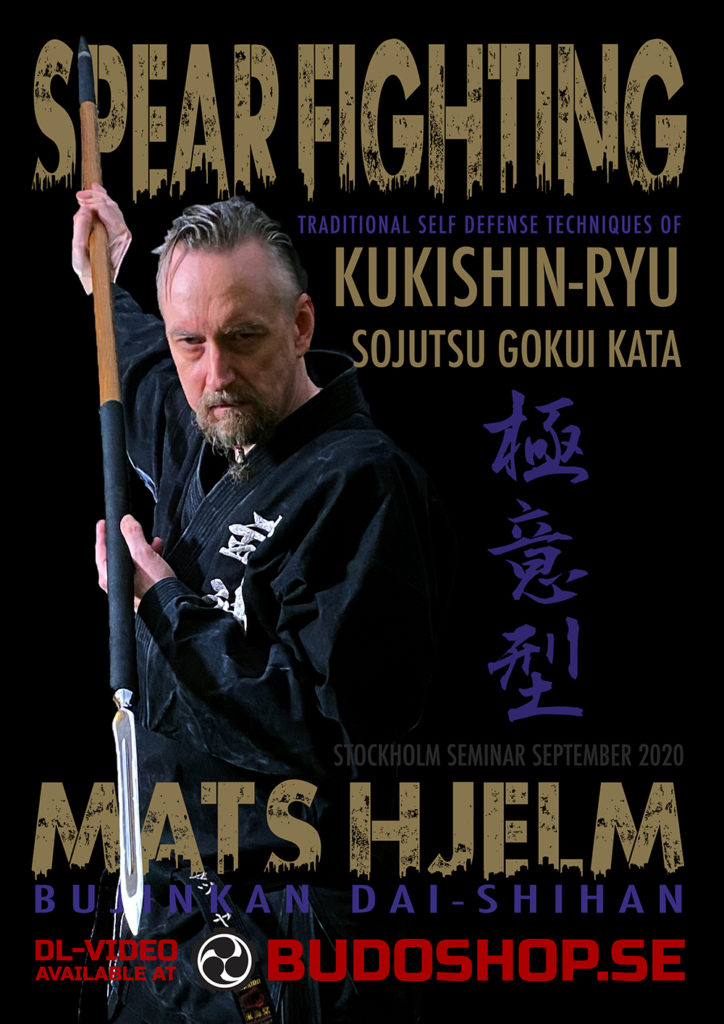
SPEAR FIGHTING The essentials with MATS HJELM. These spear techniques of Kukishin-ryu is a follow up on the old Sojutsu Kaisetsu Kata with Mats Hjelm released 16 years ago. This video covers Gokui Kata, the second level of traditional spear fighting techniques of Kukishin-ryu.
When one speaks of Gokui (essence), people get this sense of something mysterious, something really deep being there. And novelists also describe it this way. Gokui means something which that person can do well, his forte – that becomes the Gokui-gata. Warriors don’t ponder so deeply. “I’m good at this” – that what they go on. Just like in cooking: if it’s good, that’s fine. Like the expression “to cook the opponent” – Gokui is similar to that.
Masaaki Hatsumi on the Quest video SPD7006
Download SPEAR FIGHTING The essentials with MATS HJELM
On this video Mats show all 9 Yari techniques from the Gokui Kata of the nearly 700 year old school Kukishin-ryū in the Bujinkan system. These are the nine techniques.
極意型 GOKUI KATA
一文字 ICHIMONJI
菊水 KIKUSUI
巻蔦 KANCHŌ
鬼刺 KISASU
飛龍 HIRYŪ
突伏 TSUKI-BUSE
蔭蝶 KAGE-CHŌ
三ツ玉 SATSUGYAKU
七枚葉 KYOBA
Each technique is demonstrated and explained from different camera angles. The instructions are in English.
This video is from Kaigousuru 2020; this was the first Taikai after the last and the best Taikai in 2007. Recorded in Sundbyberg, Stockholm in September 26-27’th 2020. The seminar was organised by Bujinkan Kaigozan Dojo.
About the instructor
Mats Hjelm started training in Bujinkan for the first time around 1983. It wasn’t until 1986 when he had the opportunity to start training more seriously under a Shidōshi. He has taught at numerous seminars all around the world, gone to Japan 3-5 times every year. After he started training he never had a training break. He takes his budo training very seriously! If you want to sponsor a seminar or course, please don’t hesitate to contact him. For more information see his web site kesshi.com or come and train with him at Kaigozan Dojo.…
Stick Fighting, traditional self defence techniques is a follow up on the old Stick Fighting, Techniques for Self Defence video released 9 years ago. This video cover the traditional aspect of Stick Fighting.
On this video Mats show all 16 Hanbō techniques from the nearly 700 year old school Kukishin-ryū in the Bujinkan system. In the first level there is nine techniques against someone armed with a short sword or knife. The second and third levels is against someone armed with a sword. The instructions are in English.
This video was recorded at a seminar done by Mats Hjelm in Tallinn, Estonia in February 25-26’th 2020. The seminar was organised by Bujinkan Estonia.
The extended 100 minute video with additional variations and explanations.
HD1280x720 1,85Gb
Bonus stick fighting video
At the last hour on the last day we finished off the training where the participants showed a Taijutsu technique of their choice, and Mats showed how the technique could be done with the Hanbo (stick fighting). This footage is not included in any of the download videos, it is only available at our Bitchute channel (download it for free from there). Create an account on Bitchute and subscribe to our channel.
About the instructor
Mats Hjelm started training in Bujinkan for the first time around 1983, but it wasn’t until 1986 he had the opportunity to start training more seriously under a Shidōshi. He has taught at numerous seminars all around the world, gone to Japan 3-5 times every year. Since he started training he never had a training break. He takes his budo training very seriously! If you want to sponsor a seminar or course, please don’t hesitate to contact him. For more information see his web site kesshi.com or come and train with him at Kaigozan Dojo.…
Is the link between the Togakure Ryu and Kukishin Ryu deeper than we thought???
In the middle ages, there was a very serious samurai practice to take written vows when undertaking the study of a military science, especially when the pupil is from outside of the family.
In the case of the Kukishin Ryu, the Kuki family to this day still preserves a document from 1532 CE that has been continuously added to until modern times. The document is the 2nd scroll in a set of two titled “Seiyakusho” (誓約書). It is a written oath that pupils sign upon formally entering the school or “Ryu”. It is a promise to uphold the true meaning and spirit of the martial arts (military arts) and that one promises to cultivate a great sense of justice. The signature is traditionally accompanied by a thumbprint in blood, vowing they will never reveal what they have been taught to others without the master’s permission.
In the book Kukishinden Zensho by Ago Kiyotaka in 1983 he writes that he could hold in his own hands and examine this original 1532 CE document carefully. He notes that the more recent portion of the document leading up to the modern times was re-written by Kuki Takaharu in 1904.
This list is a veritable all-star list of Japanese military commanders and master swordsmen. Including Yamamoto Kansuke (Red Star on pic), known to have studied Togakure Ryu ninjutsu from Fujibayashi Nagato no Kami. The list also includes Sanada Masayuki (Green Star), the father of Sanada Yukimura. Both men are recorded as hiring local shugenja from the Togakure and Iizuna regions as shinobi and “Kamari” commandos in their forces.
Takamatsu Toshitsugu (Yellow star), our current Soke’s master also signed this list in 1899, vowing his allegiance to the emperor and the nation and to protect the teachings of the Kukishin Ryu. His “Kohai” or junior training partner Iwami Nangaku signed the list in 1922.
As Kuki Takahiro (隆博) died in WWII he was the last signature on the list as the Kuki family has taken vows of peace and no longer are involved in the martial arts. They now run several successful businesses and corporations all over the country and still administrate the Kumano Grand Shrine.
The original document list begins in 1532 with the vows and signatures/stamps of;
Kuki Yagoro, 1532 CE
Yamamoto Kansuke, 1534 CE
Kuki Moritaka, 1573 CE
Kuki Yoshitaka, 1574 CE (Formed the Kuki Navy from various bands of pirates from the Shima region)
1 name omitted
Sanada Masayuki, 1577 CE (Father of the famous Sanada Yukimura who used Shinobi from Togakure)
Bessho Nagaharu, 1576 CE
2 names omitted
Itō Ittōsai, 1573 CE (Famous master swordsman, 2nd to only Miyamoto Musashi, 33 matches, no losses)
Kuki Shigetaka, 1576 CE (Son of Kuki Yoshitaka)
Kuki Takasue, 1597 CE (Son of Kuki Moritaka)
Miyamoto Musashi (Black star), 1494 CE (Here we have an enigma, the date is exactly 100 years too early but it is for the famous swordsman, the Kuki family claims that it is the same Miyamoto Musashi who wrote the book of 5 Rings and fought over 60 duels with only one loss, I think the date may be a typo and should read 1594 putting Musashi at around 10 years old, the normal age of taking these vows)
Chōsokabe Motochika, 1595 (Daimyo of the Chōsokabe Clan)
Takagi Oriemon (Blue star), 1616 CE (Founder of the Takagi Yoshin Ryu)
Kuki Takayuki, 1648 CE (Daimyo of the Tanba Ayabe Domain)
1 name omitted
Kuki Takanao, 1662 CE (3rd Daimyo of the Tanba Ayabe Domain, brought Kito Ryu into the Kuki family)
Kuki Takahide, 1683 CE (Son of Kuki Takanao)
Shibukawa Bangoro, 1625 CE (Founder of Shibukawa Ryu Jujutsu)
Kimura Ittosai, 1649 CE (no information on him at this time)
Kuki Takashin, 1712 CE (Founder of the Shima branch of the Kuki family)
Kuki Taka??, 1743 CE (no information at this time)
Kuki Takanori, 1773 CE (8th Daimyo Lord of the Tanba Ayabe Domain)
3 names omitted
Ishitani Matsutaro, 1868 CE (Takamatsu Sensei’s 2nd master)
Takamatsu Toshitsugu, 1899 CE (Hatsumi Sensei’s master)
Iwami Nangaku, 1921 CE (Takamatsu Sensei’s Kohai under Ishitani Sensei)
9 names omitted
Shiozaki Katsuo, 1923 CE (Student of Iwami Nangaku)
Essay by Sean Askew
Bujinkan Kokusai Renkoumyo
9/6/2018
Let’s know in the comments. Please, if like what we are doing, click “Like,” “Fellow”, give us “Feedback” “comments,“ and get a notification about a new post.…