From 自然行雲流水 by 自然行雲流水

” If all you are, are uke in your martial arts career and survive. Then, you have succeeded as a martial artist !”
To write about being an uke, or for that manner, anything about budo is extremely difficult. One cannot even hope to express fully the reaches of the soul to explain it’s travels. Regardless, I will pass on my thoughts at this present time in regards to being uke for your teachers.
When I say teachers, I mean every person that you engage in training with. I do not limit my teachers to the men who stand in the middle of the dojo. The closest teacher you will have during each training session will be your training partner for that day. If one can think like this, then you will be looking at developing a common wave length to connect in both mind and body to truly get the most from your training. This does not mean that you firstly question your partner about their life, but “feel” for a commonality between you both and drive toward creating a harmony.
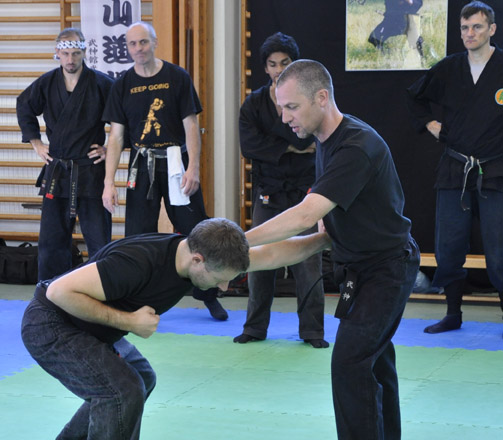
Being uke is about cleansing yourself. It’s about controlling your mind and body and unifying yourself ( shin gi tai ichi ). Being uke is not about trying to “beat your opponent up”, or ” fight them”. Being an uke is training. We are training in the principles of taijutsu. We are training to make use of the kihon ( punches, kicks, kamae, ukemi, cuts, etc ) We are aiming to deliver effective, and straight attacks at the right distance with an awareness of timing and flow. Being uke is about understanding your Kihon. The better your kihon, the better your training experience.
” Training is a promise. You trust that your partner won’t hurt you, and you do so in return. Take things slow and practise them properly. It will do you no good to creat bad habits by practising improperly. There are countelss ways to punch, but you as Uke, you should punch straight and true for the beneift of your tori – none of those tracking, side-like punches that float all over the place. That type of punching does not benefit anyone.”
- Nagato Shihan
If a person is not able to be a good uke, than he has no chance of understanding the budo he endevours to learn. Learning budo requires one to understand the relationship and feeling of both victory and defeat. There are two sides to everything, and budo is no exception.
Understanding and performing the role of uke requires the student to relinquish the ego. If one cannot do this, than they will only be able to learn %50 of what it means to study Taijutsu. To hold onto ones ego actually, is a means of ” killing oneself “. The abililty to absorb attacks requires one to release ones conscious mind to the point of responding subconsciously. To do this, one must move away from ones desires.
People who are unable to accept the role of uke hold fear within themselves. To be able to perform sutemi, one must transcend fear and move forward with a single mind. This feeling to me, is required for a good uke and tori training relationship. If you cannot forget yourself, and move forward with a mind of ” giving “, you are holding back your discovery of the self and budo. As an uke, you are giving yourself for the betterment of not just your tori’s life, but for your’s and possibly those who are viewing your training. You must look at the greater picture! Training is not just about you. Training as uke is about assisting everyone in obtaining a better life and understanding of living.
There are diseases in people. These diseases are shown in their taijutsu. It is shown greatly during their role as uke. Please watch people carefully. Your ability to understand budo is from obtaining a healthy, natural understanding of both the role of uke and tori.
Many people (of generally higher ranks ) from my observations give no energy when being uke. As a result, the partner is unable to assimilate the “feeling” of the waza. Why? Budo is about fighting. Budo is about energy. Fighting is energy. You have to give energy that is focused with a sence of conviction or committment. This energy is not malicious, but is energy that enables the tori to feel for the correct taijutsu. What I am trying to say is that there are people who just put their arm out like a wet and dead fish and just let it droop with a dead limp whenever someone tries to perform a waza. What is this!? Is that a realistic feeling for two people engaged in a possible life and death situation?!
These people hold selfish desires through their insecurities. There is no use trainin with someone like this. Sometimes these people fancy themselves as teachers and like to show you that you cannot do it. If you experience someone like this in training. Reply by moving your body the same way and tell them that you are just mimicking them! If they don’t get it, train with someone else, or hit them!
Some people like to purposely change the attacks to make it difficult for you, or counter everything you do. If this happens, you must never do what they expect. From the beginning, you both have viewed your teacher and will go and try to emulate their teachings. If your training partner changes the attack constantly, how can you learn what was shown? The person changing is adhering to their own ego and has their own agenda. Don’t waste your time or money. They are only concerned about their own training, not yours.
Soke often asks us to accept new things and forever evolve by not becoming obstinate or adhering to ones desires. Those with the in-ablility to rid themselves of debiliating desires will forever be immersed in ego and have a strong sence of competitivness with everyone. We can often see this in the dojo.
To be uke, means understanding the opposite side of life. It means coming to terms with ones true character, personality, and heart. The tests of being uke are in fact sometimes greater than that of being tori. To recieve physical pain is one aspect, but to endure the psychological element is far greater. Being an uke is a spiritual path. You feel your emotions, and have to learn to control them at all times. Ukeship is an incredible journey.
Many people cannot endure pain or discomfort. Many of these people have been training in the martial arts for a long time and are highly ranked. Noone likes pain, but when it comes to learning budo, there is no way to avoid it. Pain is an indicator that you are still alive, so be thank full !! Perservering with strenuous training gives you the chance to develop your character, learn about your body, and how to let go of your ego.
A balanced character is important. Uke that are too soft, are not realistic. So to are those who resist everything. For those that have endured real fights, we know that the body has moments of intense strength and also moments of relaxation. For the professional or experienced fighter, the effective use of energy is important to last the distance, especially if there are many attackers. There are many more aspects that can be discussed in regards to topic.
In one experience at a seminar, I asked my uke to throw a basic right punch. My uke threw two punches insetad? I will cut a long story short….Do what your teachers asks you! If you want to fight or test teacher, do it outside. If you pay money and want to learn, do what your teacher says! Isn’t it obvious that he has a plan to teach a particular point or two or three?! I’ll put this to you. Would you throw wild hay maker punches at Nagato shihan if he asked you to grab him by the collar? No need to answer that one, eh.
We are told to “show” our partner his openings or “suki”, but this doesn’t mean that we should knock his block off! You can see some people take great pleasure in showing that their training partner has a weakpoint. Remember. Two can play at that game!
Training in the Bujinkan Hombu is unique. Every martial art around the world has it’s own unique training manner. What is important is to train according to what is expected at each school. When in Rome, do as the Romans do! Many Bujinkan dojo’s around the world train according to their culture or the desire / experiences of their teacher.This is fine. What is important is that we transcend individual desires and follow the path of this Japanese budo as closely to the Japanese Shitenno and Soke as possible. If we do not, then we are doing our own thing!
Also, over committing with strikes or under committing is not balanced ( unless desired to study a particular waza ). The important thing is to have the right mind. In the Bujinkan, we can see a varied level of skill in regards to uke and attacking. Nagato Sensei himself has said that there are very few people in the Bujinkan that has shown any real skill in attacking. This is appalling really isn’t it.
Many people believe that self defence is learning to defend against punches and kicks, and not that of learning how to do them! Real budo is about balance. And this means that one must understand and have skill in all elements of fighting. Hence, we have the 18 skills of the Togakure ryu Ninja.
There are many, many things to consider in regards to being uke. You should love being uke, and love having the chance to feel the teachings of the ninja traditions from your teacher. The ninja were masters of ukemi, and therefore we need to put ourselves in as many situations as possible to learn and develop our skills. You learn about distance, angles, timing, kyojutsu, and more. By enjoying the role of uke, you will learn and also appreciate a greater training experience and feeling for life and relationships.
I could write for longer on my thoughts about being uke. I will endevour to write some more at a later date when the feeling arises naturally.
My words regarding training are from personal experience. For me, I have been lucky ( along side many, many others ) to endure being uke for the many great teachers of the Bujinkan. I’d like to think my approach to training has helped me recieve these expriences.
Of course, everyone is different. So, please follow your own path and keep going.
” Every moment is a new moment.”
Take this philosophy with you into training. As an uke, we have to deliver convincing attacking movements for our tori. To constantly do this, we have to treat the beginning of each technique as a new beginning, regardless if we have been repeating it hundreds of times!
What is necessary, is to commence each new practice as if it was the first time we had practised it. In this way, we are learning to clear our intent and understand how to enter the “now“. If we are thinking about the past or future, then we are not fully capable of entering the moment to ensure our training partner recieves the fullest conviction of our whole body. Training is not about just delivering effective movements, but more importantly, carrying with each change the spirit to give it real substance. I hope you can understand what I’m saying here.
Soke often states that we should grasp the heart of a three year old child. This is one aspect of Sanshin. In this way, we learn to play and be moved by each new moment without grasping onto the past or future. In this way, we can “play” in and with every moment. Imagination is also extremely important here.
To be able to understand why we train the way we do, is extremely important. There are many that feel that the Bujinkan manner of keiko is unrealistic. If people were actually mature and open in their mind, they wouldn’t be saying these things. Safety is crucial. We learn to move in order to protect ourselves. If we do not, then we will be injured and our training life will be reduced. Is this not common sense? Those that wish the person to ”really do” the technique on them have something wrong with them.
I once had a person ask me to put a wrist lock as hard as I could on them. I tried to reason with them, but they insisted that they wanted to feel if they could actually avoid it. It is very important to understand the words you speak and to take full responsibility for everything. Soke often warns everyone that you may get injured or killed in the dojo, and that if they can’t accept that, they should leave! Anyway, the persons wrist was lucky to not have serious injury as they dropped to the floor in pain.
” In a real fight, you will be hit and you must not be shocked by contact. Being hit lets you know you did something wrong and need to work on it until you get it right. Simply practise properly.” --
- Nagato Sensei.
Being uke requires you to understand the body and your natural responses or reactions to particular situations,strikes,hits,etc. How can you understand these things? The only way is from strong training. This is reiterated by the Shihan and Soke. Those that just try and perform the seemingly effortless movements of the Shitenno and Soke without knowing this important point are in a state of delusion. You have to know how pain manipulates your body, mind and spirit. If you do not “feel” this over a length of time, you will not understand the true potential of the techniques you attempt to perform on your partners.
The most important aspect of this point is this: Through experiencing the pain, or actual contact from strikes etc, you come to understand how your body and mind/spirit naturally responds. Therefore, in future training scenarios, you are able to respond naturally in a less vigorous training setting to the same attacks. Ultimately to assist in realistic , but safe training.
” First know yourself, then your enemy.” Sun Tsu.
Unfortunately, there are some uke that take being uke to the extreme. They fly around too easily, and land with a gasp. They treat it more like a show, rather than budo. Some uke already have made their mind up to take ukemi before tori has even committed to a waza/henka. They are training in a different space. This is dangerous in reality. This is also dangerous in training. This is not being a real uke. This is being a performer. Just like people who clap after a class has finished at the dojo, they have forgotten the concept and truth behind the budo in which they think they study.
” There are Shidoshi out there that have never been hit. Yet they are professing to be teaching Budo.”
- Nagato Sensei.
Unfortunately, people often jump to this type of training before the body knows how to move. This therefore breeds disbelievers, or people that try to “hold their ground” while a technique is being practised on them. This is a sickness from pure lack of training, and / or ignorance to the way of training. I’d like to also state here that Soke recently mentioned the cultural learning concept of Shu Ha Ri. This may have some significance to this current post aswell.
Nagato Sensei once said. ” If you are training correctly, then you are actually doing randori.”
Training is only going to be realistic if both the uke and tori have a working knowledge of the truth of training and the necessary mind set in order to produce the “feeling” of reality when practising. There is much responsibility for both the uke and tori. It’s about ” give and take or give and return.” It’s about training correctly right from the beginning!
“ Many people look at my training and say. ” that hurts.” Then when they train iwht me , they feel that it hurts and don’t want to come back. It is very important to get used to getting hit and learning to deal with it. Otherwise, how could you survive in a real fight.”
- Nagato Sensei
Being an uke is about learning the “feeling” of Bujinkan Budo. You will sense the good and the bad teachers. This is important. Soke asks us to learn to discern the good from the bad and train with the good. This is something we have to learn ourselves. Unfortunately, there are many students out there ( even in Japan ) that have not been able to see the truth of some teachers. They therefore are treading further from the true path without even realising it.
The “feeling” you recieve from your teacher depends entirely upon how open you are or, how empty your cup is. If your body understands the taijutsu, then your mind should ultimately be free from any thoughts. Therefore, being an uke is just like the godan test( thank you Lance ). If you enter the state of Mushin ( no mind ) , and your teacher is moving from the same inner peace, then the connection between you both has developed to a larger capacity. The projection of intent is more acutely felt and utlisied. Training moves into a different space. From a sense of bushin no wa, uke and tori trip into the kukan and recieve a greater chance to experience the gokui of budo.
This capacity requires both uke and tori to develop their Sainou and Tamashii. They can increase their capacity to understand Budo through harmonising their efforts, rather than fighting against one another. Soke often states that fighting is not what we do. Can you gain a better appreciation of his words now? It is gaining the ability to harmonise with the opponent that enables us to defeat them him/them without fighting. This is only possible from obtaining shin gi tai ichi.
Soke wishes us to develop martial friends ( buyu ). This is the first step to learning the secrets of budo. From becoming friends, we come together and train. We laugh, feel pain, but enjoy the training. Because we enjoy it, we relax and have fun. These pleasurable times in the dojo lead us away from our debilitating thoughts. We begin to connect with our buyu, and we therefore advance our lives further by opening our hearts.
Opening our heart also empties our cup. We become much more accepting of people, different values and cultures, etc. We develop a larger capacity to live more freely and happily. The art of giving is the important thing here. This is what the role of uke teaches. It is also the necessary trait required to progress along the correct path in budo.
I have many more thoughts about being uke. But, I will leave it there. Being uke is personal. It’s up to you to try and understand what lessons are to be learned by being uke.
Good luck.
…