Skip to content

Keiko31 – Holger Kunzmann – Gyokko-ryu Kosshijutsu, Joryaku no maki

From New Products from Budo Shop Store by New Products from Budo Shop Store

Title: Keiko31 - Gyokko-ryu Kosshijutsu Joryaku no maki
Instructors: Holger Kunzmann
Theme: Gyokko-ryu Kosshijutsu Joryaku no maki
Recorded: Recorded in Stockholm April 30th-May 1st 2011

The instruction is in English Format: NTSC, AAC Stereo, DVD/R- (it might not work on older DVD players! check your manual first!) approximately 120 Minutes playing time.

This DVD contains all 12 basic taijutsu techniques from Gyokko-ryu Kosshijutsu Joryaku no maki. All Taijutsu techniques are taught and explained thoroughly as the basic foundation, and with many applications and henka. The following techniques where taught...

玉虎流 上略の巻 GYOKKŌ-RYŪ JŌ RYAKU NO MAKI
This is the first Taijutsu level in Gyokko-ryu and a very important if you want to learn the Bujinkan Budo Taijutsu system.

1. 虚空 KOKŪ
2. 輦輿 RENYO
3. 弾手 DANSHU
4. 弾指 DANSHI
5. 逆流 GYAKURYŪ
6. 梟鷗 KEO
7. 跳火 HANEBI
8. 闕倒 KETO
9. 指砕 YUBI-KUDAKI
10. 締脈 KETSUMYAKU
11. 殺締 SAKKETSU
12. 蹄拳 TEIKEN

All these techniques are explained and taught in detail. The DVD has menus where you can chose technique to see, completely with chapters.

Extra material from this seminar

We also released an 82 minute video as download file whith warm-up and basic Taijutsu training drills. Including extra 20 minutes with henka that we couldn’t fit on this DVD. This is only available as download file, click here for more information

About the instructor

Who is Holger Kunzmann Holger's main interest in Bujinkan is the basics. And he has become quite famous for his excellent taijutsu and very good knowledge and skill of the basics in Bujinkan. He travels to Japan 3-4 times per year to study the with Hatsumi Soke, Someya Shihan and the other Shihan to. If you want to sponsor a seminar or course, please don’t hesitate to contact him. For more information see his web site Holger's web site... www.bkd-reutlingen.de Note! The instructions is in English and there is no sub titles on this DVD

Skr239.00

Utsuru 映る: Is Your Mind Reflected in Your Taijutsu?

From Bujinkan Santa Monica by Bujinkan Santa Monica

Dusk, Moon with Sunset Reflected in a Bubble. photo by arhadetruit
What have you been studying for the Bujinkan yearly theme of 2011? It seems that every year we start out on a journey of exploration. At the beginning of the year our minds seek something concrete to study. And Hatsumi Sensei puts something out there for us to consider. But as the year goes on, the theme evolves so that by the end of the year it feels like something else entirely.

However frustrating this may be for those of us who don't live in Japan to try to keep up, this is a very natural way of learning. And it is a lesson in itself. This year started out with Kihon Happo, but has transitioned to also include 万変不驚 Banpenfugyo and Juppo Happo.

There are many ways to look at Banpen Fugyo (Infinite change, No surprise). But how do you train on this? A very simple but profound example can be found in nature when we observe the reflection of the moon. I wrote about this before in my post "Ninpo and Mu: Waxing and Waning Like the Moon" but with this year's theme I think there is more to consider.

In Japanese there is an idea that can be expressed as utsuru 移る. This word has many interesting meanings for training, Like: shift;  move;  change;  drift;  catch (cold, fire);  pass into or to change the target of interest or concern. Or written another way, utsuru 映る - to be reflected;  to harmonize with.
"The mind is like the moon on the water
Form is like the reflection in a mirror

This verse suggests that the mentality proper for the martial arts is that of the moon’s abiding in the water. It is also the reflection of your body abiding in the mirror. Man’s mind moves to an object like the moon moves to the water. How spontaneously this happens!"
Yagyū Munenori translated by William Scott Wilson
The light from the moon can be considered like our shifting focus. If the water is disturbed (or changed) the reflection does not disappear, it rides on the ripples of change and as the water settles it remains pure and clear. Our focus never falters, only the water was disturbed.

Whether in everyday life or in a fight, no matter what happens, our focus should remain clear and undisturbed.

The moon can also be reflected in more than one place. Here in a puddle, in a cup of tea, and there in the lake… all at the same time. Our attention can shift but take in anything. It comes out from it's source at the clear center to be reflected everywhere.
"Enlightenment is like the moon reflected on the water.
The moon does not get wet, nor is the water broken.
Although its light is wide and great,
The moon is reflected even in a puddle an inch wide.
The whole moon and the entire sky
Are reflected in one dewdrop on the grass."
Dogen (1200-1253)
Violence in a fight happens very fast. But this does not have to present any problem for us. Our minds can move as fast as light from the moon. Yagyū explains that "… man’s mind moves to an object as quickly as the moon pierces the water." If you cover your teacup with your hand and then remove it, how quickly is the moon reflected?

What we train with our taijutsu is the ability to flow with this natural state. As natural as a moon's reflection. As Yagyū describes, "When the mind moves, the body will move there as well. If the mind goes, the body will go. The body itself follows the mind."

Of course if your heart and focus are unclear, then the movement of your body will be unnatural and slow. Please look at the moon tonight and consider that people in Japan have the same moonlight reflecting in their eyes. Try to catch that feeling in your training!


Naginata in bokken bag

From Paart Budo Buki by buki stolar


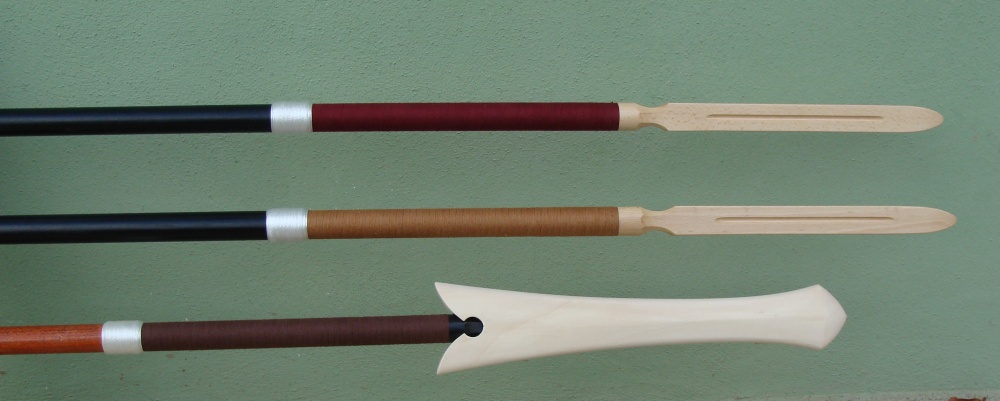
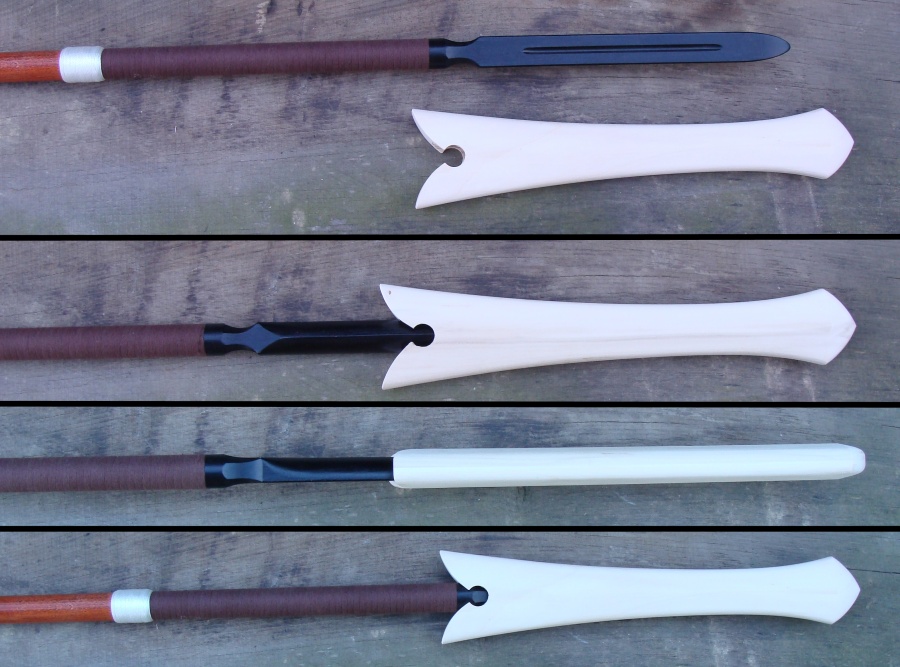
Here are my dear friends, in front of you is probably the first naginata in two pieces, which can be purchased for training.

I spent a long time to realize these idea, mostly by trying to find a manufacturer of metal tube that would be ideal for this type of joint. 
So here I must thank to sensei Erwin Steinhauser, Shibucho of KomeiJyuku Austria Honbu Dojo, which was first revised my Naginata, and made from her Naginata from two pieces. In this way, I was directed to create an elliptical diameter metal pipe, instead of seeking the manufacturer of such tubes
Only in this way is possible to make a connection, which is as sturdy as the Naginata from one piece.
I think that what you see in the picture's, the best solution for those who want Naginata in the bag for Bokken


in the picture below, you can find the special screwdriver that I made for this nginata
For securing naginata, it is necessary to twist the screw out, for one or two rounds, while the bolt head is aligned with the surface naginata shaft


little trick is that the screws that serve to fortify the compound stays in  piece which is connected externally, so it will not happen to lose the screw


消体 Shotai: You Cannot Divide Nature

From Bujinkan Santa Monica by Bujinkan Santa Monica

Chikuhō no kodomotachi (Chikuho’s Children) by Ken Domon
Hatsumi Sensei writes that sensing the true nature of things (消体 shotai) like budo and nature, shows that they are connected and cannot be divided. He explains this by way of photography:
"The mon 門 (gate), or shumon 宗門(religion), and bumon 武門(martial), are captured beautifully by the shutter of the famous cameraman Ken Domon."
Ken Domon, in advocating realism, said: "Realistic photography in the true sense brings us directly to reality. Photographic expression is an attempt at a truthful presentation of reality — in other words, it is a crystallisation of man's anger, his happiness and his sadness."

Domon famously defined his goal as a photographer as "the direct connection between camera and motif."

Domon's method of photographing temples was to stay at the location for some time before taking the first photo. He would then begin photographing based not on a systematic, scholarly approach to the subject, but based on how his feelings towards the subjects moved him to record them.

Profile of Ken Domon (土門 拳, Domon Ken, 25 October 1909 – 15 September 1990):
One of the most renowned Japanese photographers of the twentieth century. He is most celebrated as a photojournalist, though he may have been most prolific as a photographer of Buddhist temples and statuary.

Born in Sakata City, Yamagata Prefecture, in 1935 Domon joined Nihon Kobo, an organization that produced news photographs. He later worked as an independent photojournalist recording the tremendous changes taking place in Japan until he was stricken by cerebral thrombosis in 1979. During his career he produced many photographic collections including Bunraku (1972), Hiroshima (1958), Fubo (1953) and Koji Junrei (five volumes, 1963-75). Reflecting on the inadvertent role he played during WWII producing propaganda photographs, he became a main proponent of the postwar photographic realism movement that focused on society and the lives of ordinary people, and his powerful works influenced many amateur photographers of the age. Declaring his love of Japan and the Japanese people, Domon changed his focus and attempted to capture the essence of his photographic subjects. The photographs he took of Buddhist images both prior to and during WWII remain among the most highly acclaimed of his works and are thought to exemplify his photographic aesthetic. Before his death in 1990, Domon donated the entire body of his works to the city of his birth, and in 1983, the city of Sakata honored him by opening the Ken Domon Memorial Photographic Museum.

I hope you can find inspiration in photography and art as well as budo!


wooden Tanto

From Paart Budo Buki by buki stolar

Here is few pictures of my wooden O- tanto's, with saya  and ito maki


tanto with white Jabara ito have also wooden menuki, that was first time that i put menuki on any of my bokken's or tanto's, but it hepen to be very nice and natural for this kind of wooden buki


All this O-Tanto's have Hishigamis under itomaki wrap, 
shape of blade and kissaki is very similar to original look tantos from that time.

When you order Tanto from me you could chose lenght of blade, lenght of tsuka, size and shape of tsuba , and as you se colour of ito maki.
If I don't have colour of ito maki which you like to have, you could buy it somewhere else and send it to me to wrap your tanto


TAIJUTSU & FELDENKRAIS with DORON NAVON

From Budoshop by BUDOSHOP.SE

52 minutes, 354 Mb for $14.99

Also available on VideoCD

Doron Navon from Israel started training with Hatsumi Sensei in 1968 long before the “ninja-boom”. While in Japan he was also introduced to the Feldenkrais method by the Israeli physicist Moshe Feldenkrais who was an accomplished Martial Artist that came to Japan for a shorter visit. When Doron came back home to Israel in 1974 he deepened his knowledge in the Feldenkrais method directly under Dr Moshe Feldenkrais.

Doron says that the Feldenkrais method is a shortcut to the godan test. This has been confirmed by both Hatsumi Sensei and many other who have studied Taijutsu and Feldenkrais.

This video was recorded in 1994 in Stockholm. It was originally released on VHS and then later as a VCD / Video CD in 2003 by BUDOSHOP.SE hence the quality is VCD PAL (352×288), playing time is 52 minutes. It has been remastered and converted so that it plays nice on iPod, iPad, iPhone, PC, Mac, or any other device that can play standard h.264 videos. It is not DVD quality!

Sample clip

http://www.youtube.com/watch?v=GL5ecJvJddA

About the download

Click here for more information about our download files and how it works!

Doron Navon – Taijutsu and Feldenkrais 1994 (Trailer)

From Uploads by shugyou by shugyou

Doron Navon from Israel started training with Hatsumi Sensei in the late 60 s long before the "ninja-boom". When he came home from Japan 1974 he had so many injuries that he could hardly move for a long time. He was introduced to Dr. Moshe Feldenkrais who founded the Feldenkrais Method, and learned this method directly from him. Doron says that the Feldenkrais method is a shortcut to the godan test. This has been confirmed by both Hatsumi Sensei and many other who have studied Taijutsu and Feldenkrais. This video was originally released as a VCD / Video CD in 2003 by BUDOSHOP.SE hence the quality is VCD PAL (352x288), playing time is 52 minutes. It has been remastered and converted so that it plays nice on iPod, iPad, iPhone, PC, Mac, or any other device that can play standard h.264 videos. It is not DVD quality store.payloadz.com
From: shugyou
Views: 3527
9 ratings
Time: 01:25 More in Howto & Style