Skip to content

What Happened at the Michael Glenn Bujinkan Seminar in Florida?

From Bujinkan Santa Monica by Michael

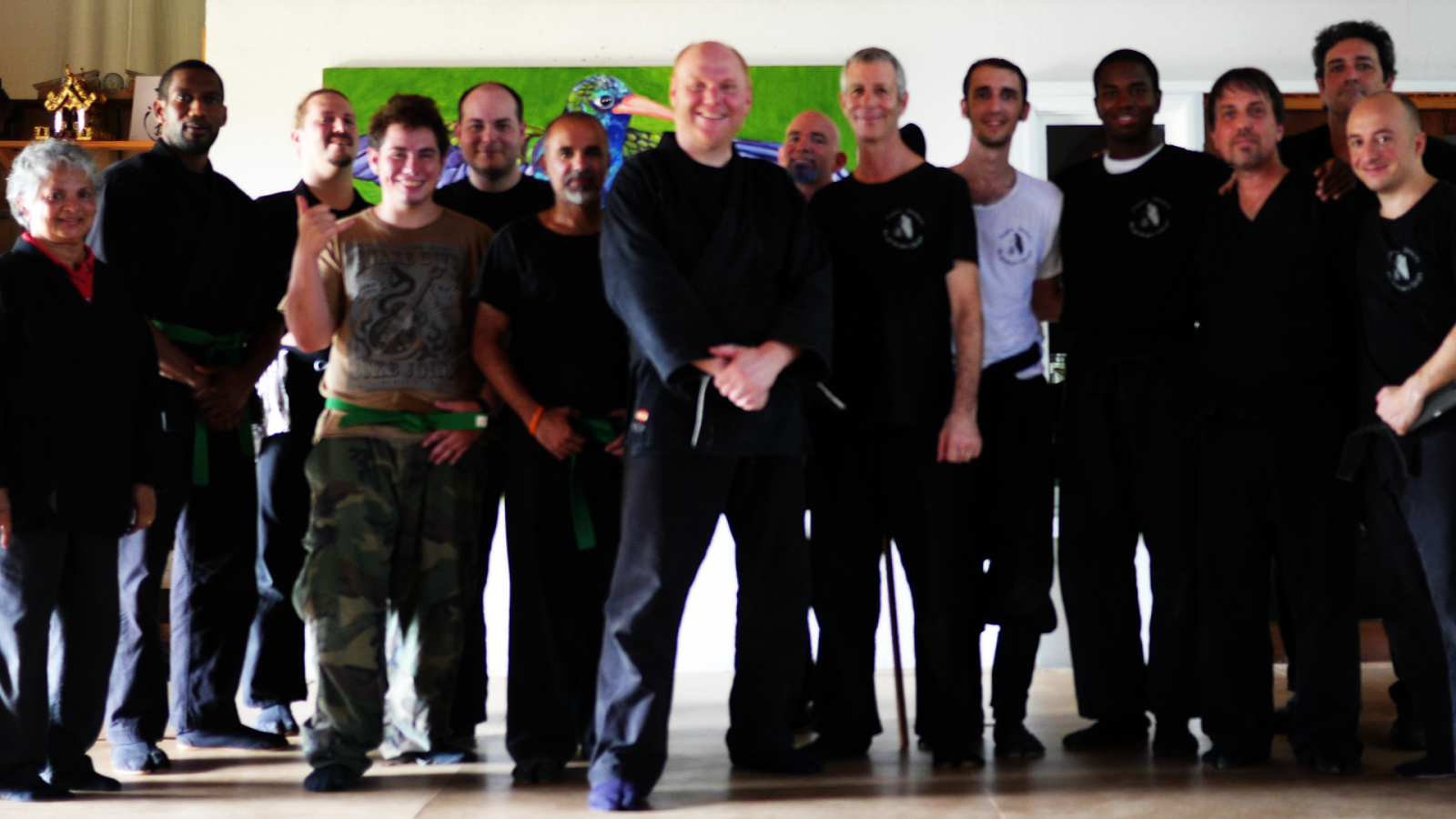
Michael Glenn with Paul Fisher and Friends. West Palm Beach, Florida 2014
I just returned from teaching a seminar in West Palm Beach, Florida. My friend Paul Fisher and his students were friendly and gracious hosts. And maybe I learned more from them than they did from me!

It all started when one of Paul's students reached out to me after subscribing to my training notes. He emailed me privately to ask a technical question about training and during our correspondence, he asked if I ever came to Florida. I said no, but I would if there was interest.

Well his teacher Paul Fisher is an open and adventurous sort of guy. And he quickly embraced the idea. Now it was up to me.

Since my recent trip to Japan, I have been actively studying the strategies I learned from Hatsumi Sensei regarding this year's theme of 神韻武導 Shin Gin Budo. Out of all the notes, and all of my recent training, three points stood out to me that I could share with my new friends in Florida.

I wrote about these 3 strategies back in May: Kyusho of Zero in Three Easy Steps  But writing about them and sharing them live are quite different. Luckily, Paul's friends and students at the seminar were up to this kind of exploration.

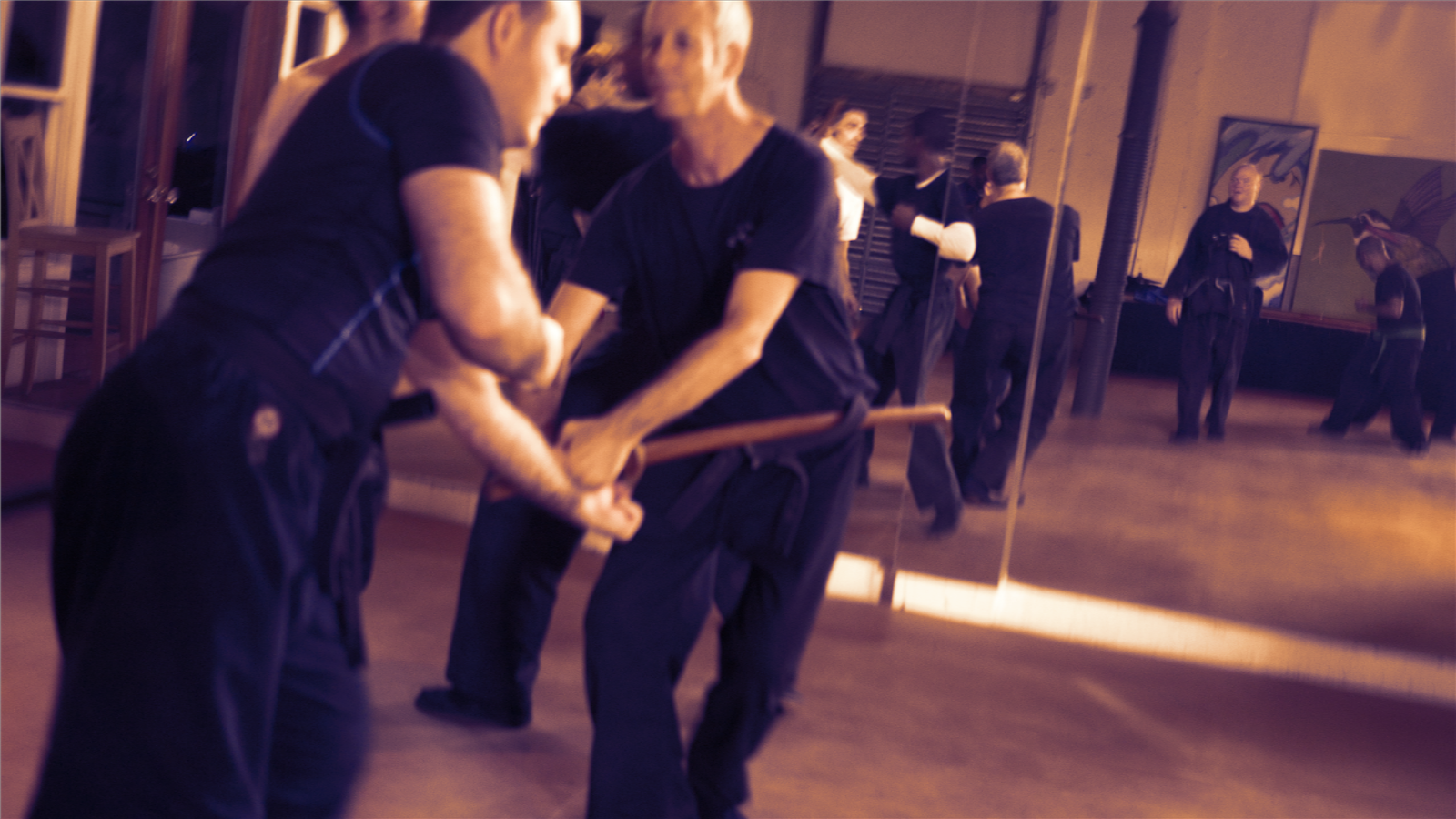
Using two kata from Shinden Fudo ryu as a place to start, we quickly took these kata to their inevitable 自然至極 Shizen Shigoku outcome. We did this by expanding our own personal kukan, understanding and using 気配 kehai, and through mirroring the attitude and kamae of our opponents.

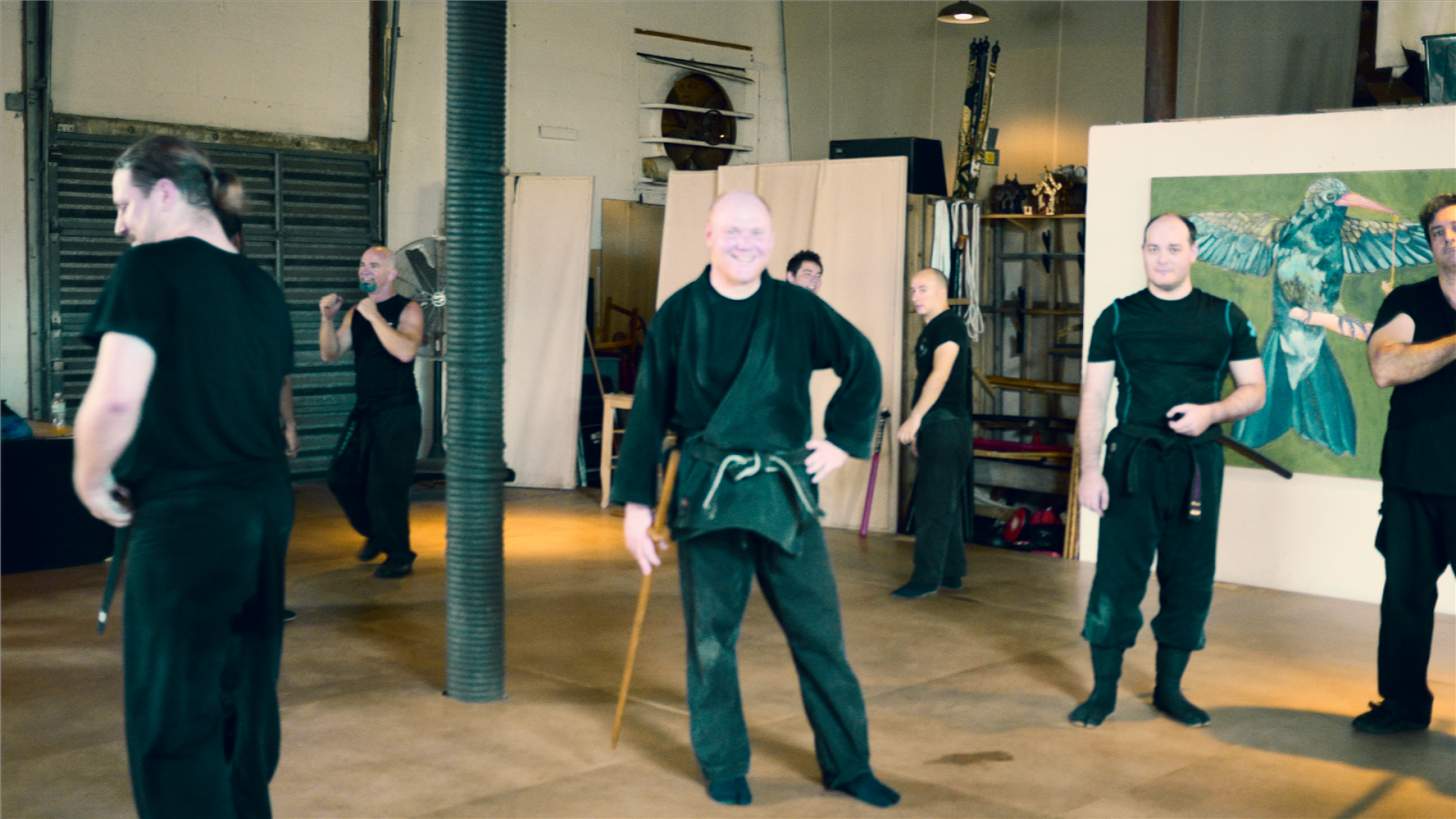
The people training with me were smart. They asked hard questions and kept it real. They also trained with a focus and diligence that was surprising given how hot it was. I was inspired by their commitment.

Florida in the summer is not my natural habitat. So I ended up drenched from my own sweat most of the trip. Luckily, I anticipated this and packed many changes of clothes.

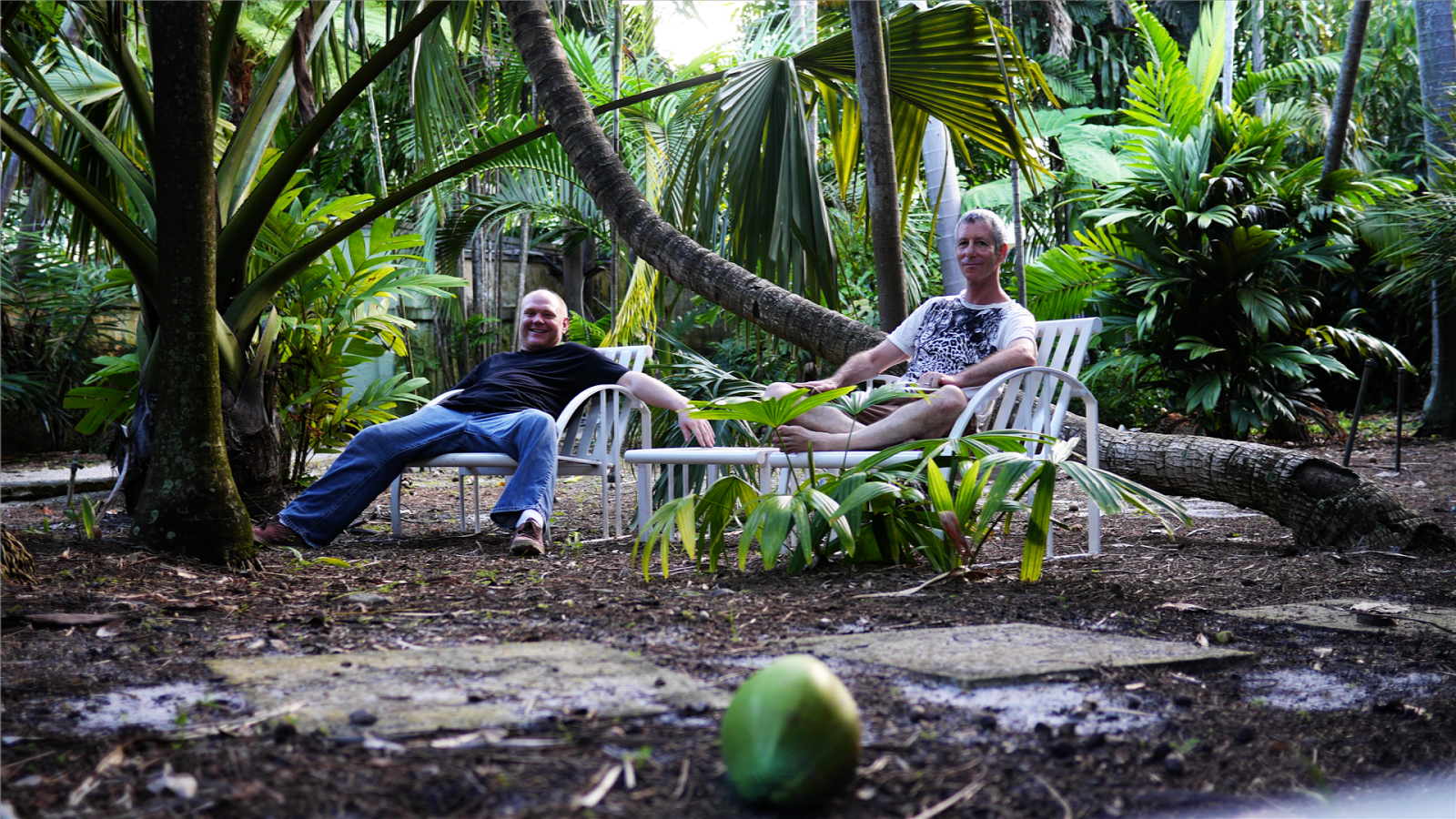
Michael Glenn and Paul Fisher Lounging with Coconut
Like me, Paul's life revolves around art, Bujinkan training, and nature. I felt so lucky to make a new friend that I can connect to on these levels. He took me to an art opening that was a fundraiser to address bee colony collapse.

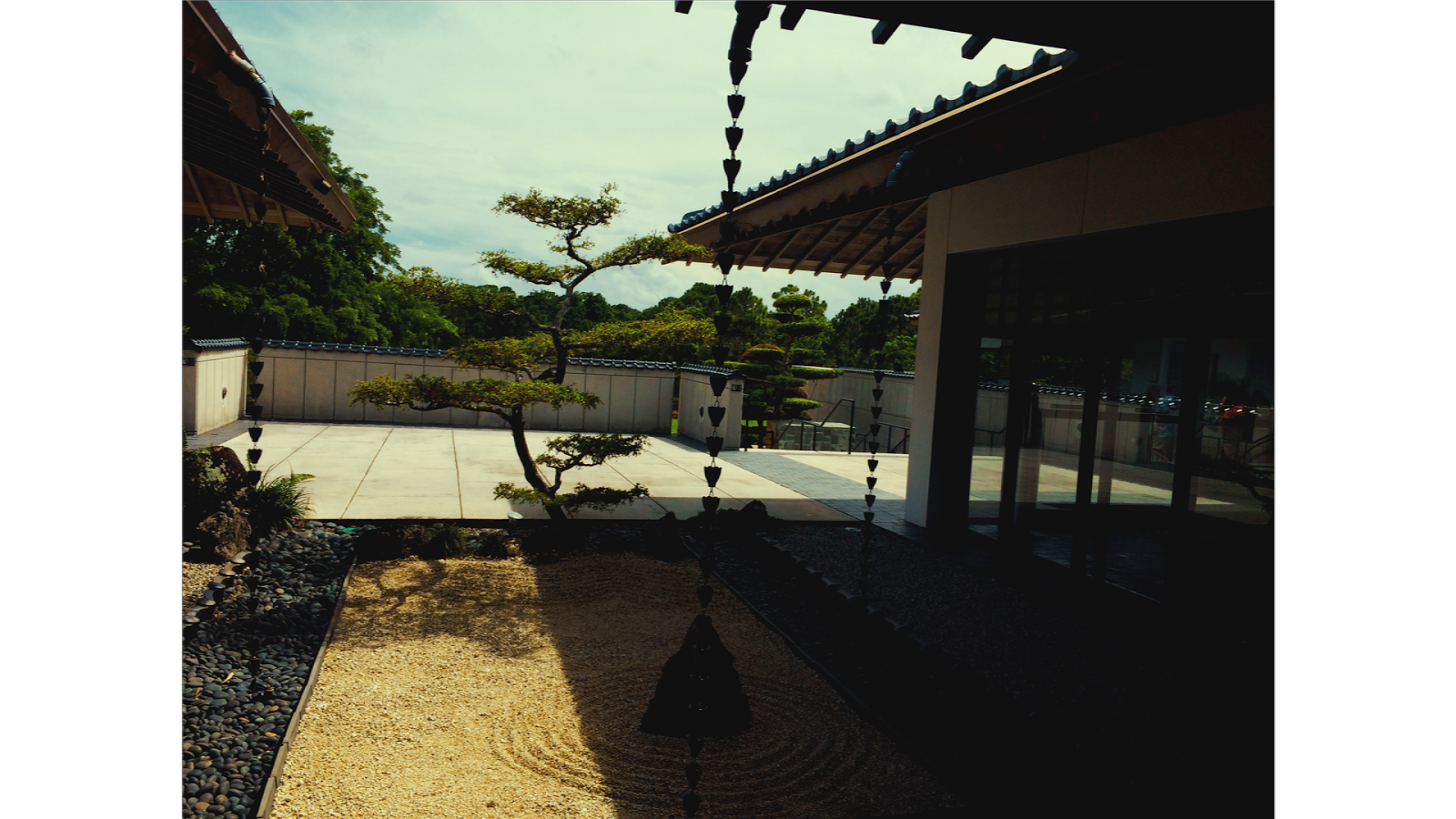
Morikami Gardens
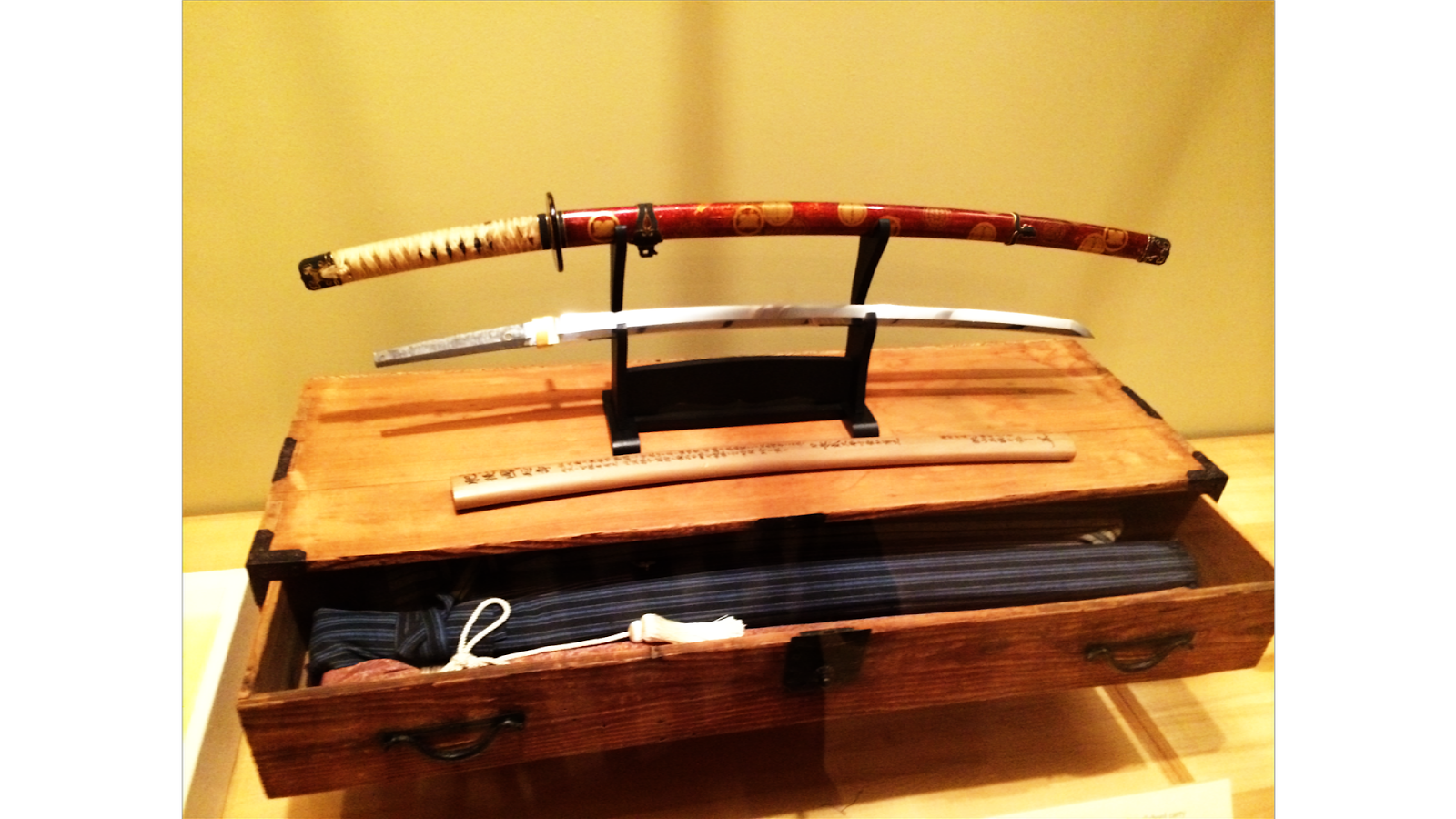
He also took me to the Morikami Japanese gardens where we saw the most incredible landscape, along with amazing wildlife including gators! The museum gallery there had a sublime exhibition of paper sculptures by Kyoko Hazama, as well as a fantastic display of Japanese arms and armor.
Kamakura period sword at Morikami Museum

But Paul was never far from his own personal menagerie of birds, cats, frogs, and lizards. It isn't easy to share the feeling of 神韻 Shingin all of this brings to Paul's life, but I felt right at home.

Paul Fisher with Midori
Thank you Paul!

Mushin: No Intention

From Shiro Kuma's Blog by kumablog

http://www.budomart.com

image

無心, mushin (no intention, no thinking) is one of the many concepts we encounter when walking on the martial path.

I was reading recently a quote from Sensei where he explained that “During the times of the warring states in Japan, everyone was like a wild animal. Everyone would react to whatever you intended to do. So the only way to win was to have no intention”.*

Having no intention is quite a paradox when you imagine yourself being caught in a fight but becomes logical when you are actually fighting. The time to think is not available, chaos unfolds very rapidly and your reactions are only what remains from training your basics for many years.

You can know many techniques intellectually, the history of a given Ryûha, but nothing prepares you better than studying your basics thoroughly. Learn the taijutsu techniques, learn the weapons but trust yourself when it comes to survive. A book will never fight for you, you will.

This is why the bujinkan is so different from other martial art, it prepares you to survive not to collect waza. Sensei often says negatively that many teachers are “collectors”or “scholars”,  and this is not what he is teaching. In fact we learn them to forget them. Staying at the collecting level is for “kindergartners” he said once in class.

If knowing the techniques is an important step in your progression, it is your 器, Ursula (ability) that makes the difference. And this ability can only come from the deep integration of basics within your mind and body.

Your sole intention should be to have no intention and to rely on Shingin Budō. Let the natural flow guide your actions.

______________________
* Hatsumi Masaaki in “Understand? Good. Play!” book by Benjamin Cole ISBN 0-9710849-5-5

http://www.bushinbooks.com/testimonials.html

http://www.budomart.eu


Soyez les bienvenus à Paris

From Shiro Kuma's Blog by kumablog

http://www.budomart.com
http://www.paristaikai.eventpages.org
image

I cannot believe that the Taikai will begin in only  9 days.
This will be another chance to meet with friends from all over Europe and to exchange with the shi tenno.

As I’m not a football fan,  I didn’t know that this world event could damage the Taikai. This year, I don’t think we will reach the 
100 practitioners.

This is not a good news for me, the organizer, but this is good news for you as it means that the groups will be smaller in size giving you a chance to get the best advice from each one of the shi tenno.

Also,  this year with four training halls (the dojo has been renewed) the classes will be easier to attend to.

Each day we will have private classes with each of the shi tenno and a joint class together.

Training will begin at  1000 and end up at 1730 and will consist of 4 private classes by level and one joint training. The four groups will be decided on day one as usual. 

Group 1 will regroup the high ranks, 
group 2 the black belts / Shidôshi, 
group 3 the advanced Kyû and shodan,  and
group 4, the beginners.

The Paris Taikai is the only seminar that I know where this splitting by technical level is done,  and this allows the teacher to adjust his level of teaching to every level. I’m sure that you will appreciate.

Sunday afternoon after training we will have a “party” in the dojo.

I’m eager to welcome you all in Paris for this  11th edition.
______________________
If you didn’t register yet please do it now at http://www.budomart.eu  AND don’t forget to fill in the form HERE we need it for making this event a success.

HERE


Kunreshimasu vs Oshiemasu

From Shiro Kuma's Blog by kumablog

image

Today I want to speak about training 訓練 (kunren).

I was reading my notes from the past years and I stumbled upon a discussion I had with Sensei back in 2010. We were having a coffee at his place and he said: “Arnaud you have to teach what you have to teach, and to train what you have to train.”

There is often a vast misunderstanding between 教えます Oshiemasu,  teaching, and 訓練します Kunreshimasu, training.

The kanji 教, means teach, but also faith, and faith is something you have or not. There is no training to get it,  you can develop it if you have it.

Conversely 訓練 is composed of two kanji 1) explanation, instruction; 2) connect, take along. This is therefore something that requires time and effort if you want to get it.

訓練,  forces you to test everything for yourself. A book, a video, even a Densho (if you can read it) are not enough. You have to internalize the form in order to make it yours and this requires a real training. Often I’m surprised to see that very few high ranks put themselves out of their comfort zone. If you want to excel you have to take risks and the first one is to destroy the techniques and test alternative interpretations. This is a permanent “trial and error” process. Obviously you will often fail, but at the end you will build your own taijutsu, the one that is made for your body.

I remember one day asking Senō sensei how he gained his precise movements. His answer was amazingly simple. “I trained all the basics in slow motion changing the angles degree after degree until I knew the best way to do it” he said. I commented that it must have been a very long study. “about 5 years” he said.

Today many teachers don’t really train, they teach. And this is sad because Shingin Budō don’t need techniques but demands that you keep a “student ‘s mind” in order to have a chance to be “guided” by the divine martial winds. Train the movements for yourself and find your own answers,  then, when in Japan, ask for correction. As you know there is no good or bad way of doing those techniques, but there is a truth hidden within and this truth unfolds when you stop teaching and seriously train.

I found out that by saving the last twenty minutes of the class for me, I could train much more while officially teaching, maybe you should try it.

Bûfû Ikkan (keep going)


Feeling is Art

From Shiro Kuma's Blog by kumablog

Steve Olsen in his beautiful book “Masaaki Hatsumi Dojo Art” dedicated to Sensei’s calligraphies explains that:
“Sensei teaches at a level beyond technique. “Feeling” Sensei often reminds us, is what is most important. And how can a feeling be taught? Art. It’s up to us to learn technique and transcend so we can apply his art in our lives. That, in my opinion, is the proper purpose of our training. “

Nagato sensei in a recent class said that learning this art follows (or requires) a three-step process.

We first learn “consciously” the technique. Then with time, we do it “unconsciously”. Until one day we do things “miraculously”. This miracle is the essence of Sensei’s art and it is only about feeling. This is the transcending of the forms that Steve explains in his book. Without the ability to transcend the forms, the Bujinkan is not better than any other martial art.

Many practitioners get lost in the sterile learning of forms and never get past the unconsciously level. Learning the basics allows one to move from level 1 to level 2, but level 3 is only achieved by those who let their feelings guide their movements. Shingin Budō is this guide and the Kehai wo yomenai (see previous post) is the best way to reach natural movement.

術: jutsu, is art.
感覚: kankaku,  is feeling.
神機: shinki, is miraculous.

Therefore, bujutsu (fighting technique) is 術 jutsu (art) guided by 感覚 kankaku (feeling) is 神機術 shinki jutsu, a miraculous art.

So learn your basics thoroughly and train hard until your feelings allow you to enter the world of art.


Kehai wo yomenai

From Shiro Kuma's Blog by kumablog

気配を読めない

image

As an add-on to this year’s theme,  Sensei show recently about acting in such a way that the opponent is not able to perceive you,  or 気配を読めない, “kehai wo yomenai”.
When you look at the kanji you get:
Kehai けはい indication, sign, hint, presence,
Yomenai 読め ない to read.

Don’t let yourself be felt

Budō Taijutsu is not sport and even if facing a fighting situation, it is important that Uke dismay feel your intentions. This is why or reactions are created as a reaction to Uke’s moves. There should be no preconceived movement. Only a natural adaptation to a given situation.

Be zero

For thirty years I’ve head sensei say that we have “to be zero”.  This “zero state” can be achieved only if you do not plan your movements. If you don’t know what you are going to do next, how do you want Uke to read it? To be zero is the most difficult thing to do and comes naturally after many years of training. Being zero can only come from mastering your basics as they get ingrained in your movements to become natural. Don’t think, train your basics deeply, and maybe one day you will be zero.

Art of killing without uke feeling your presence

Kehai wo yomenai is the extension of Shingin Budō where our moves are guided by the divine. We can get rid of the threats by letting or actions be guided by something (someone?) way above our limited perception of reality. Becoming only a tool we have their no presence and Uke is controlled by kûkan.


構え Kamae of the Hunter

From Bujinkan Santa Monica by Michael

Michael hunts toys and candy. 駄菓子屋 Dagashiya, 柴又 Shibamata
Recently I was studying the kata 水鳥 Mizu Tori. The name of this kata means waterbird. The 構え kamae even mimics the pose of one of these birds.

I am a birdwatcher and have observed many waterfowl over the years. When I see them freeze very still in the water and strike this pose, they soon dart out and catch a fish. It is a hunting kamae.

We don't usually consider kamae as hunting. Normally we think of their defensive properties. Or maybe we train some offense. But hunting? That really creates a different feeling. Because it suggests strategies of stalking, stealth, and deception.

If you're a skillful hunter (rather than just an accidental or lucky one) you know that you become one with your prey. You think as they do, mirror their movement. A natural form of 自然の構 shizen no kamae grows in you.

This is how we evade the sword of our attacker in Mizu Tori. Move in accordance with his cut. Make small movement like the focus of a bird's eye as he stalks the fish.

In Mizu tori, you take a risky position with your 潜型 moguri gata. There are only a few reasons to ever take this kind of risk. One is when you are caught unprepared and you dive down as a desperate escape. But another is for deception while hunting.

And maybe most important is what happens to your body and mind when you assume this type of kamae. During tense situations, people sometimes hold their breath. Tension caused by apprehension or fear can move through your body, locking it up along with your breath. Fear can even shut down the mind.

Instead, let awareness take over the same space occupied by fear. Simple attentive watchfulness of your opponent or prey as you stalk can push fear out of your mind. 虎視眈眈 koshitantan, watch your prey vigilantly. Then you have pure awareness, which is the right kamae for this moment.

You take a kamae of life or death. The moment where you decide to kill your prey. You may also decide not to. Hatsumi Sensei tells us often to protect life and not to go for the kill.
"万一獲物が死に絶えれば、狩人いなくなるだろう。If the hunted should perish, the hunter would, too."
Your kamae gives you this choice. Remember, kamae can also be translated as your position or attitude. The wrong kamae leads to death.

You can watch this preview of my 水鳥 Mizu Tori video if you'd like to see more.

The Art of Disarming With 十方軌喝 Juppo Kikatsu

From Bujinkan Santa Monica by Michael

Discarded Tabi Along Route 3, 県道3号線. photo by Michael Glenn
Hatsumi Sensei gave directions of how to do a kata. I needed these instructions desperately. Because the opponent has his sword ready to cut me down, and I do not have a sword. How do I not get killed?

Soke's instructions are,
「門空一閃、十方軌喝で取りをとる」 "a flash of nothingness, the art of disarming with juppo kikatsu." 
Yes. Right. That's what I was going to do anyway.

But, before my opponent kills me, can I ask a question? What does that mean? I'm not dead yet, so I will try to understand.

I was working on this in my class the other night. I surprised one of my students with the way I captured him. He said, "It didn't feel like you had anything until you had everything."

A flash of nothingness. You yourself become this emptiness. Zero.

This is what allows the room in the kukan and in yourself for this year's theme of Shin Gin to be real. This has a funny effect on your opponent. It may cause him to falter or freeze. Like a flash across his mind he is trapped in a moment.

Then you take the entire space, his body and weapons, and the entire spirit of the opponent.

If you've ever seen one of Hatsumi Sensei's opponents afraid to move, this is because he feels attacked from all directions. There are threats from ten different angles. Every escape appears cut off or filled with pain.

When I've done this to someone, it is amusing from my perspective. Because it feels like nothing. But the opponent is wrapped up in it and can't move. This is Juppo Kikatsu.

PARIS TAIKAI 2014

From Shiro Kuma's Blog by kumablog

PARIS TAIKAI WEBSITE

shitenno

The Shi Tennô long long time ago ;-)

PARIS JULY 11, 12, & 13, 2014

The Yûro Shi Tennô Taikai of Paris is beginning in a few weeks. As for the last 10 years, Pedro, Peter, Sven, and Arnaud will share their understanding of the theme of the year decided by our Sôke in Japan: “Shingin Budô”.

This year we will have 4 training halls instead of 3 as our dôjô has been totally renewed. The system is the same with 4 groups of practitioners divided by ranks in order to meet each level of understanding.

As always, lunches (regular or veggie), t-shirts, and certificates are included in the price. You can sleep for FREE at the dôjô (precise it in the FORM) and do not forget your sleeping bag.

If you register before June 10th you get an immediate discount of 20%. It will then go down to 10%. So if you are planning to join us please don’t wait to register. The prebooking is 68€, the remaining is to be paid on arrival.

Once registered please fill in the FORM in order to help us make a beautiful event for all of you.

We are expecting around 120 practitioners from all over Europe, we are happy to welcome you in Paris for our National Day of July 14th!


Kyusho of Zero in Three Easy Steps

From Bujinkan Santa Monica by Michael

Three Lamps, 日本民家園 Nihon Minka-en. photo by Michael Glenn
I have found three easy steps to make 神韻武導 Shin Gin Budo happen. Sounds great even if it might be a lie. But could it be easy? Let's see…

One thing I know for sure about this year's theme is that it's difficult to teach. I went to Japan last month to study with Hatsumi Sensei. And he gave me a lot to work on. So I have been working.

Like many things Soke shares with us, this theme is connected to many previous themes. It did not suddenly appear this year in our training. And I personally am grateful to have this as a focus because I have been working on this very idea for several years in my own training.

But I always tell my students, this is what I am doing and studying myself, but I don't know how to teach it. Sorry.

Yet, thanks to Hatsumi Sensei's focus this year, I have new insights that I can share. Maybe they will help anyone trying to get a grasp on Shin Gin.

As I mentioned in another post about the 2014 Bujinkan theme,  this idea is like entering a divine space. But first you have to find it. And Hatsumi Sensei says we should make it ourselves. Make our own kukan where we can be safe, where we can survive and live. So, how do you start?

Step 1: 阿吽の呼吸 aunnokokyuu


One way to begin is with 阿吽の呼吸 aunnokokyuu. Hatsumi Sensei used this term which means harmonizing.  Like yin/yang or in/yo. Connect the Mind, body and spirit, with that of your opponent.

If you do that, the fight will never happen in the first place. But if it does, anger and aggression tend to dissipate when there is this kind of harmony. And even still, if the attacks come, you are so connected that it would be like you punching yourself. How hard is it to avoid that?

Go ahead, try it. Punch yourself. I'll wait right here while you do. 

If you are not masochistic, then you either won't do it at all, or it is very easy to avoid. This is what it feels like when you are harmonized with your opponent. But the theme this year is larger than this.

Step 2: 空間を陽空 kuukanwoyokuu


After using 阿吽の呼吸 aunnokokyuu, you enter your own space. Either by finding it or creating it. Soke said it is like an air pocket.

Hatsumi Sensei said 空間を陽空 kuukanwoyokuu. This is Yang empty space. A positive,  safe space. Like seeing daylight when emerging from a prison. Or the clouds parting after a storm.

This is where things get mysterious. Shin Gin.  Budo guided by divine resonance.

Step 3: 神韻武導 Shin Gin Budo


Once in that space, you can harmonize and connect with the heavens. Through this connection you are a lot more powerful than your own strength, ability, technique, or wit could ever be when fighting by yourself. You gain a natural 抑止力 yokushiryoku, the ability to deter attacks.

And as for offense,  Hatsumi says you can strike opponents with your spirit. You strike the space itself. 空間の九勝 Kukan no Kyūshō. Soke said,
"Lift the opponent up into the kukan and then blast them away with your spirit. It's the kyusho of air. It's the kyusho of zero."
3 easy steps, right?

What a crazy, wonderful, and powerful art we study! I would never believe any of this if I hadn't witnessed it in person, felt it directly, or done it myself. I hope you can find this in your training this year.