Skip to content

The Truth About Toda Sensei

From Shiro Kuma's Blog by kumablog

takamatsuTraditionally in Japan, the young bushi were not taught the fighting techniques by their father but by one of their uncles.
The reason for that is that an uncle was less likely to listen to the screaming of the kid. Learning Budô is painful and as Sensei said once: “if you don’t like pain, then don’t train Budô”. But we can imagine that things were even tougher for a young kid in 19th century Japan.

We know from the stories told by Hatsumi Sensei, that Takamatsu Sensei’s nickname, when he was a kid, was 泣き味噌, nakimiso (crybaby). We also know that Takamatsu’s father was often mad at him for not showing the courage expected to be found in a kid descending from a bushi family. His father was very strict and the young Takamatsu was often physically punished. This was common practice at that time (19th century).

Takamatsu’s father wanted his son to join the army and thought that he needed some training before joining the academy, and for that reason, decided to send his son to Toda Sensei’s “Shinden Fudô Ryû Jûtaijutsu dôjô”.

Takamatsu began his training, reluctantly but with consistency. He was 9 year old only when he began his training with Toda Sensei. He would join training every day after his day at school. The way trainings were conducted at that time was tough and painful. Hatsumi Sensei’s said that even though Takamatsu was a small kid (weak), he was treated by the older students as if he was a grownup, and that he spent his classes being hit and thrown all over the dôjô.

The name Toda Shinryûken Masamitsu is known to all of us in the Bujinkan. He was an instructor at the Tokugawa Military Academy in Nakano-cho in Kyoto* and retired (or resigned) for political/ethical reasons**. He taught at his Shinden Fudô Ryû Jûtaijutsu dôjô supposedly until he died in 1909. When Takamatsu (nakimiso) joined in, Toda Sensei was already very old (1818-1909)***, being 70 years older than the young Takamatsu.

But there is something that many practitioners don’t know. Toda Sensei was Takamatsu’s uncle and not his grandfather who died before he was born.

This “grandfather” error stems from the fact that in japanese 祖父, “oji”, grandfather sounds exactly the same as 伯父 “oji”, uncle. I guess that the first westerners in Japan who heard the story understood it wrong and since then the error is repeated all over the net. But if you have read Hatsumi Sensei’s books or attended classes in Japan, you should know. This “Toda sensei was Takamatsu’s uncle” was told to us during a break by Nagato Sensei.(spring 2012).

But if you never read Sensei’s books then check these:

“By the way, as you know, I was taught ninjutsu by my uncle, who used to belong to the samurai class of Iga province”. In “Essence of ninjutsu” by Hatsumi Masaaki, p17 (english edition), Contemporary books, 1988.

“Takamatsu sensei often said that between training sessions with his uncle, Toda Sensei, he was made to copy out Toda Sensei’s densho”. In “Unarmed fighting techniques of the Samurai”, by Hatsumi Masaaki, p168 (1st edition English), Kodansha International, 2008.

Please read Hatsumi Sensei’s books thoroughly and not only between the lines.
And when you have a doubt, ask Sensei directly he will gladly give you the answer.

_________________________________________
* This is not to be mixed with the “famous” Nakano Academy in Tokyo created in 1938.
**Takamatsu sensei’s own teacher, Toda Shinryûken – the 32nd grandmaster of Togakure Ryû Ninpô- taught Budô as chief instrutor at a martial academy in Kyôto, and enjoyed an excellent reputation. He was asked to do this by Matsudaira Noriyasu (1794-1870), one of the Shogunate’s senior councillors. However, political changes meant that Matsudaira Noriyasu lost his position, and Toda Shinryûken immediqtely left the academy, traveling around the kinki area, keeping his whereabouts hidden. He never again took up an official post”. by Hatsumi sensei, in “The Way of the ninja”, (1st edition, English, p27, Kodansha publishing, 2004.
***some other source say 1824-1909.


…

Caught In Invisible Brambles

From Shiro Kuma's Blog by kumablog

image

How many times did you, as a kid, ruin your clothes in a blackberry bush while picking the fruits? I guess many times. The type of movement we are expressing today in Shingin Budô* ressembles this blackberry bush, except that we are the bush and uke is the fruit picker.

The 6th element completing the五行, gogyô is 識, Shiki, or consciousness. But Hatsumi sensei also refers to it as “awareness”. This awareness allows us to grab and to create the kûkan** in order to defeat uke. Since 2003 and Juppô Sesshô***, things are no more “images in two dimensions”, they are live movements in 3D.

十方, Juppô is the evolution of the wheel of the 8 directions (happô)**** to which a vertical axis linking Ten and Chi is added. The wheel of 2D with this vertical axis in the middle, oscillates in such a way that the original circle (2D) becomes a sphere (3D). This is why sensei says that video cameras cannot seize his movements as they can only give a two dimensional representation of what is really done

Awareness belongs to 3D world which is “Sanjigen no Sekai”*****. The brambles of the blackberry bush are the same. It is a “sanjigen bush”, and when reaching out to grab the fruit you are caught without strength by the many thorns that were not visible until then. This is the feeling you have when you are attacking Hatsumi sensei, you get captured without knowing it. Sensei is permanently using the kûkan and gives you the wrong feeling that you can get him without damages.
He is like the brambles and he catches you from an invisible spot while you are only focusing on him.
He is a blackberry bush and his thorn will tear you apart.

This knowledge of Kûkan is the key. He explained it once saying that “even if you give uke some space to move, he will not, because he is stuck in the kûkan”. After being sensei’s ule, one friend told me that it was like being trapped by brambles: the more you move and the more you get stuck and injured.

When you are able to manifest this awareness of kûkan, you are a true Bujin. There is no preconceived intention, you do what you have to do because the kûkan evolves with uke’s moves. In fact once you have reached full awareness and consciousness, you become able to react unconsciously inside a permanently evolving kûkan.

It sounds like paradoxical isn’t it? in fact, it is not.When you move in full consciousness you don’t think, you are fully aware of everything surrounding you (uke, kûkan, environment), you are zero. Any modification of those elements, even minimal, will be taken into account and dealt with naturally.

Sensei said once:” 90% of the mind is in the subconscious. Use it in the Kûkan and you will become invisible to uke”. This was during the Daikomyôsai 2008 and it is still valid at the Shingin Budô level.

The bujinkan is as simple as that, and this is why it is complex.

____________________________________________
*神韻武導, Shingin Budô: our martial ways are guided by the natural artistry of the gods
** 空間, kûkan: empty space
***十方折衝, Juppô Sesshô
**** 八方, happô has the meaning of “all sides, all directions”. Front, back, left, right, and the 4 diagonals. Symbolized by a circle or a wheel.
*****三次元の世界, Sanjigen no Sekai was the theme of the first year of Juppô Sesshô in 2003.


…

Chûshin And Chōwa

From Shiro Kuma's Blog by kumablog

image

Recently Senō sensei said to my friend Moti that he might come back to teaching. This is a very good news for all of us as his taijutsu completes perfectly the classes of the other Japanese Shihan. The depth and precision of his movements are always impressive.

I remember him teaching once the concepts of 中心, Chûshin* and Chōwa**; “pivot and harmony”. When those two concepts are done together, the balance is uke is taken.

Senō said that in any movement do, we have to pivot from our control points (chûshin) in order to harmonize (chōwa) our actions with the attacker’s actions.

When you reach this level, there’s no technique but only a permanent adaptation to the tensions of uke. Often, because of the pivoting of the body, you are so close to uke that your legs are in a position to take his balance from under, using 斜八足, Sha Ha Ashi.

When using Sha Ha Ashi, use your leg to take Uke’s balance but do it with the full body weight without using any strength. You don’t pivot with the legs but with the whole body.

Everything comes from the proper use of distance****, and by increasing or decreasing this distance, your body enters the kûkan created and adapts freely to Uke’s reactions. Using the Chûshin, you stay in the middle of the kûkan and become the Tenkan, everything rotates around you.

Chûshin is at the center of the kûkan.  We can say that this is the kaname of the 空間, kûkan. This is the 要の急所, kaname no kyûsho explained by sensei during the Daikômyôsai of 2011.

Using the Chûshin lying in the center of this evolutive kûkan properly, you can easily break Uke’s balance, keep yours, and reach chōwa, full harmony.

_____________
*中心/chuushin/center; centre; middle; heart; core; focus; pivot; emphasis; balance|-centered; -centred; -focussed; -oriented; centered on; focussed on
** 調和/chouwa/harmony
*** 斜/sha/diagonal, 八/hachi/eight/infinite, and 足/ashi/foot|leg
****remember that sensei used to subtitle each of his videos “martial art of distance”
***** 空間/kuukan/space; room; airspace


…

Quick! Change Your Bujinkan Training with 早替わりHayagawari

From Bujinkan Santa Monica by Michael

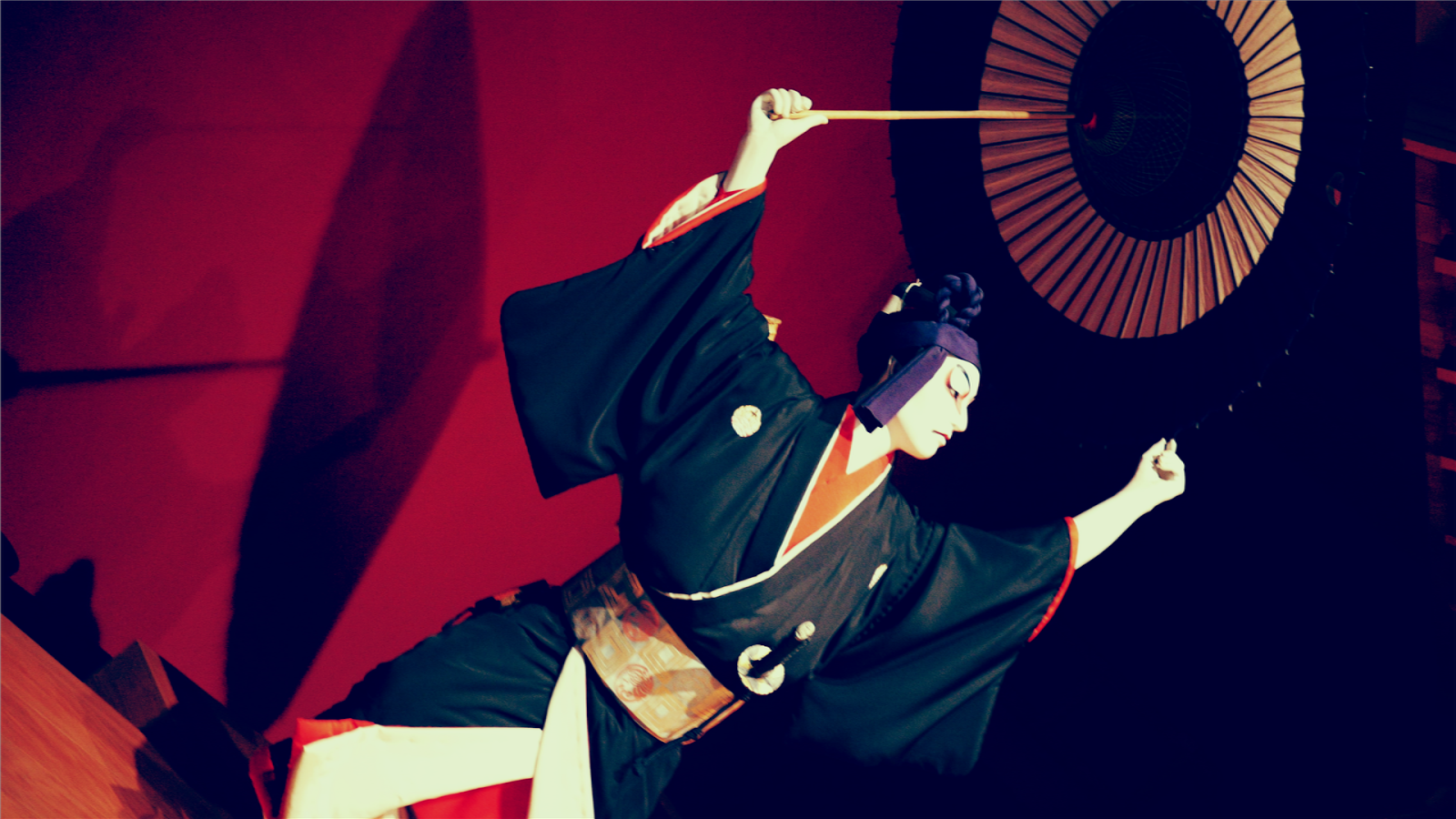
Kabuki Performer, photo by Michael Glenn
One of our Bujinkan gokui comes from the secret writings of Shinden Fudo ryu and it says, 
豹変して必ず勝つ hyohen-shite kanarazu katsu. 
"Sudden change will always prevail." This kind of change suggests sutemi or discarding the self.

Hatsumi Sensei tells us that this kind of change can come from the unconscious. He uses the expression 早替わり hayagawari to describe this quick change.  And it can lead to a complete transformation in combat, your Bujinkan training, or even your own life.

What is 早替わりhayagawari? Like many of the references Soke gives to us, it originates from Kabuki theater. It is a quick change technique for actors on stage. The tricks they used allowed them to quickly change from one occupation to another, male to female, young to old, good to evil, etc.

Sometimes actors would even play more than one character in a play. Then they would need tricks called 外連 keren to make a quick change on stage, or hayagawari. They might have one costume hidden under the layers of another. Or, the actor could add makeup to quickly transform his face. Actors used different masks over the face, or even 後面 ushiromen which were masks on the back of the head.

All of this calls to mind the ninja techniques of 変装術 hensojutsu. There were a number of stock characters the ninja might employ like a craftsman, priest or monk, traveling entertainer, or even a samurai! A quick change of mannerism, accent, language, or attitude could complete and really sell the effect.

Add to this other kabuki/ninja effects like 宙乗り chûnori, and you could fly. Or the tricks used for rapid appearance or disappearance of the actor. I saw a demo of some of these last April in 墨田区 Sumida and I was reminded of Ninja disappearing tricks I have learned over the years.

One secret to all of this is that by adopting the outward, physical change, there is an inward change that occurs. This is a secret for life. We learn it as children with our play and the art of pretending to be something you are not. Fake it till you make it.

If you want change in your training, or in your life, use sutemi and discard the self. Act the part. Take on the role. Learn your lines. Before you know it you will achieve 早替わりhayagawari. You might be more surprised than anyone else at how quickly you transform.…

Daikokujin

From Shiro Kuma's Blog by kumablog

daikokujinWhile cleaning my papers I found a notebook relating my japan trip of April 2007.
A lot of time has passed and my students of 2007 are all 15th dan now and live their own lives.

During the year 2006 we had been studying the Shinden fudô ryû, and even though we were now studying the concepts and techniques of the kukishin ryû the concept of Ikken Hassô 一剣八双 (one weapon, all weapons/directions) was totally in harmony with the feeling sensei was teaching.

Ikken Hassô can have different interpretations but what sensei said that night of Friday 13th, April 2007 is interesting.

Here are my notes from what he said during that class:

  • You have to train all the weapons but not only in the use they were designed for. This is the essence of Ikken Hassô 一剣八双.
  • Train slowly even if Uke is fast, use small (light) controls.
  • When uke is down be like a cat playing with a mouse.
  • You have to train the feeling hidden within the form of the waza and only then you can play, this is the way you should train.
  • Shingitai Ichi 心技体一 is very important in budô”.
  • Train the 9 schools but with the principles of the Bujinkan, because the evolution of the bujinkan follows the Bufu Ikkan 武夫一環”.

What is amazing is that Sensei is still saying the same today. The Bujinkan has been created through the study of the nine schools but has become today a path on its own. This is why for example even if we have sword techniques only in the Kukishin ryû and the Togakure ryû*, we can train sword techniques with the feeling of any other ryûha.

Later during the same trip, I went for lunch with him and Nagato sensei and he said: “The fake Shihan like xxx and xxx go by themselves. Anyway I had this statue of Daikokujin made to smash those who are in the way”. He laughed and added “it weighs 6 tons!”.**

Did you know that Daikokujin 大国主神 when written Daikokujin 大扱く塵 could mean “big stripping of impurities”. Maybe the statue is there to clean the bujinkan from those fake practitioners.

__________________________________
* only these two ryûha have biken densho (private discussion with Sôke in 2013).
**the huge statue outside of sensei’s house in Noda was made in memory of Takamatsu sensei for the 50th anniversary of their encounter in Kobe (1957).


…

Hidden Weapons of the Unconscious

From Bujinkan Santa Monica by Michael

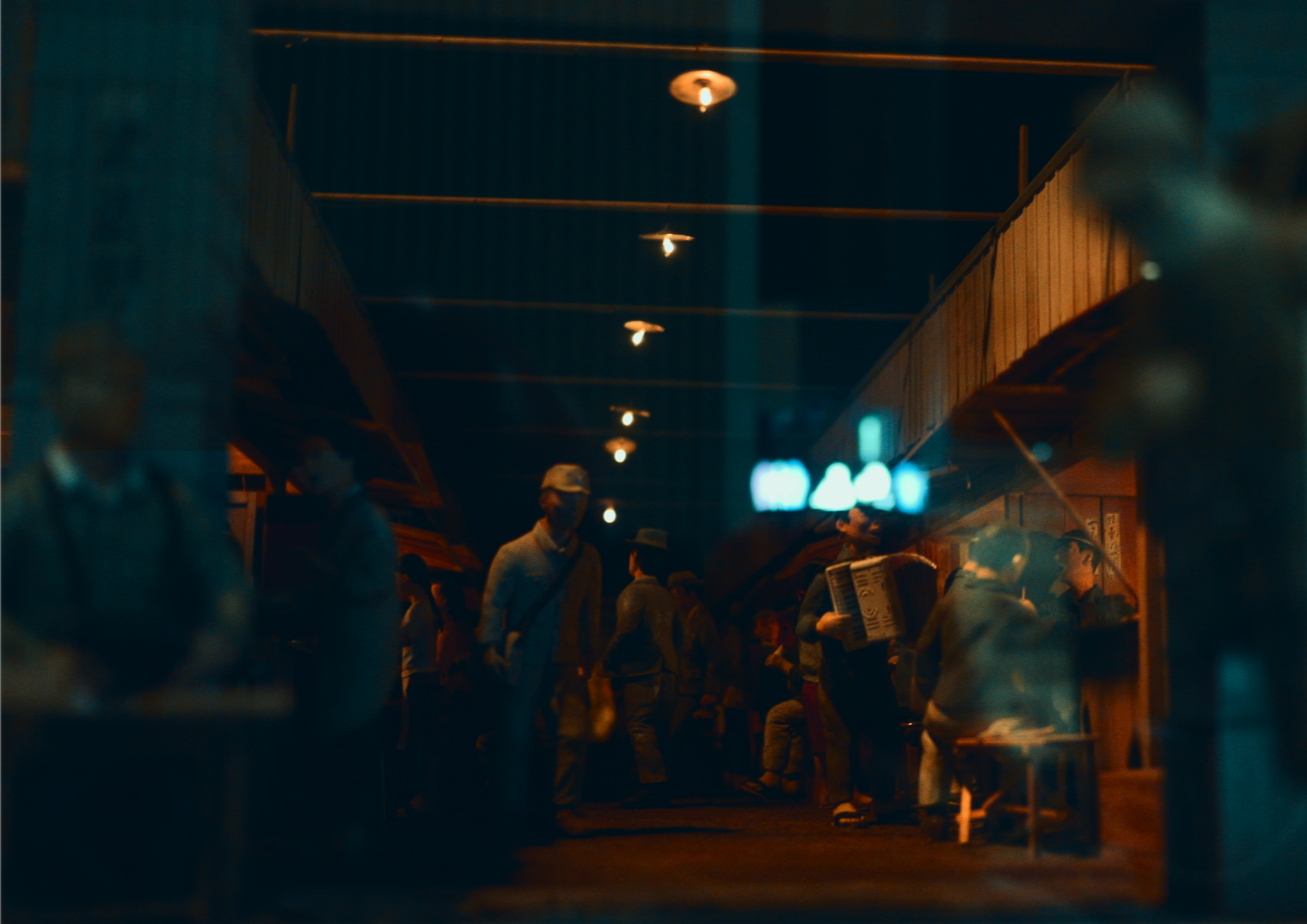
Black Market at 江戸東京博物館, Edo Tōkyō Hakubutsukan. photo by Michael Glenn
One of the secrets to understanding this year's theme of 神韻武導 Shingin Budo  is the ability to find the hints and openings hidden everywhere. These are like the lingering sound of a bell that hangs in the air after it has been rung. If you did not hear the original strike of the bell, would you know what you were hearing or where it originated from?

This sound is like the hidden training that takes place in the Bujinkan. Training that takes place in the unconscious. If you are only learning with your body and mind, you are missing out on the important unconscious training that is very real in correct Bujinkan training.

You may know that your unconscious affects ordinary life. It also is at work in combat or in the dojo. But do you know what it is doing?

Hatsumi Sensei has written 無意識 muishiki (the unconscious), as 武意識 buishiki which is warrior consciousness or military awareness. With this kind of unconscious ability, you will always be able to tap into hidden fighting strategy. Or find a surprise victory in an impossible situation. This is also a secret for hidden ninja weapons.

The best hidden weapons are not weapons you are hiding. That takes too much conscious effort and can be seen, read, and even countered. The best hidden weapons are hiding in plain sight.

Soke tells us we can find 鉄扇 tetsubane, 鉄刀 tetsuto, 馬手差 metezashi, and 隠し武器 kakushibuki hidden everywhere in normal everyday life. These things leave hints or suggestions (暗示 anji) to the warrior who is attuned to their resonance. Your unconscious can read these clues and allow you to find these hidden weapons.

If everyday objects can be transformed into weapons by the unconscious following these hidden signs, then what about yourself?  Soke says that this type of knowledge will make your life pulsate (生悸に一変) and undergo a complete change. It can make it possible for 早替わり hayagawari, or for you to quickly change into anything. This is the real shugyo.

Martial arts create this kind of transformation in life. Seek out a dojo that has these hidden hints and signs for your unconscious intelligence. Remember, if you're the smartest guy in the dojo, then you're in the wrong dojo. Look for hints that lead you to hidden knowledge and the right teacher for your whole self, not just the conscious part.

…

Be Strong, Then Soft

From Shiro Kuma's Blog by kumablog

image

During a recent class,  while we were still in seiza after the opening rei, Hatsumi sensei began to speak. He said that: “when you are under the age of thirty it is important to develop your strength and your muscular power. Only when you get older can you train the more subtle movements”.

I don’t know what triggered his opening speech, but it is a fact that too many young practitioners lack power in their techniques.
The next day, I was in the train to Atago with my friend Marco from the Nederland, and we spoke about what sensei has said the day before.

Marco has been training for a long time in jûdô, jûjutsu and the bujinkan. And he is still training jûjutsu. I did jûdô for seventeen years and a lot of other things and I was defeated quite often.

But many newcomers in the new Bujinkan generation that we see training on the mats started their martial arts training with the bujinkan. They never had to fight in a tournament or in real life and they don’t know what it is to fight.

The worst part is that we see now some new teachers with the same  “zero” experience! When sensei aura that we have to become zero, I don’t think he means that. And these new teachers teach their beginners how it is to “fight for real”. But where did they get their knowledge from?

This is a dangerous turn in the Bujinkan and we have to be aware of it. Maybe it is the reason why sensei some about it before the class.
I’m not saying that we should have competition or that we should try to test our techniques for real, I’m just saying that we have to understand that our young students need to be more physical on the mats. If we don’t do it there might be some dangerous outcomes for them.

As teachers we have a big responsibility.

Sensei keeps saying he is teaching to the jûgodan. But for many, it flatters their ego as they understand that they are so good that sensei is teaching them the secret stuff. This is a wrong understanding.

What he means is that he is teaching students who have been training for a long time and are way beyond 30 years of age. And these senior students, because they have had their “muscular” years already, can now move to a more subtle way of training. It is because you have the ability to destroy life that you can preserve it, not the opposite.

In we compare Budō training to the gearbox of a car, we can say that today’s practitioners are always driving in 6th gear but are unable to go down to 3rd or 2nd gear. Now what will they do when in need of more engine power?

Copying the Japanese Shihan subtle movements is nice but totally useless and counter-productive when it comes to actual fight.
In Ninjutsu there is a field of practice called 幻術, Genjutsu, the art of illusion, magic. And many teachers are caught by this self illusion.

So it is important to train your students in muscle power until a certain age so that they will understand how to get rid of it when the time comes. The peaceful warrior is a real warrior with the power to use his skills to kill but who chose not to in order to preserve life.

The highest level of expertise in the martial arts is to defeat the opponent without fighting, but if you only trained the “cosmic” moves, I can assure you that the wake up call will be painful.


…

A Waza Is A Sketch!

From Shiro Kuma's Blog by kumablog

image

My last class with Nagato sensei was full of interesting details. Once again, for those that didn’t read my blog recently, Hatsumi sensei has asked Nagato sensei to teach exclusively from the densho. And this is like rediscovering how good he is.

Obviously like every Japanese Shihan his personal style is visible but it gives even more insight on these techniques. Since we lost two of the Shi Tennō, it is nice now to have Nagato sensei showing an alternative to Noguchi sensei’s vision of the ryûha. I have to admit that I really enjoyed all the classes I had with him during this trip.

Today it was even better as Hiromi San was reading the densho while Nagato sensei was teaching it. And this was new to many of the students present today. For years I have been repeating that the densho were simple and not very precise in their explanations. We saw that today.

This apparent lack of precision in the explanation of a waza is the reason why the bujinkan is so different from other martial arts. This freedom of interpretation let students develop their own creativity within the frame given by the waza. But as Noguchi sensei said it last week, “to create variations, you first have to learn the waza”. Nagato sensei added during the class, that a waza is only a sketch that gives the general idea of the technique.

When you make a rapid sketch of a tree, everyone can see the tree, but depending on the technique of painting used, or the artist doing it, the same initial sketch will look different. Shapes, colors, volume, and rhythm will be different. This is the same in a waza.

But at first you have to recognize the global form of the tree. This sketch of a tree is the waza as detailed in the densho. Next time you open your notes, try to find first, the initial sketch (Kaname?). And only then will you be able to create variations. Today we continued with the Shinden fudō ryû Shizen shikoku no kata, the ground techniques.

In the Shinden fudō ryû, Nagato sensei reminded us that each technique can also be trained on the left side. It might be a surprise to many because if you work on the left side you give access to your “strong side”, the side of your weapon.

I have a theory about it and I’d like to share it with you. The name of Toda sensei’s dôjô was “Shinden fudō ryû dôjô” even though he was teaching many different ryû. Toda Shinryûken Masamitsu, was Takamatsu’s uncle* and first martial arts teacher. My feeling for years is that after retiring from the Nakano Academy** he dedicated himself to the teaching of Budō. And I believe that he tried to adapt the warfare techniques to the modern world. To do so maybe (that’s my guess) did he rewrite the techniques to render them suitable to the new times.

Remember that at the same time Kanô sensei’s creates the kodōkan jûdô by mixing a few old systems, Funakoshi Gishin transforms the Karate*** from Okinawa into shotokan karatedō****,  and Ueshiba Morihei, distancing himself from Takeda creates his aikijutsu that will later become the aikidō.

So it is reasonable to think that Toda sensei tried to do the same by transforming the deadly techniques of the past into some kind of educational system like jûdô, Karate, or aikido to be used for self-defense in the modern world.

At the end of the 19th century there is no more Yoroi and it is now forbidden to samurai to carry their swords. So these new systems of fighting are now more self defense oriented (the hanbō jutsu is a modern application of staff techniques to be used with a walking stick). In this evolution of Japanese society, the techniques have now to be trained on both sides.

Nagato sensei said also that each technique has an omote form and an ura form.  Because the techniques can be studied on both sides, it is important to be able to do them inside the attack or outside of the attack. Also, the techniques on the ground can be done standing up because in modern time, we should be able to perform them being seated or standing up.

Remember that our ryûha were designed and refined from the Muromachi Era (1333) through the Azushi Momoyama Era. When the Edo period was established in 1603 and the unification of the country carried out, they lost the Yoroi and the horse, but were still training in the way they have received from the past. Through a long period of forced peace*****,  my understanding is that, they lost their purity. The ryûha became a tradition rather than a fighting system applicable to its time.

Today in the Army we see the same unconditional love for “tradition”. The bayonet is the best example. The bayonet was designed for the long rifle that replaced the spear. With these rifles until WW1 you could shoot only once in battle, and if you were unable to reload your weapon then you could still reverse to the original spear by using the bayonet (cf. Jûkendō in Japan). Today’s armies still have a bayonet (mainly used for parades) but why do we still have them when our weapons do not exceed 60cm to 1m, and are able to shoot 30 rounds in a few seconds?
The bujinkan to survive today has to evolve in the same way its constituting ryûha have evolved through centuries in order to adjust to their times. Warfare techniques and weapons evolve so our techniques must evolve too. The Shinden fudō ryû of Toda sensei, in my opinion, followed the same path and tried to adapt to its time, and this is why we have these possible variations in the school today. But I doubt they were possible in the past.

I personally prefer to teach the Muromachi feeling and to think that we are still carrying the Yoroi, this is why I teach only one side in the technique. But when it comes to learning the waza, I do it both sides because waza is only a sketch.
_________________
*yes Toda sensei was not his grandfather! (cf. The essence of Budō by Hatsumi sensei).
**Military Academy under the Tokugawa shogunate
*** 唐手 Chinese boxing (T’ang dynasty) compared to
**** 空手 empty hand. The name was changed by Funakoshi sensei so that this Okinawaian martial art would be accepted as a Japanese Budō.
*****after the unification, war was forbidden, peace was established. And the Japanese began to lose their fighting creativity.


…