Skip to content

The 間 Aida of Skipping a Stone Across Water

From Bujinkan Santa Monica by Michael
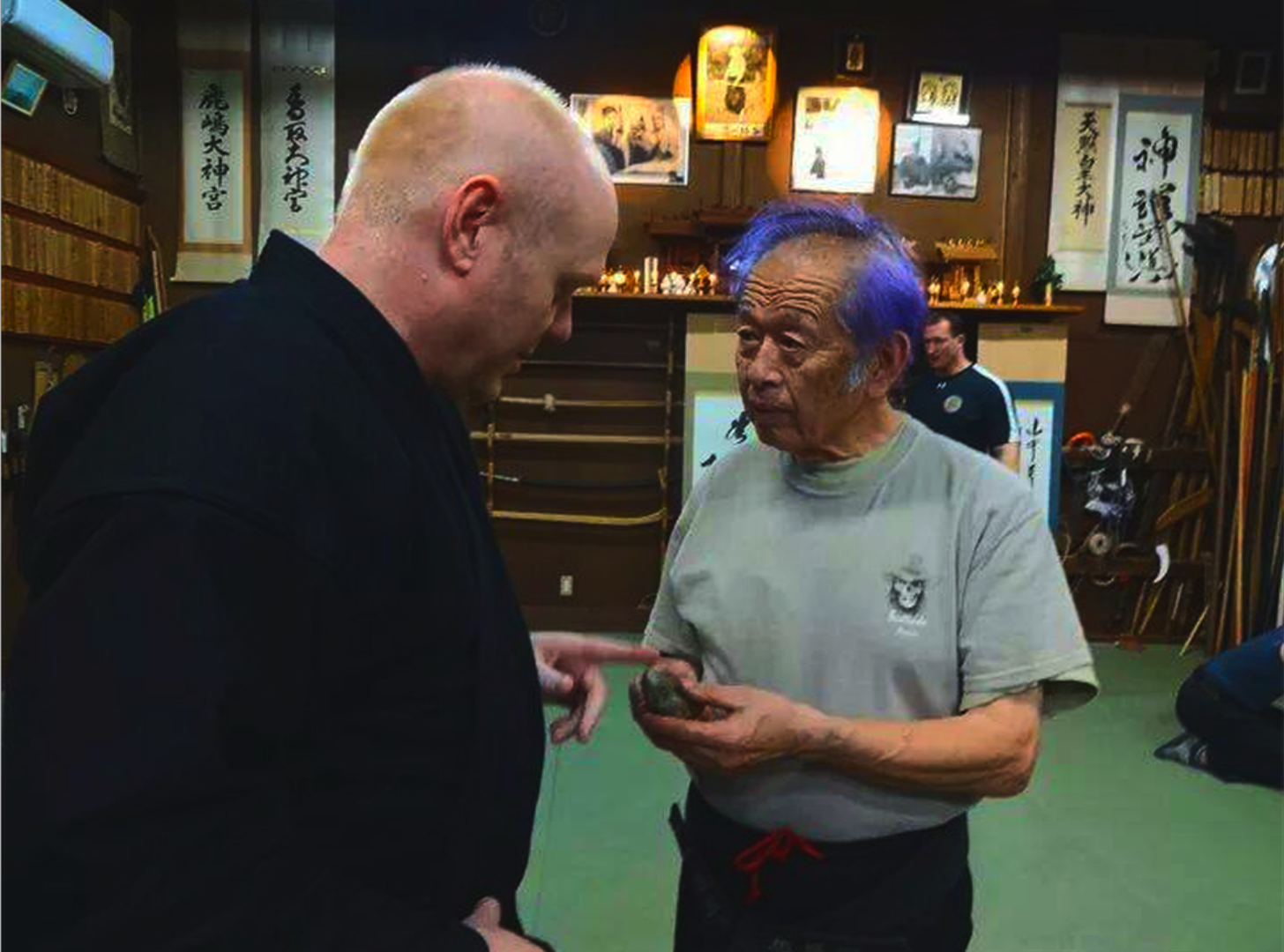
Michael Glenn Shares a Stone from the Santa Monica Mountains with Hatsumi Sensei
My punch at Soke left me hanging over the depths. Beneath me was the profound moment of life or death falling into darkness below. I felt I could sink with it.

Above was Hatsumi Sensei, who had just bounced me off the surface of this pond like skipping a stone across the water. I looked at him, he laughed. He wasn't going to let me sink. Not today.

Not today because he is sharing the idea of skipping a stone across the water with the whole class. Last week he used this image again and again in his classes. And right now I was the stone.

When I heard him talk about this in previous classes, I nodded my head. The concept made sense to me. It reminded me of another image he had used last year of 乗換 norikae. Changing trains, going from one track (or technique, kyusho, etc…) to another.

But now when I experienced what it felt like to be the skipped stone, I realized there was so much more. There is the stone, the person throwing, and the surface across which you fly. But there is also the entire body of water. What lies beneath?

If you've ever skipped stones across a pond, you may recall the rhythm. If you have a nice flat stone and a good throw (angle and speed), the stone will skip or bounce off the surface a few times. The first bounce is long, the second shorter, and each one after has less space between bounces. You may even get 6 or 7 before the stone sinks.

But the stone does sink. Just as the opponent is defeated. The final result is the sinking of the attacker into the depths.

Hatsumi Sensei wants us to focus on 間 aida. This is the space between, or the interval from one time the stone contacts the water to the next. During this moment, the stone flies through the air, but falls again toward the water.

Today, in this class as Hatsumi Sensei's uke, I am powerless to stop myself from hitting the surface again.

In this moment, this aida... I skim across the surface and I glimpse something that really surprises me, and that I don't know how to explain. I realize my fate is in the depths below. I am going to sink. But when I look down at the water I also see Soke's reflection, smiling at me.

When he describes to the class a stone skipping across the water, it is easy to think of a stone, of throwing, and watching it bounce across the water. But that is the training that exists above the surface. That is beginner stuff. When you pass Godan you may glimpse below the surface.

He was not just skipping a stone. He was drawing on the power of the depths below without sinking into them himself. And even more, he had decided that he was not going to let me sink either. I felt that at the end. He let me see deeply into the depths of our training by protecting me from what was beneath.

I'm sure this all sounds crazy, but describing what I felt is difficult. So I offer you the metaphor of the skipping stone that Hatsumi Sensei gave us. It is up to you if you want to pick up the stone for your own training.…

Hatsumi Sensei Shares Some Ninjutsu 文化 Bunka with Class

From Bujinkan Santa Monica by Michael

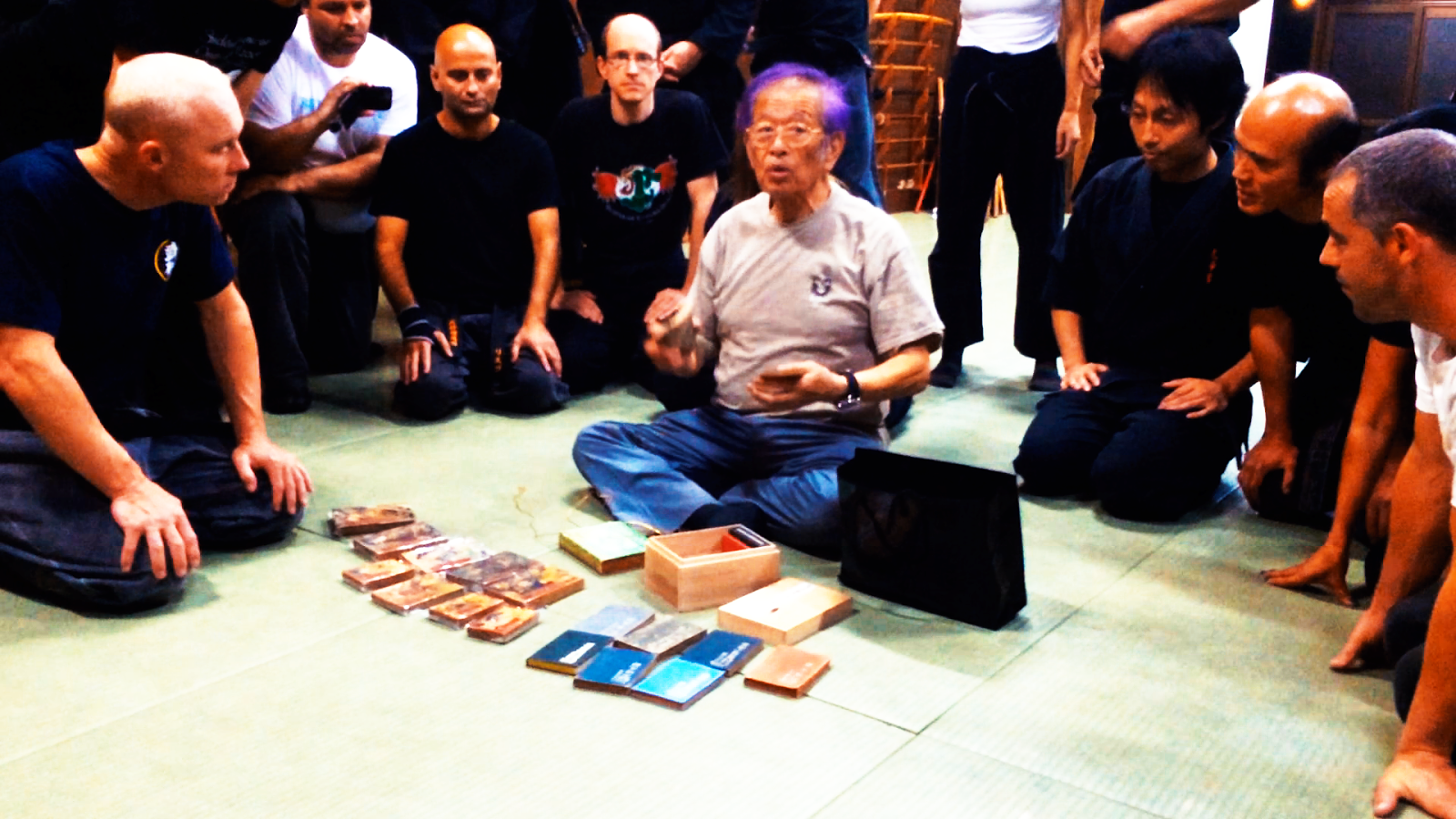
Hatsumi Sensei Shares with us, photo by Michael Glenn
Last week Hatsumi Sensei set a tone for class that was subtle but very important. It started in a way that I have experienced before with Soke, with a show and tell before class. He brought out a sack full of books to show us.

Soke said these books were tales of ninjutsu 名人 meijin. They were mostly children's books and many were illustrated budo legends. But something was different about these from ordinary comics or manga.

Before I explain the difference, let me describe an experience from my own life that has the same echoes. It is an experience that is natural as you age, but the pace of change in our current era make it extreme. In my lifetime, a major change is the internet and smart phones.

Lately, I've been thinking a lot about this in relation to the experience of learning, training and daily life itself. Many people younger than me did not experience life before cellphones and the internet. They may not know that it had a different quality.

You had to learn differently. Train differently. Find and connect with teachers differently. This made your entire way of thinking.. different.

I have observed the effects of this change in younger students in the Bujinkan. Some aspects of it are really wonderful and Hatsumi Sensei embraces change like no one else. But our art was born of a different time and manner of training.

When I was a kid, I couldn't just look stuff up. I couldn't easily call or text my friends. We had to agree to meet (physically) somewhere ahead of time. Or just find each other.

That happened. Even with my own Bujinkan teacher, I followed my instincts and just found him. There was no website, or even a flyer with a phone number.

This may seem like silly "old man" nostalgia. But really, life was different. You HAD to learn stuff differently. Very few bother to learn this way anymore. Or experience the world through the interface of instinct and their senses.

When I teach Bujinkan, people struggle to remember the littlest things. And their first instinct is to reach for their phone to look it up.

But let's get back to class last week and Soke's books.

Many of these books came from when Hatsumi Sensei and Noguchi Sensei were children. Soke said to Noguchi, "you probably read these as a child…" and Noguchi said, "yes, then we would go outside for ちゃんばら chanbara with sticks" (play sword fights).

Hatsumi Sensei was a bit nostalgic when he spoke of reading these kind of books by candlelight. He said it was before television and children were riveted to these stories. Hearing him speak about this in person rekindled my own sense memories and childhood feelings of a time before things changed.

In Hatsumi Sensei's lifetime there have been enormous changes. Both for Japan and the world. The way people live in the world and interface with it for learning is not the same as that kind of candlelight inspiration from his childhood.

That night in the Hombu dojo he told us that Japan used to have this kind of warrior culture and it is important to preserve it. He said that the Bujinkan has it's own 文化 bunka or cultural heritage. He said we have to preserve these things because they represent and express the abundance of humanity.

One of the special things about martial arts training is that it HAS to be learned in the old way. With your mind, body, and heart working together. And it can only be passed down from a connection from teachers to students through their lives, experiences, and personal histories.

I come to Japan and train with teachers who lived in a time when the Japanese warrior culture was still alive as part of the fabric of their childhoods. And some of my teachers trained with Takamatsu Sensei which takes the thread of connection back even further into ages before internet, TV, radio, cars, telephones…

Back to a time when all they had for training was found in nature, the denshou, or in a teacher's heart.

What did the warriors learn then? And how did they learn it? This is the core of our Bujinkan heritage. Thank you Hatsumi Sensei for sharing that with us.

…

Senou Sensei Taught a Wonderful Class Today

From Bujinkan Santa Monica by Michael

I arrived early to the dojo because I'm like that, and I helped Senou Sensei cut some fresh 榊 sakaki for the shelf behind us.

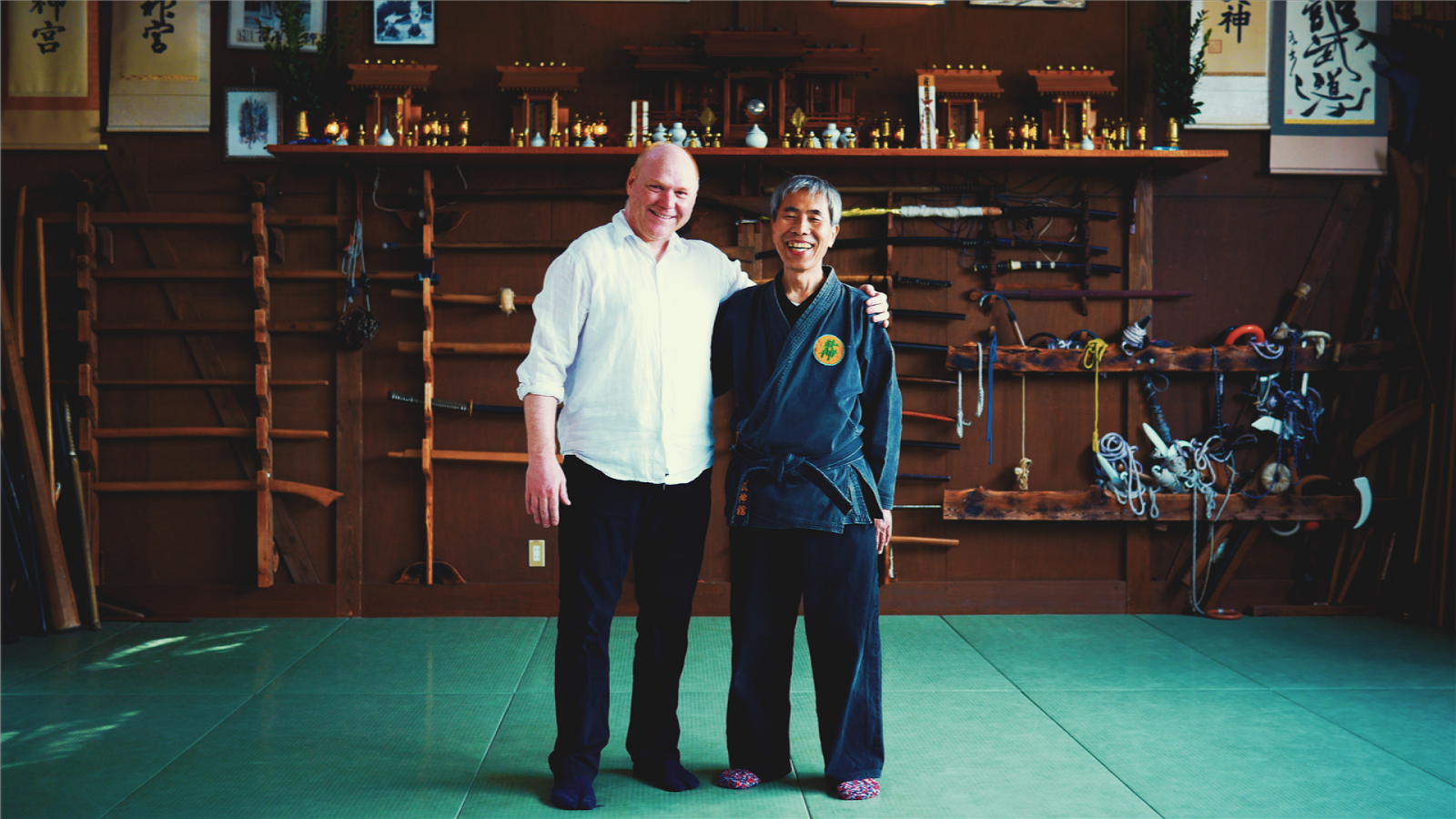
When he unlocked the dojo, he walked in and was a bit emotional. He took some time examining everything because things were different. He told me it had been nearly two years since he had taught here.

Then he taught a great class. He told everyone there that all of the good thoughts from people in the Bujinkan had helped him to regain his health.…

師恩 Shion: a Teacher’s Grace and Kindness Inspires Our Bujinkan Training

From Bujinkan Santa Monica by Michael

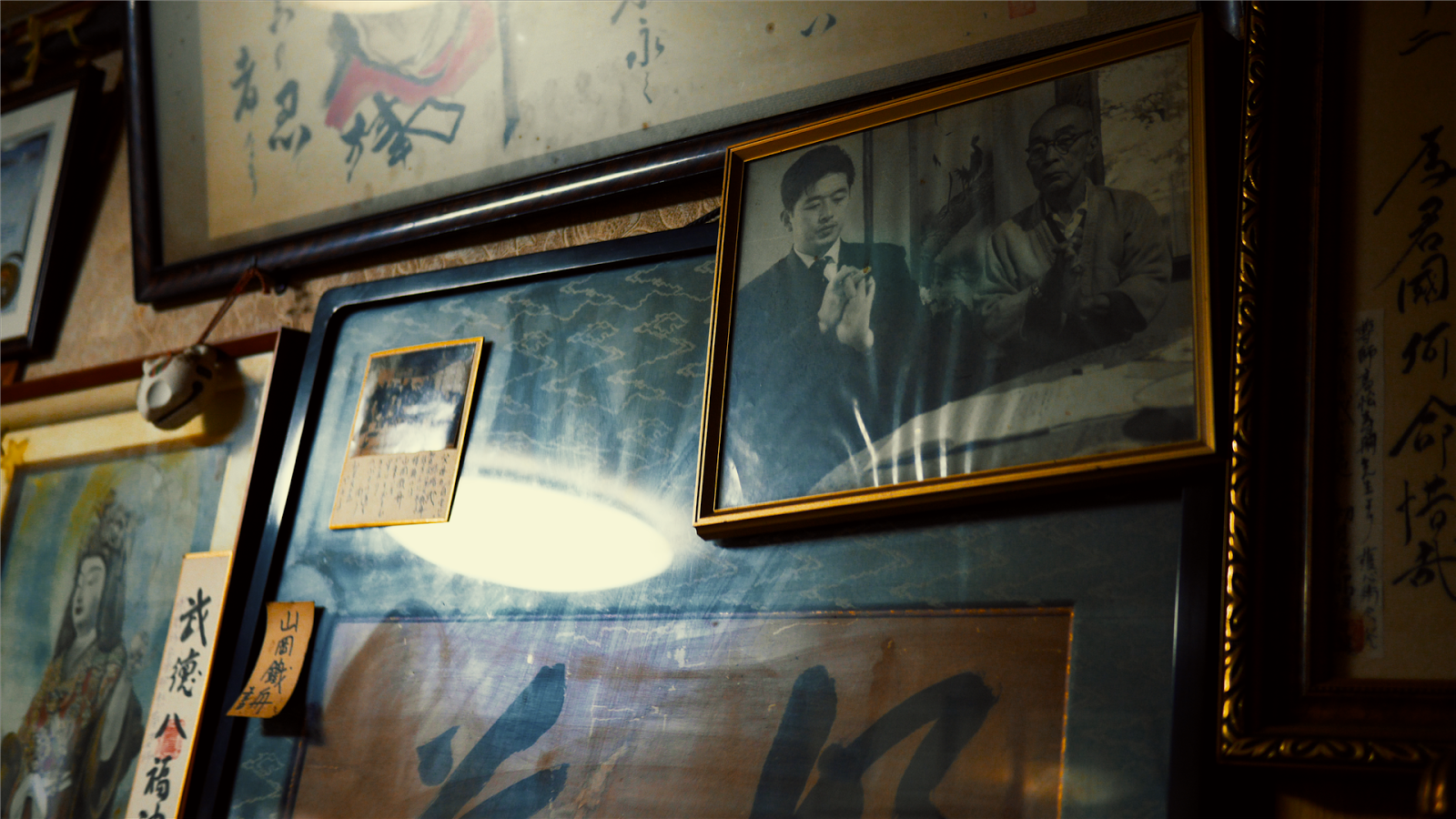
師恩 Shion on the wall in Soke's house. photo by Michael Glenn
I want to give you a clue for how to study in the Bujinkan. This clue I will share below comes directly from Hatsumi Sensei. But first, let me tell you why your teacher may not even know this.

Some teachers follow the teachings of Hatsumi Sensei, but many do not. Many have their own ideas about how the Bujinkan should be taught or transmitted. This is a mistake that many who claim to follow Soke will make without even knowing it.

They develop their own curriculum and make their students learn and study in ways that have never been part of the Bujinkan. This includes many lost people who think they can recreate the early training of the old days. If you weren't there, then you don't know. But I guess you can make stuff up.

Bujinkan arts are taught very differently from other martial arts and that is quite intentional. It is a natural strategy that Hatsumi Sensei has chosen. And if you don't understand it, there is a reason for that as well.

Hatsumi Sensei is an artist. How do artists learn from one another? Primarily by inspiration. If you have ever been inspired, think about the energy that put into your mind, your heart, or your body. This energy moves you to act.

Hatsumi Sensei says that beyond even heart to heart transmission is 絵心伝心 eshin (egokoro) denshin. This is artistic inspiration passed from one artist to another. This happens instinctively for artists, but it cannot be put in any training manual.

Like many things Soke tells us, this is a play on words relating artistic inspiration to 以心伝心 ishindenshin which is a mutual and natural understanding between people that borders on telepathy. This is when you can give somebody a glance and they know exactly what you mean.

This artistic inspiration and mutual understanding guided me to Hatsumi Sensei's dojo in the first place. We didn't know each other and had never spoke. But our hearts communicated across time, culture, and distance to bring us together.

Soke says that this is the path of Budo. Nothing needs to be explained or said. By training with and being in the presence of such a teacher, you just get it.

This is how I study Bujinkan. I use 画心 gashin or an artistic instinct that I have developed and received from many years of being inspired by my teachers. And I repay their 師恩 shion (a teacher's grace and kindness) with gratitude by sharing this inspiration with my students.…

A New Bujinkan 初段 Shodan in my Dojo

From Bujinkan Santa Monica by Michael

Richard chats with Peter Crocoll
I went to Arizona last weekend for training. This was more than just a normal training trip. One of my long-time students, Richard, was going for his initiation to shodan.

In many dojos, a Bujinkan 初段 shodan  is not really treated as such a big deal. In most of the Bujinkan it requires at least a few years of study and a proficiency with the basics. But in my dojo and my teacher's dojo, we see it as an important event in a student's journey. So we approach this threshold with certain key ideas.
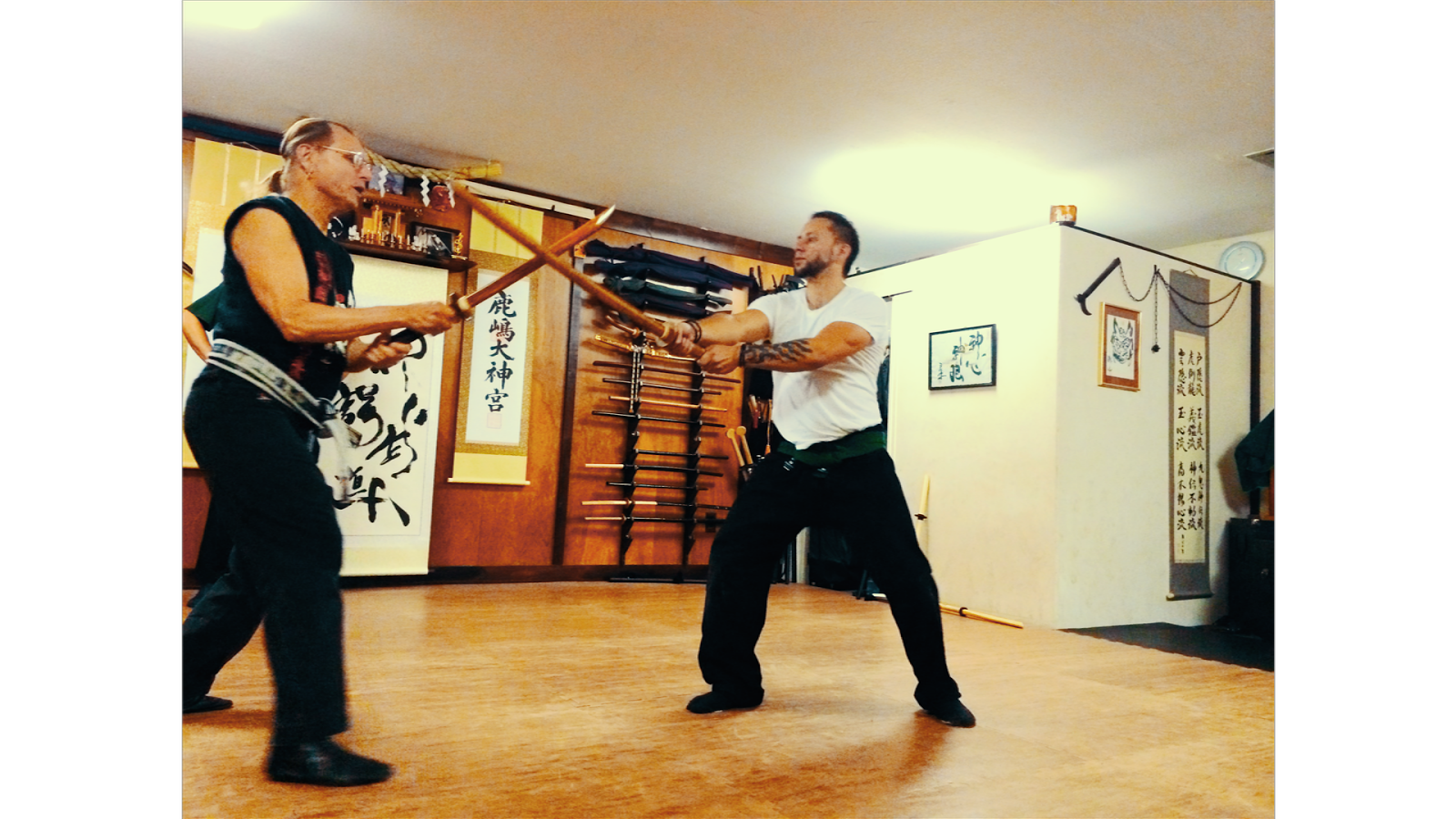
Peter Uses a Ninja-to on Richard
To begin with, skill and technical ability are important. Richard had to demonstrate this, but by the time I put any student up for shodan, I already know very well what he is capable of. So we only look at technique to make sure the student knows for himself what he is AND is not capable of.

The next part has to do with the personal journey. How or why did you start? Why do you keep going? For most of us, these reasons change as we grow in the art. Richard's path to his shodan was not straight or direct, but it was natural like life.
Peter Disarms Richard
Then there is the connection to our history. The student should be able to trace a direct line from his own training back through his teachers to Hatsumi Sensei and the history of the art in Japan. The more direct this connection the better. Lucky for Richard, he was surrounded by many people who have trained with Hatsumi Sensei in Japan directly and some who have been doing so for decades.

The importance of 忍 nin in our study cannot be overestimated. We often think of nin as perseverance. And it is.
Peter Cuts Richard Down
But some deeper meanings arise as you advance in training. The character for nin has the sword over the heart. This has been suggested to mean that even under the threat of the sword, the heart will persevere.

You may also find your heart reflected in the polish of the sword. It might be a way to hold your own blade or you may find it reflected in your enemy's weapon. But your heart can be made clear by the polishing done in the dojo.
Richard relaxed and happy before the storm
When you have completely polished the mirror (your heart) it is absolutely clear of dirt or imperfections. So then perseverance is easy, because there is nothing there. You reflect your enemies back to themselves. You embody nothingness and you are not a target. There is nothing to attack or defend and endurance is a matter of sutemi.

This idea takes us well beyond shodan. But this weekend all of us who were there to help Richard were there to be nothing but a mirror for him. Our job was to remove our agendas or egos from the process so that he would only find himself reflected back.
Michael Glenn and Richard with his new shodan
Congratulations Richard! Thank you for training with me all these years.…

Timeline

From Shiro Kuma's Blog by kumablog

image

The Japanese developed their fighting systems out of necessity. They were not the more gifted, nor the best. But they did it for a longer time than us.

When you try to understand the development of Japanese Budō it is important to keep in mind the time-line of Japanese history.

In the West we do not really understand the reality of Japanese warfare and we take for granted that the 江戸時代, Edojidai (1603-1868) is the “golden age” for martial arts. This is a common misconception.

The 鎌倉時代 Kamakurajidai (1185-1333) didn’t survive the Mongol invasion of China (1279)*.  Japan since the T’ang Dynasty (618-906)** has been in close contact with the Chinese Empire. Through its “embassies”*** Japan had been copying everything from China since the 7th century (coins, writing, silk, arts, science etc),  in fact the Japanese society was a copy of the Chinese structure (political and economical). So when the Mongols invaded the Empire in the 13th century, and tried to invade Japan twice in the process****, the Japanese economical and political system collapsed and gave birth to a new type of society.

The 鎌倉時代 Muromachijidai (1333-1573) that followed tried to keep things the way they were, but when the 応仁の乱 Ôninran began (Ônin war 1467-1477) it was too late. It was the beginning of 下剋上 Gekokujō; a time when the lower daimyô tried to take power and replace the ancient rulers*****. It ensued a period of permanent wars 戦国時代, Sengokujidai (1467-1568), that ended up with the unification of the country and the Tokugawa shogunate in 1603.

Even though many of our fighting systems had been created before the 14th century, this is during these centuries of warfare (14th – 16th) that our ryûha were developed and refined. Not after.

In fact, I consider the Tokugawa period as the end of creativity in the martial arts. Because this is during this Edo period that the ryûha were systemized and  lost the creativity that made them survive until then. As explained brilliantly in “the principle of Lucifer” by xxx, “every living cell, plant, animal, if not under the risk of being destroyed will not carry out the necessary actions in order to survive”. survival is what triggers creativity. Peacetime is not.

Hatsumi sensei often says that we are training Muromachi techniques. I never heard him say that we were training Edo techniques. So when unification was finalized by Tokugawa Ieyasu, the development of Budō techniques stopped. And what I love about the bujinkan is that we keep these old techniques alive as well as their creativity.

There is no other martial art as complete and true as the bujinkan because we train the ways of the past in order to apply them in the modern world instead of reproducing dead techniques carved in granite by four centuries of peace time.

_______________
* “The Mongol invasion of China spanned six decades in the 13th century and involved the defeat of the Jin dynasty, Western Xia, the Dali Kingdom and the Southern Song, which finally fell in 1279. The Mongol Empire under Genghis Khan started the conquest with small-scale raids into Western Xia in 1205 and 1207. By 1279, the Mongol leader Kublai Khan had established the Yuan dynasty in China and crushed the last Song resistance, which marked the onset of all of China under the Mongol Yuan rule. This was the first time in history that the whole of China was conquered and subsequently ruled by a foreign or non-native ruler, compared with the Manchus (who established the Qing dynasty) who did so a few centuries later”. From  http://en.m.wikipedia.org/wiki/Mongol_invasion_of_China
** T’ang dynasty: http://en.m.wikipedia.org/wiki/Tang_dynasty
*** Embassies: http://en.m.wikipedia.org/wiki/Japanese_missions_to_Imperial_China
**** The Mongol invasions of Japan (元寇 Genkō?) of 1274 and 1281 were major military efforts undertaken by Kublai Khan to conquer the Japanese islands after the submission of Goryeo (Korea) to vassaldom. Ultimately a failure, the invasion attempts are of macrohistorical importance because they set a limit on Mongol expansion and rank as nation-defining events in Japanese history. During both invasions, the Japanese defenders were aided by major storms which sunk a sizable portion of the Mongolian fleets. From http://en.m.wikipedia.org/wiki/Mongol_invasions_of_Japan
***** Gekokujō (下剋上) is a Japanese term for “overthrowing or surpassing one’s superiors”. It is variously translated as “the lower rules the higher” or “the low overcomes the high”.

http://www.budomart.com
http://www.koimartialarts.com


…

Ninja kusarigama

From paart budo buki by Mats "Toryu" Hjelm

Dear Budoka's


I apologize because it has been a while since the last post, I needed to finish a some standard carpentry jobs, but,

soon will be new items for now one from few months ago, soon new photo's and more info 


…