Skip to content

Don’t Xerox The Master!

From Shiro Kuma by kumablog

img_20170502_211510.jpgEach class, Hatsumi sensei speaks about moving “Yukkuri”, slow. This is different from training slowly. (1)

Training slowly: Study level/acquisition/Dōjō
Moving slowly: high-level/reaction/fight

Training slowly is part of the learning process, reacting slowly deals with actual fighting. When you train slow, you create new mental/body patterns that will be useful in a real fight. When you move slowly in the encounter, you stop emitting intention. Therefore it is easier for you to read the opponent and to adjust your reactions naturally to Uke’s attacks. Many practitioners, high ranks included, misunderstand this difference. We end up mimicking Sensei’s slow movements. And as we don’t have his many years of practice, if we only copy his slow moves, it will get us killed.

For years now he has been saying that he is teaching for the Jūgodan not for beginners. What he shows is Ura, if you copy his movements, you stay at the Omote level. Buying a black belt in a Budo shop doesn’t make you a black belt. What Hatsumi sensei shows in class is a result, not a process. Do not mistake the end result for the path. Stop copying, you don’t have the level for that! Moving slowly comes after many years of moving fast. The “no-waza” state he has reached is beyond our grasp. We are heading towards it, but we are not there yet. It comes after years of repeating the forms of the waza. There’s no shortcut. As I said many times here, in order to forget the techniques, you have to learn them in the first place.

Yesterday, Hatsumi sensei insisted on moving slowly. This is the secret of high-level taijutsu, he was insisting on the “yukkuri”, but he added that to be successful, one has to keep moving. We did several sword attacks from behind similar to train the Sakki feeling. Each time, the sword could not touch him because he never stopped. Turning his back to Uke, Sensei didn’t wait, he kept walking, and the blade was avoiding him like by magic. Hatsumi sensei insisted that if you stop, then you give a fixed point in space that the attacker can use against you. What we do is effective taijutsu, even if we are moving slowly. Senō sensei often asks us to move out too late and to be hit. Then to move a little earlier, then again and again until we can move slowly enough, and at the right distance, and with the perfect timing to avoid the attack. If you never get hit during training how can you possibly know how to fight for real? The truth is that you cannot.

Instead of repeating Sensei’s movements, you should listen to what he says, and build a training progression that will teach you how to do it. If you are a Bujinkan high rank, hopefully, you have studied all the Waza. You come to Japan, not to learn Waza but to bring back home new insights and new feelings, that you will train in your Dōjō until your next trip to Tōkyō. You come to Japan to bring back homework.

If you want to improve your knowledge of Taijutsu, stop copying and begin to listen.
Don’t copy the Omote, the visible, it’s a dead-end.
Listen to him, it will teach you the Ura of things, and help you improve your movements.

__________________________________

  1. ゆっくり, Yukkuri: slow, at ease, restful

Please Pronounce Correctly

From Shiro Kuma by kumablog

koshiI don’t speak Japanese, but I do my best to pronounce it correctly. Too often, I can see t-shirt written “Gyokko Ryū Koshi Jutsu” instead of “Gyokko Ryū KoSShi Jutsu.” (1)

Twelve years ago in a Nagato sensei’s class, he asked what we wanted to study as he always does. An American teacher jumped in and said: “Koshi jutsu.”

So, we trained hip-throws for two hours. I remind you that back in 2005, Nagato sensei’s classes were more “dynamic” to say the least.

At the end of the training, everyone was happy that training was over. Then my American friend came and complained to me (why me?).

– Him: Why did Nagato do Nage Waza? I asked him to do Koshi Jutsu!
– Me (soft and enjoying it): Because Koshi means hip in Japanese.
– Him (getting excited): But I wanted to study the Gyokko Ryū!
– Me (playful): So you should have asked,
– Him (getting aggressive): That’s what I did!!!!
– Me (enjoying it): No. You asked for Koshi instead of Kosshi
– Him (troubled): …Yes, it is the same, no?
– Me (in heaven): No. Koshi is the hip, where Kosshi is the main kaname for this year’s study of Gyokko Ryū.
– Him (not getting it): ugh?
– Me: You have to pronounce each one of the “Ss” if you don’t, it means something else, like hip in that case.
– Him: ???

He left me with the bright, and sharp look of an oyster. (2)
To this day, I’m not sure that he did understand, but luckily he is a high rank… (3)

As I said in the introduction, I do not speak Japanese, but I know that some sounds with nearly the same spelling can have different meanings in Japanese. When you learn the vocabulary, we use in training, pay attention to those double consonants.
That is also important with the long vowels like “o” / “ō” and “u” / “ū.” (4)

So, learn Bakka correct Japanese sounds if you don’t want to look like a Baka. (5)
_______________________
1. 腰, Koshi: back; lower back; waist; hips; lumbar region
骨子, Kosshi: main point; gist; essentials; bones (e.g. of an idea); pith. And in 2005, Sensei used it with the meaning of “central pivot”, “vertical axis”, “coccyx.”
2. Metaphor intended
3. pun intended
4. The correct transcription uses an extra “u” after the o for the long “ō” and long “ū”. For example, Happou is Happō; Doujou is Dōjō; Chuu is Chū, Juudan is Jūdan. Because in the French language the sound “ou” is “u” (like in “Bujin”), I use the transcription with the flat accent on top. More on this here https://en.wikipedia.org/wiki/Romanization_of_Japanese
5. 許, bakka: only; merely; nothing but; no more than
馬鹿, baka: fool; idiot


Mumei And Yokenai

From Shiro Kuma by kumablog

IMG_20161127_130637
Mumei, no name, no fear

Hatsumi sensei is getting deeper, every class, into the world of Mutō Dori.
The majority of you is now familiar with the vast complexity os this concept that we have been training on and on for nearly a year and a half now.
As he explained here, Mutō Dori is not only the “unarmed defence against a weapon. It is much more. In “Japanese sword fighting”, sensei writes that “(…) Even if you have a sword, Mutō Dori starts with the development of the courage to face an opponent with the preparedness of not having a sword.” (2)
My dragon name being Yūryū, it resonates with me. (3)
Courage is to face the enemy even if you risk to lose your life.

The Mutō Dori of 2017, the way I understand it now, goes beyond this bravery. And he explained it during class when he said “Yokenai”, don’t protect yourself! (4)

Not concerned by the outcome you go straight to the opponent with no intention and ride the wave of his intention. Fear is not at play, you do your best and watch the result. As you have no plan of action, it is Uke that defines your reactions. Not frozen in the “I want to”, your body adapts to the situation.

But this detachment finds its origin in another concept that Sensei mentioned the other night. This concept is Mumei. (5)

At dome point during the class, Sensei did a particular grip on the sword, and I went to ask for its name. “There is no name for it” he answered. Maybe I looked puzzled, so he added “at Mutō Dori level many techniques have no names. You do them naturally.”

Kacem late told me that these techniques have no name (even if they have) because a name would limit them. I thought of Plato saying that “knowing the words led to the understanding of the world.”
It means that when you name something, you define it. You set limits to what it is, and what it is not.

Therefore, you are trapped by its definition. And this is where the Oriental philosophy have invented Mumei, the “no-name” concept, so familiar to Zen practitioners. Mumei doesn’t limit things to a single reality. Things are not “de-fined”, they have no boundaries, no finitude.

In Mutō Dori, as you don’t name the technique you stay away from the limits of the definition.

This is why Sensei moves naturally. On a few occasions, he dodged easily the sword and knife attacks of Shiraishi sensei, he kept walking towards him as if nothing would touch him. Strangely, nothing cut or stabbed him, his distance was always perfect. Because in the “un-limited ” world of Mumei and Mutō Dori, there is nothing to fear.

“Courage knows what not to fear,” said Plato. When you face your opponent with no fear, you cannot be defeated. So, you don’t need to protect yourself, Yokenai!
_________________________
1. 無刀捕, Mutō Dori
2. “Japanese sword fighting”, by Hatsumi sensei, pages 64 and 65 (published 2005 by Kodansha). Read here. More on Mutō Dori here
3. Yūryū: 勇竜, Dragon of bravery; courage; heroism. At the beginning of the 90s, Hatsumi Sensei gave us, Yūro Shi Tennō, “dragon names.” Today people don’t bother receiving them; they only add a dragon name to look cool. (sic)
4. Yokenai: 除け無い, yoke/protection + non-existent, not being there
5. Mumei: 無名, nameless, anonymous

Paris Taikai 14th to 16th of July. 3-day seminar with Sven Bogsater, Peter King and Arnaud Cousergue. Registration opened here


Don’t Be A Selfish Ninja!

From Shiro Kuma by kumablog

shareDon’t be selfish!
If you have the chance to train in Japan, let the Bujinkan community know about what you learned.

Every year, about 5000 Bujinkan members come to Japan to study the Bujinkan techniques under Hatsumi sensei and his best students. The majority of these Bujinkan members are Shidōshi.

So why don’t we have more information on what is going on in Japan? When you train in Japan, it is our responsibility to share what we live not only with our students but with the whole Bujinkan community.

When you take out from the 5000 visitors, the non-Shidōshi, those who don’t write in English, those coming only for a new promotion, and those coming only for tourism; there is still a significant number of people that could write and share their feelings and discoveries with the Bujinkan community. Don’t you think?

The Bujinkan is about 500 000 students in total, so the 5000 lucky travellers represent only 1% of the community. It’s time to help the other 99%.

The Bujinkan is like a “family”, but no one communicates. I invite you all, travellers to the Honbu, to write about your experience in Japan. Share with the rest of us, and help more Bujinkan practitioners who don’t have the chance to travel to learn.

Today I just created a new Facebook page called “Bujinkan Trips” where you can now share your training experience from Japan. The address: https://www.facebook.com/bujinden/
Would you be willing to put your Japan trips notes and insights on it? Your contribution can be recent or not, and will serve the community. Thank you

Written on the train to Honbu, before class with Sōke, on a beautiful and sunny spring day.


Fun’Iki, Control The Environment

From Shiro Kuma's Blog by kumablog

IMG_20170428_211146This year Mutō dori is about controlling Funiki, your environment.
During the class, Hatsumi sensei demonstrated it with Taijutsu, Tantō, Katana, and Naginata. Each time the Uke seemed lost and unable to get him. His main point today was that the weapon, or the lack of it, is not what truly matter. In fact, with or without a weapon, Sensei was moving very slowly, keeping a perfect distance with the opponent, who always ended up cutting, stabbing himself, or getting controlled. There was no fight, no opposition, Sensei’s movements were natural. From the outside, it looked like Uke was fighting alone.

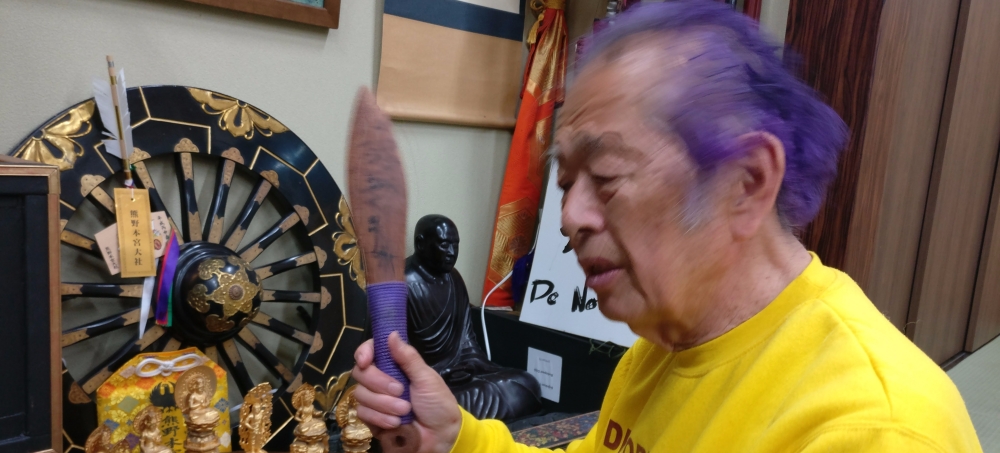
Sensei demonstrated it with the Tantō, using a unique grip that let his Taijutsu play by itself.
You hold the knife reverse, hiding it under your forearm and use either the blade or the Kashira to get Uke naturally. (2)
The key, he said, is not to use the Tantō, and to let Uke cut himself in the process. Correcting a student he told her that thinking about cutting with the blade, created a Teko (3), a point of leverage and focus that the opponent can use against you. Sensei added that in the case of a small weapon, it had to be always hidden.
But when Uke finally sees it, the trick is to let Uke “think” the knife while Tori still ignores it and his mind is not trapped by it. Sensei added that when you want to cut or stab with your knife, you are creating a fixed point in your mind limiting your freedom of action.

With the Naginata; it was even more devastating. Sensei said that when using this weapon, your grip of the weapon should be loose and all the movements executed using Naname. (4)
My understanding is that the physical encounter is enough to cut the enemy, your body supporting the Naginata loosely on top of the forearm. Also, keeping the edge oriented at 45 degrees guarantees a cut when in close-combat. The cuts are done by walking the body around Uke. When he was demonstrating this, I had the feeling the Naginata was alive and moving by itself.

In a sword against sword encounter, he explained to move towards the attack, using the body to support the blade as a shield. With the weapons in contact use the joints to apply leverage. Grab the opponent’s sword and then slide your katana under his helmet.

Finally, in Taijutsu, Sensei reminded us to use our fingers as if playing the piano on Uke. Then one finger extended was often enough to overcome the adversary even when he was armed with a sword.

All these techniques that we did were practical applications of high-level Mutō Dori. Mutō Dori is entirely misunderstood. It is not what we learned at beginner’s level. Mutō Dori is done in every situation, with or without weapons. Because it is about controlling Fun’iki (1), the environment, the atmosphere.

When your mental presence is aware of everything and controls the space between and around you and the opponent, then defeat is never yours. (5) (6)

The essence of Mutō Dori is Fun’Iki, to control the environment naturally.

________________________
1. 雰囲気, Fun’iki or Fuinki, air, atmosphere, environment
2. Kashira 頭, the head/top of the weapon/hilt
3. 梃子, lever(age). Teko – lever, and Shiten – fulcrum are one the secrets of the Kukishin Ryū
4. Naname 斜め, diagonal, oblique
5. Sensei used the word Fudōshin (不動心) to express it. And many of his attackers today explained that they cannot get him because of his commanding presence.
6. 不動心, Fudōshin: a) imperturbability; steadfastness
b) cool head in an emergency; keeping one’s calm (e.g. during a fight)


Kantan Janai!

From Shiro Kuma's Blog by kumablog

seno1Senō sensei’s class was very technical, even more than usual. Luckily my partner was Holger, and we were both very much into learning because it was not easy.

Too often, when you partner with a beginner, you end up being bored or correcting your partner. Today, thanks to him I enjoyed the research/training we both did.

The locks by Senō sensei were subtle, and we had a hard time finding the right amount of force to apply them correctly.

He didn’t teach many techniques during this training session, but each one he did require a lot of work. We went to him several times for each movement to “feel” them. And even after we had experienced them, we had a real difficulty to get them correctly. It was high-level taijutsu.

I’m not saying that the movements done by the other Shihan are easy, but at least I am more used to their taijutsu. As a joke, I told him that his techniques were “Kantan” (easy), (as they were not), and he kept repeating it after each demonstration while laughing. Senō sensei is a gentleman of Budō. It is hard to accept that he was one of the more dangerous and fierce students of Hatsumi sensei when he was young!

At some point, he changed technique, and we trained the precise timing and rhythm of Uke Nagashi + lateral shutō.
This simple movement made me understand how bad my taijutsu is compared to his. I discovered that I had been far from correct for the last 33 years!

The rhythm of the counter-attack after the Uke Nagashi is more subtle than I thought, and when done properly is much more powerful. This way of delivering the shutō will be my on new personal training list, once I’m back.

What I discovered today will benefit my whole taijutsu so much, that if I would go home today only after a few classes, I think to have enough material to study before my next trip in July.

Senō sensei’s apparent “nonchalance”, hides a fantastic power. This class was a revelation. And when I discover gems like that here in training, I wonder even more why so few people travel to Japan. Visiting Japan once in your life will not suffice to improve your taijutsu. Nothing is hidden in the Bujinkan, but if you don’t come here, it will be hidden to you forever. Because without a teacher, these details are impossible to find.

To help you, here are a few points worth adding to your next training:

1. Receive the attack with the shoulders backwards, and counter with your shoulders forward
2. As much as possible, move in three directions at the same time: hips, legs, arms. This sanshin is the key to create a strong Kûkan
3. Apply pressure with your torso, not your hands. Mainly if your hands are in contact with uke’s body
4. Adjust your movements slightly by “listening” to uke’s body reactions, and do not hesitate to change the form
5. Take your time to understand with your body, and remove any force. Train slowly
_______________________-
1. Kantan 簡単, easy, simple, uncomplicated


Past, Present, Future: All Is Connected

From Shiro Kuma's Blog by kumablog

nagato - Edited

For any Bujinkan practitioner (including me), Nagato sensei’s level is out of reach. With Noguchi sensei and Senō sensei, they are the best students of Hatsumi sensei. So, to say that he has “improved” would seem quite arrogant. That is honestly what I think.

As long as I can remember, Nagato sensei always did “his magic stuff”. He was never teaching a particular waza.
But when he was forced by Sensei to show the waza from the Denshō, he had to revisit his basics. By doing so, he unfolded another level of excellence, that anyone attending his classes can now see.

How is it possible? Only because he reconnected his vast knowledge to the past, train them in the present, to better his future. This interconnection is called “Kako, Genzai, Mirai” in Japanese, and was taught by Sensei in 2012. (1)

I invite you to read the excellent blog post by my friend Michael Glenn at the end of the text. (2)

The human learning process is based on repetitive cycles. Often, when we “know” something, we stop repeating it. With the years, some bad habits develop and we begin to drift away from the original form without being aware of it. Why do you think that Noguchi sensei always reads the techniques directly from the Denshō at every class? For the same reason.

Two years ago, I had to “re-study” the first Tenchijin thoroughly. I discovered that for some techniques, I had drifted away from the original text. My forms were not wrong, but they were not the ones that had to be trained. The same happened to Nagato sensei.

Now, nearly three years later, he is back to his own movements, and they are deeper, more meaningful, more powerful with less effort.

Life is about learning. And learning never stops because the past, the present and the future are One.

Next time that your teacher asks you do your basic ukemi, kamae, uke nagashi, try to remember this and enjoy this luxury instead of complaining that you already know them. To believe that you know something is an illusion. A pianist, or a dancer, do their basics every day without complaining because they know that the iterative process will allow them to show their best on stage.
_________________________________
1. Kako 過去, past; Genzai 現在, present; Mirai 未来, future
2. More on the subject by Michael Glenn from Santa Monica Dōjō Blog

Paris Taikai 2017 Registration


Do. Think. Don’t Think!

From Shiro Kuma's Blog by kumablog

arnoguchi“I cannot teach anybody anything. I can only make them think” Socrates

Sensei once said nearly the same: “I don’t teach my students, but I teach them to teach themselves”. That is the same idea except that in Budō thinking is not possible.

If you think the movement while doing it, nothing good gets out of it. The thought process is only present in the studying phase, not during the battle.
We had a Kukishin ryû class yesterday with Noguchi sensei, and the ease with which he was unfolding the waza didn’t let any opening for thinking. Beyond the form lies the beauty of natural movement. When Noguchi sensei does a technique, he more or less always follows the same pedagogical pattern, i.e.:
1) basic waza read dusky from the denshō;
2) breaking the waza;
3) changing the beginning of it to adjust the kaname hidden within to the intentions of the opponent. (1)

This last part is always the most interesting because when he does it, it is hard to see the original form. And this is where Budō is different from Socrates. There is no thinking involved. Noguchi doesn’t think, he does henka after henka, without stopping. Those of you familiar with his classes know what I mean. Each class is a permanent rebuilding of the waza based on the kaname.

As we were uneven in the class yesterday, he asked me to correct the students which gave me a good chance to witness the whole class from the outside. This allowed me to understand better his modus operandi. When I train as a student, I’m doing my best to follow his body flow. Being an observer yesterday, gave me a deeper vision of his moves. Learning the original waza is a necessary step when your study Budō, and at a certain level, you have to forget these basic forms to dig deeper into the feeling they contain.
Many practitioners do not understand that. I often see high ranks doing waza correctly according to the text, but never going away from it. In a way, they train like “advanced beginners”.

As a Shidōshi, you have to know the basic technique. And Sensei repeated it again during his first class of the year. But to grasp the essence of Mutō Dori, one must not stop there. The real fight is not possible if you simply do the form. Waza are only valid if you can free yourself from them.

The secret is to teach the written waza and to train the kaname beyond the form. And to do that, you have to study more and to think a lot about the invisible part which lies within it. If you don’t, you will never be able to grasp the natural body flow which comes with direct adaptation.

Once you have acquired the waza, you have to destroy it. Once destroyed, you do not need to think, you use uke’s intention against him. This three-step process in Japan is called “Shu Ha Ri”, or “absorb, innovate, depart”.

Here’s how it works: “In Shu, we repeat the forms and discipline ourselves so that our bodies absorb the forms that our forebears created. We remain faithful to these forms with no deviation.
Next, in the stage of Ha, once we have disciplined ourselves to acquire the forms and movements, we make innovations. In this process, the forms may be broken and discarded. Finally, in Ri, we completely depart from the forms, open the door to creative technique, and arrive in a place where we act following what our heart/mind desires, unhindered while not overstepping laws.” (Wikipedia) (2)

Each class with Noguchi sensei is a fantastic opportunity to see this process in action. But thinking is only possible during the first two phases Shu and Ha. Because Ri is a pure reaction, and the only thing to do is to ride the waves of uke’s intentions.

_______________________
1. Kaname: 要, vital point; cornerstone; keystone
2. On Shu Ha Ri: https://en.m.wikipedia.org/wiki/Shuhari

Paris Taikai Registration are open 


Uchû Sayû: Mastering The Space-time Continuum  

From Shiro Kuma's Blog by kumablog

The concept of “Kannin Dokuson” (1), the Mutō Dori of 2017 involves the control of the center of space.

Since Albert Einstein, we know that time and space are interconnected. They are like inyō. There is no duality, only a space-time unity.

Sayû, the well-known Bujinkan principle of “left-right”, also means “control”. Once again, it is similar to “inyō” (the Japanese “yinyang”). Therefore controlling the space is to control the unified interaction of yinyang within time. (2)

Last November, Sensei said the Kaname was to control the centre of the space delimited by the two opponents. (3) 

A few months later, I understand it better. He was preparing us to get the simple complexity of “Kannin Dokuson”: “mutual respect, self-respect, respect of the attacker”. 

The moment you control the space between, and around, the two opponents, you are capable to control Time itself. Therefore we can see Uchû Sayû (宇左右), the “control of space-time” (4) , as Uchû Sayû (裏中左右), “to control the invisible center of a situation”. (5)

________________

1. 貫忍 独尊 Kannin Dokuson

Kan 貫/ 貴ぶ/tattobu/to value; to prize; to esteem; to respect

Nin 忍/nin/endurance; forbearance; patience; self-restraint

Dokuson 独り/hitori/one person|alone; unmarried; solitary and

Son 尊ぶ/tattobu/to value; to prize; to esteem; to respect

2. 左右/sayû/left and right|influence; control; domination

3. 要/kaname/pivot|vital point; cornerstone; keystone

4. 宇宙/uchû/universe; cosmos; space

5. 裏中 U-chû 

裏/u-/ura/bottom (or another side that is hidden from view); undersurface; opposite side; reverse side|rear; back; behind (the house)

中/chuu/medium; average; middle|moderation. 


Push Your Limits

From Shiro Kuma's Blog by kumablog


While in Dubai, we had a nice discussion after the Sakki test. The new Dubai Shidōshi, was telling me that when I came him for the test, he thought his heart was going to explode. He was scared to death. 

But we all know, the only risk is a bump in the top of the head. There’s no need to be afraid. Tense, yes. But far, no. 

We are afraid when don’t know. Training, the Sakki test, is only a question of knowing. The more we learn, and the more we know. The more we know , and the more we push our self  imposed limits. 

Life is about pushing these limits. When you are afraid of something, the best attitude (Kamae) is to face it, to see what is the origin of your fear. 

Many people have fears they never confronted. To me this is not the path of a true Bujinkan practitioner. Learning the Bujinkan way is to accept those challenges and situations. 

All my life I have faced my fears: heights, depths, speaking to large groups, etc. This is why I did skydiving, mountain climbing, Scuba  diving, and big seminars. 

Everytime I found out that there was no logical reasons for my fears. Our fears exist prior to the experience. They are simply a mental construction that has no real foundation. They come from our reluctance to changes. 

After so many years in the Bujinkan, I can say that one of the most interesting aspects of sensei’s teachings is to develop this ability to survive and to push our limits. 

Instead of being afraid of the unknown, face it and tame it. It’s easier than you think. 

When I called Hatsumi sensei right after the Fukushima catastrophe, and asked him if he was planning to leave, his answer was “Banpen Fugyō”. To me this is the answer to any fear: Ten thousand changes, no surprise! 

Do not accept your limits, free yourself from fear itself be recognizing  it for what it is: an illusion. 

You want to be happy? Push your limits, because if you don’t, they will become your true limits. 

Ps: congratulations to the first shidōshi made in UAE. 
Paris Taikai 2017 registration