Skip to content

Simplicity Is Complex

From Shiro Kuma by kumablog

IMG_20170429_124108_449

Someone said “What comes easy, won’t last, what lasts, won’t come easy”, this is a correct definition of the class we had today with Senō sensei.

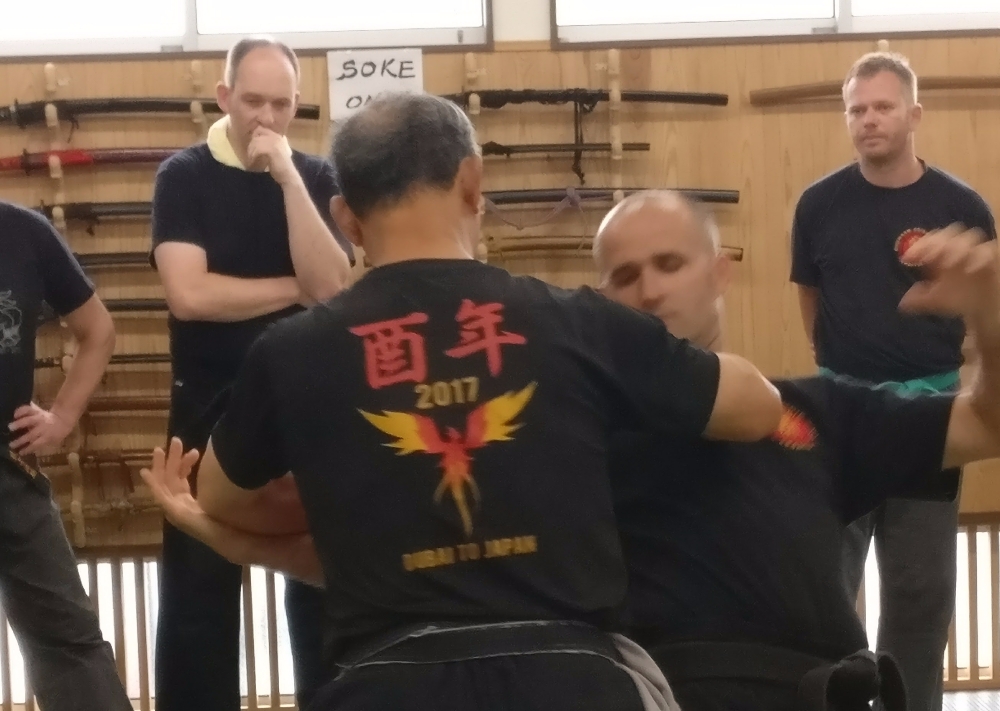
For the whole class, we did only two techniques using his deep understanding of body mechanics. Joseph, a French Nidan, and I were lost in the first tries.

Senō sensei like any other Japanese Dai Shihan has a touch of magic when it comes to body mechanics. And to replicate it takes multiple repetitions. Often I am unable to reproduce his Taijutsu, but when I do it, even partially, it benefits my whole training.

Today, I didn’t do it perfectly as it was so subtle and efficient. I was close, but not enough. Senō’s techniques always look easy until you try to do them. A few years ago, I asked him where did he get this precision. He told me that: “for three years, I tried every possible angle, for every joint lock.”

“What comes easy, won’t last, what lasts, won’t come easy”. Excellence is about repeated failure. Nothing is given. Everything is the result of hard work. And once you have it, it will last. Remember how difficult it was as a kid to learn how to swim, or ride your bike. Today when you swim or ride your bike, you know.
The harder it is to get, and the deeper it is ingrained.

Senō sensei insisted on three main points: proper distance, correct footwork, full body pivot. They are all linked to one another, but before connecting them together, you have to study each one thoroughly.

Proper distancing is the space between you and the many possible attacks by the opponent. It is not enough to copy the blocks, locks, kicks. You have to position your body correctly at each step. Training properly demands slow movements.

As always in the Bujinkan, a correct footwork is a capital element of the technique. When you study the footwork of the Japanese Dai Shihan, you will discover that each one of them has a personal way to position the body correctly. They move all differently, but they achieve the same result. If Noguchi sensei is more into Kosshi Jutsu, and Nagato sensei more into Koppō Jutsu, Senō sensei is into Taihen Jutsu.

The last point, and he insisted a lot on it, is to move the opponent by pivoting the body as a whole, through the hips and the feet, and not with your hands. Grabbing is a consequence of a correct body motion, not the opposite. Last April, I remember how he taught us how to take Uke’s balance by bending the body forward instead of putting strength in the hands.

Your hands become your worst enemy if you overuse them because you will lose the natural efficiency created by your knowledge of distance, and by the quality of your footwork. Use your body.

Today during class, as I was struggling with what seemed simple techniques, I remembered what Kary Mullis, Nobel prize of Chemistry said: “It is complex to make something simple.” (1)  I asked Senō sensei to do it a few times on my partner and me, and each time I was not able to do everything he did, even when I had the chance to experience it or to see it at close range. Senō sensei is like those close-up magicians. You can observe their movements; you never see what is happening.

“What comes easy, won’t last, what lasts, won’t come easy” is a good way to summarise the whole class. Even though I got technically close to what he did, I was not doing these techniques as well as he did. But I know for sure that my entire Taijutsu got upgraded today with the little things my body understood. What is strange is why so few people have the courage to attend his classes and face their limits. After all isn’t facing your limits, the essence of Mutō Dori? (2)

____________________________
(2) Today only 12 students join the class. I don’t understand.

Simplicity Is Complex

From Shiro Kuma by kumablog

IMG_20170429_124108_449

Someone said “What comes easy, won’t last, what lasts, won’t come easy”, this is a correct definition of the class we had today with Senō sensei.

For the whole class, we did only two techniques using his deep understanding of body mechanics. Joseph, a French Nidan, and I were lost in the first tries.

Senō sensei like any other Japanese Dai Shihan has a touch of magic when it comes to body mechanics. And to replicate it takes multiple repetitions. Often I am unable to reproduce his Taijutsu, but when I do it, even partially, it benefits my whole training.

Today, I didn’t do it perfectly as it was so subtle and efficient. I was close, but not enough. Senō’s techniques always look easy until you try to do them. A few years ago, I asked him where did he get this precision. He told me that: “for three years, I tried every possible angle, for every joint lock.”

“What comes easy, won’t last, what lasts, won’t come easy”. Excellence is about repeated failure. Nothing is given. Everything is the result of hard work. And once you have it, it will last. Remember how difficult it was as a kid to learn how to swim, or ride your bike. Today when you swim or ride your bike, you know.
The harder it is to get, and the deeper it is ingrained.

Senō sensei insisted on three main points: proper distance, correct footwork, full body pivot. They are all linked to one another, but before connecting them together, you have to study each one thoroughly.

Proper distancing is the space between you and the many possible attacks by the opponent. It is not enough to copy the blocks, locks, kicks. You have to position your body correctly at each step. Training properly demands slow movements.

As always in the Bujinkan, a correct footwork is a capital element of the technique. When you study the footwork of the Japanese Dai Shihan, you will discover that each one of them has a personal way to position the body correctly. They move all differently, but they achieve the same result. If Noguchi sensei is more into Kosshi Jutsu, and Nagato sensei more into Koppō Jutsu, Senō sensei is into Taihen Jutsu.

The last point, and he insisted a lot on it, is to move the opponent by pivoting the body as a whole, through the hips and the feet, and not with your hands. Grabbing is a consequence of a correct body motion, not the opposite. Last April, I remember how he taught us how to take Uke’s balance by bending the body forward instead of putting strength in the hands.

Your hands become your worst enemy if you overuse them because you will lose the natural efficiency created by your knowledge of distance, and by the quality of your footwork. Use your body.

Today during class, as I was struggling with what seemed simple techniques, I remembered what Kary Mullis, Nobel prize of Chemistry said: “It is complex to make something simple.” (1)  I asked Senō sensei to do it a few times on my partner and me, and each time I was not able to do everything he did, even when I had the chance to experience it or to see it at close range. Senō sensei is like those close-up magicians. You can observe their movements; you never see what is happening.

“What comes easy, won’t last, what lasts, won’t come easy” is a good way to summarise the whole class. Even though I got technically close to what he did, I was not doing these techniques as well as he did. But I know for sure that my entire Taijutsu got upgraded today with the little things my body understood. What is strange is why so few people have the courage to attend his classes and face their limits. After all isn’t facing your limits, the essence of Mutō Dori? (2)

____________________________
(2) Today only 12 students join the class. I don’t understand.

Control, Don’t Fight!

From Shiro Kuma by kumablog

IMG_20170429_124108_446“Mutō Dori is not about fighting; it is about controlling.”

That’s how Hatsumi sensei summarised the feeling he showed yesterday during training.

It was my first class with him since my last trip in April, and even though it looked the same, it became more subtle if possible. He demonstrated this with Taijutsu, Bō Jutsu, Biken Jutsu, and Tantō Jutsu.

“Onaji desu!” (1) “Whatever the weapon, it is always the same” he added.

Last year, this year, and next year we have been, we are, and we will be studying Mutō Dori. In Japanese past, present and future are called “Kako, Genzai, Mirai”. (2)

I interpret Kako, the past, as the limited vision of Mutō Dori which is simply to deal with an armed opponent while being unarmed.

Then Genzai, the present, teaches us to be brave, and have the courage to face the opponent even if it means death for us.

Finally, Mirai, the future, is what Sensei is doing these days, it is about controlling not fighting. Controlling is a threefold concept. As Sensei repeated it during class, we have to gain control of ourselves, control the opponent, and control the space in which we move. That is the essence of “Kannin Dokuson”, the theme of the year.

Controlling the centre of space is how Sensei introduced the theme of 2017 last December. When you can control the centre, you control the whole sphere of action. This control is possible if you do not try to do it. As he said: “do without doing; catch without catching.” When the student can achieve that, he is playing at the ultimate level of Mutō Dori.

That is the concept we train in class these days. Not fighting, but controlling.

_________________________________
(1) 同じです, Onaji desu: this is the same
(2) Kako, Genzai, Mirai: 過去, 現在, 未来


Control, Don’t Fight!

From Shiro Kuma by kumablog

IMG_20170429_124108_446“Mutō Dori is not about fighting; it is about controlling.”

That’s how Hatsumi sensei summarised the feeling he showed yesterday during training.

It was my first class with him since my last trip in April, and even though it looked the same, it became more subtle if possible. He demonstrated this with Taijutsu, Bō Jutsu, Biken Jutsu, and Tantō Jutsu.

“Onaji desu!” (1) “Whatever the weapon, it is always the same” he added.

Last year, this year, and next year we have been, we are, and we will be studying Mutō Dori. In Japanese past, present and future are called “Kako, Genzai, Mirai”. (2)

I interpret Kako, the past, as the limited vision of Mutō Dori which is simply to deal with an armed opponent while being unarmed.

Then Genzai, the present, teaches us to be brave, and have the courage to face the opponent even if it means death for us.

Finally, Mirai, the future, is what Sensei is doing these days, it is about controlling not fighting. Controlling is a threefold concept. As Sensei repeated it during class, we have to gain control of ourselves, control the opponent, and control the space in which we move. That is the essence of “Kannin Dokuson”, the theme of the year.

Controlling the centre of space is how Sensei introduced the theme of 2017 last December. When you can control the centre, you control the whole sphere of action. This control is possible if you do not try to do it. As he said: “do without doing; catch without catching.” When the student can achieve that, he is playing at the ultimate level of Mutō Dori.

That is the concept we train in class these days. Not fighting, but controlling.

_________________________________
(1) 同じです, Onaji desu: this is the same
(2) Kako, Genzai, Mirai: 過去, 現在, 未来


First blog post – Web Designer

From Blog – Bujinkan Kokusai Renkoumyo 武神館國際連光明道場 by Charles Onaje Lucas

Hello everyone:

I am the web designer for Sean Askew’s new Bujinkan Kokusai Renkoumyo 武神館國際連光明道場 website.  Thank you for your patience while we build the website and post the new content.


Let’s know in the comments. Please, if like what we are doing, click “Like,” “Fellow”, give us “Feedback” “comments,“ and get a notification about a new post.…

PARIS TAIKAI 2017

From Shiro Kuma by kumablog

IMG-20170629-WA0011

Last Week-end, the Yoroi Taikai was fantastic! Christophe and Laid did a wonderful job by creating this opportunity. But life doesn’t stop.

In two weeks we are happy to welcome you once again to the Paris Taikai 2017.

PARIS TAIKAI 14th 15th 16th JULY 2017

Peter King, Sveneric Bogsater and Arnaud Cousergue are sharing their insights on Kannin Dokuson.

Register today HERE


PARIS TAIKAI 2017

From Shiro Kuma by kumablog

IMG-20170629-WA0011

Last Week-end, the Yoroi Taikai was fantastic! Christophe and Laid did a wonderful job by creating this opportunity. But life doesn’t stop.

In two weeks we are happy to welcome you once again to the Paris Taikai 2017.

PARIS TAIKAI 14th 15th 16th JULY 2017

Peter King, Sveneric Bogsater and Arnaud Cousergue are sharing their insights on Kannin Dokuson.

Register today HERE