Skip to content

Control, Don’t Fight!

From Shiro Kuma by kumablog

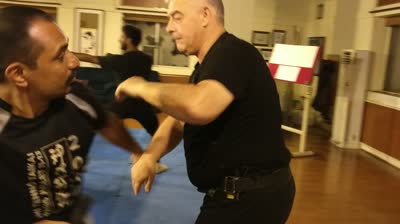
Control_hatsumi_arnaud_cousergue

During the flight from Japan to India, I was sorting my training notes, and I remembered this sentence by Sunzi: “the Supreme art of war is to subdue the enemy without fighting.”
It is quite similar to “Mutō Dori is not about fighting, it’s about controlling” that Hatsumi sensei kept repeating in each class.

The focus these days at the Honbu is not only about controlling the attacker (Jin), but also the environment in every possible way. Without proper control of the situation, you are limiting your options solely to the Jin Ryaku! If you can manage the space of the Ten Ryaku (weather) and the Chi Ryaku (terrain) together with the Jin, then the control is total.

I call that “Sanshin no Seigyo” (1): controlling the three aspects of the Tenchijin.

The Sanshin no Seigyo is not a technique, it is an attitude that goes beyond the Waza learned in the dōjō. As Sensei said, “everyone can do a Waza correctly, but controlling is more high level.”

It is linked to this year’s theme “Kannin Dokuson”. (2)
By controlling the Sanshin no Seigyo, you apply the three aspects of Kannin Dokuson based upon respect.
They are the respect for your attacker, for yourself, and mutual respect. Respect in Japanese is Tattobu (3), this is also the “Kan” in Kannin Dokuson.

But don’t get it wrong. Respect is not only to esteem, but it also means that you have to pay attention to your attacker’s intent; to show nothing about your intentions, and to develop a full awareness of your space and environment. The management of space includes the attacker, the defender, and the surroundings. Forget this simple complexity, and you lower your technical level to a mere Waza. And control is not about doing Waza!

On a sword attack by a Japanese Shihan, Sensei added that “you have to control the Kûkan in which the sword is moving in”. This space is not static; it is moving and unfolding in the moment. If you try to react to the cut, you end up dead. On the contrary, if you grab the space and control it, nothing will surprise you, and you will be able to react correctly before the blow hits you. Obviously, this requires a high level of expertise. I must admit that I find it hard to achieve. I’m working on it.

Sanshin no Seigyo seems to me to be the next step of my Budō evolution, maybe it should be yours, too, because controlling is stronger than fighting.
________________
1. 制禦/seigyo/control; governing; checking; suppression; repression; restraint; mastery; management
2, Kannin Dokuson: 貫忍 独尊: Kan 貫/ 貴ぶ/tattobu/to value; to prize; to esteem; to respect
Nin 忍/nin/endurance; forbearance; patience; self-restraint
Dokuson 独り/Hitori/one person|alone; unmarried; solitary and
Son 尊ぶ/tattobu/to value; to prize; to esteem; to respect
3, Tattobu 貴ぶ, to value; to prize; to esteem; to respect.


Flow Around Like Sensei Does

From Shiro Kuma by kumablog

“Mutō Dori is about controlling, not fighting!” said sensei, once again, at the beginning of the class.

But what does he mean? Here some beginning of an explanation.
Watching and listening carefully, I understood the following: Sensei uses his finger(s) as a contact point(s) with the attacker. The contact(s) act as a Shiten, fulcrum. (1)
Once the connection established, Hatsumi sensei only rotates around the fulcrum, and reposition his whole body in a dynamic flow, and in slow motion. Slow is the key.

Since we studied the proprioceptive abilities of the human brain, we know that “speed” is perceived more or less accurately if the shape (your body) is still in view.

Big shape vs. small speed = shape is what matters; small shape vs. big speed = speed is what is important to the brain. (2)

When Sensei touches Uke with one finger, this point of contact becomes the axis of rotation. But what I noticed in class, is that Sensei is not pivoting from this point, he’s turning the whole body around it. That is the difference between Mawashi and Mawari. In Mawashi you pivot from the axis; in Mawari you walk around the axis. Using the image of a merry-go-round, it rotates on the axis, but you on the horse are turning around. We studied that in 2003 with the Kunai.

When you attack sensei, you have the feeling that you’re going to hit him because it seems to you that he’s not moving at all. But the moment you think you hit him, he is not there, and you’re defeated. His movements are slow, but his timing, his distance, and the rhythm of his movements are perfect. He’s like a plane flying under the radar.

This perfection is achieved with what he called “Zentai”, full body movement. (4)

He’s not only walking away at the ideal moment, but he’s also moving his shoulders up and down in a wave-like motion. Noguchi sensei made me aware of this “kata Nami” movement, “look at the shoulders” he told me. And I saw it. Without his help in not sure I would have seen it. (5)

During the whole class, Sensei insisted that we have to use the subconscious mind instead of the
conscious mind to be able to flow naturally the way he does.

I understand, but I’m unable to do it. That is the next level.

Ganbate
_________________
1. Shiten: 支点, Fulcrum
2. Proprioception: Here’s a short reminder. The human brain processes the information following the importance of the “5S”: Shape, Speed, Sound, Spectrum (colour), Smell.
As long as your visibility is more important to the attacker’s brain and sight, that your slow movements, he will not “see” you moving. Technically you’re “invisible”. Conversely, if you speed up your movements, they will get more important for his brain, and he will counter your actions.
3. Mawari: 回り, rotation, around,
Mawashi: 回す, to turn; to rotate; to gyrate, to surround.
Please note that the kanji are identical. It is the conceptual scheme that differs here.
4. Zentai: 全体, whole; entirety; whatever (is the matter) / here: the whole body
5. Kata Nami:
波, wave + 肩, shoulder; To roll the shoulder up and down to open Uke
6.潜在意識, Senzaiishiki, subconscious (awareness)


Iwai_stream_arnaud_cousergue

Did Sensei Give The Theme For 2018?

From Shiro Kuma by kumablog

Hatsumi_Arnaud_cousergue_Bujinkan

Is Mutō Dori the first step to knighthood?

Is it possible to become a knight in the modern times (Jidai), or was it only possible in the past (Jidai)? (1)

Here is an occidental Knight’s oath that reminded me of the Mutō Dori theme:

Be without fear in the face of your enemies.

Stand brave and upright.

Speak the truth always, even if it means your death.

Protect the helpless and do no wrong.

When you read this oath from the past, you see similarities with what Hatsumi sensei is teaching at the Honbu dōjō. The Mutō Dori of 2017 is to move towards the opponent with no fear even if you might die. And this whether you have a weapon or not. Ethics and values will keep us brave and upright. But this requires physical courage and high values.

How many Bujinkan Shihan and practitioners understand that today?

Sunday after the calligraphy session, Sensei was speaking to us, saying that the next year’s theme would be “Ninkyō”. “There are many meanings for it” he added. In this post, I’d like to share with you some of them.

Ninkyō 任侠 means chivalry. Thence my interrogation about knighthood.

It also carries the ideas of generosity; heroism; chivalrous spirit; and helping the weak and fighting the strong. Aren’t those values what Sensei tried to achieve by developing the Bujinkan during these past forty years?

We all know that the Bujinkan has developed without any “master plan”, as Sensei only follows the path of nature, and adapts his vision permanently to the situation. In fact, Sensei, like the Ishitobashi of 2015 (2), bounces on the surface of life following the changes on the surface of the water. After the Fukushima catastrophe I phoned Sensei, and when I asked about how he felt, he answered: “Banpen Fugyō”, “10000 changes, no surprise”. Change is permanent, and as a Bujinkan member and a follower of Sōke, we have to go with the flow of things. The Bujinkan is not an organization; it is a gathering of people following his understanding of life.

Or it was supposed to be like that. Because these days, things are changing (decaying?) fast, and I am witnessing abroad, and also in Japan, a negative evolution in the Shihan’s behaviors and values. Respect and obedience are disappearing, and I’m concerned that some turbulent times are coming. I hope that Sōke’s dream will prevail, and maybe this is why the next theme might be Ninkyō, chivalry.

Chivalry, knighthood, regroup values that our society has discarded to a more profit-oriented life. If money and power are the only values the majority is seeking, then no wonder why our Budō is not developing in the proper direction. But don’t blame Sensei for that, blame yourself! We are the Bujinkan, and now is the time to stand up and to fight for re-establishing our values.

Ethics and morality might be outdated, but they are the real foundations of the Bujinkan Budō. I’m not referring here to the modern vision of Budō exposed in the Hagakure or the Bushidō, even if some aspects of these books can still be of value today for the serious practitioner. (3)(4)

With Ninkyō, Hatsumi sensei’s Budō is turning us into new knights, and this is our duty to make ours, the values of the old Jidai (時代) to bring them into the Jidai (次代) of the future because the future is now. If we do not act rapidly, all that Toda Sensei, Takamatsu Sensei, and Hatsumi Sensei have created might vanish like a “puff of smoke”.

Toda Sensei showed the correct path:

To know that patience comes first. Know that endurance is simply a puff of smoke.

To know that the path of man comes from justice. Know that the way of men is justice.

To renounce avarice, indolence, and obstinacy. Forget the heart of greed, ease and relying on others.

To recognise sadness and worry as natural, and to seek the immovable heart. One should regard both sadness and malice as natural laws, and just gain the enlightenment of an unshakable heart.

To not stray from the path of loyalty and brotherly love, and to delve always deeper into the heart of Budō.

In your heart, never leave the ways of loyalty and filial piety, and aspire greatly for the ways of the pen and the sword.

Written on New Year’s Day in 1891 Toda Shinryuken Masamitsu

If we don’t take action rapidly to correct our attitudes, follow the guidelines set up by Toda Sensei, and the ethics and values of chivalry, then the Bujinkan will turn into anarchy and tyranny, and prove Plato right. (5)

Ninkyō (任侠), “chivalry” is also our Ninkyō (任今日), our “duty for now” (6); if we do not want to become Ninkyō (仁虚), “evil humans!” (7)

___________________________

1. 時代 vs. 次代, Jidai vs. Jidai: If the first Jidai, 時代 means: 1. period; epoch; era; age ; 2. the times; those days ; 3. oldness; ancientness; antiquity; it is interesting to know that Jidai, 次代, means “the next era ”

2. Ishitobashi: 石飛ばし, skipping stones (on a body of water)

3. Hagakure and Bushidō: The Hagakure by Yamamoto Tsunetomo was written by a clerk (?) during peace time in the 18th century, fifty years before Meiji. The author had no clue of the Sengoku Jidai period. https://en.wikipedia.org/wiki/Hagakure

4. The Bushidō by Nitobe Inazō was written even later in 1899 and published in the 2oth century! https://en.wikipedia.org/wiki/Bushido

5. The Plato Republic, book VIII: http://www.mc.maricopa.edu/~davpy35701/text/plato-democ2.pdf

6. Ninkyō (任今日), obligation; duty; charge; responsibility + today

7. Ninkyō (仁虚), human + falsehood


Did Sensei Gave The Theme For 2018?

From Shiro Kuma by kumablog

Hatsumi_Arnaud_cousergue_Bujinkan
Is Mutō Dori the first step to knighthood?
Is it possible to become a knight in the modern times (Jidai), or was it only possible in the past (Jidai)? (1)
Here is an occidental Knight’s oath that reminded me of the Mutō Dori theme:
Be without fear in the face of your enemies.
Stand brave and upright.
Speak the truth always, even if it means your death.
Protect the helpless and do no wrong.
When you read this oath from the past, you see similarities with what Hatsumi sensei is teaching at the Honbu dōjō. The Mutō Dori of 2017 is to move towards the opponent with no fear even if you might die. And this whether you have a weapon or not. Ethics and values will keep us brave and upright. But this requires physical courage and high values.
How many Bujinkan Shihan and practitioners understand that today?
Sunday after the calligraphy session, Sensei was speaking to us, saying that the next year’s theme would be “Ninkyō”. “There are many meanings for it” he added. In this post, I’d like to share with you some of them.
Ninkyō 任侠 means chivalry. Thence my interrogation about knighthood.
It also carries the ideas of generosity; heroism; chivalrous spirit; and helping the weak and fighting the strong. Aren’t those values what Sensei tried to achieve by developing the Bujinkan during these past forty years?
We all know that the Bujinkan has developed without any “master plan”, as Sensei only follows the path of nature, and adapts his vision permanently to the situation. In fact, Sensei, like the Ishitobashi of 2015 (2), bounces on the surface of life following the changes on the surface of the water. After the Fukushima catastrophe I phoned Sensei, and when I asked about how he felt, he answered: “Banpen Fugyō”, “10000 changes, no surprise”. Change is permanent, and as a Bujinkan member and a follower of Sōke, we have to go with the flow of things. The Bujinkan is not an organization; it is a gathering of people following his understanding of life.
Or it was supposed to be like that. Because these days, things are changing (decaying?) fast, and I am witnessing abroad, and also in Japan, a negative evolution in the Shihan’s behaviors and values. Respect and obedience are disappearing, and I’m concerned that some turbulent times are coming. I hope that Sōke’s dream will prevail, and maybe this is why the next theme might be Ninkyō, chivalry.
Chivalry, knighthood, regroup values that our society has discarded to a more profit-oriented life. If money and power are the only values the majority is seeking, then no wonder why our Budō is not developing in the proper direction. But don’t blame Sensei for that, blame yourself! We are the Bujinkan, and now is the time to stand up and to fight for re-establishing our values.
Ethics and morality might be outdated, but they are the real foundations of the Bujinkan Budō. I’m not referring here to the modern vision of Budō exposed in the Hagakure or the Bushidō, even if some aspects of these books can still be of value today for the serious practitioner. (3)(4)
With Ninkyō, Hatsumi sensei’s Budō is turning us into new knights, and this is our duty to make ours, the values of the old Jidai (時代) to bring them into the Jidai (次代) of the future because the future is now. If we do not act rapidly, all that Toda Sensei, Takamatsu Sensei, and Hatsumi Sensei have created might vanish like a “puff of smoke”.
Toda Sensei showed the correct path:
To know that patience comes first. Know that endurance is simply a puff of smoke.
To know that the path of man comes from justice. Know that the way of men is justice.
To renounce avarice, indolence, and obstinacy. Forget the heart of greed, ease and relying on others.
To recognise sadness and worry as natural, and to seek the immovable heart. One should regard both sadness and malice as natural laws, and just gain the enlightenment of an unshakable heart.
To not stray from the path of loyalty and brotherly love, and to delve always deeper into the heart of Budō.
In your heart, never leave the ways of loyalty and filial piety, and aspire greatly for the ways of the pen and the sword.
Written on New Year’s Day in 1891 Toda Shinryuken Masamitsu
If we don’t take action rapidly to correct our attitudes, follow the guidelines set up by Toda Sensei, and the ethics and values of chivalry, then the Bujinkan will turn into anarchy and tyranny, and prove Plato right. (5)
Ninkyō (任侠), “chivalry” is also our Ninkyō (任今日), our “duty for now” (6); if we do not want to become Ninkyō (仁虚), “evil humans!” (7)
___________________________
1. 時代 vs. 次代, Jidai vs. Jidai: If the first Jidai, 時代 means: 1. period; epoch; era; age ; 2. the times; those days ; 3. oldness; ancientness; antiquity; it is interesting to know that Jidai, 次代, means “the next era “
2. Ishitobashi: 石飛ばし, skipping stones (on a body of water)
3. Hagakure and Bushidō: The Hagakure by Yamamoto Tsunetomo was written by a clerk (?) during peace time in the 18th century, fifty years before Meiji. The author had no clue of the Sengoku Jidai period. https://en.wikipedia.org/wiki/Hagakure
4. The Bushidō by Nitobe Inazō was written even later in 1899 and published in the 2oth century! https://en.wikipedia.org/wiki/Bushido
6. Ninkyō (任今日), obligation; duty; charge; responsibility + today
7. Ninkyō (仁虚), human + falsehood

Nagato Sensei: Henka Your Basics!

From Shiro Kuma by kumablog

Nagato_Sensei_O_Soto_Gake
Nagato sensei was in a good mood today. And even if we finished the class fifteen minutes earlier than usual -he had an appointment- his class was dynamic and full of insights.
“When you make natural Henka on basics, it turns into an art form,” said Nagato sensei on the first set of movements he did today. And in fact, the natural flow of his movements during the whole class was simple and efficient.
Each technique he would do was repeated in many forms. “don’t do the same technique twice, change them permanently. As you know, the word “Henka” in Japanese means “change” (1), and he did change the original forms a lot. “It is like the Kihon Happō in the Gyokko Ryū, each one of them has “8” variations, and each variation has another “8” changes, and so forth”.
What I understood is that if you stop at the basic form, you will never be able to adapt to the many attacks launched by your opponent. For example, we did many variations around Harai Goshi. One particularly interested me, I will call it Uchi Mata Oshi. (2) In this Henka of Uchi Mata you stay away of Uke, you push him to his outside, and, using crossed legs, you throw him with the inner leg.
We also did many variations on Ō Soto Gake turning around the attacking fist and applying different foot movements such as Ko Soto Gake, Ko Uchi Gake. We also passed in front of Uke, and used the technique on the opposite arm, using a natural Te Hodoki turning into a “super Hon Gyaku” as he put it.
That was interesting to see the variety of Nagato sensei’s Henka. Each time he would do like Senō and flood us with three or four different movements. “Don’t copy what I’m doing, grab the feeling.”
On Uchi Mata, please remember that it is called Uchi Mata / Uchi Gake. Strangely Uchi Gake is rarely taught, and that is a shame. It can be Ko Uchi Gake (on the inner leg) or Ō Uchi Gake (on the outer leg). The same also goes with Ō Soto Gake that can turn into Ko Soto Gake. The Kaname (3) is how you manage the distance and the body angle between Uke and you.
We then applied all these Taijutsu moves (Uchi Mata, Ō Soto Gake, and their many Henka) with the Hanbō. Uke would attack with the hand, or grab a wrist with one hand and attack simultaneously with a Tsuki, grab both wrists, or the stick. Nagato sensei insisted on the core aspect of all these techniques. Each time he would end his technique saying with the now familiar “Kantan Desu!” (4) and smile at our inability to reproduce his free flowing movements.
Another great class by a Japanese Dai Shihan.
________________
1. Henka: 変化, change; variation; alteration; mutation; transition; transformation; transfiguration; metamorphosis . Interestingly, the Kanji 変 means to change (at the beginning), and the Kanji 化, to metamorphose (the end of change)
2. Oshi: 押し, push; pressure
3. Kaname: 要, vital point, keystone, key point
4. Kantan: 簡単, simple; easy; uncomplicated

Nagato Sensei: Henka Your Basics!

From Shiro Kuma by kumablog

Nagato_Sensei_O_Soto_Gake
Nagato sensei was in a good mood today. And even if we finished the class fifteen minutes earlier than usual -he had an appointment- his class was dynamic and full of insights.
“When you make natural Henka on basics, it turns into an art form,” said Nagato sensei on the first set of movements he did today. And in fact, the natural flow of his movements during the whole class was simple and efficient.
Each technique he would do was repeated in many forms. “don’t do the same technique twice, change them permanently. As you know, the word “Henka” in Japanese means “change” (1), and he did change the original forms a lot. “It is like the Kihon Happō in the Gyokko Ryū, each one of them has “8” variations, and each variation has another “8” changes, and so forth”.
What I understood is that if you stop at the basic form, you will never be able to adapt to the many attacks launched by your opponent. For example, we did many variations around Harai Goshi. One particularly interested me, I will call it Uchi Mata Oshi. (2) In this Henka of Uchi Mata you stay away of Uke, you push him to his outside, and, using crossed legs, you throw him with the inner leg.
We also did many variations on Ō Soto Gake turning around the attacking fist and applying different foot movements such as Ko Soto Gake, Ko Uchi Gake. We also passed in front of Uke, and used the technique on the opposite arm, using a natural Te Hodoki turning into a “super Hon Gyaku” as he put it.
That was interesting to see the variety of Nagato sensei’s Henka. Each time he would do like Senō and flood us with three or four different movements. “Don’t copy what I’m doing, grab the feeling.”
On Uchi Mata, please remember that it is called Uchi Mata / Uchi Gake. Strangely Uchi Gake is rarely taught, and that is a shame. It can be Ko Uchi Gake (on the inner leg) or Ō Uchi Gake (on the outer leg). The same also goes with Ō Soto Gake that can turn into Ko Soto Gake. The Kaname (3) is how you manage the distance and the body angle between Uke and you.
We then applied all these Taijutsu moves (Uchi Mata, Ō Soto Gake, and their many Henka) with the Hanbō. Uke would attack with the hand, or grab a wrist with one hand and attack simultaneously with a Tsuki, grab both wrists, or the stick. Nagato sensei insisted on the core aspect of all these techniques. Each time he would end his technique saying with the now familiar “Kantan Desu!” (4) and smile at our inability to reproduce his free flowing movements.
Another great class by a Japanese Dai Shihan.
________________
1. Henka: 変化, change; variation; alteration; mutation; transition; transformation; transfiguration; metamorphosis . Interestingly, the Kanji 変 means to change (at the beginning), and the Kanji 化, to metamorphose (the end of change)
2. Oshi: 押し, push; pressure
3. Kaname: 要, vital point, keystone, key point
4. Kantan: 簡単, simple; easy; uncomplicated

Noguchi Sensei: Happiness, Basics And Creativity

From Shiro Kuma by kumablog


Buddha said that “thousands of candles can be lighted from a single candle, and the life of the candle will not be shortened. Happiness never decreases by being shared.”

This sentence is resuming my feeling entirely during Noguchi sensei’s class, on Sunday morning. Anyone who trained in Japan knows how “foggy” you feel during this first class beginning the training day. In the old days, this class used to happening after Sensei’s class. But less and fewer people would come, so they changed the order. We now have to wake up earlier.

To me, Noguchi sensei is a candle of happiness, even though his life has been tough at some point. (1) These events could have destroyed his happiness. It didn’t happen. The Bujinkan is about being happy and to keeping going whatever hardship one meets in his or her lifetime.

Sunday, I was glad to meet my teacher again after my last Japan trip in April. (2) But to be honest, I was a little sleepy after a short jet lag night. This tiredness vanished after the first movements, as his permanent happiness spread all over the dōjō, and motivate everyone. The light of happiness spreads in all directions, and everyone is in the light.

I love Noguchi sensei’s creativity and the way he reinterprets the well-known Waza and basics of the Bujinkan. This ability to do something new with old known techniques is amazing. It has nurtured my whole Budō approach for nearly a quarter century now. I owe him a lot for the level I have today.

Sunday we rediscovered some basic techniques of the Tenchijin. (3)

We began the class with the Tonsō no Kata (4), the escaping techniques of the Tōgakure Ryû. Those nine Waza are the essence of the school and are much more than one thinks at first glance.

There are 3 sets of 3 simple techniques. The first three Waza, deal with taijutsu; the second set of three, with Mutō Dori, the last three with strategy when facing multiple opponents.

“When dealing with multiple opponents, always attack the weakest one first”, said Noguchi sensei.

If some of the techniques use Metsubishi and Shuriken, to me, this is not the important lesson. I see the Tonsō no Kata more like the Juppō Sesshō of the Tōgakure Ryû.

We continued with the Suwari Waza from the Jin Ryaku no Maki, but we did them standing up. That is where his creativity became visible. Playing with the concept of Juppō Sesshō, we did those techniques in an entirely new way, changing the angle of the grip in the ten directions. It was refreshing and reinforced our feeling of happiness.

Then we moved to the Nage Kaeshi part, reviewing Okyō, Zu Dori, Fûkan. The Okyō was entirely different from the basic form I knew. Instead of the simultaneous double hits (chest and lower back), Noguchi sensei, rotated the upper torso to the left at the start of the throw, destroying Uke’s Nage Waza, and turning it into a soft but efficient Ô Soto Gake. That was effortless and beautiful.

We finished with some creative Hanbō Jutsu starting from Kata Yaburi no Kamae (5)(6) and Otonashi no Kamae. (7)

Once again, I want to emphasize that, when you come to Japan, you have to know your basics before leaving your country as you will not train the fundamentals here, only their evolution.

If you know your basics, learning their new interpretations is easy. But if you don’t, you cannot understand the Waza and will have a wicked sense of knowledge mixing the primary forms with the advanced Henka.

For the light of the candle of happiness to shine, you first need to get a candle. Learning the Tenchijin and the schools is how you get your candle ready for the light.

__________________________________

  1. Noguchi sensei was born the same day as the Hiroshima bomb destroyed the city, his elder brother was killed during the war, and his beloved son died a few years ago at age 36.
  2. For some reason, 24 years ago, in July 1993, Hatsumi sensei asked me to train exclusively with him and Noguchi sensei. Noguchi sensei became my teacher.
  3. A new reprint of the original Tenchijin has been released in Spanish (the English version should be released very soon), check the Shinden Ediciones by my friend Fernando Aixa, Jûgodan. Without a doubt, the best-published version so far. A must-have for any serious practitioner.
  4. 遁走/tonsō/fleeing; escape
  5. Kata Yaburi no Kamae is often called Hiraichimonji no Kamae in basic programs.
  6. 型破り/katayaburi/unusual; unconventional; mold-breaking
  7. 音無しの構え/otonashinokamae/lying low; saying nothing and waiting for an opportunity

Noguchi Sensei: Happiness, Basics And Creativity

From Shiro Kuma by kumablog


Buddha said that “thousands of candles can be lighted from a single candle, and the life of the candle will not be shortened. Happiness never decreases by being shared.”

This sentence is resuming perfectly my feeling during Noguchi sensei’s class, on Sunday morning. Anyone who trained in Japan, knows how “foggy” you feel during this first morning class beginning the training day. In the old days, this class used to be given after Sensei’s class. But less and less people would come, so they changed the order. We now have to wake up earlier. 

To me, Noguchi sensei is a candle of happiness, even though his life has been tough at some point. (1) These events could have destroyed his happiness. It didn’t happen. The Bujinkan is about being happy and to keep going whatever hardship one meets in his or her lifetime.

Sunday, I was glad to meet my teacher again after my last Japan trip in April. (2) But to be honest, I was a little sleepy after a short jetlag night. This tiredness vanished after the first movements, as his permanent happiness spread all over the dōjō, and motivate everyone. The light of happiness spread in all directions, and everyone is lit by it. 

I love Noguchi sensei’s creativity, and the way he re-interprets the well-known Waza and basics of the Bujinkan. This ability to do something new with old known techniques is amazing. It has nurtured my whole Budō approach for nearly a quarter century now. I owe him a lot for the level I have today. 

Sunday we rediscovered some basic techniques of the Tenchijin. (3)

We began the class with the Tonsō no Kata (4), the escaping techniques of the Tōgakure Ryû. Those 9 techniques are the essence of the school and are much more than one thinks at first glance.

They are divided into 3 sets of 3 simple techniques. The first three Waza, deal with taijutsu; the second set of three, with Mutō Dori, the last three with strategy when facing multiple opponents.

“When dealing with multiple opponents, always attack the weakest one first”, said Noguchi sensei. 

If some of the techniques use Metsubishi and Shuriken, to me, this is not the important lesson. I see the Tonsō no Kata more like the Juppō Sesshō of the Tōgakure Ryû. 

We continued with the Suwari Waza from the Jin Ryaku no Maki, but we did them standing up. This is where his creativity became visible. Playing with the concept of Juppō Sesshō, we did those techniques in a totally new way, changing the angle of the grip in the ten directions. It was refreshing and reinforced our feeling of happiness.

Then we moved to the Nage Kaeshi part, reviewing Okyō, Zu Dori, Fûkan. The Okyō was quite different from the basic form I knew. Instead of the double simultaneous hits (chest and lower back), Noguchi sensei, rotated the upper torso to the left at the start of the throw, destroying Uke’s Nage Waza, and turning it into a soft but efficient Ô Soto Gake. That was effortless and beautiful.

We finished with some creative Hanbō Jutsu starting from Kata Yaburi no Kamae (5)(6) and Otonashi no Kamae. (7)

Once again, I want to emphasize that, when you come to Japan, you have to know your basics before leaving your country as you will not train the fundamentals here, only their evolution.

If you know your basics, learning their new interpretations is easy. But if you don’t, you cannot understand the Waza and will have a wrong sense of knowledge mixing the basic forms with the advanced Henka. 

For the light of the candle of happiness to shine, you first need to get a candle. Learning the Tenchijin and the schools is how you get your candle ready for the light. 

__________________

  1. Noguchi sensei’s was born the same day as the Hiroshima bomb destroyed the city, his elder brother was killed during the war; and his beloved son died a few years ago at age 36.
  2. For some reason, 24 years ago, in July 1993, Hatsumi sensei asked me to train exclusively with him and Noguchi sensei. Noguchi sensei became my teacher.
  3. A new reprint of the original Tenchijin has been released in Spanish (the English version should be  released very soon), check the Shinden Ediciones by my friend Fernando Aixa, Jûgodan. Without a doubt, the best published version so far. A must-have for any serious practitioner. 
  4. 遁走/tonsō/fleeing; escape
  5. Kata Yaburi no Kamae is often called Hiraichimonji no Kamae in basic programs. 
  6. 型破り/katayaburi/unusual; unconventional; mold-breaking
  7. 音無しの構え/otonashinokamae/lying low; saying nothing and waiting for an opportunity

Wu Wei: Action Without Action

From Shiro Kuma by kumablog

IMG-20170723-WA0016
There was a time when you came to the Honbu dōjō for techniques.
Then there was a time where you came for some profound philosophical concepts.
The time now is about the rest: non-action. Wu Wei. (1)
Today Hatsumi sensei added a “click” in his no-action movement. “Mutō Dori is Zero” was his introduction to the class.
As often on Sundays, the Dōjō was full of people from all over the world visiting Japan in the hope of understanding better the intricacies of our art. But there was nothing to understand. Sensei was unfolding the same things he has been doing for quite some time through Taijutsu, Katana, and Tantō. But today his actions were impossible to understand.
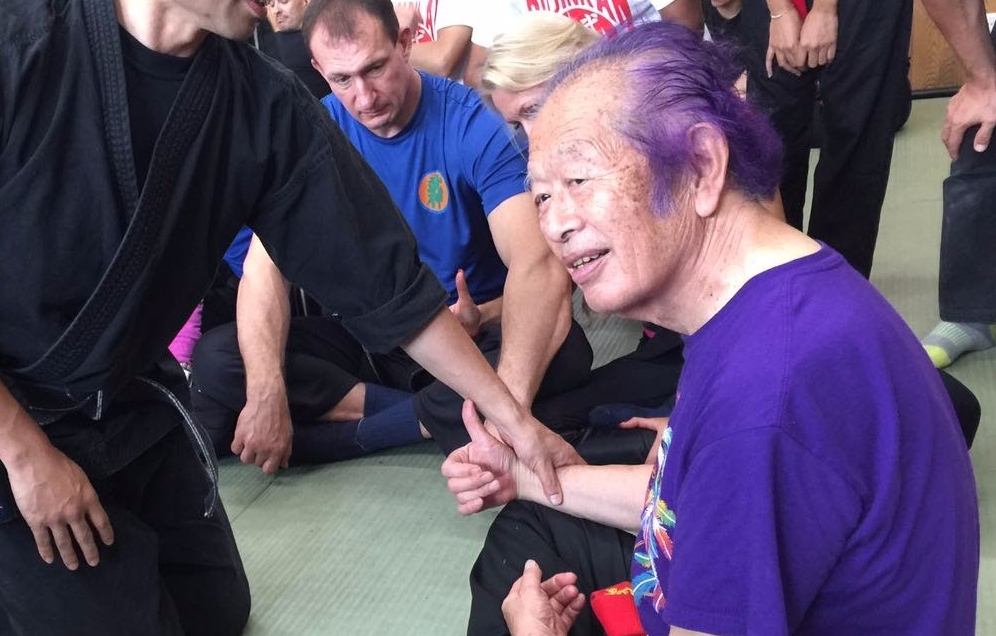
Sensei can control the space, and the opponent using only one finger at a time. There was no Waza (he repeated it a few times), there was no philosophical concept, there was nothing. It reminded me of this Wu Wei the “action without action”. Even when I had the chance to be his Uke, I couldn’t get it. It was as if Sensei was not there with me, but I was incapable of doing anything. Putting his fingers, one at a time he would control all my movements as if playing music on a keyboard. On a sword attack, he would only grab the blade from above and use his fingers to lock the blade in place as if taken by a pair of pliers.
During the break, seated on the ground next to him he would continue to show us the simplicity of it. Pedro was asked to Tsuki him and would lose his balance on the spot. The same happened to me, and to a few Japanese high ranks around him. Each time he would read Uke’s balance and destroy it effortlessly. Watching it, was something, feeling it yourself, or better said, not feeling anything was amazing. Today I began to see the vast path opened to us, and the power of non-action. Touching the attacker with only one fingertip, Sensei was able to use the power of Kūkan. (2)
Earlier, he had reminded us of the Ishitobashi (3), the skipping stones, and of the importance of using those “air pockets” created by the bouncing of the stone on the surface of the water. His Budō has never been so simple, and at the same time so difficult to reproduce. Because that was beyond feeling, sensation, or intent. One moment you attack, the next, you are defeated with no reason.
When you are Uke, you usually have a better chance to grasp the feeling, not anymore. Let me insist here. Even when you are Uke, you do not see; do not feel, do not understand what is happening. There is no pain; there is no speed, there is no technique. It is pure nothingness.
I call it Wu Wei (Chinese, literally “non-doing”) for that reason. Wuwei is an important concept of Taoism and means natural action, or in other words, an action that does not involve struggle or excessive effort. It is the cultivation of a mental state in which our actions are quite effortlessly in alignment with the flow of life.
“No excessive effort” summarises quite well what Sensei did to us today. Sensei was hardly moving, and whatever attack he was facing his control was the same. He said it like that: “at this level of Mutō Dori everything is the same, this is Zero!”.
I wish more Bujinkan would join the training in Japan because if they don’t, I don’t see how they can evolve and complete the Shingitai. (4)
Mastering the Gi and controlling your Tai is good, but moving at the Shin level requires another type of training that you can only get here in Japan.
_____________________
2. Kūkan: 空間, Space, airspace
3. Ishitobashi: 石飛ばし, skipping stones (on a body of water); skimming stones​
4. Shingitai: 心技体, originally a concept originating from Sumo: spirit, technique, physique

Wu Wei: Action Without Action

From Shiro Kuma by kumablog

IMG-20170723-WA0016
There was a time when you came to the Honbu dōjō for techniques.
Then there was a time where you came for some profound philosophical concepts.
The time now is about the rest: non-action. Wu Wei. (1)
Today Hatsumi sensei added a “click” in his no-action movement. “Mutō Dori is Zero” was his introduction to the class.
As often on Sundays, the Dōjō was full of people from all over the world visiting Japan in the hope of understanding better the intricacies of our art. But there was nothing to understand. Sensei was unfolding the same things he has been doing for quite some time through Taijutsu, Katana, and Tantō. But today his actions were impossible to understand.
Sensei can control the space, and the opponent using only one finger at a time. There was no Waza (he repeated it a few times), there was no philosophical concept, there was nothing. It reminded me of this Wu Wei the “action without action”. Even when I had the chance to be his Uke, I couldn’t get it. It was as if Sensei was not there with me, but I was incapable of doing anything. Putting his fingers, one at a time he would control all my movements as if playing music on a keyboard. On a sword attack, he would only grab the blade from above and use his fingers to lock the blade in place as if taken by a pair of pliers.
During the break, seated on the ground next to him he would continue to show us the simplicity of it. Pedro was asked to Tsuki him and would lose his balance on the spot. The same happened to me, and to a few Japanese high ranks around him. Each time he would read Uke’s balance and destroy it effortlessly. Watching it, was something, feeling it yourself, or better said, not feeling anything was amazing. Today I began to see the vast path opened to us, and the power of non-action. Touching the attacker with only one fingertip, Sensei was able to use the power of Kūkan. (2)
Earlier, he had reminded us of the Ishitobashi (3), the skipping stones, and of the importance of using those “air pockets” created by the bouncing of the stone on the surface of the water. His Budō has never been so simple, and at the same time so difficult to reproduce. Because that was beyond feeling, sensation, or intent. One moment you attack, the next, you are defeated with no reason.
When you are Uke, you usually have a better chance to grasp the feeling, not anymore. Let me insist here. Even when you are Uke, you do not see; do not feel, do not understand what is happening. There is no pain; there is no speed, there is no technique. It is pure nothingness.
I call it Wu Wei (Chinese, literally “non-doing”) for that reason. Wuwei is an important concept of Taoism and means natural action, or in other words, an action that does not involve struggle or excessive effort. It is the cultivation of a mental state in which our actions are quite effortlessly in alignment with the flow of life.
“No excessive effort” summarises quite well what Sensei did to us today. Sensei was hardly moving, and whatever attack he was facing his control was the same. He said it like that: “at this level of Mutō Dori everything is the same, this is Zero!”.
I wish more Bujinkan would join the training in Japan because if they don’t, I don’t see how they can evolve and complete the Shingitai. (4)
Mastering the Gi and controlling your Tai is good, but moving at the Shin level requires another type of training that you can only get here in Japan.
_____________________
2. Kūkan: 空間, Space, airspace
3. Ishitobashi: 石飛ばし, skipping stones (on a body of water); skimming stones​
4. Shingitai: 心技体, originally a concept originating from Sumo: spirit, technique, physique