Skip to content

9 Juli – Kihon Happo kurs med Shihan Ilan Gattegno (Israel)

Ilan Gategno, Shihan 15 Dan (Israel)

Ilan Gattegno, Shihan 15 Dan kommer från Israel och har tränat Bujinkan Budo-taijutsu i 37 år sedan 1974 då han blev medlem i Bujinkan Dojo. Han kommer till Kaigozan Dojo och håller en endagskurs med temat Kihon Happo. Mer information om Ilan kan ni läsa här.

Kozushi, Moguri, Nagare

Detta är en kurs som Ilan gjort sju gånger i USA, England och Israel där det varit mycket uppskattat av lägerdeltagarna. Denna kurs utlovar att öppna upp deltagarnas ögon och att man  kommer att lära sig hur man rör sig effektivt i varje moment i grundteknikerna.

Lägerpris

Priset för denna kurs är endast 350 kr och betalas på plats.

Anmälan

Plats

Lägret hålls i Kaigozan Dojo i Sundbyberg, Albygatan 117. Om vädret är okej så är det möjligt att träningen är utomhus på andra sidan gatan mot vattnet (där vi brukar vara).

Lägret är Lördag den 9:e Juli och startar kl 11:00 och slutar ungefär kl 17:00, kom i tid och betala lägeravgiften kontant (helst jämna pengar!). Vi öppnar upp ca 30 minuter innan. Ta gärna med lunch, det blir inte alltför lång lunch paus.

 …

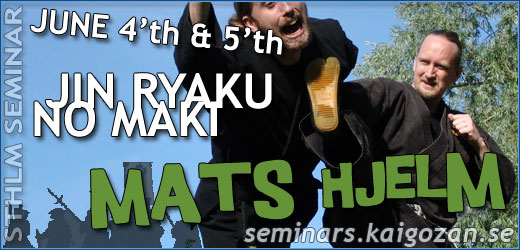
JIN Ryaku no maki seminariet, 4-5 Juni 2011

Lucas Koki tecknik

Lucas hoppar högt och dubbelsparkar i brösthöjd, i tekniken Koki

Vi hade tur med vädret, vi tränade utomhus i skuggan under den stora björken. Det blåste lagom mycket och svalkade oss.

Det kom deltagare från Riga, Eskilstuna, Norrköping, Skövde, Västerås, Stockholm och Lucas från Kaigozan Dojo.

Speciellt tack till Daniel från Norrköping som ställde upp som uke.

Lägret filmades och kommer upp på BUDOSHOP.SE om någon vecka eller så.

Vi ses på nästa läger!?

/Mats…

偸眼 Chugan: Eyes Like a Dragonfly Thief

From Bujinkan Santa Monica by Bujinkan Santa Monica

photo by TANAKA Juuyoh (田中十洋)
When I was a young man, one of my favorite movies was "The Karate Kid." The Sensei in that movie, Mr. Miyagi, played by Pat Morita, was full of patient but stern advice for his young student, Daniel-san. In one memorable quote, he chastised Daniel for looking down,
"Look eye!, always look eye!"
Very good advice for self defense. But there is a lot more to be understood about the eyes in our training. And, despite my fondness for that simple time in my life when a movie meant so much to me, I will break from Miyagi Sensei to suggest you don't always look eye.

There is a lot of psychology in a glance. A lot of nonverbal communication that takes place before a fight. Looking someone in the eye can be perceived as aggressive and create tension or make you a target for their anger. At the same time, the right type of look can cause the opponent to back down.

Takamatsu said that truly skilled martial artists can decide a fight by looking at each other. The better fighter knows he is better and graciously gives his adversary an opportunity to back down. If the weaker has any skill at all, he will perceive his opponent's superiority and concede to him.

A proverb says that the eyes are the window to the soul. This creates weaknesses and opportunities. If, you give away too much in your own eyes, your opponent can see your bluff, or know what your next move will be. Or, if you look in his eyes and see fear. You could easily reflect or manifest that same fear in yourself.

On the other hand we have the idea of Seigan, ‘Correct eye’ 正眼 with the feeling that you can manipulate your enemy and control his mind. As Soke says,
"to cloud the mind can be another important way of blinding the eyes. I would like you to know that it is the core of the metsubushi techniques to make the eye stop working."
This brings us to a more advanced use of the eyes for mind control. Ganko Issen is a sudden flash or glint of light of the whites of the eyes which can create the effects of Fudo Kanashibari and is also a basis for Toate no jutsu (striking from a distance).
"I have no eyes -- I make the flash of lightning my eyes." - unknown samurai c.1300
Hatsumi Sensei says that it is possible to "see" without using the eyes, and to "hear" without the ears. He says that, "In Ninpo your whole body must act as your eyes and ears."

This brings us to the concept of 偸眼  Chugan - looking askance; pretending not to look, or stealing a look. Maybe another word for it is tōshi 盗視 or 偸視 a stealthy glance;  furtive glance. I see Hatsumi Sensei do this all the time. In fact he often advises us to do this.
偸眼にして蜻蜒伯労を避く。
With a pilfered glance, the dragonfly evades the shrike.
This idea has many layers. One is that by not looking directly at your opponent you can make your focus broader to take in the whole environment. People and animals often do this naturally when surrounded. Looking nowhere but everywhere. This can be called Happo Nirami (staring in all directions). One benefit here is that your opponent's actions will be caught in your peripheral vision which responds very well to sudden, quick movement.

Another layer is that you can confuse your opponent by shifting his mind along with your line of sight. This can be simple misdirection like looking at one target on his body with your eyes but attacking another. As in 二目遣い Futatsumetsukai from Noh theatre which is a double glance where you look first but your mind does not stop there; or you look at your opponent when you appear not to be looking.

But it is also something more profound. When he attacks, especially if done with anger, he is looking to confront another soul directly. By shifting your awareness, it is like you are sidestepping his intent (like shifting your spirit back at 45 degrees) and his attacks will dissipate when they encounter nothing.

Hatsumi Sensei is constantly saying things that allude to this concept. Like "dissipate" the attacks, or you just "disappear" in the face of the attacks. Become zero.

Thank you Miyagi Sensei. I was sad when actor Pat Morita died in 2005, but his lesson is immortalized on film. And I'm sure he would agree, acting is all about the eyes.


Duncan Stewart, Shihan (Japan)

From Sweden Taikai 2011 by Sweden Taikai 2011

Duncan Stewart in Stockholm 2010

Shihan Duncan Stewart, 15th Dan, is a senior student of Bujinkan Grandmaster Masaaki Hatsumi. He started training in 1988, and moved to Japan in 2004 to study weekly with Hatsumi Soke, Nagato Shihan, Noguchi Shihan, and Someya Shihan. He is well respected in the Bujinkan and is often called-upon to demonstrate at classes.

Duncan Stewart, Shihan (Japan)Duncan was Nagato Shihan’s sole uke at the Bujinkan Hombu for two years when studying direct from the Gyokko Ryu and Kukishinden Ryu Densho. Duncan has also studied Nihon Buyo (Traditional Japanese Dance) under the direction of Noguichi Sensei.

Duncan conducts seminars worldwide for those wishing to gain more exposure to current training in Japan. And, back in Japan, he runs his own training at the Hombu dojo and Kashiwa.

Duncan successfully co-coordinated the 2007 Australian Bujinkan Taikai and participated in many Japanese Bujinkan Embu for which he has received the Gold Medal and Certification from Hatsumi Soke.

In addition to his exceptional skill and understanding of Bujinkan Budo Taijutsu, Duncan is an excellent teacher. He is highly sought-after and do seminars all over the world.

To Learn more about Duncan, visit his web site: http://tazziedevil.wordpress.com/

Video clips with Duncan

www.youtube.com/watch?v=a6YcF3iAmKY

www.youtube.com/watch?v=pDO6pEYHANo

Skip to 2:07 to see Duncan!

www.youtube.com/watch?v=f5EngBX8AqE

www.youtube.com/watch?v=2oA80eui1Kg

強弱柔剛 Kyojaku Jyugo: Like a Dream in the Void

From Bujinkan Santa Monica by Bujinkan Santa Monica

Paul Masse Santa Monica Training
We had some great training with Paul Masse last weekend. One idea that Paul shared with us is:
強弱柔剛あるべからず 故にこの心から離れ 空という一字に悟り  体また無しとして 之に配す
Neither strong or weak, soft or hard, separate from the heart of these and enlighten yourself to the one character of nothingness. Make your body nothingness and reside therein.
This comes to us from Toda Shinzaburo Masahide of the Togakure ryu. Another translation of this phrase can be found in Hatsumi Sensei's book, "The Way of the Ninja,"
"One should be neither strong nor weak, neither soft nor hard. Leave such thoughts behind, awaken to the Void, and make your body Null to abide by this."
Paul had us exploring these ideas through 虚実 kyojitsu, 無心 mushin, and 縁 connection.

Paul explained that for kyojitsu to be effective you have to sell it. He likened it to a magician performing an illusion. In order to sell it, he has to believe in it himself. In the world of magicians this is called misdirection. The next day Paul and I shared our personal stories as magicians with each other. We both studied and performed magic when we were younger. It was a lot of fun sharing memories on prestidigitation and coin sleight of hand methods.

With kyojitsu you can show the kyo to the opponent (misdirection) and then you hit him with the jutsu. The interesting part is, if he doesn't fall for the kyo, it becomes real- it becomes the jutsu. Maybe it was never fake to begin with?

Soke on Kyojaku Jyugo,
It's not whether you're good or bad. If you think you've reached a certain skill level then you probably haven't. That's why there's this saying, strong or weak, it doesn't matter. You have to have the balance of these points (heijōshin 平常心).
Mushin 無心 means "innocent" or "free from disturbing thoughts" or simply, "empty mind." Mushin is held in the fourth, intuitive level of Godai:
"The fourth dimension is that of the world of Mu— nothingness— a world haunted by death, a world of spirit only. It is a world with no physical existence, where everything simply disappears. That is why in that world you must not let an opponent see or sense your form- you must wipe it out entirely." -Masaaki Hatsumi, The Way Of The Ninja
In Zen, Mushin is the thinking of the body. In the Bujinkan we often describe this as flow. And it is obvious when watching someone whether they are doing technique from their heads or from the wisdom of their body using flowing taijutsu.

Under heaven nothing is more soft and yielding than water.
Yet for attacking the solid and strong, nothing is better;
It has no equal.
The weak can overcome the strong;
The supple can overcome the stiff.
Under heaven everyone knows this,
Yet no one puts it into practice.
-Lao Tzu

Hatsumi Sensei describes Kyojaku Jyugo further:
"This means that in Budo, it is naive to get caught up in thoughts of strong weak or soft/hard; in the end, even concepts such as skillful/unskillful simply fade away, Jutaijutsu contains fifteen strong arts and fifteen weak arts, making thirty in total, which can be seen as three sets of ten (as in Sanshin no Kata: Tenchijin and the Juji idea). Nevertheless, one deliberately and willfully eliminates all of that to make oneself Void."
Mushin is like looking at your own reflection in the moonlit water. If the water is still, maybe you see the moon reflected there with your own shadow. You  might forget that the moon is in the night sky behind you! Don't trouble the calm water with your worries and doubts. Allow your mind to fill the sky and be with the moon.

This type of connection to heaven is something Soke reminds us about constantly.

Thank you Paul! It was all like a dream (夢 yume).


Christmas seminar (Hankyou 2005)

From New Products from Budo Shop Store by New Products from Budo Shop Store

Instructors: Christian Spicker, Ola Grönlund, Martin Berg, Fredrik Markgren, Roger Mattsson, Petter Swedin, Kristoffer Metsälä, Christer Westberg, Mats Hjelm, Jonas Stenlund, Arvid Karlsson, Arne Elmlund. Theme: Reflections of this years Bujinkan theme, Gyokko-ryu kosshijutsu Many instructors from Sweden went to Japan to train with Hatsumi Soke and the Shihan. Many of these instructors came to share their knowledge and feelings from their training trips. Recorded in Stockholm, Sweden December 2005 Format: DVD/R- which plays on all computers using and ordinary DVDRom. It also plays on most DVD players (check your manual!). 125 Minutes playing time top quality, available in NTSC only. Language: Most of the instructions is in Swedish, some instructors spoke in English to
Skr239.00

忍辱の鎧 Ninniku No Yoroi: Patience as Armour

From Bujinkan Santa Monica by Bujinkan Santa Monica

"Caution. The simulated protective device was not safety device and offered no protection."                                               photo by Sam Howzit

 鎧をつけている人は、転ぶと大きな音がする。

He who wears armor falls with a big crash!

This saying reminds me of medieval knights of old, encased in metal, then falling off their horses, only to bellow on the ground like a sick overturned tortoise. anyone who has worn yoroi may have experienced similar sensations. But the armour that really weighs us down most often and acts against us is in our own hearts. We wear our pride or technique on our bodies like it will stop bullets. Ninniku offers us a different choice. In our Bujinkan training this is some of the most powerful armour available.

Hatsumi Sensei has explained to us how he dissipates the attacker's energy. This is one aspect of three methods that make up 忍辱の鎧 Ninniku No Yoroi. We will look at these three strategies after we try to understand Ninniku.

Soke describes it this way,
Ninniku Seishin. There is a saying, "Enduring insults and humiliation, I drop all
rancor, I desire no revenge," which implies bearing no hatred and holding no grudges.

This word derives from Ksanti-paramita (Ninniku-haramitsu Bosatsu, "Arrival at the Other Shore of Patience"), Ksdnti in her Sanskrit name means "patience" and is translated into Sino-Japanese as ninniku. She is also called "Nin-haramitsu"

Ninniku is the third of ropparamitsu, the six paramitas or disciplines of Mahayana Buddhism.  Here the patient heart tempers and subdues anger and hatred. Enduring insults originating in men, such as hatred, or abuse. And surviving distress arising from natural causes such as heat, cold, age, sickness, etc. The symbol associated with ninniku is a flower.

Hatsumi Sensei also tells us,
The Ninja uniform is like the Kesa of the Buddhist priest,
and Takamatsu Sensei used to call it "a taste of Zen."
Buddhist priests wear a kesa or scarf which has another name, 忍辱鎧 ninniku-gai, or armour of patience. Or patience as armour. 忍辱の鎧 Ninniku No Yoroi - armor of perseverance.

The idea of ninniku no kesa comes from the Lotus Sutra, where the preacher is described as cloaked in "the thought of tender forbearance and the bearing of insult with equanimity."

This kind of armor shields you in ways that will seem supernatural. You cannot be insulted or degraded (fujō 不浄). You are also free from attachment to the uncertainty and undecidability of the cause and effect of a fight (fujō 不定). You float outside that cycle of violence with these three tactics:

  • Awareness: this allows us to evade an enemy's attack naturally and disappear. By showing no intention to fight you can be invisible. 
  • Hard training prepares you for any situation, so you may experience banpen fugyo in the midst of chaos. Then use natural principles and methods to prevail.
  • Have the perseverance of Ninniku Seishin: "hiding spirit" hide your intentions, don't show off everything, be patient, wait and endure to succeed.
"If your heart is small, one unjust word or act will make you suffer. But if your heart is large, if you have understanding and compassion, that word or deed will not have the power to make you suffer. You will be able to receive, embrace, and transform it in an instant. What counts here is your capacity." -- Thich Nhat Hanh


Sakura No Kaze II

From The Magick & The Mundane » Bujinkan by Shawn Gray

The second annual Sakura No Kaze (“cherry-blossom wind”) seminar was held in Surrey, BC, just outside Vancouver, on May 14/15. Bill Brown and I team-taught for the two days, alternating back and forth, sharing lessons that we’ve learned from our time in Japan training under Hatsumi Sensei. This included both unarmed taijutsu techniques as well as variations with the sword and the 6-foot bo staff. We also taught techniques from both the perspective of a defender using the technique against an aggressor, and also from the perspective of having the technique applied to you by someone else, turning the technique back upon them (this is known as kaeshi-waza, 返し技).

The turn-out was very good despite the threat of rain, and although it did rain at times over the two days, there were hot, sunny breaks as well – a nice smattering of variable Vancouver weather. As many Vancouver-area Bujinkan groups do, we were training outside. At times, training jackets came off because it was getting hot, and at other times those training jackets were dripping with mud. The Vancouver groups are used to training outdoors in all sorts of weather. I had the same experience in my 5 years of training in Vancouver before moving to Japan – sun, rain, snow, mud, concrete, gravel, ice – we trained on and in it all.

It was so encouraging to see many old friends and new ones as well, the new generation who have come up the ranks in the 19 years since I began my training in the area. At the time I think there were only 2 or 3 Bujinkan black belts in BC. The Bujinkan community was very isolated from Japan. Few made the trip to Japan for training, and there were swindlers around who would take advantage of people’s ignorance, keeping them in the dark and taking their membership and grading fees and issuing their own certificates and membership cards instead of the official ones that are supposed to come from the Bujinkan office in Japan. Over time, people began to see other instructors and make their own trips to Japan, aided by the spread of information via the Internet since the mid-90′s. Now there are many instructors who have taken groups of students to Japan to train with Sensei, and the exposure of more instructors to the training in Japan has, over time, resulted in a much greater skill level than existed in the province when I first started out. It’s good to see – relationships between local training groups have developed and people are cooperating on hosting and organizing events and showing up to support each others’ seminars. Such inter-group cooperation was rare back in the ’90s. I felt a great sense of happiness when I thought of this as I looked around at the faces of the participants as the seminar came to a close. The Bujinkan in Western Canada has come such a long way, due to people’s efforts and sacrifice, and is developing it’s own history, one that I’m proud to be a small part of.

It was great to have the honour to be invited to teach here again.

Namaste, Arigatou, Keep Going!

Shawn