Jason & the Scorchers live at Akkurat Stockholm 2011
From Uploads by shugyou by shugyou
…From Uploads by shugyou by shugyou
…From Bujinkan Santa Monica by Mats "Toryu" Hjelm
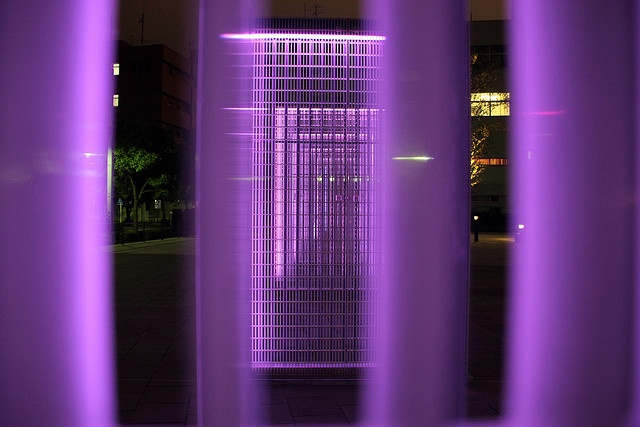 |
| Purple Grid - Yokohama, Japan photo by OiMax |
I was at a Friday night class with Hatsumi Sensei in the Hombu Dojo when Soke described toate no jutsu as a kiai or projection of spirit (maybe 気迫 kihaku?). Sensei said it was like the color of your heart projecting into space. That color comes from your character or can be that which you decide to project. He said all this with his purple hair and made reference to Kabuki theatre in which a purple scarf on the head denotes death.The concept of Goshiki 五色 can be 5 colors. Usually we hear this word as 5 consciousnesses (Goshiki 五識). From the Great Buddhist Dictionary (仏教大辞典、小学館) we can learn the following:

From Shiro Kuma's Weblog by kumablog

In exactly 30 days the Yûro Shi Tenno Taikai of Paris begins!
This year has passed so fast that I am amazed that this is already the time for this major seminar. The Paris Taikai has evolved a lot since its creation back in 2007.
This is a very special seminar that was designed to give a chance to get the « Taikai feeling » of the old days to the newcomers to the bujinkan and a sense of « the good ol’days » to the old bujinkan members.
This seminar is special for many reasons:
First, this is the only remaining seminar where the « Shi tenno » are teaching together. Since 1993 Sven, Peter, Pedro & Arnaud have been teaching together in Spain, France, England, Ireland etc…
Second, the four friends are used to teach together which gives a kind of « family feeling » to this event;
Third, this is a 3 days seminar like the taikai of the past when Hatsumi sensei was travelling the world to spread his teaching;
Fourth, the group of participants is divided into four groups by technical level. This means that a beginner will receive a class that he or she can understand; but also that a high rank student (judan and above) will also get something to improve his or her understanding;
Fifth, each day is divided into small training sessions of about 1 hour where each group has the chance to train with each one of the shihan in a private class;
Sixth, the 3 training halls (mats or wooden floor) allow each one to spend a full day of training in different environment;
Seventh, the free t-shirt, the hot meals, the free lodging (during, before or after the event), makes it a big opportunity to exchange with the many practitioners from all Europe but also to take the chance to visit Paris;
Eighth, the final party at the end of the third day is always a good moment before going back home and parting from 150 new friends coming from 15 to 18 countries.
The YSTT is a very good opportunity to meet your buyu from Europe, to exchange, train, and learn a lot of things in a very friendly environment.
This year, this is the 27th year of my bujinkan training. SO I decided that each participant that is booked online will receive a FREE 2 months unlimited access to our online streaming website displaying more than 600 bujinkan techniques.
Thank you for your support!
A. Cousergue
Bujinkan Shihan


 …
…
Lägret hålls i Kaigozan Dojo i Sundbyberg, Albygatan 117. Om vädret är okej så är det möjligt att träningen är utomhus på andra sidan gatan mot vattnet (där vi brukar vara).
Lägret är Lördag den 9:e Juli och startar kl 11:00 och slutar ungefär kl 17:00, kom i tid och betala lägeravgiften kontant (helst jämna pengar!). Vi öppnar upp ca 30 minuter innan. Ta gärna med lunch, det blir inte alltför lång lunch paus.
…

Lucas hoppar högt och dubbelsparkar i brösthöjd, i tekniken Koki
Vi hade tur med vädret, vi tränade utomhus i skuggan under den stora björken. Det blåste lagom mycket och svalkade oss.
Det kom deltagare från Riga, Eskilstuna, Norrköping, Skövde, Västerås, Stockholm och Lucas från Kaigozan Dojo.
Speciellt tack till Daniel från Norrköping som ställde upp som uke.
Lägret filmades och kommer upp på BUDOSHOP.SE om någon vecka eller så.
Vi ses på nästa läger!?
/Mats…
From Bujinkan Santa Monica by Mats "Toryu" Hjelm
 |
| photo by TANAKA Juuyoh (田中十洋) |
"Look eye!, always look eye!"Very good advice for self defense. But there is a lot more to be understood about the eyes in our training. And, despite my fondness for that simple time in my life when a movie meant so much to me, I will break from Miyagi Sensei to suggest you don't always look eye.
"to cloud the mind can be another important way of blinding the eyes. I would like you to know that it is the core of the metsubushi techniques to make the eye stop working."This brings us to a more advanced use of the eyes for mind control. Ganko Issen is a sudden flash or glint of light of the whites of the eyes which can create the effects of Fudo Kanashibari and is also a basis for Toate no jutsu (striking from a distance).
"I have no eyes -- I make the flash of lightning my eyes." - unknown samurai c.1300Hatsumi Sensei says that it is possible to "see" without using the eyes, and to "hear" without the ears. He says that, "In Ninpo your whole body must act as your eyes and ears."
偸眼にして蜻蜒伯労を避く。This idea has many layers. One is that by not looking directly at your opponent you can make your focus broader to take in the whole environment. People and animals often do this naturally when surrounded. Looking nowhere but everywhere. This can be called Happo Nirami (staring in all directions). One benefit here is that your opponent's actions will be caught in your peripheral vision which responds very well to sudden, quick movement.
With a pilfered glance, the dragonfly evades the shrike.

From Sweden Taikai 2011 by Sweden Taikai 2011

Shihan Duncan Stewart, 15th Dan, is a senior student of Bujinkan Grandmaster Masaaki Hatsumi. He started training in 1988, and moved to Japan in 2004 to study weekly with Hatsumi Soke, Nagato Shihan, Noguchi Shihan, and Someya Shihan. He is well respected in the Bujinkan and is often called-upon to demonstrate at classes.
 Duncan was Nagato Shihan’s sole uke at the Bujinkan Hombu for two years when studying direct from the Gyokko Ryu and Kukishinden Ryu Densho. Duncan has also studied Nihon Buyo (Traditional Japanese Dance) under the direction of Noguichi Sensei.
Duncan conducts seminars worldwide for those wishing to gain more exposure to current training in Japan. And, back in Japan, he runs his own training at the Hombu dojo and Kashiwa.
Duncan successfully co-coordinated the 2007 Australian Bujinkan Taikai and participated in many Japanese Bujinkan Embu for which he has received the Gold Medal and Certification from Hatsumi Soke.
In addition to his exceptional skill and understanding of Bujinkan Budo Taijutsu, Duncan is an excellent teacher. He is highly sought-after and do seminars all over the world.
To Learn more about Duncan, visit his web site: http://tazziedevil.wordpress.com/

www.youtube.com/watch?v=a6YcF3iAmKY

www.youtube.com/watch?v=pDO6pEYHANo
Skip to 2:07 to see Duncan!

www.youtube.com/watch?v=f5EngBX8AqE
From Bujinkan Santa Monica by Mats "Toryu" Hjelm
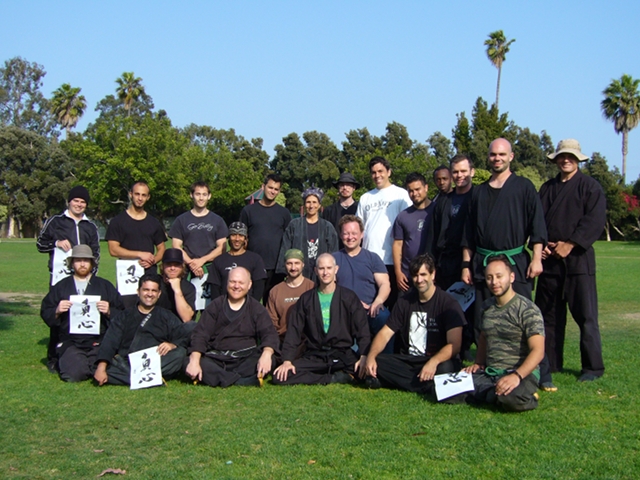 |
| Paul Masse Santa Monica Training |
強弱柔剛あるべからず 故にこの心から離れ 空という一字に悟り 体また無しとして 之に配す
Neither strong or weak, soft or hard, separate from the heart of these and enlighten yourself to the one character of nothingness. Make your body nothingness and reside therein.This comes to us from Toda Shinzaburo Masahide of the Togakure ryu. Another translation of this phrase can be found in Hatsumi Sensei's book, "The Way of the Ninja,"
"One should be neither strong nor weak, neither soft nor hard. Leave such thoughts behind, awaken to the Void, and make your body Null to abide by this."Paul had us exploring these ideas through 虚実 kyojitsu, 無心 mushin, and 縁 connection.
It's not whether you're good or bad. If you think you've reached a certain skill level then you probably haven't. That's why there's this saying, strong or weak, it doesn't matter. You have to have the balance of these points (heijōshin 平常心).Mushin 無心 means "innocent" or "free from disturbing thoughts" or simply, "empty mind." Mushin is held in the fourth, intuitive level of Godai:
"The fourth dimension is that of the world of Mu— nothingness— a world haunted by death, a world of spirit only. It is a world with no physical existence, where everything simply disappears. That is why in that world you must not let an opponent see or sense your form- you must wipe it out entirely." -Masaaki Hatsumi, The Way Of The NinjaIn Zen, Mushin is the thinking of the body. In the Bujinkan we often describe this as flow. And it is obvious when watching someone whether they are doing technique from their heads or from the wisdom of their body using flowing taijutsu.
"This means that in Budo, it is naive to get caught up in thoughts of strong weak or soft/hard; in the end, even concepts such as skillful/unskillful simply fade away, Jutaijutsu contains fifteen strong arts and fifteen weak arts, making thirty in total, which can be seen as three sets of ten (as in Sanshin no Kata: Tenchijin and the Juji idea). Nevertheless, one deliberately and willfully eliminates all of that to make oneself Void."Mushin is like looking at your own reflection in the moonlit water. If the water is still, maybe you see the moon reflected there with your own shadow. You might forget that the moon is in the night sky behind you! Don't trouble the calm water with your worries and doubts. Allow your mind to fill the sky and be with the moon.

From New Products from Budo Shop Store by New Products from Budo Shop Store
 | Instructors: Christian Spicker, Ola Grönlund, Martin Berg, Fredrik Markgren, Roger Mattsson, Petter Swedin, Kristoffer Metsälä, Christer Westberg, Mats Hjelm, Jonas Stenlund, Arvid Karlsson, Arne Elmlund.
Theme: Reflections of this years Bujinkan theme, Gyokko-ryu kosshijutsu
Many instructors from Sweden went to Japan to train with Hatsumi Soke and the Shihan. Many of these instructors came to share their knowledge and feelings from their training trips.
Recorded in Stockholm, Sweden December 2005
Format: DVD/R- which plays on all computers using and ordinary DVDRom. It also plays on most DVD players (check your manual!).
125 Minutes playing time top quality, available in NTSC only.
Language: Most of the instructions is in Swedish, some instructors spoke in English to
Skr239.00
|
From Sweden Taikai 2011 by Sweden Taikai 2011
We where just informed that Paul Masse won’t make it! To bad we was looking forward to see him here. But we still have three great instructors booked. We will think about what to do over the weekend, check out the web site next week or follow us on twitter or RSS.
We are on Twitter now @taikai2011, please use our hash tag #tks2011 if you tweet about us.
Twiter, Facebook, Blogs, Forums, Web sites, etc…
Please use one of these banners and link to http://taikai.se, or download Banners_TaiKai2011.zip if you want to change size to fit your web site better.


 …
…
