忍辱の鎧 Ninniku No Yoroi: Patience as Armour
From Bujinkan Santa Monica by Mats "Toryu" Hjelm
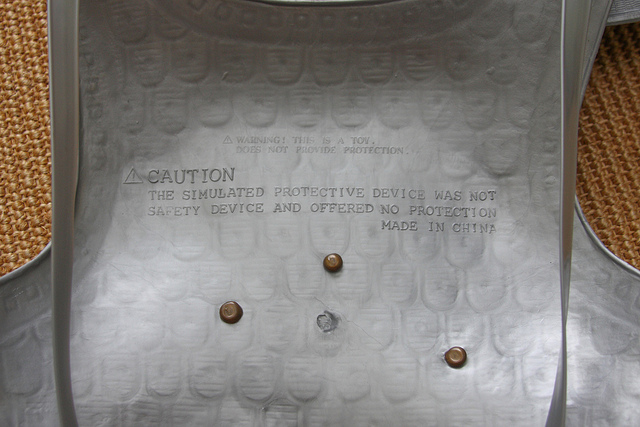 |
| "Caution. The simulated protective device was not safety device and offered no protection." photo by Sam Howzit |
鎧をつけている人は、転ぶと大きな音がする。
He who wears armor falls with a big crash!
He who wears armor falls with a big crash!
This saying reminds me of medieval knights of old, encased in metal, then falling off their horses, only to bellow on the ground like a sick overturned tortoise. anyone who has worn yoroi may have experienced similar sensations. But the armour that really weighs us down most often and acts against us is in our own hearts. We wear our pride or technique on our bodies like it will stop bullets. Ninniku offers us a different choice. In our Bujinkan training this is some of the most powerful armour available.
Hatsumi Sensei has explained to us how he dissipates the attacker's energy. This is one aspect of three methods that make up 忍辱の鎧 Ninniku No Yoroi. We will look at these three strategies after we try to understand Ninniku.
Soke describes it this way,
Ninniku Seishin. There is a saying, "Enduring insults and humiliation, I drop all
rancor, I desire no revenge," which implies bearing no hatred and holding no grudges.
This word derives from Ksanti-paramita (Ninniku-haramitsu Bosatsu, "Arrival at the Other Shore of Patience"), Ksdnti in her Sanskrit name means "patience" and is translated into Sino-Japanese as ninniku. She is also called "Nin-haramitsu"
Ninniku is the third of ropparamitsu, the six paramitas or disciplines of Mahayana Buddhism. Here the patient heart tempers and subdues anger and hatred. Enduring insults originating in men, such as hatred, or abuse. And surviving distress arising from natural causes such as heat, cold, age, sickness, etc. The symbol associated with ninniku is a flower.
Hatsumi Sensei also tells us,
The Ninja uniform is like the Kesa of the Buddhist priest,Buddhist priests wear a kesa or scarf which has another name, 忍辱鎧 ninniku-gai, or armour of patience. Or patience as armour. 忍辱の鎧 Ninniku No Yoroi - armor of perseverance.
and Takamatsu Sensei used to call it "a taste of Zen."
The idea of ninniku no kesa comes from the Lotus Sutra, where the preacher is described as cloaked in "the thought of tender forbearance and the bearing of insult with equanimity."
This kind of armor shields you in ways that will seem supernatural. You cannot be insulted or degraded (fujō 不浄). You are also free from attachment to the uncertainty and undecidability of the cause and effect of a fight (fujō 不定). You float outside that cycle of violence with these three tactics:
- Awareness: this allows us to evade an enemy's attack naturally and disappear. By showing no intention to fight you can be invisible.
- Hard training prepares you for any situation, so you may experience banpen fugyo in the midst of chaos. Then use natural principles and methods to prevail.
- Have the perseverance of Ninniku Seishin: "hiding spirit" hide your intentions, don't show off everything, be patient, wait and endure to succeed.


 …
…

 Sveneric is one of the grand old men and one of the most experienced teachers of the Bujinkan. He travels frequently to Japan to receive more training, and hold many seminars all around the world.

 Rob is resident of Japan where he has lived for over five years. Rob is in a unique position to share insights from Budo Taijutsu. He works full-time as a movement coach, training people in the Zeropoint Training System , which includes injury-prevention exercise for adults, rapid body reconfiguration, and a number of movement and exercise courses for people of all ages and skill levels, not the least of which is working with leading Japanese schools to implement cutting-edge children’s educational, exercise programs.
 As Hatsumi Sensei often says: “You cannot truly understand a technique until you understand its counter!” With this in mind, I will be showing the progression from co-operation to resistance, looking at how uke and tori would “counter” each move, then show how to use that counter to your benefit, allowing you todevelop your own “intuition” of the proper movement needed for any given moment. (This methodology can be used for any technique, but we will be focusing on Kihon Happo in conjunction with Soke’s chosen theme for this year.)

 Steve has been training in Japan since 2001. He trains with Soke and the Japanese Shihan weekly. He looks forward to sharing his perspective on techniques and themes recently seen and discussed in Japan.