Shinobi Daisho
From Paart Budo Buki by buki stolar
For now, we call them Shinobi Daisho, of course, these are for sale and who offered more, will have an interesting training.
From Paart Budo Buki by buki stolar
From Bujinkan Santa Monica by Michael
![]() |
| Both Ox and Self Transcended, digital c-print photograph by Andrew Binkley |
Bujinkan Shodan 初段: Searching for the BullSo what kind of training do we do for Hachidan?
Bujinkan Nidan 弐段: Discovering the Footprints
Bujinkan Sandan 参段: Perceiving the Bull
Bujinkan Yondan 四段: Catching the Bull
Bujinkan Godan 五段: Taming the Bull
Bujinkan Rokudan 六段: Riding the Bull Home
Bujinkan Nanadan 七段: The Bull Transcended
![]() |
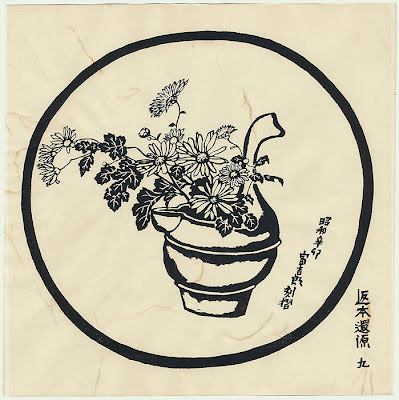
| Woodblock print by 德力富吉郎 Tokuriki Tomikichirō |
"Soke" signifies nothingness, zero, emptiness, void. Something that exists, and yet does not. The Soke is just an ordinary person, and yet, somehow, he is someone who is living his life according to some invisible divine command. You see, I do not live by my conscious mind, not at all, so that whatever I have thought up till now can just suddenly change in my mind, though it is not a consciously engineered change."And here is the same idea from Zen:
"A distinguished Zen teacher, questioned as to how he disciplined himself in the truth, simply said: 'When I am hungry I eat; when tired I sleep.' The questioner remarked that this was what everybody did and asked whether they could be considered as practising the discipline as he did. The teacher replied: 'No; because when they eat they do not eat, but are thinking of various other things thereby allowing themselves to be disturbed; when they sleep they do not sleep, but dream of a thousand and one things. This is why they are not like myself."The emptiness of this stage burns away every thought of technique or no technique. It burns away any thought of attacker or no attacker. Defender or no defender. As the poem above states, dualistic and discriminating thoughts are burned away like a snowflake in a raging fire…
From TENRYU by jorgevaccaro
There is a Japanes proverb that says 猿も木から落ちる Saru mo ki kara ochiru. Which means “Even the monkeys also fall from the tree”
I like to sometimes change it for 龍も空気から落ちる Ryu mo kuki kara ochiru, “Even the dragons fall from air”
The nature of the dragon is to fly in an oscillating and changing wat throughout the air and throw fire on ocasions. The fire is one of it’s weapons, to drive off the bad spirits, protecting the weak from evil and powerful.
It’s fire may sometimes be it’s words and techniques, trying to take care and teach, even though sometime by fear of human conscience, ends up being misinterpreted.
There are no dragons of water , earth, sky, fire, clouds, struggle, etc… those are simply variants of the endless manifestations that an honorable White Dragon may have during certain state of divine awareness, giving life to thousand of dragons all around the world.
The features are individual, but the manifestations are changing according to lifes. Infinite changes of conscience ar the result of millions of manifestations of human conscience, but it all ends in a position of the escential point of life (Kaname no Shisei).
Those dragons filled with hunger tend to burn the tail of other dragons, to delay their flights and take advantage onto their roads, who have been confused with the role to protect, by the role of colonizing in a state of competition.
A dragon with the burned tail, just comes around to check itself on how bad it’s body is, but knows that it can auto-regenerate itself instantly in the sinergic force of it’s flight, on the giving and protecting. A Dragon comes from the sky, it’s escential nature doesn’t belong to earth, however takes care and plays with people.
If today you feel that your tail has been burned, just continue your path, in the direction of giving and protecting, not just those who believe, come and follow their flights in action, but also to those who even asleep ignore the force of the dragons.
Komyo no satori wo sagashite “Seeking within the light of hope”
Tenryu, fall of 2012 in Buenos Aires.
From Sweden Taikai 2012 by alexander
Finally our sign-up form is online. We’ve had some unforeseen and unfortunate hiccups along the way (including a slow bank employee), so we’ve decided to open the sign-up and opt for payment instructions later. Don’t worry – they WILL come later, though
So – without further ado – click on the Sign-up form link in the header menu and prepare for Tai Kai Sweden 2012!
…From New Products from Budo Shop Store by New Products from Budo Shop Store
From Bujinkan Santa Monica by Michael
![]() |
| The Ox Transcended, digital c-print photograph by Andrew Binkley |
Bujinkan Shodan 初段: Searching for the Bull
Bujinkan Nidan 弐段: Discovering the Footprints
Bujinkan Sandan 参段: Perceiving the Bull
Bujinkan Yondan 四段: Catching the Bull
Bujinkan Godan 五段: Taming the Bull
Bujinkan Rokudan 六段: Riding the Bull Home
![]() |
Woodblock print by 德力富吉郎 Tokuriki Tomikichirō |
From Paart Budo Buki by buki stolar
This is the second tachi bokken slightly better, with few details on the saya and kashira, still under development,From TENRYU by jorgevaccaro
There are off course, levels, ranks and casts everywhere.
I believe this cast of zones is important for human existance in earth.
I feel this things are necessary for those who adapt. The creation of a territory is also what adapts on each individual. I believe that is not something that produces an impediment, but also what is free. This is some matter to understand on each position. Those who not have this strenght and aim to high, will certainly fail.
On my 5th Dan test, there’s an attack from behind. This is the beginning of the Kihon Happo. Please this means that you must understand the Happo and the Juppo. This is what is called Juppo Sessho no jutsu. You don’t know where an opponent may come. You don’t know what kind of dissaster will come and from where.
You must be able to deal with things when they come from certain way, and it’s not just a question of protecting from a blow from behind – Please know about Juppo Sessho no jutsu and Kihon Happo. The ways in that Kihon Happo can be applied on this kinds of situations, are the tipe of things that are though on 5th dan. The test isn’t about just try to avoid an attack from behind.
Three people are bound to propose someone for the 10th dan. This in a sence, is Sanshin No Kata. This is the meaning of Sanshin no Kata that I’ve mentioned before. A person cannot become a 10dan without 3 people as sponsors.
There are individual differences on people, that’s why there are ranks until the 15th dan -This isn’t a question of ryuha-
I’ve created the ranks of 15dan, off course, with the meaning that people can take notice that they are in fact human beings. You could say that is to leave the abode.
From TENRYU by jorgevaccaro
As many of you may know, the teachings of Sôke during 2001, where focused in Gyokko Ryû and Daisho. Inside Gyokko Ryû Sensei Hatsumi tought the concepts of IN/YO (opposite polarities) applied to the In Ryoku 引力 concepts (gravity force, attraction),Jû Ryoku 重力 (gravity), Ji Ryoku Sen 磁力線 (magnetic force line) among others.
Last night, we had a wonderful class with Sōke. Outside of the Dojo, the wind and the rain blew strongly in Taifu 台風 way, inside of the dojo the wind of the Bufu kept us moving from the hands of Sōke, while he shared with his Kuden the theory of relativity of Einstein 相対性理论, applied to Taijutsu. During the class, as Sôke showed techniques with Katana, Daisho, Kodachi and long weapons (Bo), he explaines the importance of moving freely taking advantage the skillness of being able to use any weapon, even firearms. Throughout the enlightening skills of Sôke, while Uke fell naturally over the sword, that was naturally unsheathed by letting if fall down (In ryoku), he started to introduce us into the theory of relativity of Einstein, Everything happens so fast in the Dojo when Soke teaches, but at the same time seems very slow and hard to understand.
The escencial idea, of vital point (Kaname) of the theory of relativity, is for example that two observers that move relatively side by side with different speed, (if the difference is much minor than the speed of light, it’s not appreciable), often will have different measures of the time (time frames) and space (distance – maai) to describe the same series of events. That is, the perception of space (kukan) and the time depend of the state of movement (Taijutsu) of the observer or its relative to the observer. However, despite of the relativeness of space and time, there’s a more sutile form of physic invariance, as the content of the physical laws will be the same for both observers. This last thing means that, despite that the observers differ on the result of concrete measures of temporary and space magnitudes, they’ll find that the equations that relate physical magnitudes have the same form, with independence of his state of movement. This last fact is known as principle of covariance.
I feel that beyond what’s relative on each observer and the variance of perceptions, we can all find a vital point (Kaname要) that can connect us to the escense of Budo, even though there are infinite changes (Banpen) and if the Mushin mind is kept, the escencial point appears by itself. Maybe that’s the Gokui of martial arts, though if we try to understand it, it’ll loose it’s escense.
Soke said, The Kaname can be understood, or it cannot be understood, it’s simple”
Bufu ikkan Banpen Kaname !!!
Christian
From TENRYU by jorgevaccaro
平静 Heisei; is equanimity, from latin “aequanimitas”: balance, fairness, consistency and fairness in mind. We can understand it as keeping a balanced and serene attitude. It can also be translated as neutrality, balance or justice.
Antonyms of Fairness: imbalance, Inequality, obsession, paradox, bias, perversion, goodwill, prejudice, injustice.
If anyone saw pass “equanimity” please let it notice and don’t let it get away!!
Train daily both inside and outside of the Dojo is one of my targets, to achieve “Kokoro no heisei (心の平静), an equable mind.