Skip to content

Naginata blade

From Paart Budo Buki by buki stolar

Hello Buyu's,

I received a request to make Kukishinden ryu naginata, and so I "fell" to the stage built up Naginata's
I do not know how many I will  make them, and in how  many forms, it  is a big issue. For now here are a few forms of the blade, soon it will be more.
Here it will be only pictures of blades,
because the shape is what makes the difference, everything else, tsuba (size of tsuba), Ishizuki (shape of ishizuki), length of nagaye(handle), tachiuchi, is up to you.

I will also try to make my version of Tsukushi naginata (orTsukushi fukuro) for practice.


Koryu bokken, sori 2 cm

From Paart Budo Buki by buki stolar

Here is another koryu bokuto but  with 2 cm curvature,

natural curvature of course,
made of the acacia tree, because it looks nice, but like all other porous trees is not appropriate for hard contact bokuto,
 
more photos soon


Shot to the Heart of Kaname 要

From Bujinkan Santa Monica by Michael

Yabusame 流鏑馬, Kumamoto-shi, JP. photo by malfet_
We are more than halfway through 2012 and training has been great! Back in December, I wrote about a class where Hatsumi Sensei suggested some possibilities of a theme for 2012. As often happens the theme has evolved to express other ideas than those Hatsumi Sensei shared in December. One idea that has emerged has been an exploration of the idea of kaname 要.

Kaname 要 can be described as the essential or vital point of a technique, of a moment, or of strategy. It is essential because victory or defeat can pivot at this point. Everything hinges on grasping this moment. But this is not a new idea from Hatsumi Sensei.

At last year's Daikomyosai, Soke gave us a lot of focus on the concept of Kukan no kyusho. At the time, besides having my eyes opened, this concept felt pivotal to everything we are currently studying in the Bujinkan. And, it turns out that kaname and kukan no kyusho are getting at the same feeling. In years past, Soke has also used the terms koshi or koppo to get at this idea of a key point that controls things.

This kaname, or kyusho in the kukan, is very dynamic. So when you connect to it and affect the situation, change the uke's balance, strike a kyusho, or win the fight… The situation changes. And you must change with it to connect to the new vital point of the moment. What is fascinating is that through this process you will discover pivotal points that were hidden from your normal level of awareness and ability.

There is a secret here that I cannot describe or even teach. Soke hints at it in the scroll he painted for this year: shinryuyogo 神龍要護. You will notice the character for "yo" is the same as kaname. And "go" is the same as mamoru which means to safeguard or protect. But another secret here has to do with shinryu or the divine dragon.

Here is an excerpt from my recent training notes on this:
"With both ideas you can use these essential points as pivot points. But what is being pivoted? Certainly you can pivot your body around a point in space that you feel is essential to the execution of the technique. But that is a very flat or two dimensional understanding of kaname.

To expand the concept what is really pivoting is your shin 心 (heart, mind, or spirit) or shin 神 (spirit or kami). Both you and your opponent's "shin" are pivoting around in the kukan. This allows for the spontaneous creation and use of any henka, but also kyojitsu, rokkon shoujou, juppo sessho, roppo kuji, kuki taisho… or any number of principles that respond to the dynamics of the instant!

And our shin 神 are pivoting around each other as well as the real essential point which is the connection to heaven  or: chance; fate; destiny; karma. We can stay connected with 因縁 innen which is the underlying source of all actions or the origin. This is the true shinzui 神髄  of kaname that can lead us to the expression of kamiwaza 神業 ."
What I wrote above is a sample of what I send out 3 times a week to subscribers. If you haven't subscribed to my training notes you can get them here: 稽古記録 Keiko Kiroku

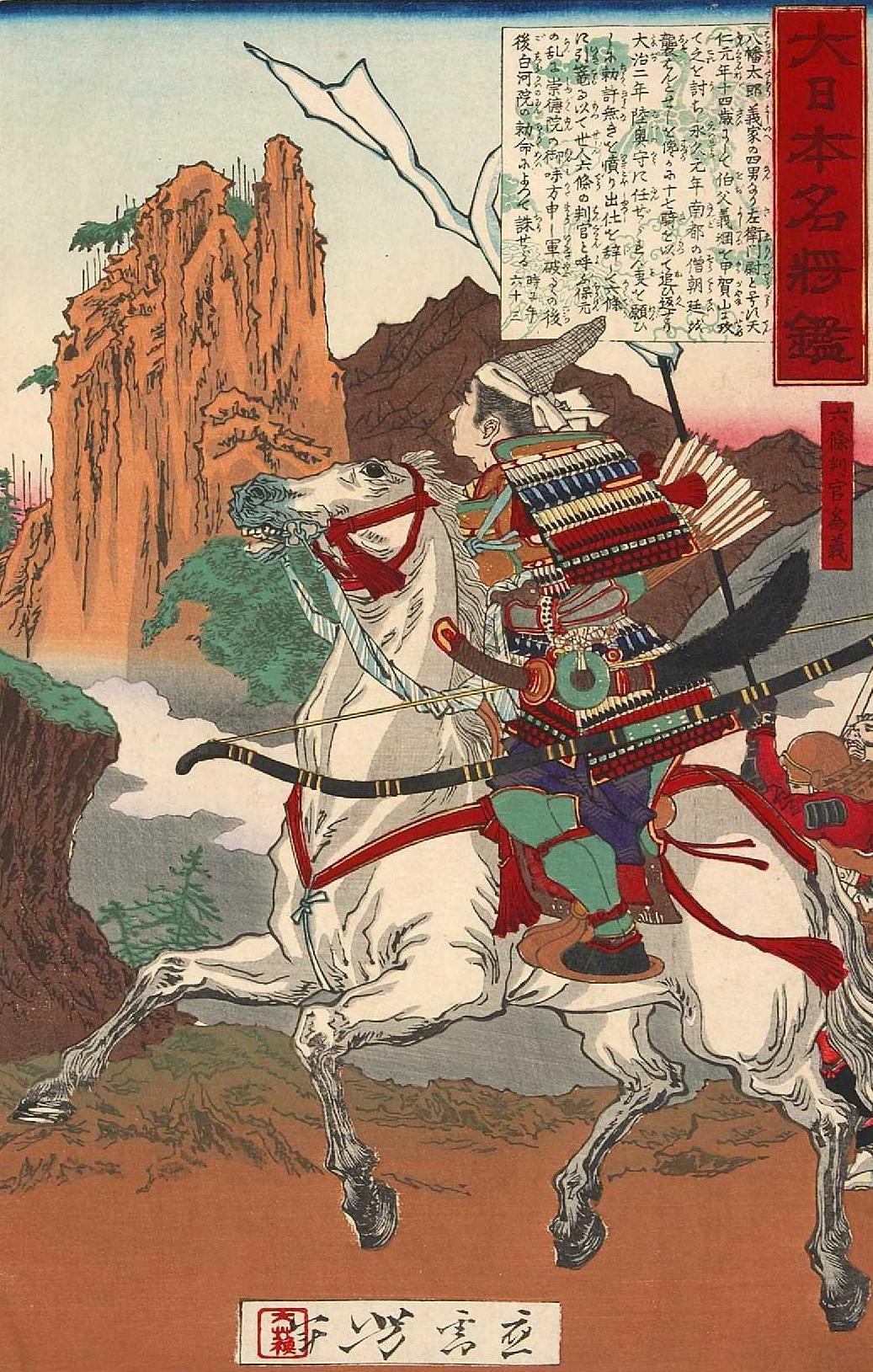
Last year Hatsumi Sensei shared a story that gets at the depth of feeling behind kaname. It comes from a famous moment in the epic tale of Heike (平家物語), During the Battle of Nashima in 1184, the enemy retreated to their ships. They placed a fan on top one of their masts claiming that it protected them from archers on the shore and they dared the Minamoto to shoot it off.

An archer, Nasu no Yoichi 那須 与一 who was known for his accuracy but not his strength, rode out into the sea on horseback to get close enough. With the waves splashing around the horse's neck, and rolling the ship around in the surf, somehow he loosed his arrow and split the fan in two!

Soke explains that this moment had such power that "it pierced the heart (kaname 要)" of the Taira army and the Minamoto were victorious. It was also a pivot point or turning point in the entire war. This moment has power in our imaginations to this day as it is retold and represented by artists with great reverence.

So in my own training for the first half of 2012, I have been exploring Kaname in our training as the essential, or vital point around which the technique, fight, or taijutsu derives its' power. The results have been spectacular for me and I can't wait to study it more and train even harder.

Tsuka Kashira

From Paart Budo Buki by buki stolar

There are various forms of Kashira Tsuka, for start some basic shapes for my bokken.

So when you decide to order production of Bokken from me,  these are four basic shapes to choose from, of course, that could be any other forms of Kashira


Kotō Ryū Koppōjutsu – article translation

From Wanderings in Budo by bujinshugyo

虎倒流骨法術
骨法といっても、今はやりの喧嘩芸との関係は無い。玉虎流を僧玉観から学んだ戸田左京一心斎が16世紀中頃に創始した。もともと骨法とは古代中国から伝わった技で、強法とも呼ばれ、隠し武器を使うのが特長だという。戸隠流とともに伊賀忍者から戸田家に伝えられ、やはり百地三太夫も学んでいる。初見氏によれば骨はの技コツに通じるという。

Kotō ryū koppōjutsu
Present day fighting techniques bear no relationship to what one might call koppo…
Toda Sakyō Isshinsai learned the Gyokko ryū of Sō Gyokkan and founded (this school) in the mid 16th Century. The technique of koppō was originally introduced from ancient China, also known as Gōhō (strong method), its speciality is to make use of hidden weapons. Transmitted to the Toda family along with Togakure ryū by the Iga ninja. Momochi Sandayū also learned this. According to Mr Hatsumi there is the ‘knack’ to understanding the technique of using the skeleton/bones.

虎倒 Kotō – tiger knocking down, tiger defeating, to fell a tiger.
僧玉観 Sō Gyokkan – a (Buddhist) monk, jewelled appearance. Looking at the Chinese for 玉観 you could also see the name as suggesting that this person is a treasured (possibly imperial) advisor or observer.
強法 Gōhō – strong or powerful method. Pronunciation as gōhō is indicated by furigana alongside kanji in the text.

The first line was particularly vexing to translate into something that made sense in English, after trying out several different versions I am currently happy with the one written above. Similarly with the last line there are various ways to phrase it in English, and thus subtly altering the meaning.

As with Togakure ryū in the genealogy chart, Kotō ryū is descended from the Gyokko ryū of Hachidō Nyūdō, but through Tozawa Hyakuunsai Kaneuji to Gyokkan who is seen as the source of four styles. Kotō ryū is passed on to Hatsumi Masaaki, as with Togakure ryū, through Momochi Sandayū, the Toda family, Toda Shinryūken Masamitsu and Takamatsu Toshitsugu.


Bujinkan Jūdan 拾段: In The World

From Bujinkan Santa Monica by Michael

In The World, digital c-print photograph by Andrew Binkley
Hatsumi Sensei describes the journey of a Bujinkan student through the Dan ranks as being akin to the Ten Oxherding pictures in Zen Buddhism. These pictures describe the seeker's journey to enlightenment.

If you haven't read my other posts in this series, please check them out. You may find them useful no matter what your rank is:

Bujinkan Shodan 初段: Searching for the Bull
Bujinkan Nidan 弐段: Discovering the Footprints
Bujinkan Sandan 参段: Perceiving the Bull
Bujinkan Yondan 四段: Catching the Bull
Bujinkan Godan 五段: Taming the Bull
Bujinkan Rokudan 六段: Riding the Bull Home
Bujinkan Nanadan 七段: The Bull Transcended
Bujinkan Hachidan 八段: Both Bull and Self Transcended
Bujinkan Kyūdan 九段: Reaching the Source

Now as a Jūdan, you may stroll casually through the dojo, yet your steps are not misplaced.
Woodblock print by 德力富吉郎 Tokuriki Tomikichirō
 入鄽垂手 In the World
Barefooted and naked of breast,

I mingle with the people

of the world.

My clothes are ragged and dust-laden,

and I am ever blissful.

I use no magic to extend my life;

Now, before me, the dead trees

become alive.

I have abandoned the whip and ropes

All ideas of shuhari 守破離 have been swept away. Anyone still in the cycle of shuhari will not see the source of your freedom. Simply,
"You destroy whatever needs to be destroyed, you subdue whatever needs to to subdued, and you care for whatever needs your care." - Chögyam Trungpa
As one who has reached the peak of our Bujinkan training experience or found enlightenment as in the Oxherding poems, you appear remarkably unaffected. You have internalized our art and this is reflected purely in everyone you meet. In this reflection you see wonderful taijutsu expressed by any student of the art.

This stage is one of freedom. You don't consciously show any signs of ability or seniority. Nor do you adhere to any rules, forms, or training regimen. Yet simply and without striving, you express mastery.

Hatsumi Sensei quotes Confucius, "Those that understand play have life's greatest treasure."

It is strange to no longer show any skill. Skill is too limiting and you have slipped free of that trap. Yet you are a great help to others who may be seeking skill. Students grow just by being around you. This is Shinden 神伝.

Some may turn away from you or critique your abilities. You reply with a smile. Tenkataihei 天下泰平, all is peaceful under the heavens.

People expect that someone of your level will have incredible skill and almost supernatural technique. You know those skills are there but realize they are actually ordinary illusions and even unnecessary.

Your pure state is reflected in everyone. As you shine forth, anyone may collect some of your light. You simply help anyone you meet to grow and learn. This happens naturally without concern for compensation or worry about who accepts your help.

Hatsumi Sensei says that Shōsan had the feeling of "The heart that thinks of oneself, suffers. The heart that thinks of others, is free."

This journey through Jūdan and the ten Oxherding poems and pictures was inspired by Hatsumi Sensei's teacup that has these ten drawings. He says as he sips from this cup, "It is the moment when tea and Zen are one."

And you are there like the moonlight reflecting in a hundred cups of tea. Each reflection is whole, yet nothing takes away from the moon itself.

11 Aug – Yarijutsu (spjutläger) med Mats Hjelm i KGZ Stockholm


En dags studier av Bujinkan Yari, spjuttekniker.
Träningen kommer att vara utomhus i närheten av dojon. Vi träffas i dojon kl 10:30-11:00 sedan går vi ut och tränar.
Om det är för dåligt väder så tränar vi inomhus och då Hanbojutsu (kort stav) istället. Vi har vapen för utlåning.
Kostnad 200 kr

One day seminar, studying the Yari (spear techniques).
Training will be outside. We meet in the dojo between 10:30-11:00 then we go outside to train. If it is really bad weather, we stay inside and train Hanbojutsu. We have weapons you can borrow.
Price 200 SEK…

Togakure Ryū Ninpō – article translation

From Wanderings in Budo by bujinshugyo

戸隠流忍法
木曽義仲の家臣だった戸隠大助が、12世紀の始め頃、戦いに敗れて伊賀に身を隠し、叔父の霞隠道士から骨指術や剣術を始めとする様々な武術を学んで開いた。最初は戸隠流八法秘剣と呼ばれ、時代によって名称は様々に変化した。伊賀忍者の百地三太夫などが学び、紀州藩の取名家を経は、17世紀頃から戸田家に伝わった。戸隠流は、手甲、施盤投げ、手裏剣、水遁の術に使う四尺のしの竹などに特長がある。戸隠流忍法体術は、骨指術からの分家である。

Togakure Ryū Ninpō
Togakure Daisuke was a vassal of Kiso Yoshinaka in the early 12th century, he hid in Iga after losing a battle, from his uncle Kagakure Dōshi he was taught a variety of martial arts beginning with kosshijutsu and kenjutsu. Though the name was changed depending on the period it was first referred to as Togakure ryū happō biken. In the 17th century the Toda family took over the school. Iga ninja such as Momochi Sandayū learnt from the distinguished family when it moved to Kishū province. Specialities of the Togakure ryū are shuko, senban throwing, shuriken and water evasion techniques including the use of a 4 shaku bamboo tube. Togakure ryū ninpō taijutsu is a branch of kosshijutsu.

霞隠 Kagakure – mist hiding, hiding in the mist – also read as Kain.
雲隠 Kumogakure – cloud hiding, hiding in the clouds
道士 Dōshi – a moral person or Taoist
Kagakure and Kumogakure are used interchangeably, both can be seen as coming form the from the homeland of Togakure ryū – the mist sheathed mountain slopes of Iga – as well as the use of smoke to escape that is synonymous with the legend of the Ninja. So you can see Kagakure Dōshi as a religious person who is able to hide in the mists and clouds – this also brings to mind the 修験道 Shugendō idea of being able to subsist through eating mist.

百地三太夫 Momochi Sandayū – a famous ninja who’s exploits appears in many stories.

手甲 Shuko – hand spikes. But also be read as Tekko – hand armour or armoured sleeves.
施盤投げ Senban nage – rotating plate throwing. Although the first character used in the text is 施 which refers to begging or alms so reads ‘begging bowl throwing’ bringing to mind the idea of disguise as a beggar in espionage. The characters for rotating plate are 旋盤.
手裏剣 Shuriken – blade inside the hand, small throwing blade
四尺のしの竹 Yonshaku no Shinodake – 4 length or measure bamboo tube. A shaku is 30.3 cm so the breathing tube is around 1.2 meters.

The genealogy chart shows Togakure ryū as coming from the Gyokko ryū of Hachidō Nyūdō through Kagakure Dōshi to Togakure Daisuke. It then passes on though Momochi Sandayū to the Toda family, to Toda Shinryūken Masamitsu, Takamatsu Toshitsugu then Hatsumi Masaaki.