Skip to content

The Meaning of ‘Shihan’

From The Magick & The Mundane » Bujinkan by Shawn Gray

What does the title Shihan mean?
This blog post is in response to a question that I received on Facebook the other day:

I’m surprised every time I see people in the Bujinkan title themselves as Shihan. If I’m not mistaken you never present your self with -san added, this is only used when addressing others. So would not the same thinking apply to Shihan?
I’m not sure when people started doing this, maybe when they got tired of “just” having 15 dan? However, this are just my own thoughts, which very likely can be completely wrong [:)] I’d be curious to hear your thoughts on this. Maybe this could lead to yet another great and educational blog post of yours?

In the Bujinkan martial arts, the title “Shihan” has come to be used to refer to anyone ranked Judan (10th degree) and higher. Many people seem to think that it was always used this way, but it actually used to be used differently. So for this blog post I’ll be discussing what the word Shihan means in general, and how it’s come to be used the way it is in the Bujinkan.

師範

The word Shihan is generally defined in regular Japanese as instructor, teacher, or model. In Japan, there are various groups, organizations, or situations where both Sensei (the much more commonly used of the two terms) and Shihan are used, and in such cases Shihan is generally used to mean senior instructor, senior teacher, etc. This is common in the martial arts, but both words are  often used in other areas of Japanese life as well.

As far as the use of the word Shihan in the Bujinkan martial arts goes, the term was originally used to refer to the senior Japanese students of Hatsumi Sensei. That much is common knowledge, but many people I’ve spoken with over the years were unaware that Shihan was also used to refer to the senior Japanese students even before they reached the rank of Judan. Even now many people don’t seem to be aware of this – most people seem to think that the title is synonymous with the rank of Judan and up – and indeed, in a large sense, this is the meaning that it has taken on over the years. However, the senior Japanese students of Sensei (and two foreigners that I know of – there very well could be more) were called Shihan (by Hatsumi Sensei himself) before they reached the rank of Judan.

Over time, as the senior Japanese instructors began to reach ranks of Judan and above, they of course continued to be called Shihan. As time passed, foreigners began to associate the title Shihan with the colourful Judan patch. As more time passed and foreign students also began to reach ranks of Judan and above, they started to call themselves Shihan, thinking that it means a rank of Judan or higher, and perhaps desiring a new title after having already “achieved” the title of Shidoshi way back at Godan. Eventually, people began to think that having one of those Judan patches on one’s uniform makes one a Shihan, and this has become the default understanding that we see in the Bujinkan today.

In Japanese culture, just as with a title like –san, a title like Shidoshi, Sensei, or Shihan is not something that one applies to oneself. It is not something one puts on one’s business cards. It is not something that one uses to refer to oneself in class, or on one’s own website, or in email or other correspondence. It is something that others apply to you out of respect. In speaking of respect, it is my opinion (because this is the way that my teachers taught that it should be) that one should not force one’s students to call them by any particular title. This is something that should come naturally from the students’ side. If someone wants to be a Sensei or a Shidoshi or a Shihan, it is more important to act like the type of Sensei or Shidoshi or Shihan who deserves that title. In simple terms, respect is something that should be earned rather than demanded.

It’s important to realize that the word Shihan doesn’t just refer to a number on a rank certificate. This is one possible reason that Hatsumi Sensei refers to good Shihan (meaning that also, by unspoken implication (quite important in Japanese culture), there are not-good Shihan as well). In speaking of good Shihan, Sensei is indicating that it is more than just a numerical value written on a piece of paper. It is something other than simply that. There is a reason why we have both the numerical grade names (Judan, Juichidan, etc.) as well as the title Shihan. Through observing the people and the circumstances in which Hatsumi Sensei refers to people as Shihan, it is my opinion that he is using the title with an expectation that the person indicated is willing and able to take on positions of leadership and responsibility within the Bujinkan organization. More than just a numerical rank grade, it is a title that acknowledges leadership. These two things, rank and leadership, are not at all necessarily the same. Simply because someone is a skilled martial artist doesn’t mean that they are ready, willing, or even able, to take on a role of leadership in the Bujinkan and assume the responsibilities of service (let’s not forget that leadership is service) that are required of a leader. True Bujinkan Shihan are able to act as leaders and role models for others, leading by example and inspiring others to become martial artists of true ability, humility, integrity, and sincerity. These abilities don’t come from a rank number, but from a heart set on the true values (価値観, kachikan) and virtues (武徳, butoku) of the martial arts.

I hope that this article has provided some insight into the meaning of the word Shihan, particularly with regard to the history of the use of the term within the Bujinkan and how it relates to leadership in the organization.


Bujinkan Rokudan 六段: Riding the Bull Home

From Bujinkan Santa Monica by Michael

Riding the Ox Home, digital c-print photograph by Andrew Binkley
Hatsumi Sensei describes the journey of a Bujinkan student through the Dan ranks as being akin to the Ten Oxherding pictures in Zen Buddhism. These pictures describe the seekers journey to enlightenment.

If you haven't read my other posts in this series, please check them out. You may find them useful no matter what your rank is:

Bujinkan Shodan 初段: Searching for the Bull
Bujinkan Nidan 弐段: Discovering the Footprints
Bujinkan Sandan 参段: Perceiving the Bull
Bujinkan Yondan 四段: Catching the Bull
Bujinkan Godan 五段: Taming the Bull

Passing beyond Godan brings us to a place of creative play. The Bull (mind) obeys without searching about and we don't need to work to constrain it anymore.
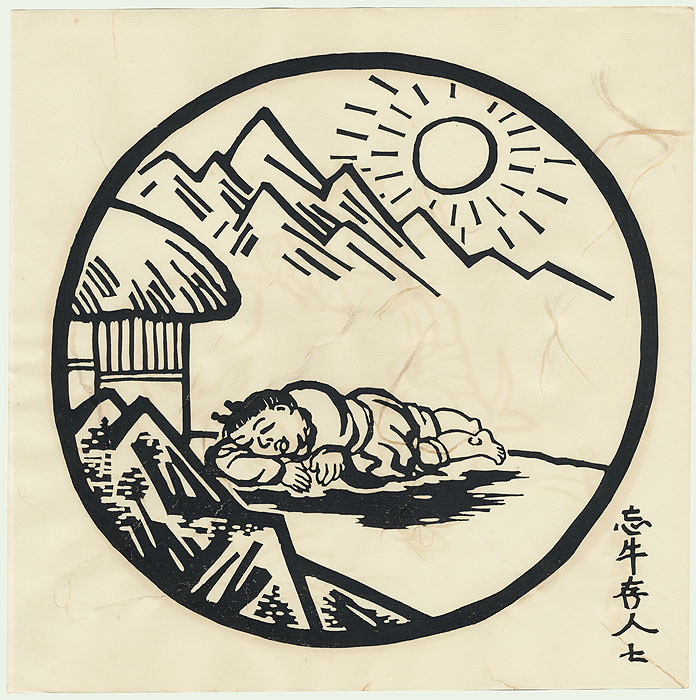
Woodblock print by 德力富吉郎 Tokuriki Tomikichirō

骑牛归家 Riding the Bull Home
Mounting the bull, slowly
I return homeward.

The voice of my flute intones
through the evening.
Measuring with hand-beats
the pulsating harmony,
I direct the endless rhythm.

Whoever hears this melody
will join me.

Sensei says that "When you pass the Godan test, then you realize 無意識 muishiki." This is moving from the unconscious. Once this seed is planted there is nothing to do except allow this state of muishiki to grow. There is no longer any question of trying to prove anything in relation to your rank.

When people first pass Godan, sometimes they continue searching for something in themselves. Some kind of change in ability or looking for more in training and wondering, is this all? At this stage the search comes to rest. The wall between unenlightened/enlightened, strong/weak, soft/hard, good/bad, and win/loss disappears so training follows its own course.

Unhindered, free taijutsu without any blocks.

Here is a trap. You become so free and comfortable and relaxed with training that improvement stops. This is like the middle age of training. People just settle in and enjoy, comfortable in rank and ability. But the real, true polishing of the heart is yet to occur.

Hatsumi Sensei says,
"Just because someone has been training for 40 or 50 years, it doesn't mean anything. Even for myself, no matter how long I've been training.. it's nothing special. I'm still walking along behind Takamatsu Sensei. That's what the tradition means."
Riding the ox home. Where is this home? And why are we not there yet? One experience of home is to be back where it all started, as a beginner. Beginner's mind as they say. Going full circle. We are not there yet because our self is still busy admiring it's own reflection in training or technique. We are not yet able to do taijutsu without observing ourselves in the experience.

Sometimes, like watching the sunset, or listening to the flute, we become nostalgic for the "old" days of training. We tell many stories to junior students about how training used to be. We miss those times.

But every note resonates with us, calling us back to pure training without thought or technique. We can experience the muishiki of the moment of godan anytime in the dojo. And this is like our compass, marking the path ahead.

Here whether we are teaching others, or being taught, we move beyond words and concepts. We can learn so much from a glance of our instructor. Or, a lesson becomes self evident so that when we show a technique, nothing needs to be said.

Hatsumi Sensei uses the word 暗黙的 anmokuteki, which is an implicit teaching. This is a silent, sometimes secret teaching that arises from a natural understanding between teacher and student. The only reason this teaching stays a secret is because the communication is on a level that not everyone is prepared to observe.

We should also teach ourselves in this manner. Then the Ox doesn't need to be led. He knows the way.

Next in this series: Bujinkan Nanadan 七段: The Bull Transcended

Bujinkan Godan 五段: Taming the Bull

From Bujinkan Santa Monica by Michael

Taming the Ox, digital c-print photograph by Andrew Binkley
Hatsumi Sensei describes the journey of a Bujinkan student through the Dan ranks as being akin to the Ten Oxherding pictures in Zen Buddhism. These pictures describe the seekers journey to enlightenment.

If you haven't read my other posts in this series, please check them out. You may find them useful no matter what your rank is:
Bujinkan Shodan 初段: Searching for the Bull
Bujinkan Nidan 弐段: Discovering the Footprints
Bujinkan Sandan 参段: Perceiving the Bull
Bujinkan Yondan 四段: Catching the Bull

In the Bujinkan, Godan is marked by the Godan test. You must be free of doubt to pass through this gate. How do we become free of doubt?


Woodblock print by 德力富吉郎 Tokuriki Tomikichirō
牧牛 Taming the Bull
The whip and rope are necessary,
Else he might stray off down
some dusty road.
Being well-trained, he becomes

naturally gentle.

Then, unfettered, he obeys his master.

Once you have caught hold of the bull, rather than simply hanging on desperately as he bucks and runs around, it is necessary to tame the bull. The Ox or bull in these parables is the mind. In our Bujinkan training, it is the mind, spirit, and body.

Most of us begin training to develop physical skills and abilities. As we search for that elusive quality that our teachers have and seem to create at will, we start to realize we need to develop our minds and spirits equally.

In catching hold of our true nature- our true mind, body, and spirit… we discover where the heart of our training lies. While this is a nice feeling and helpful in the dojo, we may wonder, can we call this essence up at will?

To tame the ox, you must notice, it is not you doing anything. You are not performing techniques. You are not passing the Godan test. You are just sitting.

Having this realization is wonderful. But it is still far from being able to create this and connect to it when needed. The Godan test marks a chance for you to do that. If you pass, there may be a curious sensation of having done something, but not having done anything at the same time.

This is a vital feeling!

A feeling at the root of 虚実 kyojitsu. Truth and Falsehood. In taming the Bull, when you show truth, your taijutsu will be good. When you are mislead by falsehood, the Ox runs away with you dragging behind. To master these two is to understand one is the other. Truth is Falsehood, and Falsehoods are truth. When you can present either one purely the Ox is tamed.

To keep this feeling awake in the dojo requires a renewed focus and disciplined training (whipping the ox). With sincere training that is connected to your true nature, the pure essence of training will be reflected in your heart. This is the polishing of the mirror of our hearts.

The more pure your taijutsu becomes, the less whipping is needed. This will be reflected in your uke's response to your efforts, in your relationships in or out of the dojo, and the naturalness of your taijutsu.

Eventually the Ox is so tame, that you can let him go and he will follow you anywhere. In the dojo, with any uke, on the streets, at work, home, with your family… Your kamae expands to be always present.

When sitting for the Godan test, you should have no doubt about passing. The person giving the test also has no doubt. Their cut is a connection from the heavens down through you into the earth. As Soke often tells us, Don't sever this connection.

We'll see where this leads us with Bujinkan Rokudan 六段: Riding the Bull Home.

Thoughts on Rank

From BUJINKAN TASMANIA by Duncan Stewart

The ranks in the Bujinkan are for heart.

Those with the right heart will accept rank from their teacher without question.
The student, with their feeling of discomfort or inadequcey for their new rank, should then go away and train hard until they become worthy of the grade.
This is understanding Sakizuke.

This is the correct feeling to have when dealing with the Bujinkan grades.

Everyone in the Bujinkan receives rank based on Sakizuke ( attaining a rank before the actual skill/understanding is achieved ).
It is important to understand this and therefore not become concerned with ranking requirements to achieve a higher rank.

The Bujinkan is like an Organism, rather than an Organisation. It is alive and very natural.
Those that wish to control their dojo by creating set requirements, rules and obligations etc, often are going against natures way.

All we have to do is trust in Sokes manner of transmitting his budo and train hard to obtain Shin Gi Tai Ichi.

There are over 300 jugodan ranks in the Bujinkan world today. Soke has said that none of them are masters. His ranks are in “hope” that one day, some masters will sprout from this group. this is an important teaching. It is important for everyone to keep training and never become complacent or satisfied with their supposed rank. Rank is transparent in the real world. The teachings are to remove oneself from the constraints of material gain and reward and to understand that the “shugyo” is the most important thing. The training never ends and the master never thinks of being a master. The master thinks of himself as forever a student. This is what truly inspires. Very few people in any martial art can truly become masters. Thus, the ranks of the Bujinkan are alive and people succeed or fail just as in life. The ranks of the Bujinkan are teaching that life and budo are one in the same. Therefore, we are encouraged to walk everyday with an everyday mind and just think of “keeping on Going”. That is all that matters – Bufu ikkan!!


Words based on recent thoughts sprouting from classes in Japan.


Think by Yourself.

From BUJINKAN TASMANIA by Duncan Stewart

THINK BY YOURSELF
– By Soke Masaaki Hatsumi

In ancient times, a person who strve to learn budo would do individual keiko. After learning skills from his teacher, he trained himself to master those lessons. He had to have the determination to study through the techniques alone. Going into the mountains, he would repeat his solo training in nature, fighting with animals and trees.
These days, so many people forget to ” go into the mountains.” These people tend to desire the easy way out. If they are having problems that are complicated, they immediately ask someone older to solve it for them. Moreover, the elder gives them easy advice. Most people answer nicely because they think it would be good to help the situation along, but in fact, this often ends up hurting the individual`s growth.

It might be a little different from keiko in budo, but some problems can only be understood by the person who has the problem. An advisor gives suggestions trying to solve the problem through applying his own experiences, while the listner ( who does not have those same experiences ) listens to the guidance as if it were being recieved from some divine being. There is sometimes a serious danger in issing a lesson`s important point. Therefore, you should sometimes offer the advice, ” Ponder the dilemma yourself,”You may consider this ” coldhearted.” However, being cold illustrates the need to solve a problem ( finding warmth ).Perhaps some days later, the individual will return saying: ” I can`t figure out a solution…” and he will recount his problem in a totally different manner than his first telling. You will now be able to discern how to offer advice that is more appropriate by judging from his revised account.

In budo, we inform students of the proper answer after the “torment”, of making them think for themselves. Some things must be learned through suffering or they will be forgotten for the rest of your life. We must all learn to solve our own difficult problems.Furthermore, in budo, we suffer great pains to master the best techniques. It was throught the pains and labors of our ancestors, who became the founders of our traditions, that these techniques were invented.


Move. Stop. Think.

From BUJINKAN TASMANIA by Duncan Stewart

The more I train, I find I know very little.

When I do train though, I am searching out for the kotsu or “knack” of what is being transmitted.

To do this requires a particular focus and understanding of the feeling behind the training in the Dojo.

In order to practise, the uke and tori must assist in each others learning.

The beginning stages of the physical training can be related to SHU level. This is the stage of taking the time to learn set movements with set attacks. In this stage, there is no Henka or “variations”. The Tori is learning a new skill set and pursuing the training as an “in depth study of the self and uke”.
Nagato Shihan has said once, ” Move,Stop,Think.” The training is about moving with logic to learn the mechanics of the body, basic physics and the workings of the principals of timing,distance and angles.
You learn about leverage and how to achieve it with correct body movement.
We Move to an attack from uke and then Stop. At this point you can Think/observe your balance and that of your uke. You can see if you are in distance for another attack, does he/she have a hidden weapon, what is around you, does your angle of position put you in advantage or disadvantage, etc etc.
Training is about discovering your weak points and learning how to make them into strengths or how to make them work for you ( kyojutsu ). To do this, we must take the time and practise slowly so the mind,body and the technique can unify. This is Shin Gi Tai Ichi – the ultimate goal of the martial artist.

We are studying to live with balance. The process of learning Budou is helping us to ahcieve this. Just as there is a process to life, there is a process to learning.

Basically, people are trying to run before they can walk. People want to make the training “more realistic” by increasing attacks with speed, power and resistance. They do ths too quickly. They have not taken heed of the first code of the Dojo – Know that patience comes first.
The fact is, most of the training we recieve ( in a Shihans class ) is at a level where we are to “mimic” and learn their taijutsu. We do this to rid ourselves of our bad habits and learn to move correctly like our masters. We are all beginners in their class. If you are not, then you cannot learn. It is very important to generate the right mind set. This level of training is the first level. If you cannot get what is shown to you in the basic form, then how can you move forward and train in henka? You first have to have something ( SHU ) before you can break ( HA ) it.

The teacher asks his Uke to peform a set attack. The attack for this example shall be a right punch.
The Uke lunges at him with deep but centered attack with body. The teacher moves, captures the energy and redirects the energy to control the uke. He then asks everyone to “do just that”.
What is important during this stage, is that the students watching observe both the uke and tori during the demonstration. If the students want to try and gain a “feeling” of what was shown, they must “mimic” both roles the best they can.
Nagato Shihan has recently had to resort to lining people up in the dojo and counting out the sequence of movements while getting everyone to mimic him. It comes down to ” having a childs mind”. If the mind is cluttered and full of things ” we want to see” rather than empty and absoring directly the things ” that really are ” then we will always have difficulty learning.

In Dojo around the world, I see people who are Dan ranks that cannot even perform the basic te-sabaki ( hand movements ) for the Koshi Kihon Sanpo. As to help these people and also to help their students, I break the fundamental kata down into three physical skill sets.
Te-sabaki
Tai-sabaki
Ashi-sabaki
When I do this, people can see their shortcomings in each waza. Then, after they can “see” ,they have the opportunity to practise and learn correctly. After these skill sets are mastered, then they are unified to complete the kata as we normally see them.

There are people that are offering ” Soke revision classes “. This is laughable. They are saying they can do it, or “they get it”. People that say that about themselves are strange. where can they go from there? Once you have got it, what do you do then? These people will fade away.
No Japanese Shihan says this at all, and they especially do not offer classes to teach you what Soke did the night before. These men have been training with him for over 40 years. Something to think about.

Training is about learning to open the “eyes of your soul” that little more. It is difficult for all of us to travel this road less travelled. However, as buyu, we can all support and nourish each others growth in many ways.

Bufu Ikkan.