Skip to content

Is this the most adaptive word in the Bujinkan?

From Bujinkan Santa Monica by Michael
In a recent class we studied Bujinkan uke kihon gata. I demonstrated how to physically do a jodan uke. But here is what I wrote in the training notes that I send out to my subscribers:
 "performing jodan uke begins with an attitude. Remember, uke comes from 受けるukeru which means to receive. There are three important moments when I  have to remind students of this: during ukemi; when performing uke nagashi; and even when being an uke."
But the fourth moment for this attitude is the MOST critical for your Bujinkan training. It is so important that I made a video about this word that you can watch below:


the most adaptive word in the Bujinkan?
Is this the most adaptive (and important) word for your Bujinkan training?
Posted by Rojodojo on Wednesday, September 9, 2015
you can also watch this on http://youtu.be/2pN1StVJhD4
receptive. that’s the sense
of an approach

no, more of an attitude for training.

some students arrive clear and receptive
others show up closed off
should they even be called students?

those who insist they are open
are the most dangerous to themselves
Their attitude fills them like the zen master’s
teacup. Can I serve them any more tea?

When I am a training partner. I receive.
In this moment I am filled with knowledge.
Do I even care that my role is to lose?

I receive an attack. this is the flip side of my counter.
Not a block.
after, I reverse the flow.
just enough
to match for that which I was given

I float here. In the space.
My ukemi protects me not because I am good
But simply receptive.
comfortable in my own space
that belongs to everyone else too.

If You Only Do The Densho Version of Bujinkan Kata, You’re Doing it Wrong

From Bujinkan Santa Monica by Michael

Bujinkan Honbu Dojo and Summer Grasses, photo by Michael Glenn
In a recent class in my dojo we were studying the Bujinkan kata, 彈指 danshi. It is important to note that the waza is not in the densho. The densho cannot capture the fullness of the technique. The waza is transmitted from teacher to student as densho PLUS kuden. If you just do the densho version, you are doing it wrong.

This was evident when I had a student read from the densho and show the technique. Then I showed the actual waza as I learned it from my teachers. There are many subtleties not contained in the densho that make the technique real and functional. Some of these are burned in my own memory from experiencing them in person, some I recover from my personal training notes.

For example, when striking with the boshi ken, there is a particular way to trace the anatomy to the target. This comes from Hatsumi Sensei who shared 切紙  急所説明 48穴当込みの場所 , 口伝。This art of paper cutting (kiri kami) is used to show the kyusho locations of 48 openings for striking, and it is a kuden (verbal transmission).

Another example comes from Soke’s use of 親殺 oya goroshi. I rarely see him do this kata without emphasizing this aspect.  It has an out-sized effect on the outcome of this kata. But it is not in the densho.

To finish, I shared some of the feeling from my two Japan trips so far this year. We move beyond the waza to defeat the opponent using 繋がり tsunagari alone. The ability to do this supersedes all form. And it is one basis for the theme this year.

繋がり tsunagari means connection, link, or relationship. And maybe the most important connection in the Bujinkan is to the lineage of the art in Japan. Strive for the most direct connection possible. Go study there yourself, or study with a teacher who does. In my opinion, I think you should do both of those things.

Go Ahead, Ask Me About Sanshin Again…

From Bujinkan Santa Monica by Michael

Michael Glenn, Bujinkan Honbu Dojo, Last Month
Sometimes I go on a rant in my personal Bujinkan training notes. I usually don't share it publicly on my blog. But this one happens SO often, I will just hit you with it.

Not a week goes by that someone doesn't ask me "how" to do sanshin. This week, I'm really annoyed with this question. For two reasons: one, this question always comes from people who don't even know what they are asking... and two, because they never listen to my answers!

Anytime I do sanshin, I am reminded of my last class with Oguri Sensei and him teaching us these movements. He studied these even to the end. More than 45 years of Bujinkan training, and in his last class on earth, this is what we studied.

If you need a quick summary of sanshin in the Bujinkan, I wrote it: Sanshin no kata, are you doing it wrong? But nobody listens. People do whatever their ego tells them.

I know this because of the wide "variety" of basic versions I have seen from different teachers and at different dojos over the years. The one that I focus on is directly from the Japanese text as shared by Hatsumi Sensei.

But I have watched him teach it this way, and people ignore him. Even in Japan!

It always surprises me when people bring their baggage with them even to the Bujinkan Honbu Dojo. You would think after all the expense and effort it took them to get there, they would be ready to learn something. But something else happens...

Hatsumi Sensei will show them how he would like the form practiced and studied. But they never let go of their baggage of how they learned it from some teacher outside of Japan. People make excuses and call it henka, but many times it is just wrong.

They can't even bother to try it his way even right in front of him at the Honbu dojo. Then they go back home, and continue to show their badly formed kata. I feel sorry for their students.

The saddest part is, they or their students never actually "see" the lesson Soke is sharing. So they think they are studying the correct form. And will even argue with someone who tries to help.

I admit, "seeing" what Soke is teaching us is often a challenge. And I screw it up too. But people who never trained in the Bujinkan at all will argue with me. And even "experienced" Bujinkan students who are trapped in their so-called "kihon" that they never understood in the first place will debate with me about it. It gets really old.

The kicker is, you don't have to take my word for it, why not just copy Soke? That seems straightforward, but with sanshin, people don't. But I guess you can't be bothered because YOUR teacher taught it differently.

I say YOU because no one ever thinks it is them. It is always that other dojo over there that is messed up.  When I have this same discussion face to face with someone, they nod like they agree. But what they agree with is that OTHER people do this, never themselves.

So please, don't ask me "how" to do sanshin unless you are "really" asking and prepared to forget all that you already think you know about it. I hope my rant doesn't prevent you from blindly continuing to do what you think you know!

Bujinkan Nagamaki in the Mountains with Peter Crocoll

From Bujinkan Santa Monica by Michael

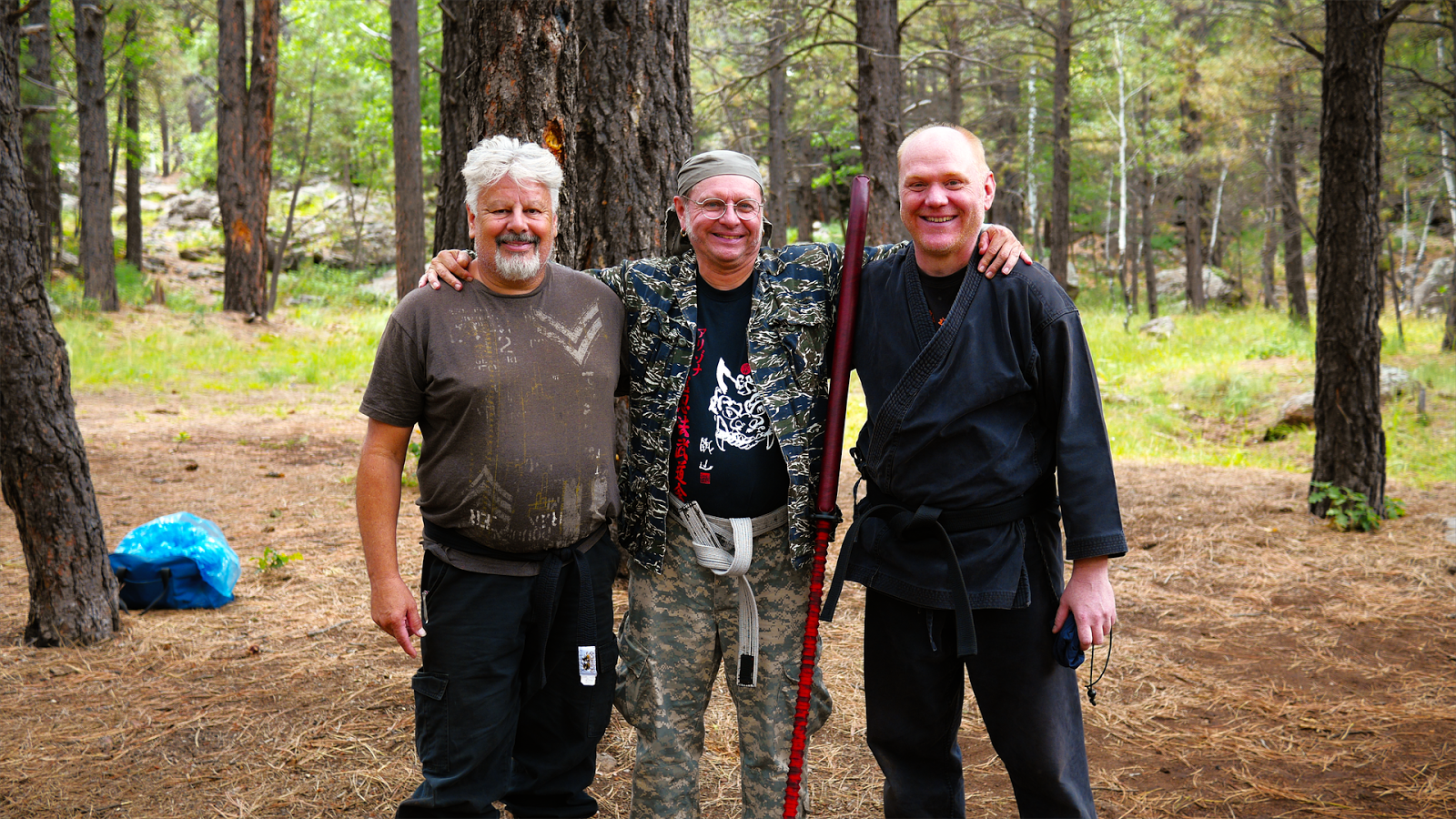
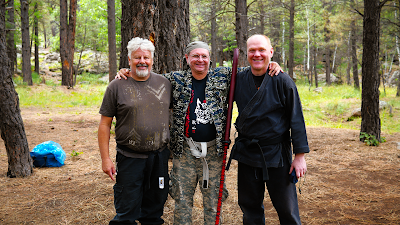
Robert, Peter, and Michael in the Forest of AZ
I went to the annual Arizona Bujinkan campout in the mountains of the Coconino national forest. This is an event I have been participating in for more than 20 years. Big thanks to my teacher, Peter Crocoll, and all of my friends in AZ who welcome me back home every year.

After an 8-9 hour drive from Santa Monica, we arrived mid afternoon to our campsite of over 7000 ft elevation. We set up camp quickly because this time of year, afternoon rain showers are common. But the rain came in the evening.

Heavy and loud with lightning. But I was happy to curl up in my sleeping bag in the cold mountain air for some rest. Adjusting my heart and lungs from sea level can be hard work.

During the night, the rain broke. I woke up with moonlight illuminating my tent. I saw a movement out of the corner of my eye. There was a dark silhouette crawling up the wall. I thought a big insect had gotten inside so I poked at it. It was a tiny frog!

The next morning, I had a very early hike. Then my student, Robert Grove prepared a very hearty breakfast. It turns out I didn’t need to pack any food at all, because he was quite the camp chef.

My teacher, Peter Crocoll began the morning session with nagamaki kihon. Then we moved into some bisento kata he did with Someya Sensei in Japan. The nagamaki has no formal kata in the Bujinkan, so the bisento forms are a useful starting point.

I did some of these forms with Someya Sensei myself during my March Japan trip. They are short, direct, and deadly. A sword on the end of a polearm is a formidable weapon!

During the whole weekend, I would find myself getting too flashy with the weapon. I wanted to twirl, cross step, and brandish it. But Peter kept reminding me that straightforward taijutsu was the best approach. This was also my experience with Someya. This is why it is so important to remain a student, because you never see your own movement clearly.

We trained all day, then had a dinner break. Now it was time for night training. I will not reveal much about this because it is meant to be experienced.

We start when it is dusk, but still plenty of light. Peter asked me to show some muto dori I did in Japan during my recent trip in July. Then he asked my friend Nate to share some of his experience.

As the light faded, our eyes adjust. But away from the city, and out in the wilderness, it gets quite dark. The moon wasn’t rising until early morning. So the darkness was nearly absolute.

Imagine doing muto dori in these conditions. We can’t even see our opponent, much less the weapon. Soon, it did not even matter whether you were facing the opponent or not, since you cannot see even your own hands.

Some people had revelatory experiences in these conditions. I felt myself become the darkness. And that was pure fun!

Afterwards the time around the campfire roasting marshmallows was very relaxing. We shared many jokes and old training stories. Normally this goes pretty late into the night, but many people were exhausted after training all day. I stayed to put the fire out around 11 pm.

Then I went for a solo hike in the blackness. No flashlights. Just pure sensory blending with the dark forest.

Later that night, I awoke in my tent to find the moonlight streaming in. The tiny frog was crawling up the outside of my tent again. I must have parked my tent on top of his home! or maybe he just liked all the dew that condensed on the fabric of my tent.

Next morning, I was up quite early for a hike. Robert again prepared a great and hearty breakfast. I told him that I decided he must come along on all of the camping trips!

Peter continued with bisento waza using the nagamaki. He showed the basic form and the ura waza. Peter takes detailed and extensive notes during his Japan trips. So he always shares the little details that reveal the secrets of our art.

I gave Robert a surprise promotion to nidan. He performed well in this stressful ambush I prepared for him. He already had a shodan from another dojo when he started training with me a year ago. But his martial arts background goes back more than 30 years.

It was hard to say goodbye to my friends (really more like family). And the mountain forest. Training in this environment brings me a bit closer to the experiences of my ninja ancestors from the mountains of Japan.

Why is There an Ox Cart Wheel in the New Bujinkan Honbu Dojo?

From Bujinkan Santa Monica by Michael

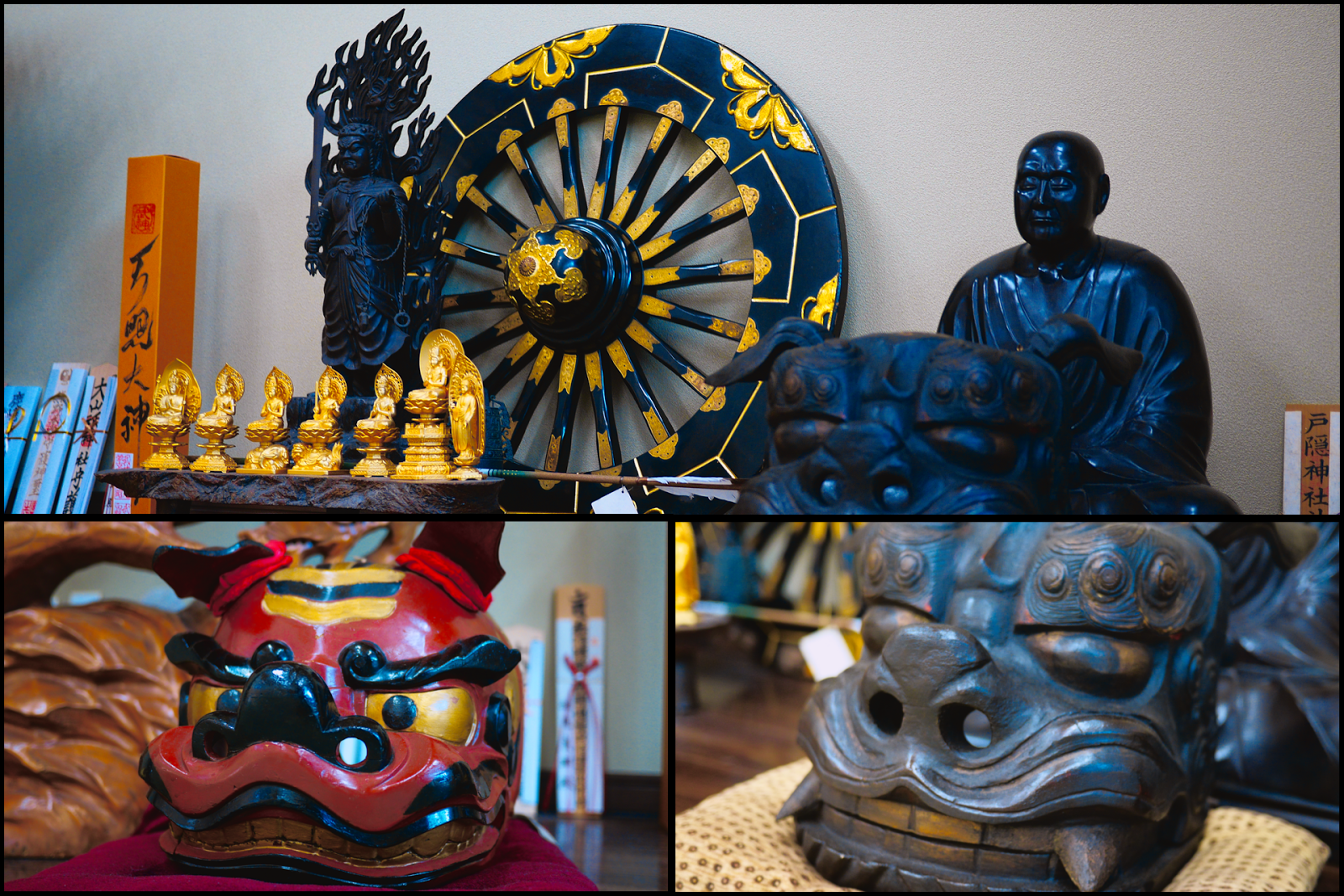
Two shishi dogs and goshoguruma in the new Bujinkan Honbu Dojo. photo by Michael Glenn
Before class, Hatsumi Sensei unwrapped several large objects. Noguchi Sensei was quite curious. Two were the heads of dogs.

I laughed when Noguchi Sensei forced open the mouth of one. As the jaw came unhinged, Noguchi bent over to see if there was anything inside. Then he put his hand in and pretended the dog was biting.

The third object was a large wheel. I turned to my friend Paul Masse and said it looked like a dharma wheel. But I was ignorant.

I look at my students and I know immediately when they understand and when they don’t. It’s natural as a teacher. And Hatsumi Sensei does the same thing. I don’t just feel his attention, I literally see him watching. It is like we are all travelling down the road he built.

He is patient about it. He knows if we stay on the path, it will all work out. That night he even told us,
“I’m giving you some hints so that you can practice on your own. Don’t worry if you can’t do it right away because you won’t be able to do it right away.” 
Well, maybe this wheel is a hint of some kind. I asked Senou, Noguchi, and Nagato Sensei about it and they all said 御所車 goshouguruma. Which is the ox-cart the wheel comes from. In the Heian period, noblemen rode in ox carriages. By itself the wheel is sometimes called 源氏車 genjiguruma.

That is because the wheel is a crest for the Genji (or Minamoto) family. You may have heard of The Tale of Genji. In Japan, an indication of your refinement and culture is to employ motifs drawn from literature that connect to your situation or frame of mind or to the occasion. And you need sophisticated understanding of Japanese culture to be able to identify these motifs. So this wheel often refers to a scene from chapter 9.

In this scene, Hikaru Genji was participating in the purification ceremony of the priestess of Kamo Shrine. In the middle of the crowd who gathered to see him, an argument broke out between the Lady Aoi and the Lady Rokujou about the positions of their ox carriages to have a better view of Genji.

Some people act like this in the dojo! Positioning themselves to gain favor of the teacher. But I don’t think that is the message Soke intends by placing this symbol in the Honbu.

In tonight’s class, Hatsumi Sensei used his fingers to attack as usual. But he said something about this that transformed my understanding of how he uses them. He told us,
“You’re not actually using the fingers. You’re using them as a point, a fulcrum to move around.”
This is like the hub of a wheel! And the fingers could be spokes. I never considered it this way before so I will study it when I arrive back home.

If you want to follow my studies, I include many more details in my personal training notes. You can subscribe here

Like the rolling of wheels, Hatsumi Sensei kept on us about the importance of continuous connection. A wheel must have this kind of connection with the road. If you break that connection, the wheel is useless. Well, Soke told us a similar thing happens when you attack,
“Anybody can just attack, but it takes more skill to control. Everyone tries to attack and that’s why they make mistakes. If you just try to control it leads to the next one. I keep teaching this year that it’s connected to the next move, the next one. Because if you stop right there that’s when you die.”
He next did muto dori against a rokushakubo strike. He told us,
“It's all connected. You have to use the kukan and move in it. It has to be all connected and continuous."
And then he took up 澄水之構 Chōsui no Kamae against a sword. That’s when he revealed,
“Because it’s all connected like this, you take his will, his desire to fight. It’s not about attacking men or dou or specific kyusho. Know the importance of the intervals in the kukan and the connection between those.”
Well, I would add, that you should know the importance of visiting the Honbu dojo and your own connection between you and your teachers. Every trip makes me happy that I have set my wheels on this road. I hope you can travel along the path with me.

The 骨 Kotsu of Bujinkan 手解 Tehodoki

From Bujinkan Santa Monica by Michael

Michael Glenn is frequently beat up in the Bujinkan Hombu Dojo
A little over a week ago, I was in Soke’s class trying to do 両手解 ryō tehodoki. Normally, this is not difficult for me except there were complications. Hatsumi Sensei showed this double wrist escape while he was being punched by a second attacker. Of course, he destroyed them both with little effort.

Soke looked around the dojo. I think he saw everyone fighting. His main point tonight was not to fight at all. He admonished us, “戦わない tatakawanai.”

Hatsumi Sensei watched me and said to do it without waza, without technique. He offered his wrists so I could grab them. I didn’t feel him move at all.

One of my training partners tried to punch him, but was blocked by my own arms. Then we were tangled. My other training partner attacked Soke, and all three of us ended up in a pile on the floor of the dojo. Hatsumi Sensei stood over us laughing. He told me, don’t do it with waza, but with 繋がり tsunagari or connection.

Then he decided to share this most important idea for the whole group. He said,
“Study this way of connecting one to the other. Don’t show that you’re trying to take something. I’m not taking anything, but still holding. If you put it out there too fast they will feel that with their reflexes. Don’t try to take anything. Release or let go in the middle. Remember that the connection is the reality. It’s the waza, but it’s not the waza.”
Well now my mind was blown. The connection IS the reality. Not the fight or any technique. Wow!

Hatsumi Sensei had me grab him again. He spoke as he tangled me up with my partners,
“Don’t try to attack, just consider the importance of connecting one to the next, and the next. This is the 骨 kotsu (knack or secret) of fighting. Very important in a real situation.”
But Soke didn’t knock me down. He just walked away and left me hanging in mid air, about to fall on one of my training partners. I teetered there like I was in a weird game of twister. I guess that’s what happens when you lose your connection.

悪い感覚 Warui Kankaku: Use Your Bad Technique as a Strategy

From Bujinkan Santa Monica by Michael

I get the distinct feeling I'm being watched. I wonder if he would approve?
I sat across the dojo from Hatsumi Sensei. He had just thrown his opponent to the ground. Then he kicked him in the skull. I felt the thud in my legs where I sat. The impact vibrated across the entire floorspace.

Then Soke said something that made everyone laugh, but he was quite serious…
"This is a bad feeling."
He used the words 悪い感覚 warui kankaku. He went on to add that you have to take what's bad, and make it good. This idea hits on many levels for our current Bujinkan study.

Of course when someone attacks you it creates a bad feeling. The bad feeling can also arise when you find yourself in a bad situation. It can even help you avoid trouble before it starts. Take the "bad feeling" and turn it to something good by winning the fight, or by escaping before the fight.

But Soke also meant 悪い感覚 warui kankaku on another level. He meant that we should take our bad technique and make it good. Not just to get better as a martial artist, but to use this as an actual strategy in combat. Use your own bad technique to win!

How do you do that? The answer has a big clue for this year's theme. Soke said,
"Don't think of trying to make it work. You don't have to make this work. Don't be tied up in whether it works or does not. No one ever teaches you that it's ok if it doesn't work."
and,
"It's ok if it doesn't work, because you can change. You can keep going."
Hatsumi Sensei even gave us an example of how to do this. First, you may try to do a technique. Maybe you use a technique that you are skilled with. When the opponent senses this, when he thinks you are about to do a technique, you just take that away from him.

Then you do a bad technique. Maybe one that you've never studied. Or a random henka that doesn't even exist in the densho. This kind of "bad feeling" is a way to steal the fighting power away from your opponent.

This leads to 自然力 shizenryoku, or to a power greater than yourself. Soke looked up from his defeated opponent on the mat. Many of us in the dojo were stunned. He said,
"There's no decided outcome, but because of that, there is. You're not deciding the outcome. You let that be decided naturally. This is this year's theme."
This happened during my first class when I got off the plane and went straight to the dojo. After 20 hours of travel, I could have just passed out in my hotel room because I was "too tired" to go to training. But I would have missed this experience. I'm glad that I took that bad feeling and made it into something good instead.

How to Use 初心 Shoshin to Protect Your Bujinkan Training

From Bujinkan Santa Monica by Michael

Rain brings Summer Flowers to the Bujinkan Hombu. photo by Michael Glenn
During the tea break today, Nagato Sensei said some profound things. He began by speaking about how Soke has said that we should not teach bad people. Then he gave some examples.

Nagato named names. He listed some of the bad people that have passed through the Bujinkan. He aired some dirty laundry with details I won't write about here. Then he also shared how they are dealt with by Soke and the Japanese instructors.

Nagato commented on the interesting fact that Soke does not eliminate these people from the Bujinkan. He said we need these bad people around to learn from them. They are the devils we know. Keep your enemies closer, as they say.

He said in the Bujinkan, we need to be capable of doing worse than the devil himself. He used the mafia or the yakuza as an example of evil. They may be bad, but we are worse. He said they should be afraid of us.

But then Nagato explained that the most important of all is to protect the goodness in yourself. Don't allow your ability to destroy evil, or to be more terrifying than the devil, color your own heart black. How do you stay clear of the bad around you?

Nagato used the word 初心 Shoshin. This is beginner's mind, or the spirit of a newborn. It can also be your original motivation for training. He said people forget why they began training. Then they lose their way.

They get caught in ideas of rank, power, politics, or building territories. And the purity of budo is lost to them. This purity that can both protect and destroy is a gift. Throw it away at your own peril.

New Bujinkan Book, "Dancing Embers" by Sleiman Azizi

From Bujinkan Santa Monica by Michael

Warm People, 日本民家園 Nihon Minka-en, photo by Michael Glenn

My friend Sleiman Azizi has a new book out called Dancing Embers. I’m not sure if Sleiman wants anyone to know, but besides being a martial artist, he is also a poet. Being a poet myself, that was one of the things that drew me to him.

I met Sleiman many years ago during one of my trips to Japan for Bujinkan training. He was not one of the loud, in your face foreigners that one often enjoys in the raucous atmosphere of the Bujinkan dojo. In fact, I may never have noticed him at all had my teacher not introduced us.

I felt a quick bond because of the subversive twinkle in his eye. I often gravitated towards his corner of the dojo during my many visits. Over the years we continued to trade training ideas along with plenty of dry humor.

One day, without knowing why, I turned to him for advice about a pending complication with my upcoming godan test. My mind had been in turmoil for days because of a premonition I had about it. Sleiman gave me a quick suggestion that immediately felt right. I thought, “ok, that’s what I will do.” My premonition turned out to be correct, and it was Sleiman’s advice that carried me through.

For this I owe him my kansha (gratitude) for being a kansha (person of sense).

But, like so many of the people I meet in training, I never felt I really knew him. This connects with one of the central ideas of his book, that you cannot really know budo because it is not there to be known. Especially with Hatsumi Sensei’s expression of Budo. It is like like the sun trying to find a dark place to hide.

So how did I begin to know the author of this new book, Dancing Embers? One day I discovered his poetry. Poetry can reflect the inner world of the author. Poetry and budo have a long history together. This poetry tries to express the inexpressible nature of life and death. The writer may fail, but in the effort we can find beauty.

And it may bring us the closest to knowing the essence of budo.

The closest I can get to knowing Sleiman is by following his thoughts. Or, as he suggests in the book, his 随筆 zuihitsu are the miscellaneous writings he shares so that we may follow the brush of his thoughts. This is like my own experience riding along with him on the train after a great class at the Hombu dojo.

Remember that subversive wit I mentioned? Well, while applying poetry to thoughts of budo, Sleiman often confronts himself and the reader with the ridiculousness of it all. It is like the sufi story where Mulla Nasreddin was throwing handfuls of crumbs around his house. "What are you doing?" someone asked him. "Keeping the tigers away." "But there are no tigers in these parts." "That's right. Effective, isn't it?

With the teaching methods of a trickster, Sleiman’s thoughts and writings often pass judgement. But it is the judgement of fire that burns both the judge and the accused. No one escapes. Not even the author.

This is a common trickster approach. Some of the deepest lessons in Budo are found in this space. Sleiman writes,

“Just as a good chef can taste the mindset of the person who made the food being eaten, so too a good reader can read the mindset of the person who wrote the words being read.”

If you wish to approach your budo from an oblique angle that will provide insights that cannot be found elsewhere, get a copy of Sleiman’s book, Dancing Embers (Amazon link). You will be included in the private conversations and thoughts of someone who has lived many years in Japan and studied Hatsumi Sensei’s budo with a heart full of reflection.

A New Beginning and a New Bujinkan Shodan in My Dojo

From Bujinkan Santa Monica by Michael

The Belt Exchange, Michael Glenn promotes Jesse to Shodan
Yesterday a new 初段 shodan was born in my dojo. My student Jesse proved that he has what it takes both with technique and heart. But he also showed something more which proves his understanding of what it means to be a Bujinkan Shodan.

I don’t give out rank easily. As the day grew closer for Jesse’s initiation, I checked my records to see when he started training. I was very surprised to see that he began exactly 5 years ago! I hadn’t planned for his black belt to fall on that anniversary, but sometimes everything lines up just right.

Jesse doesn’t know yet what it means to be a black belt in the Bujinkan. And of course everyone’s experience is different. I wrote an entire series about the black belt ranks that begins here: Bujinkan Shodan 初段: Searching for the Bull

For me personally, It was a new beginning. It took me a lot longer than five years to get my black belt. Getting there symbolized a re-dedication to the passion I had for Bujinkan training that began in my youth. But also a more mature relationship with training and how it fit into my life.

I have watched some of the same things happen for Jesse. But in ways unique to him. The kind of training we do means that Jesse has had to grow as a person to improve with the martial art.

This is because there is an invisible barrier in the Bujinkan. It is found in your own heart. If you don’t find it and discard it, learning (and often training itself) comes to a stop.

I watched Jesse struggle over the past five years to find that and discard it. It was clear when he did. And his training improved. Now he is a strong example for the younger students. He is also a great reflection to remind the senior students where they’ve been and what training is all about.

Shodan means beginner level. As Jesse’s teacher I personally guarantee that Jesse has well begun! Thank you Jesse and Ganbatte!