Skip to content

誠 Makoto: In Defense of Sincerity

From Bujinkan Santa Monica by Michael

Michael Glenn reflection selfie in Harajuku
I just watched Hatsumi Sensei make an attacker kill himself. This has been happening in every class for the past week. Sometimes it is with a sword, sometimes a knife. But the opponent always ends up cutting or stabbing himself.

I'm in the middle of my Bujinkan training trip here in Japan. And I haven't had much time to write. But also some things in Soke's budo are difficult to express. Like how does he get the attacker to do this?

Hatsumi Sensei told us,
"It's important to do this kind of action through the kukan. Use the kukan, become the kukan. You need to receive the opponent's power and be grateful for his power."
This sounds like a joke but Hatsumi Sensei sincerely meant it. In fact, sincerity became something of a theme my first night here. Hatsumi Sensei painted 誠 makoto for me on a scroll. Of course this has more than one meaning. One is sincerity, another is truth or reality.

Hatsumi Sensei was trying to get us to understand how to use sincerity as a strategy. You may not know this, but kyojitsu only works when it is backed up with sincerity. Truth becomes false, or the false becomes real.

Soke said we can understand the truth from a lie.  When you hear a lie, doesn't it betray the truth? He told us that if we tell a lie we must be very sincere.

In fact I will be very sincere right now when I tell you this: the opponent's attack is a lie. He doesn't really want to hurt you. He may think so, but he only wants his own destruction. You can help him find this truth.

When one attacker cut in very fast, Soke was not concerned. He said that the way to deal with a very fast attack, was to have 平常心 heijoushin. This is a normal calm state of mind that is not disturbed  or surprised by the attack.

Then Soke changed the last kanji of heijoushin. It becomes 真 which can be read as "shin" in the case of truth... or, makoto for sincerity. So what does having this type of heijoushin do for you?

It means that you sincerely want to help the attacker get what he is seeking. This may be his own destruction. And because of your own sincerity, you know from the moment he attacks where to move. His attacks can never hurt you, but they will find their true target. Even if he doesn't know it yet.

空き Aki: Fill Your Bujinkan Training With the Light of Emptiness

From Bujinkan Santa Monica by Michael

Michael Glenn Holds the Empty Teapot, 深川江戸資料館
Hatsumi Sensei told us about a very scary moment in his training with Takamatsu Sensei. One evening they were relaxing at Takamatsu Sensei’s house. Takamatsu was drinking sake. He poured himself another big glass and held it up. He said, “Let’s go train!” And he gulped down all of the sake, slamming down the empty glass on the table.

They went to the nearby jinja. It was late and cold, but the moon was shining down on the shrine. Takamatsu Sensei took out his sword and said, “This is where you live or die. You must grab my sword.”

Hatsumi Sensei told us in that moment his fear left him. Takamatsu came at him with the sword. He instinctively grabbed the blade. He told us that it was a cold night and his fingers didn’t work very well, so he couldn’t fully grasp the blade. He thinks that is what saved his hand from being cut.

Soke said this fact was testament to how good Takamatsu Sensei’s teaching was. This made me laugh because it sounds more like madness than teaching. But, teaching is not necessarily a rational process. And, that Friday night in the Bujinkan Honbu dojo, Hatsumi Sensei could see us struggling to understand this type of technique. He told us,
“There's nothing to do. Wrap him up. The 空き aki, emptiness or the hole is important. In Spain you say aqui, but aki can also be this kukan this emptiness. you connect to this nothingness without doing anything.”
Soke called this idea shinjutsu. Another way of writing aki is 明き. This is like a bright light that opens up to fill the empty space. You don't think about it, but it's there when you need it. You can feel this connection with this kind of space.

Hatsumi Sensei went on to tell us the secret to make this happen,
“You won’t see any waza or technique here. You have to become nothingness, make your body nothingness (体無いし tainaishi) and stay in that nothingness.  If you don’t have to do anything, don’t do anything. In the end it’s not a physical power that matters. It’s being transmitted through the space. It’s more of an energetic or spiritual thing. “
I bet that Hatsumi Sensei didn’t think about all of that under the cold moonlight so many years ago. Takamatsu’s teaching was an organic process that brought his student Hatsumi to this place of life or death naturally. The sword cut down, and in that moment when his fear left him, that's when he became nothing.

After You’ve Taught Everything, You are Left With 意識 Ishiki

From Bujinkan Santa Monica by Michael

Hatsumi Sensei TV interview last month. Photo by Michael Glenn
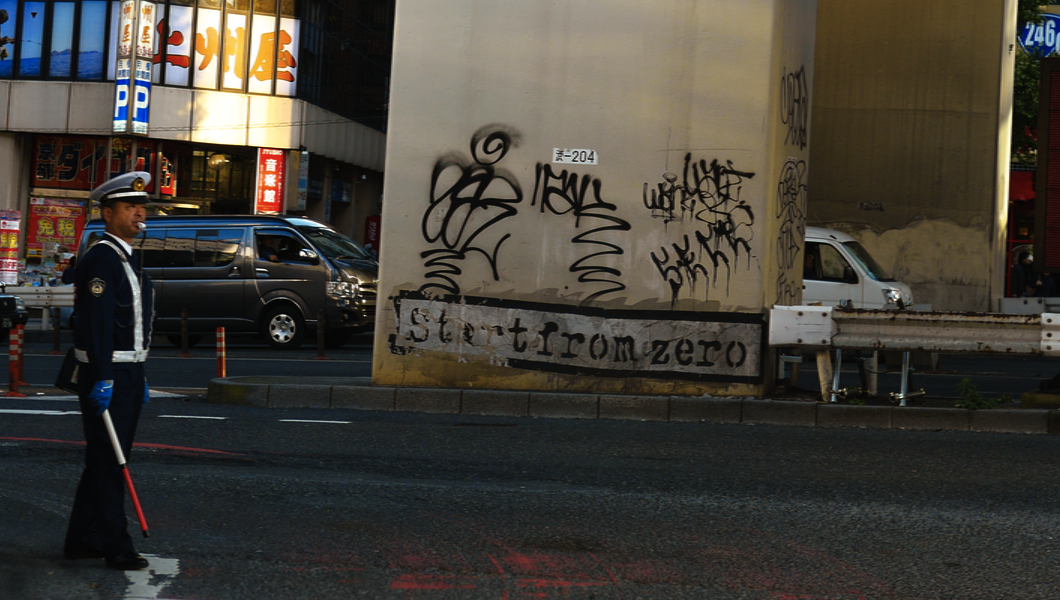
Right now in the Bujinkan, we are starting from zero. Hatsumi Sensei  says he has taught us everything. What will come next will emerge out of zero.

Sometimes there is this weird incongruity when training with Soke. He tosses me around the Bujinkan honbu effortlessly and I am almost 40 years younger than he is. His mind and wit are quicker than most people I know. But the fact is, he is an old man. He himself remarked that “I'm kind of stupid so I didn't realize I was getting older.”

Last month when I was in one of Hatsumi Sensei’s classes, my friend Silvio Herasme asked Soke how does he feel right now?  Hatsumi Sensei said that right now he feels very satisfied or content.

He continued to say that he felt happy that Takamatsu taught him and he could experience this life of budo. He was content to be surrounded by many friends who have been studying for 20-30 years or more. Then he mentioned how dangerous it is to be Soke.

One of these dangers is the onset of age. when we are young, we just train and don’t really think about what is next. Soke has grown old and IS thinking about what comes next. And even though Soke can knock me over easily and put me in great pain, he recognizes his age. He said,
“of course my physical body is deteriorating and getting weaker, but my spirit is unbalanced with the flesh.” 
Hatsumi Sensei says his memories of the years of training with Takamatsu are like images in a dream. When he looks at old photos and the 8mm film of himself with Takamatsu Sensei, he recognizes how bad he was.

Hatsumi Sensei described these days of training,
“Takamatsu Sensei wasn't very specific or hung up on form. He probably saw that I was just so bad at form and I couldn't do anything so he didn't care about the form. Maybe so I wouldn't feel bad.” 
Can you imagine being a young man like Soke was then? Just training hard and fumbling through what his teacher was trying to share. Then suddenly, Soke said,
“About a year before he died he said I'll pass everything onto you. I was kind of disappointed when he did that to be honest.”
This must have been a strange time. One day you are just a clumsy student, the next… you are in charge of the entire legacy. Today Hatsumi Sensei reflects on this time with humility when he describes his younger self,
“They say if you flatter a pig he'll jump up a tree, but then he'll fall out again. That's like me. I'm sort of like that.”
We all burst with laughter. The whole dojo was amused by this country adage. But this great humility was coming from our Soke!

During my whole trip last month Hatsumi Sensei was very reflective on the past 42 years. He said it has taken him 42 years to internalize what Takamatsu Sensei taught him. During those years, he said he has taught us everything that was taught to him.

There’s nothing left to show. No more to teach. We are at zero again.

This brings us to an odd kind of reassurance from Soke. He says that within zero there’s 意識 ishiki. This awareness or consciousness will guide us forward. He speculated that maybe this comes from kami.

Moving forward in the Bujinkan, we are going to continue with this zero feeling. The important thing will be how to internalize that. If you do it with clarity, then what comes next will be born from that.

呼吸 Kokyuu: How Hatsumi Sensei Caught My Breath

From Bujinkan Santa Monica by Michael

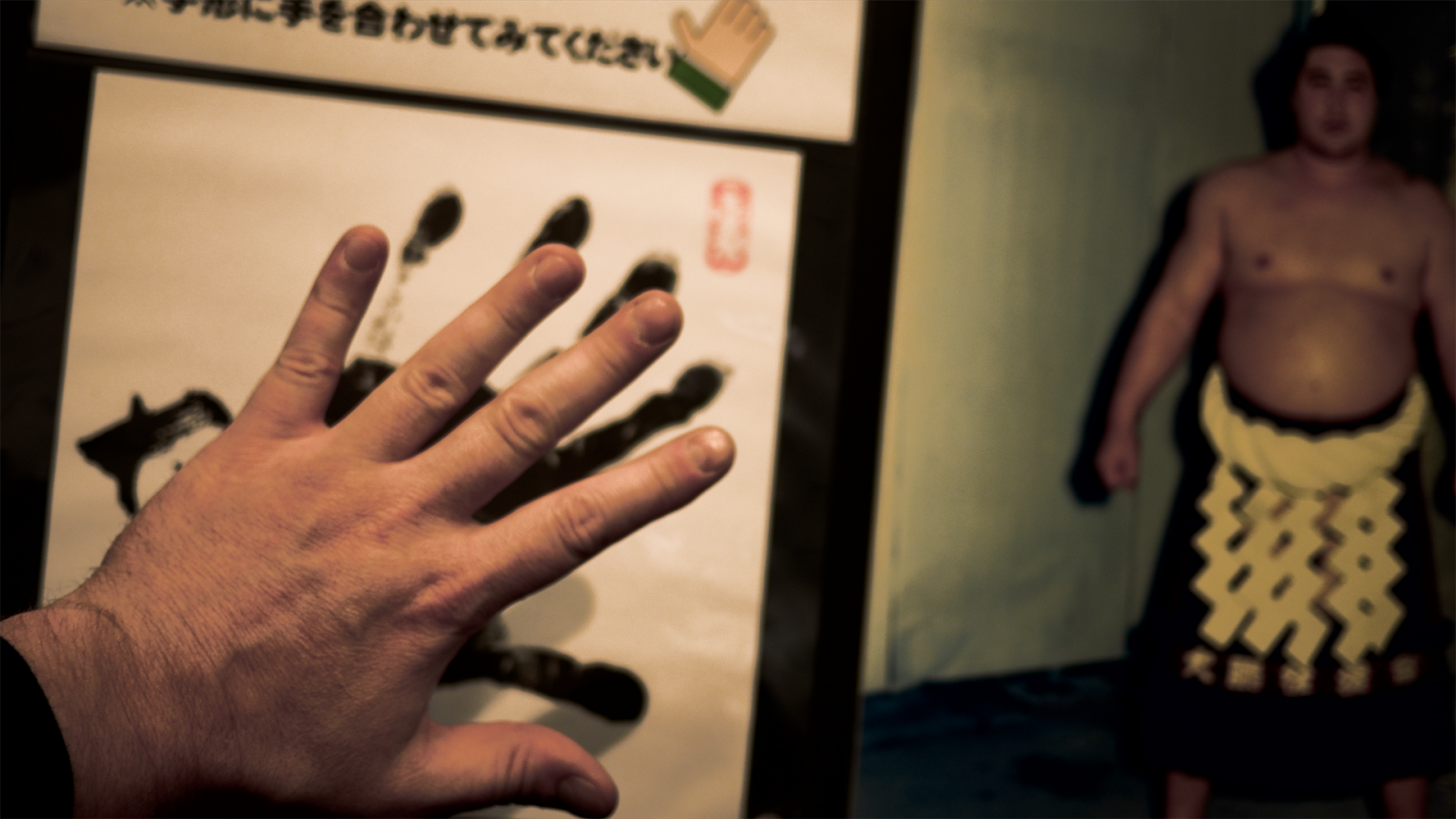
Michael Glenn Joins Hands with 大鵬幸喜 Taihō Kōki at the Fukagawa Edo Museum
I made sure to grip my sword well. My opponent stood before me, almost daring me to come in. I knew that if I didn’t cut in the space of that breath, I would be too late.

I cut, and I was stunned in an instant. I stood helpless at the point of my opponent’s sword… my own blade was slammed to the floor like the earth was a giant magnet.

My “opponent” was Hatsumi Sensei. He laughed as he drove the tip of his sword into my body. This forced my back up against the wood paneled wall.

This flash is burned into my memory from earlier this month. Soke was demonstrating to me a principle of 無く力を合わせ Naku chikara o awase that he was teaching that night. Meeting my attack without power. This principle was a thread that ran through many of my classes this month in Japan.

For some background, one night at Senou Sensei’s dojo,  Senou used the terms 姿勢 shisei: attitude; posture; stance; approach; or carriage (of the body)... And 態勢 taisei: attitude; posture; preparedness; or readiness. This means you can't just do a kata. It all depends on the attack... or the shisei or taisei of the opponent.

In another class Hatsumi Sensei effortlessly threw a series of opponents around the dojo. Each student he called out to attack him was bigger than the last. He was purposely choosing bigger and bigger bodies. He did this to demonstrate the slight changes in technique he used for each person. Soke said,
"When you catch a large fish, you have to change. You have to play the fish."
But how does this happen? If you’ve ever hunted or fished, you know how important it is to harmonize with the movements and mindset of the prey. It’s almost as if you merge with them as you stalk them. Then the moment of the kill creates an incredible concurrence. An incongruous reverence for life appears when you also see your own death in that moment. The body of your prey is your body.

Right after Hatsumi Sensei “killed” me, he said 呼吸から愛人 kokyuu kara ai jin. This is the merging of the breath between two lovers. But Soke used his humorous analogy to suggest you match your movements or your breath according to the way your opponent breathes. You become one with him. Like with a lover.

This was strange to me because it was like he disappeared in front of my cut. By matching me, he became nothing. He met my attack with emptiness. Then my next impression was the sheer force that dropped my own sword to the ground. But it was not his force, it was the shattering of the breath. My own breath. My own life which he had taken in that instant.

Bujinkan Japan Training Winter 2015

From Bujinkan Santa Monica by Michael

Below I share a preview of my Bujinkan video exploring the kata 片胸捕 kata mune dori using concepts from my training in Japan over the last couple of weeks.

Hatsumi Sensei has been very reflective. Part of this comes from his birthday. And part of it is due to the end of a 42 year cycle that he says began when Takamatsu Sensei passed away.

In the full video at rojodojo I share many of the stories Hatsumi Soke shared with us. Some of the details include:

  • What the future holds for the Bujinkan;
  • Hatsumi Sensei’s funny opinion about his 8mm footage with Takamatsu Sensei;
  • How Soke feels about his age;
  • The responsibility of our generation for Budo;
  • Two profound lessons from the 天津鞴韜馗神之秘文 amatsu tatara kishin no hibun;
  • A hidden meaning for 親切 shinsetsu;
  • How does Senou Sensei consider 姿勢 shisei and 態勢 taisei in training?
  • Hatsumi Sensei’s stories of lodging at Takamatsu Sensei’s house;
  • Stories of the terrifying training that Soke did with Takamatsu Sensei;
  • How Hatsumi Sensei survived a live blade attack from Takamatsu;
  • How Takamatsu demonstrated deadly force to Hatsumi Sensei;
  • Why Takamatsu didn’t really teach Hatsumi Sensei form;
  • How “bad people” are dealt with in the Bujinkan;
  • How to keep from being controlled by religion;
  • One of the most important purposes for the dojo;
  • My own experiences as uke for Hatsumi Sensei;
  • Turning accidents into fortune;
  • Cutting through truth;
  • Don’t confuse Fudoshin with kamae;
  • Using the eyes for evasion;
  • Throwing the self away and finding what is hidden in zero;
  • The importance of the “next one.”

Hatsumi Sensei said that he has taught us everything there is to teach in the Bujinkan over the last 42 years. But he added that we will be continuing from zero. Over the coming weeks, I will share more about these details from my experiences in Japan. But I made this video for rojodojo to get this information out quickly. You can enjoy the full length video and help support my teaching over at Rojodojo.com

Ten Ways to 清澄 Seichou

From Bujinkan Santa Monica by Michael

Shibuya, photo by Michael Glenn
A few nights ago, Hatsumi Sensei was trying to give us clarity (澄明 choumei) when he changed the kanji in juppo sesshou to 清澄 seichou which means clear and serene. The idea is that when you have this kind of clarity, you cannot be harmed by any attack. And he has often told us that the Bujinkan can only be understood with a clear, pure heart.

But not many of us in the dojo were clear that day. I think some people may be confused about what Soke is doing with his current line of training. This is understandable, because it is really hard to keep up with Hatsumi Sensei's progression.

This will be the first of several articles about the training I am currently doing in Japan, to receive all of them, please subscribe here.

It's like that feeling when you see your train pull in to the station but you're on the wrong side of the tracks. You know you can run, through the gate, up a flight of stairs, across the overpass, down another flight of stairs… you might even make it before the hiss of the doors closing.

Then again, you might fumble with coins at the gate, your suica card might be tapped out, you might trip on the stairs, maybe you drop your hat, even then you have to swim through a flood of people going the other way as they get off the train.

That's how training feels right now. It's a sprint to catch a train leaving the station. Soke's budo is as high level as ever. It has always been a challenge to comprehend or physically connect to Soke's training. But now, his budo seems to be leaving the station.

Some people seem to think they know where this train is headed, but they are probably wrong. That is what is difficult as a student. We can't understand where Soke's budo is headed because I think Soke is along for the ride too.

From my perspective, Soke's current budo is not fixed, it is searching. He himself has made every effort to let us know about the coming changes in the Bujinkan and the world. He says that he has taught us everything in the Bujinkan, and now he is searching for the "next one."

I get the feeling he himself doesn't know what that is. How can anyone? He has been a shepherd for the schools he inherited, and for us, his students. But the next phase will be out of his hands.

But budo has survived centuries despite the people who practice it. Some people add to this wealth of knowledge and understanding. Other's seek to destroy it.

Yet it keeps going. And anyone with a pure heart can catch a ride. May your journey be clear and serene (清澄 seichou).

Hatsumi Sensei Expands Into A Ninpo Type Feeling

From Bujinkan Santa Monica by Michael

flower across from the pillar of Kyōbashi. Photo by Michael Glenn
Next week I will travel again to Japan for Bujinkan training. My 3rd time this year. That may seem excessive, but the experiences I enjoy each trip help me discover the “secrets” of our art. For example, here is a lesson from Hatsumi Sensei that taught me how to be a lucky ninja.

One Friday night Hatsumi Sensei was showing us ninjutsu. Sometimes people who don’t understand our art ask, “when is Hatsumi Sensei going to teach ninjutsu?” Well he teaches these secrets all the time. But the secrets are hidden in plain sight… If you understand what you witness.

He began by striking with a koppo ken. But the koppo ken doesn’t arrive directly. It is hidden within the pattern created in the kukan. Soke said,
“Don't strike in one pattern. Expand into a ninpo type feeling.”
Then he called me out to demonstrate. I punched. He started to perform what I thought would be a ganseki nage. But that evaporated. And as the form disappeared I was thrown by something else.

Then Hatsumi Sensei said that we cannot hold onto form. Don’t let what you are holding become an obstacle.  He continued to say that もっけさせる mokke saseru is a きまり句 kimari-ku of ninpo taijutsu.

Well, this saying of ninpo is quite deep. It has layers of meaning. Mokke is something unexpected, like a mysterious apparition. But, to keep it simple, we can just consider that doing the unexpected in a fight can lead to victory.

But “mokke” can also refer to getting lucky, like a sudden windfall. Except here you create your own luck. In another class I had with Hatsumi Sensei many years ago, he said,
“you have to be the type of person that lucky things happen to” 
So how did Soke create his own luck when he threw me? He made the form of ganseki, then let it go. In that gap, that space that opens up when the form is abandoned, freedom occurs. And the opportunity to “get lucky” appears.

Many martial artists struggle with this. People who are attracted to martial arts tend to want to control a fight, control danger, control themselves. But, if you are holding onto form or seeking to control a situation, there may be no room for luck.

You should make room for own luck. Just add your email to get the details about my latest Japan training.

The 生き様 Ikizama of Bujinkan Sanshin and Mutō Dori

From Bujinkan Santa Monica by Michael

日本庭園 nihon teien in Aoyama. photo by Michael Glenn
You might learn one thing in class, and then another time, you learn the opposite. Ura and Omote. These are not contradictions, but rather they are part of one another. Like 陰 in and 陽 yo.

In my own classes, we recently studied 隼雄 shunū and 隼足 shunsoku. For these mutō dori, Hatsumi Sensei has suggested that we don’t try to catch the opponent’s sword. Instead we should entrap the sword’s very existence (生き様 ikizama).

This means you don’t focus on the weapon as a physical object. You focus on it’s entire existence in space and time. What is the weapon’s potential in any moment? Soke says,

“in mutō dori, the past present and future, the time before drawing the sword, after drawing, or when the sword has been re-sheathed., what may be called the nature of the sword’s existence(生き様 ikizama) … one entraps that.”

This is because the nature of the sword itself is not a threat. One moment it may be tucked in a corner or sitting on a rack gathering dust. In a different time it is red hot metal being hammered into shape by the smith. In all of the sword’s existence, how much of its life is spent in violence? Maybe just the space of one breath.

While this gives us some insight and philosophical strategies for mutō dori, there is a flip side. Last week I taught the opposite of entrapping the sword’s existence. What is this ura of mutō dori?

In this class, we were drilling 居合間合 iai maai using Gogyō no Kata. You have all heard how important sanshin is in Bujinkan training. And this is one example why. When you truly embody sanshin, you can do it with any weapon.

But people can’t. Someone who knows perfectly well how to do sui no kata... you give them a weapon and suddenly they fumble. This is where the ura side of mutō dori can help.

The opposite of entrapping the sword’s existence is to set it free.


For example, instead of trapping the sword’s existence, we set it free. This is the way to “use” any weapon. Let the nature of the weapon itself free as you move through space and time. Then the patterns of the weapon’s existence can emerge to protect you.

This is what sanshin teaches. It is 自然観 shizenkan, an insight of nature. Soke said that Takamatsu Sensei told him that having 自然的度胸 shizenteki dokyou (natural courage) was the most important. This is what arises out of the sword’s existence when you set it free. This is what you can learn from the 生き様 ikizama of sanshin.

If you want to study sanshin with me, here is the seminar schedule: Upcoming Bujinkan Sanshin Seminars

Do You Have Enough ゆとり Yutori to do Bujinkan Shadow Techniques?

From Bujinkan Santa Monica by Michael

Shadows in Soke's window, photo by Michael Glenn
Last night I did an omote gyaku on my opponent’s wrist by kicking it out of the air. Then I rode it down to the ground where the wrist would break as it is crushed to the earth by my foot. But I had the control to just pin it down.

My students were very surprised. But so was I. I have seen Hatsumi Sensei apply locks before where the opponent’s body just seems to assume the form of the lock without any contact from Soke. I first heard Soke describe these “shadow techniques” (kage no waza) during one of my trips to Japan in 2003.

I never understood them before and definitely never thought I would be able to do them. But during my trip to Japan this last summer, Soke helped me put the final pieces of this puzzle in place. So now here I am, surprising myself with my own kage no waza.

You must train deeply to learn all the elements that make kage no waza mysteriously arise in the kukan. And I have been puzzling over this ability for years in my own training. Here is one key piece of the puzzle that Hatsumi Sensei personally shared with me so I could go home and study his feeling.

We were practicing multiple attacker scenarios in the Bujinkan Honbu dojo. One attacker grabs both of your wrists, the other kicks or punches at you. Then Soke told us,
“Don’t try to control him right away, just have a lot of ゆとり yutori (breathing room; elbowroom;  leeway;  room;  reserve;  margin;  allowance;  latitude;  time). The connection is very important. You don’t have to throw him or show anything pretty.”
We all tried to do as he said, but most people in the dojo fought with their partners. Hatsumi Sensei laughed while he watched me struggle with my opponents. He took pity on me and came over and asked my to grab his wrists. Then, my two training partners attacked him.

From the moment I grabbed him, I felt like a pawn. He was using my own attempt to grab as a weapon against all of us. He very casually tangled us up and left me floating in space with my training partners collapsed beneath me on the tatami. I had to twist my body just to not fall on top of them.

Soke stood there laughing at me as I hung in the air.  Everything he did was so casual. There was no rush, no force. When I recovered my balance he told me,
“You do this without waza. Wakarimasuka? Do it with tsunagari.”
Not with technique, only through 繋がり tsunagari, which is connection. Did I understand? Usually when something is above my skill level, I understand things intellectually or in theory. But this time I understood the feeling with my body. And something more…

Hatsumi Sensei decided to share more of this lesson with the whole dojo. He said,
“Use your elbow here.  Don’t try to do anything, just put it out there. Keep it attached to your body. Study this way of connecting one to the other. Don’t show that you’re trying to take something…
…remember that the connection is the reality. It’s the waza, but it’s not the waza.”
Ha! This is what I wanted to tell my own students last night. They stood there looking at me like I had done a magic trick. But it was just an extension of the training I had done with Hatsumi Sensei. This is the kind of magic that fuels ninja mythology. So we are very lucky to find it in our everyday Bujinkan training.

How Hatsumi Sensei Adapted the Ura Waza of Sanshin no Kata to a Confined Space

From Bujinkan Santa Monica by Michael

Not so clumsy Butterfly at Nihon Minka-en. Photo by Michael Glenn
When anyone tries the ura waza for our Bujinkan Sanshin no kata for the first time they “blunder and fumble like a moth,” in the same way I quote clumsily from Faulkner. I show it to them, then they try it… then crash and burn. You can almost see the synapses misfiring across the hemispheres of their brain.

Not many Bujinkan teachers train the ura waza of 三心の型 sanshin no kata. And our bodies get used to the kata we always do. In my own classes, I use many approaches to sanshin to keep us adaptive. Each time we do it, it should be new again.

I will be teaching this as part of my Rojodojo Expert Rally if you want join us in Phoenix or Chicago. If you can’t make those cities, you can invite me to visit your dojo. As Hatsumi Sensei says, these things are 参考書 sankousho (a reference) for training.

I felt new again when Hatsumi Sensei showed a very practical use for the ura waza of sanshin no kata during one of my visits this year to Japan. He was showing how to use kakushi buki and he said,
“It's like the sanshin no kata. You go with the body like this.  When you don't have space (kurai dori for a 狭い semai, narrow confined, small space) you do it like this. Study that when you can't move.” 
We all tried it, but I think you can’t master it immediately. Especially when your brain and body are used to the kata you normally do. When I teach this ura waza, I literally start with putting one foot in front of the other. If you can get that small detail, you are on your way.

We should not try to be experts all at once. Rather, we should strive for the process of continual small improvements in training. It is the aggregation of these marginal gains that leads to mastery. I hope to see you at one of my Rojodojo Expert Rally’s! You can also join my email list for future updates.