Skip to content

VIDEO: Paul Masse 書道 Shodo and 水墨 Suiboku

From Bujinkan Santa Monica by Michael


Besides training in the Bujinkan with Paul, I have had the privilege of many great discussions with him as an artist. I am an artist myself, so we connect easily on that level. We got together one afternoon during his visit to Santa Monica to discuss his artwork. If you can't view the video above, here is the link: Paul Masse 書道 Shodo and 水墨 Suiboku

If you didn't already know, Paul has studied Japanese Calligraphy or 書道 Shodo, Japanese Ink Painting or 水墨 Suiboku, and Japanese Pottery. He has even been reviewed by Hatsumi Sensei! Wait till you hear what Sensei said about his work…

He was kind enough to share some of the feeling behind his work as well as some tips for beginners at this style of art. If you train in the Bujinkan, or are an artist yourself, I know you will find a lot to be enthusiastic about in our video.

Paul Masse, kickin’ it in Santa Monica

From Bujinkan Santa Monica by Michael

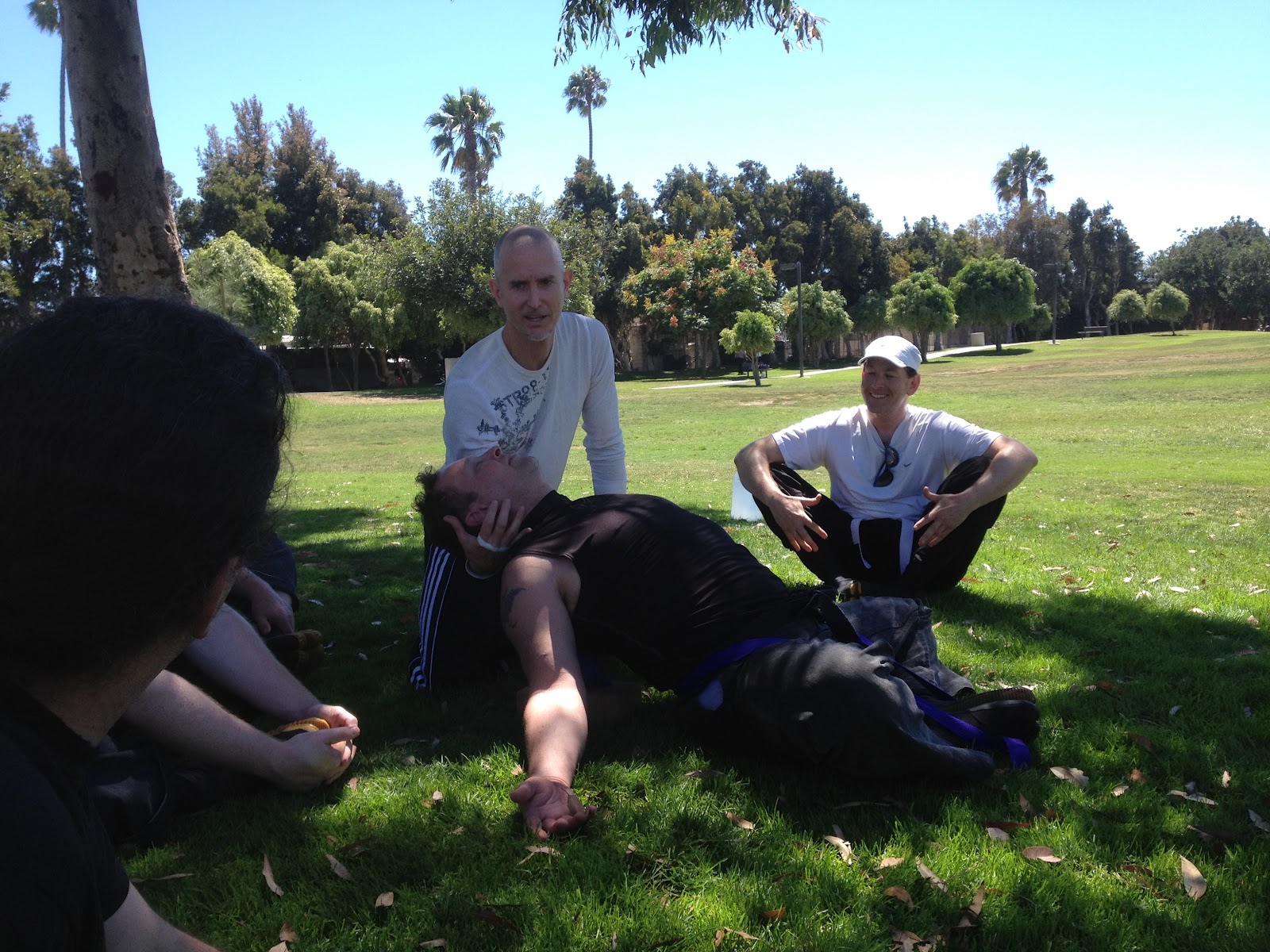
Paul Masse puts Dante in some weird Yoga Bondage
I was lucky to organize some last minute training when Paul Masse called me a few days ago to say he was going to be in Santa Monica.

Paul has traveled to India recently and studied yoga in Rishikesh. He was overflowing with an abundant need to share (or torment) us with some of his unique yoga experiences. So we began with Paul's 柔軟体操 Juunantaisou by way of India.

In between our normal taijutsu study, Paul would insert yoga experiences throughout the day. At one point when I looked around at everyone who was groaning as they tried to get into a pretzel, I raised my fist and said, "damn you Paul! Why did you have to go to India?" Even though these yoga poses were difficult for me, I gained a lot from Paul's enthusiasm.

As far as the taijutsu went, it was fantastic. Paul moved very quickly through concepts and henka to present the feeling he wanted to convey. If I had to pinpoint a theme for the day, it would be that kyusho are everywhere in the kukan and we attack them with kyojitsu..

If you know the meaning of these words, then you may realize what a deep idea this becomes. Someone asked Paul what kyojitsu means, and he worked hard not to fall down an ontological rabbit hole as he tried to explain. Simply put it means the interplay of real and unreal, or true and false in the moment. But the hard part to get your head around is that the real and unreal exist simultaneously, all the time, and everywhere.

After a yoga break, or was it the neti break, or maybe the handstands break? Paul focused on using the hanbo. Or rather, not using the hanbo. He and I spoke in some detail about our experiences in "not using" weapons and he riffed on that for the rest of the day.

He described one end of the hanbo could be the kyo, and the other could be the jitsu. His uke's might get hit with either. He shared the concepts of 中途半端 chuuto hanpa, and 決まってない kimatenai with everyone as a way of "not using" the hanbo.

At the end Paul did some calligraphy for us. He brushed out kamiwaza for me and did a variety of others for everyone there. He shared some of his new artwork with us. To my eye it was more refined than ever. Some of it was based on gokui. This matched up with the whole day as Paul was dropping the gokui on us with gusto!

Thanks for your visit my friend...

The Kaname of 神眼 Shingan

From Bujinkan Santa Monica by Michael

真是厲害的鏡頭 photo By *嘟嘟嘟*
Hatsumi Sensei has suggested that another reading of 神眼 shingan is kaname. As we study this years feeling it might become important to see with the divine eyes of shingan. To truly comprehend this principle requires we understand how to connect to the divine.

In my recent video about 不動座 fudouza, I suggested some symbolism that connected the heavens, down through the conduit of our physical bodies, and into the earth. The way Hatsumi Sensei describes this connection, it's not him doing the techniques, but they are being created through this connection. No matter your beliefs or religion, it is crucial to understand the foundations of Japanese symbolism to get the feelings behind our art.

Hatsumi Sensei says that one way to learn this is through Sanshin no kata that is connected to the heavens. It is connected through heaven, earth, and man (tenchijin). He further describes this as  天動説 tendousetsu, 地動説 chidousetsu, and 人動説 jindousetsu.

天動説 tendousetsu is a word that describes Ptolemaic theory in Japanese. This is what we also call geocentric. An old theory where the earth is the center of the universe. Everything is connected to this axis and everything revolves around it. In my video I described this as the axis mundi.

地動説 chidousetsu is the Copernican theory which is heliocentric. Here the sun is the center of everything where we and the universe are connected to revolve around that axis. This idea of revolving or pivoting is crucial for our understanding of kaname.

人動説 jindousetsu is a theory of dynamic human change and movement. In the esoteric varieties of this theory, the stars are directly connected to the human spirit and move as we move. They shine brighter or may even blink out in connection to our lives. This theory seems to stem from the Chinese Xuanye shuo 宣夜說 Firmament hypothesis. Here the tian (天 ten or even kukan) is an infinite space. Celestial bodies are light matter floating on it and move by Qi.

Modern science has made these theories obsolete. But the cosmology and symbolism may still have resonance for us. Jindousetsu becomes connected to ideas of relativity in science and futurism in art. As we move through the kukan, our frame of reference constantly shifts and the world is in dynamic change from our perspective.

Soke says this is connected to the body language of fighting. Being able to read your opponent's ability, temperament, defenses and attacks tells you which frame of reference he is operating from. So if you adopt a larger frame of reference (possibly even one that is connected to the heavens), you can easily manage his attacks. In effect he becomes unable to harm you because you are operating above and outside of his ability.

This is like taking the high ground in military strategy. A drone operator has no need for body armour because his enemy's bullets can never hit him. The drone pilot is operating from a different frame of reference.

If we connect to this type of dynamic change in our training, the waza become alive. Sensei says that because this is a living thing it changes. It's varying within its existence. In this way it is connected to everything else.

Don't be static, have 人動説 jindousetsu!

VIDEO: 不動座 Fudouza

From Bujinkan Santa Monica by Michael


Here is a quick video for all my readers about 不動座 fudouza.

If you can't see it above here is a link to the video:  不動座 fudouza

This is not a description about technical details of sitting in this kamae, but rather more about the feeling and symbolism associated with the "immovable seat."

 I describe fudouza's connection to the symbolism of axis mundi, which is the central point around which the world revolves. I then tell a story about the Buddha and his battle with mara while seated under the bodhi tree. What happened when he got up after reaching enlightenment?

I detail a bit about 坐り型 suwari gata in the Bujinkan, and how Hatsumi Sensei sometimes approaches this with the feeling of Daruma.

Oh, I forgot, I also caught my first clumsy writing of the kanji for 不動座 fudouza on camera!

And lastly I suggest a tricky way to leave Fudouza. Be careful if you try it!

The Rise of 生物奇怪 Seibutsu Kikai

From Bujinkan Santa Monica by Michael

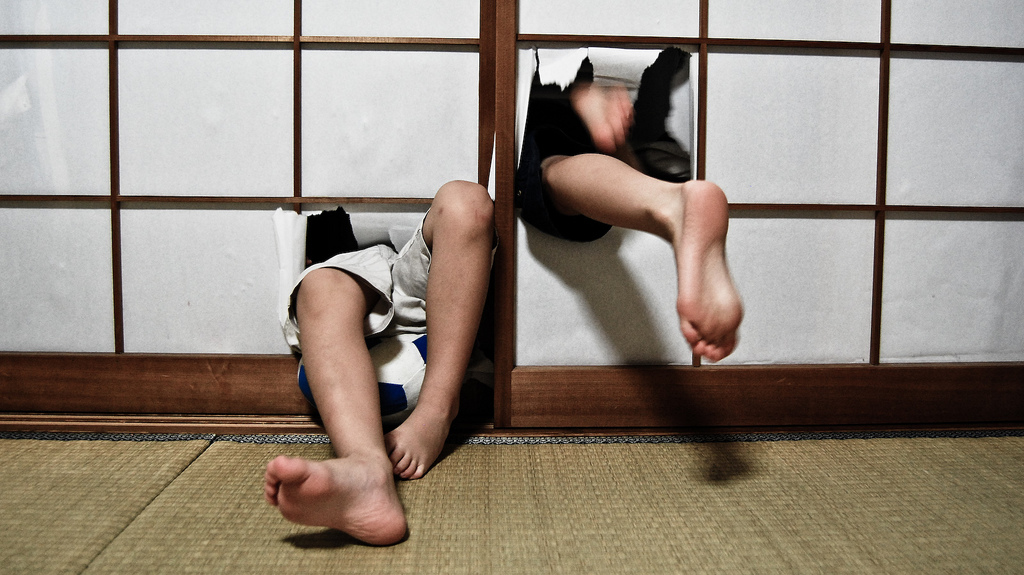
When Stunts Go Wrong, photo by Loco Steve
In our modern world, combat has evolved to an industrial and mechanical affair. Machines (機械  kikai) do the killing at a distance. For martial artists this can feel overwhelming or outside the scope of our training at a very human scale. But the Bujinkan also evolves with the times. Even though we study ancient weapons and arts, we must also keep our training alive to address modern concerns.

I was reading this humorous article about not being afraid of the robot apocalypse or of being destroyed by terminator robots: What if there was a robot apocalypse?

In this article the author explains how difficult it is for robots or computers to adapt. How easily they can be defeated by simple, and often natural methods or elements. For example, a fire hose turned on most robots will quickly end their rampage. Or a simple fishing net thrown over a robot would easily entangle its mechanics. Anything messy, really. Tar, mud, water, rubble, contaminated fuel… robots and computers are easily overwhelmed by the natural world.

The main reason drones have been so effective in combat is because they have human pilots, and they fly high above, and away from obstacles.

Reading about this reminded me of something Hatsumi Sensei has encouraged in our training. How may we address these types of warfare in the Bujinkan? I will not post any direct methods here, but Hatsumi Sensei has suggested a strategy for the future.

He suggests we should adopt a philosophy of seibutsu kikai (生物奇怪論に立って). A "living mysterious being theory." This is similar to hijoushiki 非常識. An irrational absurdity. It is like something supernatural, but as an extension and connected to the natural.

Seibutsu kikai is also cryptozoology. In Japan there are tales of Hibagon, Tsuchinoko, Kusshii, Isshii, Kappa, various Yokai, Mikoshi-nyūdō, Nue, Kasha,  Noderabō, Yamao, Buruburu, Nekomata, Shuten Dōji, Yūrei, Shiryō, Yanari, and Tengu, These mythical creatures and spirits exist in our dreams and nightmares throughout human history. They all have special traits, powers, or abilities. But they are difficult to find or hunt down. Do they exist? Did ninja? How would you go about finding one?

You cannot. And therein lies an important strategy. As Soke suggests in a play on words, this is 機会 kikai, or a time of opportunity. Drones, robots, and computers rely heavily on sensors and digital information, but how does one digitize a ghost? How can a robot fight a mystery?

Keeping this mysterious connection alive in our training is essential for those who have progressed beyond Godan, but also essential for the survival of our art as machines move beyond service to being replacements for us in life and combat. A machine could pass the Godan test with the proper sensors, but it could never properly give the Godan test. It will never have that connection. And there it will always be weak.

Shot to the Heart of Kaname 要

From Bujinkan Santa Monica by Michael

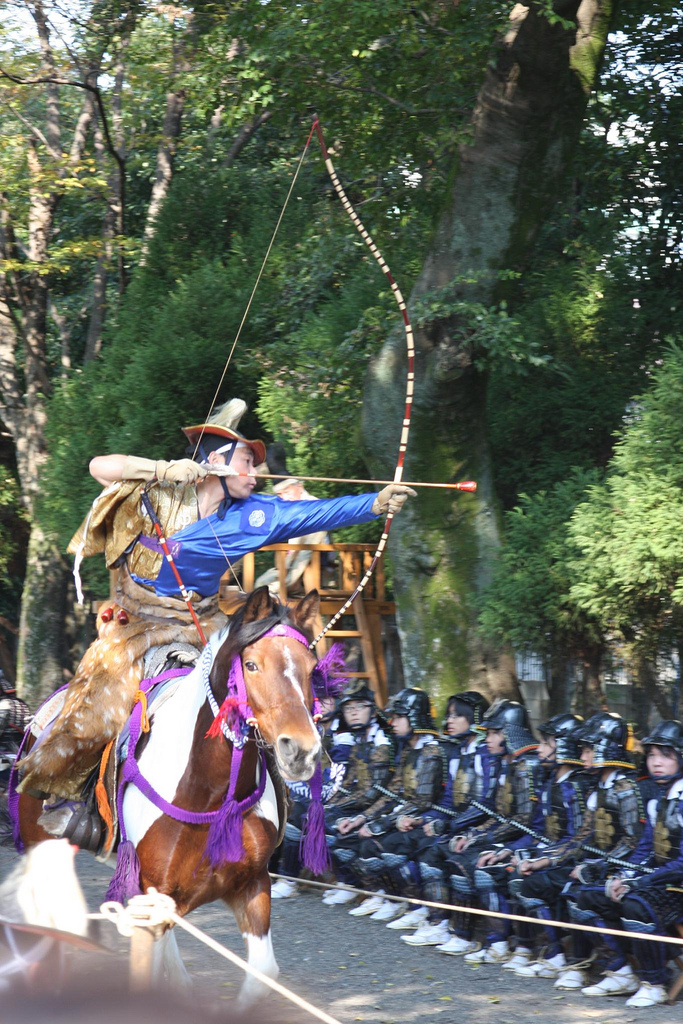
Yabusame 流鏑馬, Kumamoto-shi, JP. photo by malfet_
We are more than halfway through 2012 and training has been great! Back in December, I wrote about a class where Hatsumi Sensei suggested some possibilities of a theme for 2012. As often happens the theme has evolved to express other ideas than those Hatsumi Sensei shared in December. One idea that has emerged has been an exploration of the idea of kaname 要.

Kaname 要 can be described as the essential or vital point of a technique, of a moment, or of strategy. It is essential because victory or defeat can pivot at this point. Everything hinges on grasping this moment. But this is not a new idea from Hatsumi Sensei.

At last year's Daikomyosai, Soke gave us a lot of focus on the concept of Kukan no kyusho. At the time, besides having my eyes opened, this concept felt pivotal to everything we are currently studying in the Bujinkan. And, it turns out that kaname and kukan no kyusho are getting at the same feeling. In years past, Soke has also used the terms koshi or koppo to get at this idea of a key point that controls things.

This kaname, or kyusho in the kukan, is very dynamic. So when you connect to it and affect the situation, change the uke's balance, strike a kyusho, or win the fight… The situation changes. And you must change with it to connect to the new vital point of the moment. What is fascinating is that through this process you will discover pivotal points that were hidden from your normal level of awareness and ability.

There is a secret here that I cannot describe or even teach. Soke hints at it in the scroll he painted for this year: shinryuyogo 神龍要護. You will notice the character for "yo" is the same as kaname. And "go" is the same as mamoru which means to safeguard or protect. But another secret here has to do with shinryu or the divine dragon.

Here is an excerpt from my recent training notes on this:
"With both ideas you can use these essential points as pivot points. But what is being pivoted? Certainly you can pivot your body around a point in space that you feel is essential to the execution of the technique. But that is a very flat or two dimensional understanding of kaname.

To expand the concept what is really pivoting is your shin 心 (heart, mind, or spirit) or shin 神 (spirit or kami). Both you and your opponent's "shin" are pivoting around in the kukan. This allows for the spontaneous creation and use of any henka, but also kyojitsu, rokkon shoujou, juppo sessho, roppo kuji, kuki taisho… or any number of principles that respond to the dynamics of the instant!

And our shin 神 are pivoting around each other as well as the real essential point which is the connection to heaven  or: chance; fate; destiny; karma. We can stay connected with 因縁 innen which is the underlying source of all actions or the origin. This is the true shinzui 神髄  of kaname that can lead us to the expression of kamiwaza 神業 ."
What I wrote above is a sample of what I send out 3 times a week to subscribers. If you haven't subscribed to my training notes you can get them here: 稽古記録 Keiko Kiroku

Last year Hatsumi Sensei shared a story that gets at the depth of feeling behind kaname. It comes from a famous moment in the epic tale of Heike (平家物語), During the Battle of Nashima in 1184, the enemy retreated to their ships. They placed a fan on top one of their masts claiming that it protected them from archers on the shore and they dared the Minamoto to shoot it off.

An archer, Nasu no Yoichi 那須 与一 who was known for his accuracy but not his strength, rode out into the sea on horseback to get close enough. With the waves splashing around the horse's neck, and rolling the ship around in the surf, somehow he loosed his arrow and split the fan in two!

Soke explains that this moment had such power that "it pierced the heart (kaname 要)" of the Taira army and the Minamoto were victorious. It was also a pivot point or turning point in the entire war. This moment has power in our imaginations to this day as it is retold and represented by artists with great reverence.

So in my own training for the first half of 2012, I have been exploring Kaname in our training as the essential, or vital point around which the technique, fight, or taijutsu derives its' power. The results have been spectacular for me and I can't wait to study it more and train even harder.

Bujinkan Jūdan 拾段: In The World

From Bujinkan Santa Monica by Michael

In The World, digital c-print photograph by Andrew Binkley
Hatsumi Sensei describes the journey of a Bujinkan student through the Dan ranks as being akin to the Ten Oxherding pictures in Zen Buddhism. These pictures describe the seeker's journey to enlightenment.

If you haven't read my other posts in this series, please check them out. You may find them useful no matter what your rank is:

Bujinkan Shodan 初段: Searching for the Bull
Bujinkan Nidan 弐段: Discovering the Footprints
Bujinkan Sandan 参段: Perceiving the Bull
Bujinkan Yondan 四段: Catching the Bull
Bujinkan Godan 五段: Taming the Bull
Bujinkan Rokudan 六段: Riding the Bull Home
Bujinkan Nanadan 七段: The Bull Transcended
Bujinkan Hachidan 八段: Both Bull and Self Transcended
Bujinkan Kyūdan 九段: Reaching the Source

Now as a Jūdan, you may stroll casually through the dojo, yet your steps are not misplaced.
Woodblock print by 德力富吉郎 Tokuriki Tomikichirō
 入鄽垂手 In the World
Barefooted and naked of breast,

I mingle with the people

of the world.

My clothes are ragged and dust-laden,

and I am ever blissful.

I use no magic to extend my life;

Now, before me, the dead trees

become alive.

I have abandoned the whip and ropes

All ideas of shuhari 守破離 have been swept away. Anyone still in the cycle of shuhari will not see the source of your freedom. Simply,
"You destroy whatever needs to be destroyed, you subdue whatever needs to to subdued, and you care for whatever needs your care." - Chögyam Trungpa
As one who has reached the peak of our Bujinkan training experience or found enlightenment as in the Oxherding poems, you appear remarkably unaffected. You have internalized our art and this is reflected purely in everyone you meet. In this reflection you see wonderful taijutsu expressed by any student of the art.

This stage is one of freedom. You don't consciously show any signs of ability or seniority. Nor do you adhere to any rules, forms, or training regimen. Yet simply and without striving, you express mastery.

Hatsumi Sensei quotes Confucius, "Those that understand play have life's greatest treasure."

It is strange to no longer show any skill. Skill is too limiting and you have slipped free of that trap. Yet you are a great help to others who may be seeking skill. Students grow just by being around you. This is Shinden 神伝.

Some may turn away from you or critique your abilities. You reply with a smile. Tenkataihei 天下泰平, all is peaceful under the heavens.

People expect that someone of your level will have incredible skill and almost supernatural technique. You know those skills are there but realize they are actually ordinary illusions and even unnecessary.

Your pure state is reflected in everyone. As you shine forth, anyone may collect some of your light. You simply help anyone you meet to grow and learn. This happens naturally without concern for compensation or worry about who accepts your help.

Hatsumi Sensei says that Shōsan had the feeling of "The heart that thinks of oneself, suffers. The heart that thinks of others, is free."

This journey through Jūdan and the ten Oxherding poems and pictures was inspired by Hatsumi Sensei's teacup that has these ten drawings. He says as he sips from this cup, "It is the moment when tea and Zen are one."

And you are there like the moonlight reflecting in a hundred cups of tea. Each reflection is whole, yet nothing takes away from the moon itself.

Bujinkan Kyūdan 九段: Reaching the Source

From Bujinkan Santa Monica by Michael

Reaching the Source, digital c-print photograph by Andrew Binkley
Hatsumi Sensei describes the journey of a Bujinkan student through the Dan ranks as being akin to the Ten Oxherding pictures in Zen Buddhism. These pictures describe the seeker's journey to enlightenment.

If you haven't read my other posts in this series, please check them out. You may find them useful no matter what your rank is:

Bujinkan Shodan 初段: Searching for the Bull
Bujinkan Nidan 弐段: Discovering the Footprints
Bujinkan Sandan 参段: Perceiving the Bull
Bujinkan Yondan 四段: Catching the Bull
Bujinkan Godan 五段: Taming the Bull
Bujinkan Rokudan 六段: Riding the Bull Home
Bujinkan Nanadan 七段: The Bull Transcended
Bujinkan Hachidan 八段: Both Bull and Self Transcended

Now that we are at kyūdan, we have not only reached the source, we have returned to it:
Woodblock print by 德力富吉郎 Tokuriki Tomikichirō
返本还源 Reaching the Source

Too many steps have been taken
returning to the root and the source.

Better to have been blind and deaf
from the beginning!
Dwelling in one's true abode,

unconcerned with and without -

The river flows tranquilly on
and the flowers are red.

I have abandoned the whip and ropes

From the outside looking in at this stage of training is confusing. From the outside it makes your entire training regimen seem pointless. From the outside it appears the destination of training is to return to where you started.

Your black belt has frayed and worn so much that it is a white belt again. Maybe you should have just kept the white belt in the first place! There have been many temptations to give up training altogether.

Good technique, bad technique are exactly the same. Winning or losing are no different. Attacker and defender are exactly the same. So you may never have trained at all, and you will be at the same place.

From the outside, students see teachers at this stage sometimes acting like unskilled white belts, and the students may lose faith in their teachers or in their own path.

The truth is, this way of understanding taijutsu starts long before kyūdan. It starts as soon as we begin to develop natural henka. It can be found in the expression of 梧心の型 Goshin no Kata. The difference is that by this level, you no longer simply perform henka, you embody 変化 henka.

Henka exists as not only variations on technique, but as a continual metamorphosis.

We are no longer concerned with being or non being. We don't distinguish between technique and henka. Being is non-being. Technique is henka.

We might then say, "ただこれこれ tada korekore," which translates to "only this, this," or might suggest that everything is just as it is.

You stand in the middle of the dojo and see black gi and students doing keiko. In an airport are travellers and luggage. Does it matter where they go or only that they travel? In a field, red flowers and green grass are growing.

You put on your obi.

Shikin haramitsu daikomyo!

Our final step in this series will be: Bujinkan Jūdan 拾段: In The World

Bujinkan Hachidan 八段: Both Bull and Self Transcended

From Bujinkan Santa Monica by Michael

Both Ox and Self Transcended, digital c-print photograph by Andrew Binkley
Hatsumi Sensei describes the journey of a Bujinkan student through the Dan ranks as being akin to the Ten Oxherding pictures in Zen Buddhism. These pictures describe the seeker's journey to enlightenment.

If you haven't read my other posts in this series, please check them out. You may find them useful no matter what your rank is:

Bujinkan Shodan 初段: Searching for the Bull
Bujinkan Nidan 弐段: Discovering the Footprints
Bujinkan Sandan 参段: Perceiving the Bull
Bujinkan Yondan 四段: Catching the Bull
Bujinkan Godan 五段: Taming the Bull
Bujinkan Rokudan 六段: Riding the Bull Home
Bujinkan Nanadan 七段: The Bull Transcended
So what kind of training do we do for Hachidan?

Woodblock print by 德力富吉郎 Tokuriki Tomikichirō
人牛俱忘 Both Bull and Self Transcended

Whip, rope, person, and bull -
all merge in No Thing.

This heaven is so vast,

no message can stain it.

How may a snowflake exist
in a raging fire?
Here are the footprints of
the Ancestors.

I have abandoned the whip and ropes

At this stage of our training we have reached the state of zero Hatsumi Sensei often speaks about. In the dojo we neither train nor not train. We neither attack nor not attack. We neither defend nor not defend.

By being in neither position we become invisible. This is an aspect of ninjutsu and disappearing in plain sight. It is difficult for students because they will never see what the teacher is doing or not doing. Teachers cannot really explain it to students because they neither teach nor not teach.

In the original oxherding pictures from India and China, this was the last stage. Kakuan fleshed these ideas out from his 12th century Zen perspective so that the emptiness of the circle would not be the final goal of zen. But what is the quality of this emptiness in our training?

We can borrow a Buddhist phrase and parody it here: We do not linger where there is technique and we pass quickly through where there is no technique. Stopping to admire technique or no technique is the same trap as being tied to the Ox or the self.

We become a person who is nowhere. Hatsumi Sensei describes this in what it means to be Soke:
"Soke" signifies nothingness, zero, emptiness, void. Something that exists, and yet does not. The Soke is just an ordinary person, and yet, somehow, he is someone who is living his life according to some invisible divine command. You see, I do not live by my conscious mind, not at all, so that whatever I have thought up till now can just suddenly change in my mind, though it is not a consciously engineered change."
And here is the same idea from Zen:
"A distinguished Zen teacher, questioned as to how he disciplined himself in the truth, simply said: 'When I am hungry I eat; when tired I sleep.' The questioner remarked that this was what everybody did and asked whether they could be considered as practising the discipline as he did. The teacher replied: 'No; because when they eat they do not eat, but are thinking of various other things thereby allowing themselves to be disturbed; when they sleep they do not sleep, but dream of a thousand and one things. This is why they are not like myself."
The emptiness of this stage burns away every thought of technique or no technique. It burns away any thought of attacker or no attacker. Defender or no defender. As the poem above states, dualistic and discriminating thoughts are burned away like a snowflake in a raging fire…

This is at the heart of 万変不驚 Banpen Fugyo, as Hatsumi Sensei describes, "It's where you're not expecting anything, but you're ready for anything. You're all potential."

At this stage we are connected to our ancestors and the Bujin.

From this place we will explore Bujinkan Kyūdan 九段: Reaching the Source

Bujinkan Nanadan 七段: The Bull Transcended

From Bujinkan Santa Monica by Michael

The Ox Transcended, digital c-print photograph by Andrew Binkley
Hatsumi Sensei describes the journey of a Bujinkan student through the Dan ranks as being akin to the Ten Oxherding pictures in Zen Buddhism. These pictures describe the seekers journey to enlightenment.

If you haven't read my other posts in this series, please check them out. You may find them useful no matter what your rank is:

Bujinkan Shodan 初段: Searching for the Bull
Bujinkan Nidan 弐段: Discovering the Footprints
Bujinkan Sandan 参段: Perceiving the Bull
Bujinkan Yondan 四段: Catching the Bull
Bujinkan Godan 五段: Taming the Bull
Bujinkan Rokudan 六段: Riding the Bull Home

On reaching seventh dan we may find that we have forgotten the ox. What does it mean to forget the Ox?


Woodblock print by 德力富吉郎 Tokuriki Tomikichirō

忘牛存人 The Bull Transcended
Astride the bull, I reach home.

I am serene. The bull too can rest.

The dawn has come. In blissful repose,

Within my thatched dwelling

I have abandoned the whip and ropes

We made it home. Comfortable in our own taijutsu and in our dojo, whatever ambitions we had attached to training or rank are abandoned. We no longer attempt to manipulate training to serve the purpose of our ego.

Through all the stages of finding, following, catching, taming, and riding the ox, we have been seeking the true essential nature of training and of ourselves. If this process was pursued with pure intent, the self that was doing the seeking falls away. It disappears little by little until it is gone. What you are left with is only the essential, true training.

Even better than this, you may enter into another dimension of training where the true self doesn't even make an appearance at all. This is often symbolized in Japanese art and poetry as the pure white moonlight moving apart the clouds until there are no longer clouds and the whole world is bathed in this purity. This aspect of training becomes pure experience and is beyond words. Only direct experience remains.

And, your consciousness remains, observing. The bull is gone but through your direct experience all that is left is you observing and feeling. There clouds may gather again.

At this point in training we may start to wonder at how pointless all of the work we did up till now has been. All of the exercises, all of the kata, all of the drills… they feel like useless effort in the face of the pure moonlight. With this direct experience of the essence of training, everything else is a distraction.

People sometimes find themselves in the dojo going through the motions. Observing their movement and the movement of others and feeling like it is wasted effort. It is amusing to find your body repeating whatever the class is working on, while your heart is not in it. Or it feels pointless.

It feels like once you have grasped the essential nature of training, there is nothing left to do. You realize that what you were seeking in training is within you already, but also without. You stop looking and it is everywhere. All the secrets are made known.

So with nothing left to do, what is the point of training?

The fabric of training itself is the students and the art. Just like the stream is also water, or stars are also night sky- so students are their study. You observe this relationship: uke and tori; teacher and student; training and dojo; body and gi; hands and bokken. As you notice these things, you realize you are not them and they are not you. But you are part of this fabric.

This dreamlike quality of training can carry you for a long time. Even though you no longer need the whip and the halter, or the tools and exercises of the dojo, you are left observing these. In your reverie, you are still tied to those experiences.

Next we go even further to Bujinkan Hachidan 八段: Both Bull and Self Transcended