Skip to content

Bujinkan Sword: 6 Strategies for 峰打ち Mineuchi

From Bujinkan Santa Monica by Michael

Yoyogi kōen Sword Fighting, Tokyo. photo by Colin McMillen
We had been training with tachi all day. Then I shifted the focus of the class to katana. One of the newer students had not really done much Bujinkan sword prior to that day. So he continued to draw the katana with the same method as I had shown him earlier with tachi.

When I noticed him doing this I gave him another quick sword drawing lesson. I didn't want to slow the whole class down to teach him all of the necessary basics. But as I looked over at him, he would have his sword upside down in his belt.

It was amusing because he would try to emulate the kata I had shown the class, and every time he cut with his sword he was hitting with the back of the blade. He would then glare at his sword as if it was broken.

I told him he was unlucky to have a "backwards" sword.

But he isn't the first student to have his sword wrong way around. Many of us have done this at some point in our training careers. So if you get stuck with one of these "backwards" swords in a real battle, what do you do?

You can make use of the strategy of 峰打ち mineuchi. This is a method of striking with the back of the blade (normally on purpose). So why do this? What are some strategic reasons to strike with the back of your blade?

  • Well, in the heat of the battle, or, if you are a beginner, it could happen by accident. Then just getting your weapon into play is a start and you correct as you go.
  •  When the strategy of mineuchi is done on purpose, it opens up some wonderful options. For one, it can be a speed thing. It may give a slight advantage to strike whatever is nearest without having to turn your blade or adjust your kamae.
  •  Another option is surprise. Using the back of the blade allows you to attack from angles and directions that are unexpected. Then through principles of 引力 inryoku or 押切 oshikiri, you can transition it into a cut.
  •  A third really great reason to use mineuchi, is to open up the space. Striking with the backside of the blade up under kote before do giri is common. Or flipping down onto kote, and after slamming into his hands bouncing off this strike to cut something vital. Also, clearing the enemy's weapon while keeping the edge directed at him.
  •  The curve of the sword itself allows for the tip to wrap around obstacles and build up tremendous speed when hitting with the back of the blade.  The uke may block your strike and still be surprised when the tip makes contact with his temple. Also, this curve creates wonderful effects when redirecting an enemy's strike.
  •  But you may also do this so as not to seriously injure or kill. Hatsumi Sensei shows this all time. There are many important methods of using a sword without cutting or killing.

In 時代劇 (old Japanese plays),  the actors would prepare the sword in advance so the audience could see it was backwards to show they did not have murderous intent.

This principle is even more important with modern firearms. There is a saying in English, if you are holding a hammer, every problem looks like a nail. Meaning you will choose the "hammer" solution just because you have that tool. So with a gun, every threat looks like a target to be shot. Even though it may the wrong choice for that particular threat.

With your sword, give yourself options besides cutting by learning more about your weapon.


How You Avoid Being 餓鬼 Gaki in the Bujinkan

From Bujinkan Santa Monica by Michael

Ouch! photo by Harry Sherman
There is a certain type of student in the martial arts and the Bujinkan who is like 餓鬼 gaki. A gaki in Japanese is the spirit of a jealous or greedy person who, as punishment for mortal vices, has been cursed with an insatiable hunger or thirst. No matter how much it consumes, it cannot be sated. Gaki is also a slang word for bratty kids.

Could you be a gaki? Would you even know if you were this type of student? And if you are, how can you leave behind this cycle?

Sometimes we focus on the wrong things in training. It's easy to get lost in the details. Where did Sensei put his feet? Which hand did he strike with? What are the steps of this kata?

After asking these questions we are still no closer to understanding what was taught. Then we try to mimic the teacher and cannot. Or we do mimic but don't get the results. This becomes frustrating for many. Some give up and quit.

Some even adopt a strange strategy of trying to mimic the teacher when he was younger. (how they think they can accomplish this I have no idea… old video? stories from the so called "old days?") Many people sink deeper into details, training on form to the extreme.

We should have compassion and understanding for these gaki. In Japan they even have a special day in August (or sometimes around Halloween) called segaki 施餓鬼 which is for feeding these hungry ghosts. In training, many so called teachers cater to these unfortunate students and sell them anything they wish to consume.

None of this offers a solution. You have to go back to the original problem. What do you focus on in training?

True experts make it look easy and effortless. What does that mean to appear effortless? It means to not show effort. Masters in any art are really masters of what to leave out. What not to do. Mistakes not to make.

They narrow their focus to the absolute essence of the movement. It looks so simple. And in truth, it is!

Soke Hatsumi writes,
"... with the Zen style of painting where anything unnecessary is omitted, and the place where it has been omitted is where the genuine illustration of Zen can be seen."
We should be focusing on what is not shown. What is not attempted. What steps are not taken.

If you can discard what the master left out, you will be left with the essence. Start from this basic, ground state when learning. The teacher shows what he shows for a reason. Don't think you know better than him to go do something else.

In training we only require the ground beneath our feet. Just like Soke. That is where he begins every technique. Connecting to this realization clears away the heaps of junk that are injected into our minds by people with a variety of agendas. Know also that many teachers cater to Gaki students and have an agenda for saying what they say. Their intentions are not to help you learn, but rather "sell" themselves and promote their ability. Your training with them will be full, but you will always be empty.

You have an innate wisdom that expresses an intuitive understanding and clarity that cuts through ego, anxiety, and aggression. Every student I meet has this ability to know what is good when they allow themselves this freedom.

Good training is going into that place in yourself where this exists naturally. You do this over and over until you no longer have to search in yourself for it. You embody it and all you require is the ground. It becomes the body you live in.

When you get to this place and find your spot on the ground, you have a responsibility to reflect it in your life. Bring it forward through personal example and responsible action. This is how to teach without ego, from your own truth.

Look for that teacher or be that teacher. Anything less is like being a gaki.


魅剣 Miken: Bewitching Blade of Bisentō Jutsu

From Bujinkan Santa Monica by Michael

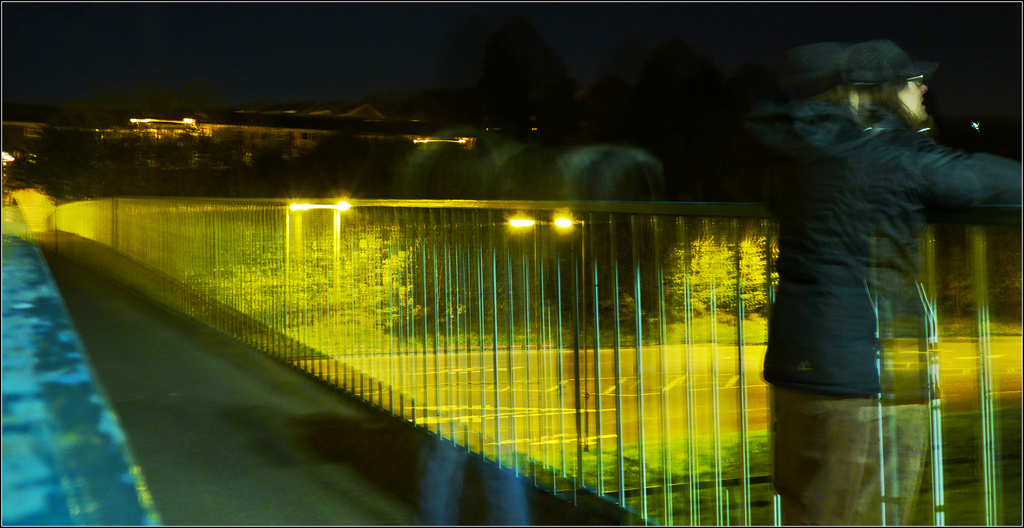
Ghostly photo by didbygraham
When I was studying the Bisento kata 魅剣 Miken, or bewitching blade, I wanted to understand what would make the blade bewitching. I know the movement is meant to confuse the opponent with kyojitsu, but what I found in my study takes this "bewitching" to another level.

Often in our Bujinkan training we encounter supernatural ideas. They are woven in the fabric of our art and in Japanese legend. This is an aspect to training that makes the art so mysterious and fascinating. Mystery brings another level of power to the art and to stories of the Ninja.

The challenging thing for pragmatic martial artists is to connect the myth to something that can be used in battle. I personally am not a pragmatist in these things. I am an artist by profession and it is natural for me to accept mysterious ideas and inspiration in my training. What really stops my mind cold is when I glimpse the supernatural at work in the pragmatic.

With Miken, Hatsumi Soke says that it is the same as 魑魅魍魎 chimimōryō in 幻実 genjitsu which is a phantom reality, or possibly 幻術 genjutsu magic/witchcraft.

He justs drops this statement on us like it is a normal way to use the Bisento.

So what is 魑魅魍魎 chimimōryō? It is translated as evil spirits of mountains and rivers; monsters, goblins, and ghosts; all sorts of weird creatures.

But to understand 魑魅魍魎 chimimōryō (chimei-wangliang in mandarin) we must know that the beginnings of Bisento in our art stemmed from Yoshiteru either learning it in China, or directly from a Chinese monk. Then for chimei-wangliang we have to go back to the very beginnings of Chinese myth. Back as far as the 26th century BC.

In the beginning… (I always wanted to say that)

There was the battle of Zhuolu. This was a battle fought between the Yellow Emperor, who is considered the founder of Chinese civilization, and Chi You. Wikipedia describes Chi You:
According to legend, Chi You had a bronze head with metal foreheads. He had 4 eyes and 6 arms, wielding terrible sharp weapons in every hand. His head was that of a bull with two horns, but the body was that of a human. He is said to have been unbelievably fierce, and to have had 81 brothers.
So you see we had quite a battle brewing.

Chi You used 魑魅魍魎 chimei-wangliang as a battle tactic. He summoned forth the demons of the swamps, forests and mountains to fight in his army, and employed 幻術 genjutsu producing a poisonous mist against the forces of the Yellow Emperor.

This poison mist was used to confuse and cause the enemy to become lost in the thick fog. The Yellow Emperor suffered several defeats because of this and eventually had to ask for help from a dragon to win the battle.

I tell this story because in our (somewhat smaller) battle with the Bisento, we can employ Kasumi (mist) techniques and cause the enemy to become lost in confusion through kyojitsu. The kata itself demonstrates the physical foundation for creating this feeling, but as Soke reminds us, "Separate yourself from the waza so that you see the whole picture. If you think "this is how we do the waza," that is very dangerous." We have to go beyond what we think we know.

I wrote about one way to reflect this feeling here: 平常心 Heijōshin: a Heart Like Clear Water.

He tells us that breathing in this life force, or  生命 seimei is of great importance to martial artists.  This is the Bufu Ikkan that blows through our lives.


Kuuki wo Yomu 空気を読む: Situational Awareness For Dangerous Foreigners

From Bujinkan Santa Monica by Michael

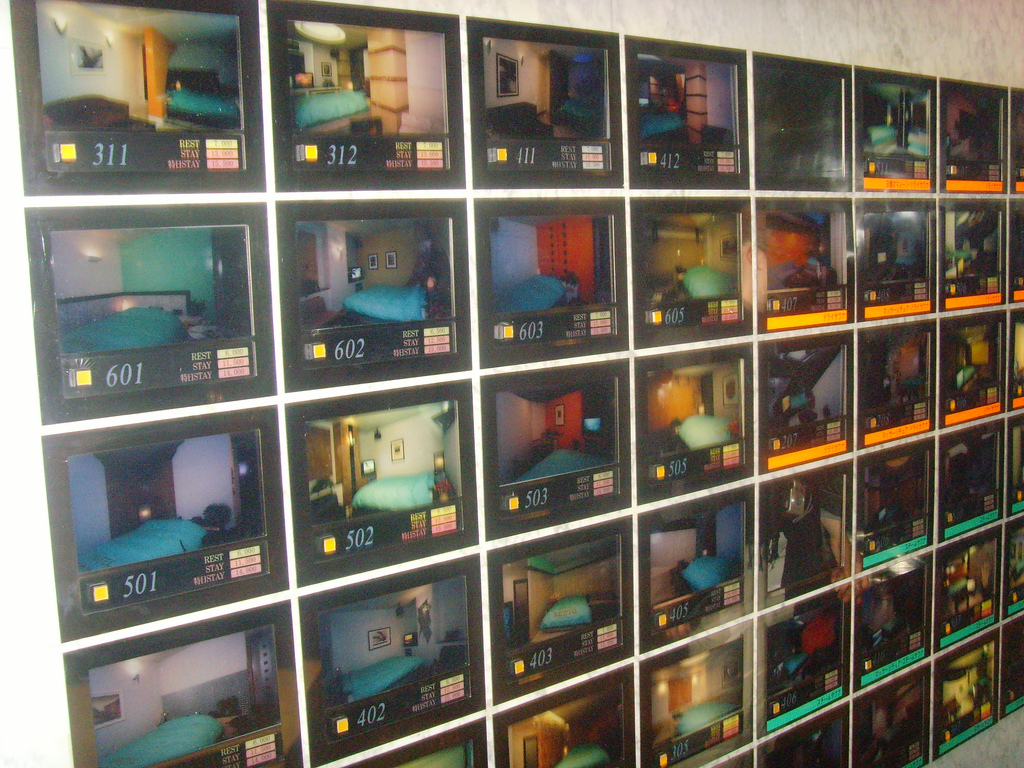
Tokyo Love Hotel Menu Board, photo by fletchy182
One day I was in Japan being my normal  yabanna gaijin (dangerous, socially unaware, foreigner) self, when I stumbled into a funny but embarrassing situation. I had travelled to Japan with an old friend who was not into training and was here on his first trip. We were wandering all over exploring the city like bad tourists.

While walking we encountered one of the themed "love hotels" that are common in some areas. He had never seen one, so I thought I would show him the menu board. Inside the lobby of this style of hotel there is often a menu board of themed rooms. It shows pictures of the rooms with options like the Cleopatra Love Suite, UFO with a bed shaped like a saucer and stars painted on the ceiling, or just straight up Hello Kitty S&M Room with lots of hearts and pinkness. Next to the picture is a price and button that you press to book the room.

Suddenly we heard a yelp from the woman sitting behind a small square window with a curtain hiding her face. She jumped out of her chair and came bursting into the lobby through a side door. We were apparently being very KY.

KY? In the U.S. this is a brand of love lubricant. But in Japanese slang it refers to 空気を読めない人 Kuuki wo Yomenai hito, or, someone who can't read the air of a situation. The opposite and better way to be is 空気を読む Kuuki wo Yomu, which is to read the atmosphere, read the air. adapt to a subtle situation. In English we use similar expression like reading between the lines, sense the mood in the air, or feeling a good or bad atmosphere in a place. In combat scenarios we call it situational awareness or just keeping your head on a swivel.

This is something that our training prepares us for and something Hatsumi Sensei often reminds us to cultivate. I wrote about one class where Sensei speaks to this idea: Kankaku 感覚: Can You Smell It?

You will not be able to sniff out or spy (探り出す saguri dasu)  these clues if you don't practice raising your awareness or heightening your senses. Worse still are people who actively destroy what little sensitivity they have with abuse of substances or poor choices. For a Ninja, the deepest of sensitivity is cultivated: the ability to sense danger before it happens; to know when someone is watching you; or when the moment is right to make an escape.

Soke said that Takamatsu could discern tea leaves that were grown on opposite sides of a mountain through differences of moisture in the leaves. That kind of awareness takes heightened sensitivity but also a lot of experience.

Sadly, I don't have enough experience with love hotels. And a very panicked woman confronted my friend and I in the lobby and ushered us back out onto the street. Even though I didn't not understand her words at the time, we quickly realized it was one of two things: either they don't allow foreigners to occupy this particular love hotel; or, more likely, they don't allow two men to occupy a room together and she thought we were there to get a room.

We had a good laugh on the street. It was so funny because of her LARGE overreaction to the situation. You see, we were being "KY," but so was she. We had not the experience or the sensitivity to know that we shouldn't have entered that lobby. But she didn't read the situation very well to discern that we only wanted to look at the pictures of the themed rooms! Even if she hadn't confronted us so dramatically we would have finished looking at the photos and left on our own.

I tell this funny but embarrassing story, to give an everyday example of reading the air. But not having this ability can get you killed in combat. And it often embarrasses many visitors to the Hombu Dojo when they don't pay attention. You can read more about this on Doug Wilson's blog here: Read the Air . And here is a brief video tour of a love hotel:


2 Bujinkan Godan Test Lessons, Plus 1 Secret

From Bujinkan Santa Monica by Michael

Tokyo Tachikawa, Cinema City / CINEMA TWO. photo by Dick Thomas Johnson
If you have taken the Godan test this may sound familiar, if not you have something to look forward to. If you think you know this stuff already, I suggest you consider it again at a deeper level.

These two lessons are: the meaning of training itself and embracing fear. I will explain what the Godan test teaches about these things, but first why do we need to be taught these lessons at all?

The Godan test is an instant in time, but it echoes forward and backward. All the days leading up to that instant and all the training after. Which is longer? These two challenges will continue to confront us before and after. So what has changed?

For the first lesson, let's look at a common problem for both pre and post Godan students:

People lose their passion for training. If you have trained for a long time, you probably have achieved some of the goals you originally set out to achieve. Maybe one of those goals was passing Godan. If you achieve your goals you are left with only questions like:
So now what? Do you keep going to class? What if everything you're being taught feels repetitive or you've already seen it?  Maybe class feels like a chore. Training used to be fun, now it's become boring.
But training hasn't really changed... your dreams have. And your dreams are now too small.

Another serious problem for both pre and post Godan is fear:

Fear leading up to Godan is maybe about the test itself. But actually fear shows up long before that. Fear is a dream killer. It is the silent inner voice that pushes away our passions to seek safety that doesn't exist. Your goals for training are overcome by doubt and you never have the chance to get bored in class because you stop going!

Many people never make it to Godan because they were overcome by fear of this type. 

And after Godan? Well, the same insecurities and doubt may be strengthened by a feeling that test was no big deal or was fake somehow. You forget what really happened in that moment. It is very easy to re-frame an instant in time when you have the rest of your life to reflect on it.

So what does the Godan teach us about these two things? The test is like a mirror. If you don't already know, training is often a good mirror for life… so I can pretend to be your life coach for a moment. Don't worry, I won't take advantage of my self appointed authority.

Leading up to the Godan and right after is a great time to reassess training in general. If your goals are too small, training becomes boring. Why are you training? If you don't know now, you knew why when you started. But the goals you started with are too small. You have grown and changed. You need bigger dreams.

The way to get bigger dreams is to ask again, "Why are you training right NOW? If you don't know, or can't answer…  you can look at your life. What problems in your life does training help you with? What do you think it could help you with?

The Godan contains infinity in that moment. If you can't find big dreams there, then you must revisit that instant.

You can find in that instant of the Godan a new reason to go to class. And your attention in class will change to reflect this new focus. A strange thing will then happen: a blast of new ideas and secrets from training will appear. You will sheepishly realize they were always there, you just could not see them.

Training will be fresh and new again.

Embracing fear is another lesson connected to the Godan. You must shine a light on your fear. Look at it directly. If you don't it feels much bigger. Give fear permission to have it's way with you. (you might want to do this in private). Fear passes quickly when you allow it passage. This is the secret: open yourself to fear.

After it is gone, notice what it did to you. Are you still intact? This is an odd feeling from the Godan test. When it is over you are left only with yourself. For some people this echoes on for a while… If that happens you probably need that time with yourself.

Bonus Secret:

Here is one lesson from the Godan that can take you far beyond Godan: Thoughts have speed; passing the test requires no thoughts.


The Changing Flame of 変火 Henka

From Bujinkan Santa Monica by Michael

Ghost in the Rain, Hyodo Rinsei, The Sanyutei Encho Collection at Zensho-an
I have been studying something in my training for 3 years. Ever since I witnessed Hatsumi Sensei show some henka during training that seemed to come from another place. But his explanation of the source was what was astonishing. It was a source of power that I had never considered in my training before.

Despite what you read here on my blog, I am largely a practical, show me, kind of guy. I like to read and write about the mysterious, but in the end, If you don't get out of the way, you get hit. But Sensei made the mysterious real for me that day.

To understand the source of what he was connecting to, I have been trying to connect to it myself for the last three years. And, as I have pointed out here, and in my 稽古記録 Keiko Kiroku training notes, I have had some success. Results which have astonished me.

It is difficult to explain this source of power. Hatsumi Sensei has been explaining it for many years, but if you are not ready to hear it it is meaningless. We can begin with an innocent question:

Where does henka come from?

A simple question that everyone thinks they know the answer to. I did. In fact I wrote a blog post about how to create henka!  It's not that my tips were wrong, they were just directed at someone who is just learning how to create henka. Or, someone who is training from their own intellect or ego.

I think it is important not to throw away this kind of training because it is very useful for discovery. And we need a foundation to grow from. So I stand by the tips I wrote about.

But the kind of henka Hatsumi Sensei showed he has compared to a changing flame. 変化 Henka can be read as 変火 Henka, changing flame. A flame seems to have no discernible form as it flickers and changes constantly.  It also changes effortlessly no matter what obstacle it encounters. And it burns out without warning. It is there, then gone. quite mysterious. Soke explains how we can glimpse its essence,
"The crucial thing for humankind when handling fire is to know that fire is an apparition, a ghost, and we should pursue this image."
He compares it to the spark of life. It is like that which causes birth, death, or the change between elements and states.

Soke says we can find the ghost of the essence in the writings of San'yūtei Enchō, a Japanese author / rakugo performer of the late Edo and early Meiji eras. He was/is known for classics in Japanese horror stories. You can imagine what feeling that horror would bring to your taijutsu!

When I first opened my eyes to this source in my training, it was because Soke framed it in terms of connecting to this immaterial essence that causes change. He had been hammering home the idea of connecting to your opponent. To his rhythm, technique and spirit. The concept being that if you had this connection, you could use it to protect yourself or counter his attacks.

This connection happens through the kukan. So naturally Soke suggested we open up the connection to something bigger than the two (or more) combatants embroiled in that momentary drama. This connection was to be made to the source of henka, of birth, death, flames…

In the three years since I have been training on this, I have developed my own strategies for making this connection. They are many, because this concept brings you to straight to the infinite. I will happily share some with you when I connect with you in training!


Like a Walk Through Yūgen 幽玄

From Bujinkan Santa Monica by Michael

Uto, Scenes from the Noh Theater, Tsuskioka Kogyo (1869-1927)
A sudden change in the atmosphere. The kukan shifts. The air itself feels alive. Only to be shattered by the tip of the bo.

This was the feeling I tried to communicate in one class. It was something I had experienced with Hatsumi Sensei and I wanted to share. But how to teach that?

How does this occur in a technique? How does the body and weapon come alive in that instant? And to make it absolutely crass, what are the mechanics?

In fact, the mechanics are super basic. Yet as with all basics, they quickly grow profound. We've been doing a lot of walking practice, or 足馴らし ashinarashi, in my classes recently. It's difficult to understand taijutsu without understanding this. Not just in our art.  Many disciplines start here, including Noh theater,
The walk is so important in Noh dancing that the highest compliment that can be paid to a player is that his walking is good. - Carl Wolz, 1976
The experience I had with Hatsumi Sensei was of the movement through the kukan having a particular quality to it, a particular way of walking. Sensei described it this way,
"You've got to walk like a Noh actor moving through yūgen 幽玄."

I've written about yūgen 幽玄 before, but how exactly are we supposed to walk? What do you do with your feet and legs? How do Noh actors walk?

There are many styles of walking in Noh, for example:

Ashibumi 足踏み : stamping
Uchimata 内股に: inward walk
Waniashi 鰐足: pedaling
Sotomata 外股 : outward walk
Tsumasaki 爪先: tiptoe
Yokoaruki 横歩き:side slide
Yokoaruki 横歩き: side cross step
Ashi o horu 足放る: side stamping
Shikko 膝行: squat walk


But before a Noh actor learns any of those comes suriashi 摺り足 or Hakobi 運ビ. This comes from 舞 Mai which is an old style of traditional dance. Mai means "to circle." In Mai the feet mostly stay in contact with the ground. While the arms gesture slowly and gracefully. This walking  has the soles sliding along the ground so lightly the performer appears to float.

If you study this movement through the kukan and Yugen, you may look towards Noh as an inspiration. The artist John Brzostoski gives a great description of the feeling of Yugen in a Noh theater,
"It appears upon the blank stage almost as if in a cinema, in slow motion, at the wrong speed of a recording, a stretched tape about to snap, pulled into intolerable pauses of holding breath, lack of breathing, lack of thought, the complete comprehension of all movements. You know where everyone has been and where everyone is going."
For me, that is what control of the kukan feels like. When I get it right anyway. The advanced form of this walking has a quality of 引張り間 hippari ai, pulling something or someone towards yourself. And if we go back to the roots of Noh Zeami tells us to walk so that, 目前神後 "the eyes look ahead and the spirit looks behind"


Kukan no Kyūshō 空間の九勝: Twisting Around a Moment in Space

From Bujinkan Santa Monica by Michael

Blue Biker, Kyoto. photo by nWevurski
Lately I've been studying Kukan no Kyūshō 空間の九勝 in my classes. When Hatsumi Sensei introduced this idea at the 2011 Daikomyosai, not many seemed to have heard of it before, but it made sense in the way elegant mathematics make sense. In other words it just felt right. But that doesn't mean I knew what to do with this feeling.

I decided to look into what I felt and observed from Sensei's classes. What is a good way to study kukan no kyūshō? If you've been receiving my keiko kiroku training notes you have seen me describe various strategies for doing this. To get my mind around this concept and be able to use it in my taijutsu requires studying it from many angles.

One idea we were working with the other night was a movement Soke described as 撚り型 yorigata. This involved spinning the sword through the kukan after twisting the body. The twisting action begins with with exposing your own 隙 suki to discover or open up suki on your opponent. For example if you want to strike the opponent's left side you first expose your left side. Then when you twist or pivot there is the opportunity to connect to kukan no kyūshō in that moment.

Hatsumi Sensei describes what may happen in that moment as "二転三転 niten santen," which is to change again and again or be in a state of flux. The truly odd part about this is if you have found the right kyusho in the moment, these changes will be hidden from your opponent. From there you can strike or act freely, without danger. Soke says,
The place where one cannot see, it's here where changes to the extraordinary happen.
I definitely witnessed these extraordinary changes while in Sensei's classes. And in my own training there have been moments from this study that have surprised me and created wonderful results. Those moments are some of the gifts to be found in our training. You can find them too- they are just there waiting for you in the kukan!


Real Bujinkan Training (Where I Risk Everything to Inspire You)

From Bujinkan Santa Monica by Michael

Eastern Slope of Mount Fuji, photo by by ninja gecko
I'm going to take a risk here. I'm going to risk trying to inspire you. The reason I want to take this risk is because I am inspired every day in my training and I want anyone who trains to find that for themselves.

How do I get inspired? Remember what it felt like the FIRST time you trained? You were new and hopeful and open to try anything. As a new student your mind was just ready to open up. Almost every class with Hatsumi Sensei feels like that. At least for me it does.

Is Bujinkan just a martial art? As a student I can tell you that it has given me a lot more than the study of combat. And as a teacher I work for moments of clarity in training that open the training up so that it is more than just a martial art and expands to reflect the lives of me and my students.

If you don't believe this is possible in Bujinkan training, then why are you studying? You should answer that question. And the mystery to this is that the answer you come up with is based only on what you have learned about training so far. It is based on what you already know. If you leave it at that, then you don't even need to go to class anymore. If you want to learn, then you must risk going beyond what you already know.

In fact, the great fun of training is in discovering ideas and movement that lead you to that "aha moment." What makes you say, "Aha!" Or "yes" is that you felt there was something more and then a teacher shows you where it is. When that happens for me it is satisfying. And it keeps me coming back to see that teacher. It is also satisfying to help students have those aha moments. Because it reflects back to me and expands my own learning.

A good teacher can help you see past the edges of your own knowledge. A good Bujinkan class can open up your awareness to something bigger than yourself.

I hope you find teachers to provide insights that you cannot easily comprehend at this moment. Give them your trust and your training will accelerate to provide clarity in your life and expand what the meaning of training is for you.


Kôichi Ôguri Sensei: 永遠の眠 A Long Sleep

From Bujinkan Santa Monica by Michael

Oguri Sensei's daughter writes: 

Sayaka Oguri (via Facebook)
"My father Koichi Oguri had a long long sleep..."

 Thank you Oguri Sensei for your wonderful spirit and training. I will miss your infectious laugh, and the way you held your hand on your hip right after you put me in a body crunch.

I also appreciate all the easy conversations we had. Even though the language barrier was awkward, you were never impatient with me.

We will train hard for you tonight!

If anyone has pictures or would like to share memories of Oguri Sensei, please comment below or email me: [email protected]


You can read about one class I had with Oguri Sensei here:

The Power of Juuji in Taijutsu, Discovered via Oguri Sensei