Skip to content

中途半端 Chuuto Hanpa: Betwixt the Half Assed

From Bujinkan Santa Monica by Mats "Toryu" Hjelm

photo by roland
Something many of us have heard Hatsumi Sensei say during his classes is the term "chuuto hanpa."  He has been using this phrase for many years to try to communicate an idea that is difficult to teach.

中途半端 chuuto hanpa / "unclear, betwixt and between, vague, half-hearted"
chuu / to / han / pa
The meaning of the first Kanji is "middle." The second Kanji means "way." The third and fourth Kanji mean, "half" and "end," respectively.

Chuuto means "halfway" or "along the way." Hanpa means "to be on neither side and be vague." Chuuto hanpa indicates the state of things which are left unfinished or the state of someone or something that is vague and unclear.

So what are some of the things this can teach us?

One is to let go of technique.  We all learn technique.  Some of us become good at techniques.  But technique is a trap.  The minute you try to apply a technique, people's survival instinct naturally drives them to actively resist or evade somehow.

It is an even bigger trap for learning.  You see your teacher show a kata, and remember, "I know xxx kata, I recognize this technique."  Then you may stop learning and fall back on habit.  Meanwhile, you missed what the teacher was REALLY showing you.  This is why Sensei advises us again and again, don't collect techniques, or memorize kata.

Here is a tip: be a beginner again.  It is like you are an expert guitar player and reading a book on basic guitar.   It is hard to be a beginner there.  Instead pick up a flute and do the same lesson.

When your technique is strong, drop it and try something where you are no good at all.  If you want to learn.  The best teachers create a class where this happens for you.

Another lesson of chuuto hanpa, is that of freedom.  By not taking any fixed technique or point, you may move freely.  When an opportunity arrives you can take it freely because you are not fixed on any technique or situation.

And a surprise awaits-  By half applying one technique and moving half into another, the effect is greater.  For example, if you apply musha dori while doing an omote on the same wrist, you can do something quite powerful without force!  Your opponent cannot counter or resist easily because you are never fixed.  That musha dori could finish with seoi nage, or nothing at all.  How do you counter that?

A greater surprise awaits even further into the esoteric whereby you float in the middle space, opening up the possibility for divine technique to enter.

This may be part of your life journey.  When you have become a great person in your field and are puffing up with pride, move to some other path where you are small and know nothing and be nobody again.  That's where learning happens. 


…

Crash, Bang, Daikomyosai!

From Bujinkan Santa Monica by Mats "Toryu" Hjelm

photo by Joi

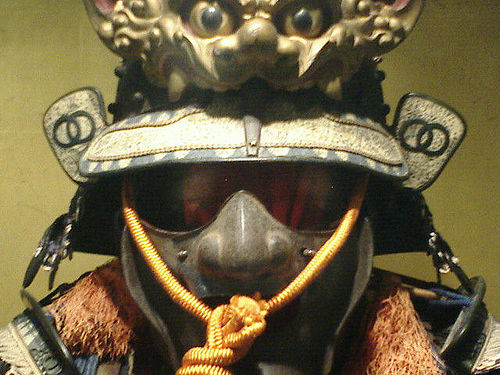
Daikomyosai has started with a crunch.  Hatsumi Sensei started the morning
wearing armor that he said was like that worn by Tokugawa.  This armor was meant to have no weak points or openings.  It was impenetrable and an impressive gold color for when the shogun would lead the way into battle.

Duncan and Holger were also in armor.  Sensei used Duncan as his uke and
proceeded to demolish him and his armor stitch by stitch.  As Duncan put it, "my armor is now rubbish."  And he later told me, Sensei used his armor against him as a weapon.  It appeared very disconcerting for Duncan.  Duncan is good with ukemi and there was really no useful ukemi for what he was enduring.

Sensei really has been focusing on the 15th dans while I've been here.  He
wanted them all to show something that they have been exploring in their
training this year.  It was a great chance for us to see how the Bujinkan is being taught around the world.  Sensei called on teachers from Spain, England, Russia, Venezuela, Israel, Argentina, the United States, Australia, Canada, and more from around the globe, to share with us.

He also has been instructing the jugodans directly about the godan test.
Sometimes he even speaks during the test itself.  I won't say here what he has been saying, but it's obvious he is trying to improve the way the test is taken and given.

Day 2 was more crash and smash in yoroi.  Sensei had all of the Shihan battle Duncan and Holger with tachi and yari.  Their movement looked great and Sensei pointed out to us that it was all unrehearsed.

Then Sensei pushed and coached Duncan and Holger into sort of randori with yoroi on.  It was smashing and crashing. When they were taking turns winning sensei encouraged them not to give up.  There was no submitting.  The energy rose and those two really got into the spirit of bushinwa.  Everyone in the room felt the specialness of this moment and erupted with a very enthusiastic applause.

After the first break some of the new godans were asked to demonstrate something with the tachi and they did well for being put on the spot.

The afternoon session was mostly tachi.  The use of the tachi is very
different than that of the katana.  So many people have not trained well with katana, and the tachi is even more foreign for them.  Even to the point of not knowing how to wear or hold the weapon.  Since that has been part of the theme for 2010, people still have time to study.

My training partners and I were called on to demonstrate a technique, so we went to the middle, it was a two swordsmen vs one tachi scenario.  We began our attack, the defender clocked the first attacker with the kashira of his weapon right on the bridge of the nose.  Blood spurted.

I hesitated with my attack.  The audience urged us to continue.  I attacked and was thrown.

By now he blood was really gushing from a cut on the guys nose and dripping all over the tatami mats of the budokan.  I decided we should not continue and held off on attacking further.  The other poor attacker had to get bandaged up for the rest of the day.

Control of distance and of the kukan is paramount with tachi or yoroi kumiuchi.  I saw many lessons being learned the hard way today.

Then Sensei asked the Shihan to explain how to give the godan test for the
jugodans.  I won't repeat these lessons here, but there was a lot to consider.  I think this is very important for the future of the Bujinkan.

Day 3 was great with a real family feeling throughout.

Sensei said the jugodans were always taking the sakki test.  He referenced a throw that someone did as sakki nage.

Steve showed us some wonerful tai sabaki using his wheelchair.  And later Brian who is missing his lower legs and half one arm was simply amazing.  Sensei had us all work on the samurai walk along with suwari waza to get the feeling he conveyed.  He and Steve were extremely well spoken and moved me greatly in sharing their experience of this Daikomyosai.

And I think their sentiments were shared by most people.  This was the warmest and most heart filled Daikomyosai I have ever attended.

Soke had the Jugodans share some more of their experiences with training and there seems to be more camaraderie than I have seen before.  Really special.

Then Sensei gave us maybe a bit of a preview for the new year with an exploration of kihon happo.

Sensei said that in the Bujinkan, there is always tomorrow and a chance for a new beginning.  I definitely am looking forward with a renewed heart and spirit to many tomorrows in this art that has opened up my international family.


…

Echo (yamabiko  山彦) of Hatsumi Sensei

From Bujinkan Santa Monica by Mats "Toryu" Hjelm

It's strange how training in Japan feels like coming home. Even though I don't travel here as often as I'd like there is always a moment after all the stress of travel drops away and I can relax into this experience that just feels right.

Maybe it's the family feeling that exists in Hatsumi Sensei's Bujinkan. Maybe it's all the friends and good memories here. Or maybe it's just reconnecting with the source of this art that is such an important part of my life.

Class with Sensei Tuesday night was truly wonderful. There were so many important discoveries I found in Soke's taijutsu that I told my teacher Peter Crocoll that even if all I had was that one class my trip was worth it. He said he thought the same thing last night.

It's hard to convey what happened in writing, but I will be working on this material for many months to come in my classes at home.

Sensei had us working on kage no tsuki for a bit. Then he made reference to existing in the kukan. He said you use a point in the kukan and you live there. For me it is like balancing on a needle. But you can make an entire life at that point as your spirit expands to open up space for you. Very esoteric stuff.

Sensei also made reference to yamabiko  山彦 or echo. The technique he did took the attacker's intent and echoed it back on him. If you think about how a mountain echo works, it starts at one small point, your shout, then expands outward, bouncing off the canyon walls, to return to you in waves that seem magnified.

I was also fortunate to watch Hatsumi Sensei write a scroll for Peter. He told Peter it was next year's theme and this was the first time he wrote it. I'm not sure I should say more about that here, except next year should be great!


- Posted using BlogPress from my iPhone


…

Groping the Void with 探り回る Sagurimawaru

From Bujinkan Santa Monica by Mats "Toryu" Hjelm

Photo by judepics
There are various types of awareness we use to gather information.  Maintaining good situational awareness is key to succeeding in any complex environment or encounter.  Once, when we were studying taihenjutsu and ukemi with Soke Hatsumi, he made reference to the term 探り回る (Sagurimawaru) which translates roughly as "to grope for, or fumble."

But Hatsumi Sensei didn't talk about this in a way us English speakers might normally consider the term fumble, as some kind of clumsy, unskilled, movement.  He spoke of it more as a exploration and a searching about the environment to see what you may discover.  It was a process of discovery.

So if we fumble about the Japanese language and look at other related terms in our art or just in the Japanese idiom, we may discover something:

You may have heard about the Ashinami Jukka Jo- The ten ways of walking according to the Ninpo book Shoninki, but we also have 探り足 Saguri Ashi and Saguri Aruki which are used for stealth and to feel your way with your feet when your eyes are not enough to set your path.

When you are trying to understand someone else you may use 探り合い  saguri ai to probe each other or sound each other out.

Maybe you are uncovering secrets:  探り当てる saguri ate ru - to find out

If you feel like Marcellus from Hamlet that something smells rotten in the state of Denmark: 探り出す saguri dasu to spy out / to smell out

Maybe you lost your house keys and need: 探る saguru to search / to look for / to sound out

Many people use training in the Bujinkan to: michiwosaguru 道を探る to seek a path;  to find one's way.

If you have bad manners you could saguribashi 探り箸  using your chopsticks to find a food you like by rummaging in your dish, pot, etc. (a breach of etiquette)

So at the root of understanding 探り回る Sagurimawaru in our training are two contrasting perspectives on your approach as a student in class.  Are you fumbling about blindly or are you on a path of discovery?  This is a choice you make everytime you step into the dojo, whether you slip in with saguri ashi or trip over the threshold.


…