Skip to content

Ninpo and Mu: Waxing and Waning Like the Moon

From Bujinkan Santa Monica by Mats "Toryu" Hjelm

Full Moon over Nagoya Castle; photo by ka_tate
In a Ninja's view of the universe, Soke Hatsumi comments on how beautiful it is to see a crescent moon peering between the clouds...  And he suggests that the "secret is to let your own existence resonate with the universal consciousness" ... whether in the form of moonlight or other natural phenomena.  He has also told us that taijutsu henka are like the phases of the moon.  These phases occur naturally, in a natural connection to the movements of Earth and Sun.  Your taijutsu should reflect the world as natural as the moonlight.

What is to be learned from cold moonlight?  In Japan, the moonlight has an empty longing to it that resonates deeply with the Japanese spirit.  Hatsumi Sensei has made reference to the author Yasunari Kawabata who, on winning the Nobel prize for literature in 1968, spoke movingly about the moon and it's deep companionship with the Japanese.  Here he quotes the priest Myoe,

"On the night of the twelfth day of the twelfth month of the year 1224, the moon was behind clouds. I sat in Zen meditation in the Kakyu Hall. When the hour of the midnight vigil came, I ceased meditation and descended from the hall on the peak to the lower quarters, and as I did so the moon came from the clouds and set the snow to glowing. The moon was my companion, and not even the wolf howling in the valley brought fear. When, presently, I came out of the lower quarters again, the moon was again behind clouds. As the bell was signalling the late-night vigil, I made my way once more to the peak, and the moon saw me on the way. I entered the meditation hall, and the moon, chasing the clouds, was about to sink behind the peak beyond, and it seemed to me that it was keeping me secret company."

Hatsumi Sensei writes about his intentions for sharing Ninpo:

There is a saying: "The village that shines in the moonlight leaves a different impression in the souls of different people."  The Chinese characters for strength and nothingness are both read "mu" in Japanese.  Therefore, nothingness is the same of strength.

My intention is to introduce you to the world of Ninpo through the method of expression based on nothingness.
Sensei also wrote, "There is no village on which the moon does not shine, the moon lives in the mind of the gazer."

What do you see in the moonlight?  Where does the light fall?  Does it illuminate something beautiful for you or melancholy?  One way to grasp our training is to approach it with the clarity of moonlight. Don't train with ego, just allow the nothingness of the teachings to fall over you.  You can find great joy if you sacrifice yourself to your training.  Have the feeling of surrender or sutemi.  And like the moonlight, understanding will flash in your eyes.

Soke talks about finding a purity of focus in life so that there is no worry for death,

In order to do so, we must have a clear purpose in our daily life.  If we live our daily lives with sutemi, the mind of budo, and the passion of the artist who pours his soul into his works, we can almost forget about death, and never regret our life at the moment of its end.
Moonlight is nothingness yet shines on all the world.  That is a clear purpose.  And the strength of Mu.


…

Kihon Happou by Soke

From Toku Bu Ryu Sui Dojo by Mats "Toryu" Hjelm

Kihon Happou

by Soke Hatsumi Masaaki

I have trained myself and instructed others in Kihon Happo and felt that those who have had previous training in Karate, Judo, Aikido, Kung Fu, and other fighting techniques tend to stay with those forms and have trouble learning Budo Taijutsu from a “blank slate.” The fighting forms stay with the student even though he starts the training of Budo Taijutsu. When do the previous learned techniques disappear? I think it is up to a person’s individual talent. The phenomenon is just like a dialect disappearing after one lives in a different part of the country.

No matter how hard one tries, he will never be a professional announcer if he speaks in dialect. The same can be said for Budo. I also studied various martial arts such as Judo, Karate, Aikido, old-style Budo, and Chinese Budo. In other words, until I encountered Takamatsu Sensei, I was a Budoka (martial artist) with many dialects. One day I began to wonder why and when did I lose those “dialects?” I realized that it was after I lost all my muscle tone after five years of illness.

Discovery of your own dialect is one way of improving Budo. When one reaches a certain degree of skill, he comes up against the “wall,” something he has trouble overcoming. This is the so-called dialect of Taijutsu.

I want to write about how to train yourself when you reach a higher rank during Budo training. I would like to use a Cat Competition as an example. I have had lots of experience in the competition because my wife served as judge of the World Cat Club and I was also vice chairman of the club.

Suppose five top cats are chosen out of hundreds of cats. All of them are wonderful and beautiful, but that alone cannot be judged. With no other way to judge which cat is more beautiful then another, the judges start to look for faults. The one with the most faults drops to fifth, the next, fourth, then third, and so on. The one with the least faults becomes Grand Champion.

Bugei is the same way. If one reaches to a higher rank, he need only eliminate his faults. It may sound easy, but eliminating faults is very difficult to accomplish, because we tend to think we are faultless. Faults can be translated into something different in Budo. They can be suki (unguarded points), or carelessness, presumption, arrogance, etc. they all become our fault. No fault, zero condition is the best. I am zero. I joke that the Soke has no Dan. Zero, no fault that is the target of Bufu Ikkan (living through the martial winds).


…

Ninja Morality of Kogarashi Monjiro

From Bujinkan Santa Monica by Mats "Toryu" Hjelm

This time of year is often spent helping, giving or thinking of others.  There are many people who misinterpret the life of a ninja as one of a solitary, dark and shadowy existence.  A lone wolf sneaking in and out of other's lives to accomplish some mission.

Sensei suggests to us that this is not a healthy view.  He says that it is an ideal to have others depend on you.  People think they are too busy to help others, but if you decide to ignore everyone else, trusting only yourself, you will soon become one of the busiest of all men.  He continues,
To give a helping hand to poor people and to want to save them is the humanity of Japanese, and of a warrior's heart.
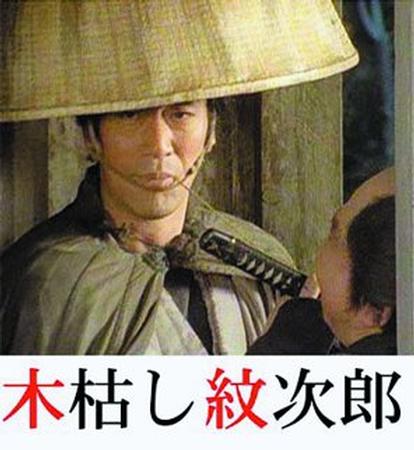
Hatsumi mentions the character Kogarashi Monjiro from the novel and 1970's TV series set in the Edo period, originally written by Saho Sasazawa. Acted by famous samurai actor Atsuo Nokamura.  Monjiro lived the wandering life of a gambler.  He had a nihilistic attitude and sought to eliminate and avoid involvement with others as much as possible.


The main character is said to have been born in a poor farming family in a village called Mikazuki (half-moon), Nittagori Country in Gunma Prefecture. When Monjiro turned 10, his family left their native soil and was separated. Why the lonesome Monjiro started to live as a homeless wanderer is unknown.
Monjiro’s typical posture includes a wooden toothpick between his teeth, and his nickname “Kogarashi” (the sound of a cold wind wailing) comes from the sound he makes when he breathes with the toothpick. He is a guy who knows no love for people, but cannot overlook evil deeds.
Soke says,
"It doesn't concern me," is a famous Monjiro quote that best represents today's irresponsible times.  In reality, Monjiro never left without helping somebody.  While he says, "It doesn't concern me," he still becomes involved and fights the villain.  This is what is so very charming about the Monjiro character.  He gives justice to people's morality. 
Hatsumi Sensei continues with this advice,
You might be living in a nihilistic manner with a callous attitude but I would prefer you have the Japanese spirit deep in your heart.  Compassionate people make others feel gracious and trustworthy
So please get into this wonderful ninja holiday spirit!  But I don't suggest wearing your red, fur lined ninja/Santa Claus suit out in public...


…