Skip to content

Hatsumi Soke Says to Live Like Momotarō 桃太郎

From Bujinkan Santa Monica by Mats "Toryu" Hjelm

photo by barto
Modern life is difficult.  Some people may even feel they are enduring in a kind of hell.  If you are going to live in hell, you'd better learn how to survive.  Hatsumi Sensei gives us a clue for how to negotiate these difficult times and circumstances.  He says we should be like Momotarō 桃太郎 who is a popular hero from Japanese folklore:

The Tale of Momotaro

Once upon a time an old couple lived in the hill country of Okayama in Japan. The old man went everyday into the mountains to cut wood, while his wife went to the river to wash their laundry. One day the old woman was washing clothes by the riverside when a great, golden peach came floating down the river! It looked so delicious that she decided to roll it home to surprise her husband.

When the old man came home, the old woman cut the peach open. To their great surprise, a small boy leaped from inside the peach! Instantly, they loved the little boy because they had never had any children of their own. They decided to call him Momotaro, which means, “peach boy”.

The old couple raised Momotaro well. He grew big and strong. One day he told his parents that he would leave to make his fortune. He wanted to rid the land of the horrible Oni (demons or ogres) that inhabited Onigashima 鬼ヶ島 (Island of Oni).

Though the old woman was sad to see her son leave, she fixed him some delicious kibi-dango, dumplings made from millet, for his journey.

As Momotaro hiked to Onigashima, he made friends with a monkey, a dog, and a pheasant, giving each of them a dumpling for their companionship. He was glad for their company when he arrived at Onigashima. Momotaro and his companions found that the gate to the Oni's fort was locked, but the pheasant flew inside and found the key. Once the pheasant opened the gate, Momotaro and his friends fought fiercely with the evil Oni. The pheasant pecked their eyes, the dog bit their legs, and the monkey clawed their backs.  Finally, the Oni surrendered their horde of treasure, and Momotaro returned to his village a hero. Momotaro and his parents lived happily ever after.

There are many versions of this tale with each version the story takes on different details to suit the region and the times, but only from Hatsumi Sensei have I seen these details:
Momotaro's monkey excelled at wisdom,  vicious wisdom.  The pheasant had an ability to predict earthquakes.  The dog looks faithful, but it can become like a ninja and smell the differences at work, using various means and tricks.
Sensei goes on to say that to live well in troubled times we should practice these three elements and embody each animal with our body and soul.

Here is a fun animated version of this story:


…

Kage No Keiko: Don’t Ask a Shadow for Answers

From Bujinkan Santa Monica by Mats "Toryu" Hjelm

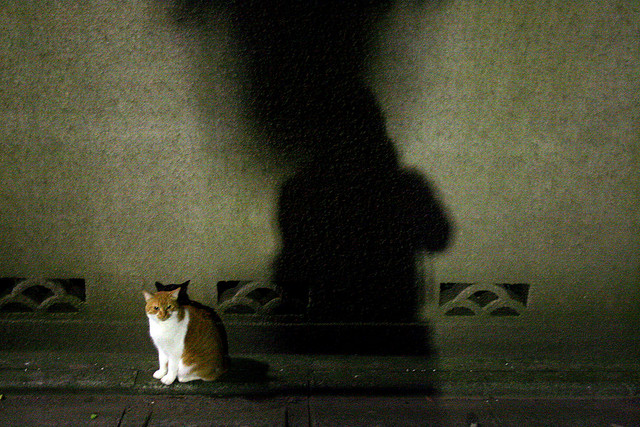
Photo by OiMax
There is an old tale about a teacher whose students asked him, "Where does your teaching come from?  What is its source?  Who is your teacher?"

The teacher replies,
You are not ready for my answer.  If I say that my teaching is from inspiration, you will consider me crazy.  If I say it is my own teaching and skill, some will worship me and never learn.  If I name my teacher, many will turn to him to ask the same dumb questions while ignoring real study.

In the Bujinkan, Hatsumi Sensei has told us that training is a process of developing the eyes to be able to see true budo. Hatsumi Sensei talks about different types of keiko or training, even in dreams.  He says that when he is training intensely, he will have weird dreams.  He tells this story about his teacher Toshitsugu Takamatsu,
He would draw from 5:00 a.m. to noon every day.  One day, he painted a picture of a dragon for his friend.  A few nights later, my teacher dreamed about a dragon that had no eyes.  The dragon said to him, "I want eyes."  The next morning he called his friend and his friend told him that the painting of the dragon had no eyes.
Sensei says that this dream training comes when you are having a hard time mastering something.  He says the "secrets of budo are introduced as "dreams from the gods."  Soke tells us that the best way to train is to learn physically first, then understand the theory.  Devote yourself to constant keiko.  Have the feeling of Ninpo Ikkan.

He says that if you get stuck you can focus even though you cannot move forward.  This is when you pass into kage no keiko (shadow training).  I wrote about the phases of training and other types of keiko here: Beyond Godan Into Wakaranai-Keiko

The teacher from the old story continues, "If, after being told a hundred times that the teachers are all one and the techniques are meaningless you still look for the source, you will never find it."

The students ask, "Then what shall we do?"

The teacher responds,
"Stop imagining that, just because you can ask a question, you can perceive the answer without any of the foundation necessary for such a perception to occur."


…

Makeru – to lose

From BUJINKAN TASMANIA by Mats "Toryu" Hjelm

SHINKEN-GATA TAIHENJUTSU

By Soke

” With a clenched fist, a half open fist, an extended-finger fist, the length of the arm naturally changes. Things such as how victory was gained in the simple story of Hideyoshi of the long and short spear match are extremely important in shinken-gata.The same applies to the relative length of the fist.”

“Grasping that losing, being thrown, getting punched, having a reversal applied, being beaten hollow, that makeru ( to lose ) is the koppou of ma-keru ( kicking the demon ), self confidence will finally be born.”


…