Skip to content

Matsu Kokoro – The waiting heart

From BUJINKAN TASMANIA by Mats "Toryu" Hjelm
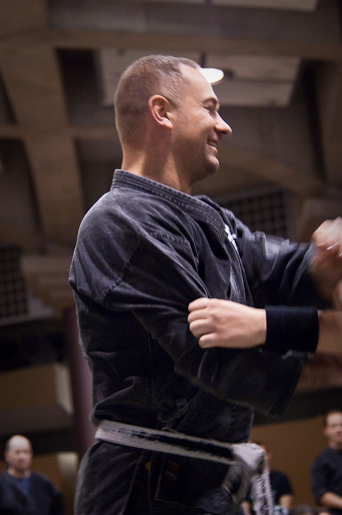
Nagato Shihan once said that when he stopped asking questions, he received the answers.

Wait for your moment.

Training is about developing perseverance and patience. If you cannot do this, you will become an annoyance in the dojo and elsewhere.

People race to Soke to ask him to experience the “feeling” of his latest inspiration. The fact is, the initial inspiration cannot be reproduced, so by doing this, you are receiving some different.

If you were meant to experience something from Soke directly, you would be approached or asked by him to be his uke.

If not, it is not your time. Be patient, wait.

If you happen to be asked to demonstrate a technique, in particular at the beginning of class or a new session, consider it as a chance to do something that you wish to receive teachings in. Do you understand? Instead of going into the middle of the dojo with your favourite uke and doing the best technique you know, do something that you wish to receive more training in. It`s your moment to be selfish!

Recently, for two classes in a row, I performed a basic version of Musha Dori. Why? Because I wished to see Sokes way of looking at this fundamental movement . After I did this, I saw many people move straight into free flowing henka rather than working on the basic form I had shown. Obviously, everyone thinks they are beyond the basics? From what I saw, many should have been sticking to the kata form.

If you are near a conversation that he has started with a group of people and you are not in that initial group, that conversation is not for you. If it was meant for you, you would have been there. I see people stop training and run over to eaves drop on conversations, etc. Personally, I feel sorry for their training partner left standing alone.

Budo is about manners. In fact, Soke mentions that the training starts and finishes with manners. Manners is the base for preserving human relationships. In Japan, great importance is put on maintaining harmony within society and groups. In budo, we call this the “Bushi no wa”.

And to reflect on this a little more, we see that Kyojutsu Tenkan Ho or Kyojutsu Houben Makoro is something that is integral in maintaining peace among warriors and the world in which we all live.

To try and gain a working appreciation of this ( especially when living in Japan ) is very important. Japans social customs are often very subtle and almost invisible to the foreigners eye.

” There was a puppy who ran to his master, please to see him. The puppy wanted to show his affection and loyalty to his master and jumped up onto his thighs and wagged his tail happily. The master got angry as the puppy had soiled his pants.”

People wish to help others, and try to show their loyalty in many ways. This can be annoying. They become a lesson of tolerance as they get in the way. It is better to understand that your loyalty is shown from your consistent character. That is all that is needed.

Don`t be in a rush to experience things, or please people. First, check your motivations and try to figure out what is the most important point.

Don`t hide your in abilities by pushing forward your strengths. In fact, it is better to show your weaknesses and become happy to work with them. To put forward your strengths is to become a Tengu. Hide your power, work on your weaknesses. Not revealing your strength is to also deceive those that work to manipulate you or see your weaknesses as not a showing of true self-confidence or actual inner strength.

Be patient, wait, observe and don`t make judgements too quickly. Your own desire for righteousness is your own downfall.

One Gokui no Uta comes to mind: ” If you think there is something there is nothing, If you think there is nothing there is something.”

Endure these moments. Accept them and train. Focus your intention on being in the moment as much as possible. These moments are where you can receive Shinden,Kuden and Taiden free from ego. You can absorb the teachings directly, even if you cannot intellectually understand. The teachings drop to your hara and you wait. Eventually, your depth of absorption and understanding will come out in your sweat and evaporate into the air ( Shizen Gyo Un Ryu Sui ). And you may come to understand the nature of the water and clouds, the cycle of life and natural understanding. The concepts of Saino Kon Ki and Rokkon Shojo are integrated here.

In saying this, I don`t profess to understand myself.

Don`t desire the answers, don`t desire to be your teachers uke.

Be present and live in the space that you inhabit and, accept it.

Words based on recent feelings and observations.


…

雨遁 Uton no Jutsu: a Rainy Day Escape.

From Bujinkan Santa Monica by Mats "Toryu" Hjelm

photo by J.J. Verhoef
Tuesday night my class was training on an aspect of Ongyojutsu 隠形術. This topic is vast and one not often covered in most Bujinkan dojos. We have the fortune of training outdoors in an area that is part urban and part natural so we were able to explore.

Out of the 30 methods of escaping, let's look at one that is contained in the tenton juppo section: 雨遁 Uton no jutsu (Rain Evasion). Using the elements of weather to aid in escape and evasion is a very natural technique, but that same weather can work against you. The trick is to be in harmony with nature's laws. As Hatsumi Sensei says, "... everywhere in the world, the trees are growing towards the sky and the rain falls towards the ground." Bearing this in mind, remember that Soke has also stated that modern military stealth methods may supersede the old densho and that we should keep up with the times. But there is still much to learn in our tradition.

To begin to use the rain, it helps to know if it is coming. Forecasting is an old and honored tradition, one that is sometimes filled with pseudoscience but will work when paired with observation skills. This is what is known as tenmon. Soke says that in the old days people observed closely the natural cycles:
"they studied the animals and plants and found ways to make predictions. For example, if sparrows enter the thicket or stay high up in their trees after busily eating food, or if insects start to enter buildings, or carp jump out of the water, or frogs start to croak, it is a premonition that rain is going to fall."
Of course modern weather forecasting and meteorology gives us some advantage, but there is still no substitute to sticking your head out the window or being in tune with the weather patterns of your region. Sensei says it is "natural to be alert."

Here's what the National Geospatial-Intelligence Agency says about a product they designed for evasion and survival:
"When Air Force Captain Scott O'Grady was shot down over Bosnia during June 1995, one of the items he acknowledged that assisted in his survival was the Evasion Chart (EVC) he carried in his vest pocket. In addition to using the chart to pinpoint his exact location, he used this unique product in a seemingly unusual way, but in fact one way that it was designed for--as a protection against the elements.  Sized specifically to fit in aircrew flight suit pocket, the EVC can be used:To catch rain for drinking water; As a shade from wind and rain, and as a shelter, cape and blanket; As a bag to haul and purify large quantities of water or food; As a liner in a hole to serve as a wash basin; As ground cloth on moist ground, or as camouflage when sleeping; To wrap clothing in when swimming or fording streams; To wrap torso with as an extra layer of clothing; To wrap sleeping gear in it during foul weather; To splint a broken wrist..."
Once the rain starts, we can use it in many ways, practical and mysterious.
  • The sound of the rain can mask the noise of your movement. Even the soggy leaves and twigs become quiet when we step on them. Be careful of splashing and slipping!
  • People tend to stay inside and off the streets. The rain can cause patrols to change. Guards are maybe not as alert while they try to keep dry. Some may abandon their normal posts to seek refuge indoors. Of course, that means you are also getting wet. Your gear and clothing may not function as well. And your stamina or immune system may become weakened.
  • Rain can be caught for drinking. This may make you lighter if you don't have to carry your own water, or just save your butt if you didn't have any. But rain does make your clothing and gear heavier.
  • Rain affects vision. Visibility decreases and at night and heavy rain reflects light back to it's source, creating a blinding effect. Umbrellas are also useful cover against cameras and being identified.
  • Another aspect of rain is that it changes geography. Large puddles or flooding washes make areas inaccessible or impassible. This creates opportunity for evasion or escape into areas where you will not be pursued. Don't drown or get trapped!
Here we come to some mysterious effects. Rain creates a definite feeling of yugen. Places and activities that would seem normal in the sunlight can take on another quality in a gloomy rain. This can be used for psychological effect.

Observing how rain and water itself falls, or human and animal behavior in the rain gives many lessons for evasion. Sensei says that rain takes on different aspects and a Ninja makes use of each phase.
"Rain becomes water vapor, rises into the skies, turns into clouds, and then becomes rain again, or a heat haze. Turning and turning, it is in a perpetual, cyclical motion."
Being rained on by the 幸雲 Cloud of Happiness (Good Fortune)
Hatsumi Sensei says that "one can perform uton no jutsu using cigarette smoke." and "If a ninja detected a stimulus from the outside world, no matter how slight, they would respond immediately."

Soke describes this feeling of gokui as that of being a jellyfish floating in the ocean. And he says that,
Takamatsu Sensei used to call himself senile and then drift about in the air of Kashiwara City, drawing and painting, and finding joy in it. This is to drift and feel the existence of the world, empathize with flowers and enjoy the harmony, and to reach heaven as a live human being."
Perhaps like smoke rising among raindrops.


…

Dissipate Your 隙 Suki With 正願 Seigan

From Bujinkan Santa Monica by Mats "Toryu" Hjelm

Ginza Rat photo by OiMax
Suki are strange vermin. You think you see one, then it's gone. You train your ass off to get rid of them, then find they are all over, and in places you never looked! And if you ignore them, they seem to multiply.

What are these intransigent vermin and what can be done about them? 隙 "Suki" is the Japanese term for "opening" or "gap" and refers to a weakness in your or your opponent's defenses. Suki can present opportunities to attack or be presented to draw an attack. These suki can be found in the timing, distance, angle, mind, or even spirit. This is partly what Soke Hatsumi means about being Zero. He says,
"If one reaches to a higher rank, he need only eliminate his faults. It may sound easy, but eliminating faults is very difficult to accomplish, because we tend to think we are faultless. Faults can be translated into something different in Budo. They can be suki (unguarded points), or carelessness, presumption, arrogance, etc. - they all become our fault. No fault, zero condition is the best."

Suki 好き can also mean likes or preferences. So the things you like and your desires or attachments can become suki. The kamae seigan when done properly gives no easy opening. To defeat this kamae maybe you look for an opening of desire. This is why seigan is sometimes written as 正願 "correct desire," to help you purify your desires and give no 隙 suki.

We first try to learn about suki through kamae. An ideal kamae has no suki. No openings or opportunities for attack. It also means no wasted or futile movement.

Next we learn about suki through ukemi. Paraphrasing Jim Vance: we learn more through assuming the role of uke, the focus on receiving techniques or sutemi allows the uke to feel the connection between them and their partner, or how a particular technique affects them. The uke is feeling suki (openings) in the connection; the body can feel suki through ukemi, it is aware of suki through sutemi (there is no self and other, only the connected unit).

Hatsumi Sensei describes this:
Takamatsu-sensei often told me, 'Mr. Hatsumi, to receive techniques is to take a person in, to take in their whole being--in other words, if a person's capacity for generosity and courage are not great, they will not be able to do it.
' An uke who selfishly tries to escape is not an uke.

Suki discovered through kamae and ukemi are the basic suki. They appear during regular and consistent training. Suki such as "a weakness of the mind” or “a weakness of the spirit" are more difficult to ascertain. And more esoteric still are the suki of the kukan or the universe.

Ueshiba (the founder of Aikido) wrote: As your Bujutsu training approaches perfection you will be able to detect the [weakness in the enemy's technique], the suki, even before he can, and as if to satisfy some deficiency in him, you can fill the opening [weakness] with your technique."

There is a feeling when you take your opponent's suki as if you are filling a void. Just be careful not to be sucked in by the emptiness!

The Zen monk Takuan Soho wrote about avoiding “suki” by means of the “mind abiding nowhere.” 

Hatsumi Sensei describes this as a point where there is no difference between attacker and defender. It is all one. The suki or opening is between your mind and his mind. Your body and his body. As you close that opening, you may sense his weakness and your own... and surely you know how to exploit that!

Soke also suggests to us that being shielded or having suki ultimately are inseparable concepts.  He says that being connected in the Kukan can create Kukan no tate, where the kukan itself protects your openings. Further, there is Kukan no suki whereby your life is in the kukan and you open up a space (suki) for you to live.

Or, as Doug Wilson describes it, you "allow your shield to protect your openings and your openings to lower the shield of the opponent."


…