Skip to content

How to Win a Sword Fight

From Bujinkan Santa Monica by Mats "Toryu" Hjelm

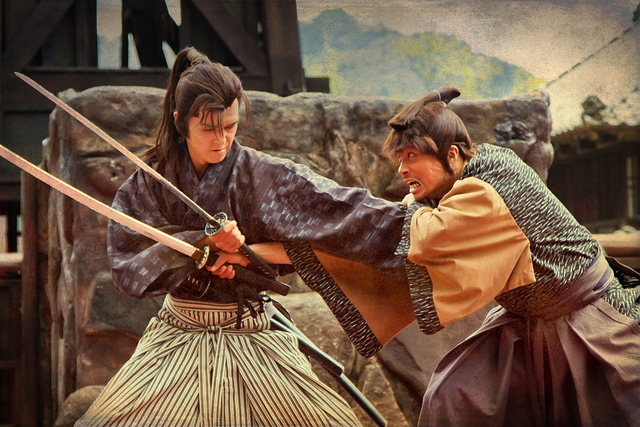
Edo Wonderland Sword Fight, photo by -ratamahatta-
If you are any good with a sword, Hatsumi Sensei says you can win without drawing your sword. He suggests this to us by pointing out the example of the famous Zen sword master, Yamaoka Tesshū (山岡 鉄舟, June 10, 1836 - July 19, 1888), a famous samurai of the Bakumatsu period, who played an important role in the Meiji Restoration. He is also noted as the founder of the Itto Shoden Muto-ryu school of swordsmanship.

One day Tesshu had a sword contest with a famous sword teacher, Asari Gimei. They fought for half a day and Tesshu was defeated. Tesshu became Asari's student and threw himself into Zen practice to try to understand the nature of his defeat.

As part of his search to understand what happened to him, he was given a koan to study by Tekisui Roshi'
"Crossed swords; neither permits retreat.
The sword-master, like a lotus in the fire,
Has a heaven-soaring spirit."
This advanced koan shows both the problem presented by a fight and the solution. Tesshu sums up his problem here:
'[When] two swords cross, all thoughts turn towards striking the opponent.'
Tesshu explains that the desire to strike an opponent while avoiding being struck is deluded. Not because this is a physical impossibility but because 'Originally, the mind is thoughtless like a bright, unclouded mirror...When the mirror is completely clouded, nothing can be reflected.' He continues 'When confronting an opponent, thoughts of striking or being struck indicate ignorance and illusion.'

Tesshu struggled with the crossed swords koan for three years of training. One morning while sitting in Zazen, he had a breakthrough. He stood up and went to fight his teacher Asari in the dojo. Asari realized right away that Tesshu had pierced through the lesson and declined to fight. He formally named Tesshu his successor and never again picked up a sword. Tesshu became a famous sword instructor who taught the way of the sword as a spiritual path.

So what happens when you cross swords with an opponent? If you are not in Zanshin, you may experience two states of mind. One is a calculating, worrying state where the mind is constantly questioning: Can you hit your opponent? Can he hit you? How can you enter, is there an opening? Does he see an opening? Can you trick him? Can you try this move or attack? Does he know that strategy and will he use it? This state is limiting, creates fear and you are defeating yourself. The limiting thoughts are never ending...

The other state lets the whole universe run through you. You erase the self and there is no you, just boundless possibility, unafraid of being cut or cutting. Your opponents efforts are no problem whatsoever. Attacks dissipate like mist.

Hatsumi Sensei says that Tesshu found this enlightenment by hearing the song of the gods in his heart. Soke describes this gokui (essense):
"In the world of martial arts, one should not stick to strength or weakness, softness or hardness; rather one should transcend physicality and understand the void, 'ku,' regarding the body also as empty."
Hatsumi Sensei goes on to explain how to use this gokui to win without drawing your sword,
"...prepare your body and show courage, the true gokui is the mind. Win without without drawing your sword. If you draw, do not cut down; bear patiently, and know that taking a life is a grave thing."


…

Riga seminar in February 2011

From 8þ Kabutoshimen by Mats "Toryu" Hjelm

The past weekend I was invited by Juris from Bujinkan Kurokawa Dojo in Riga to teach a seminar on Sanshin no kata and Juttejutsu.

On Saturday I showed and explained the way I feel is the base for Sanshin no kata. First we did the traditional warm-up routine; doing the first technique five times on the right side, and then five times on the left side, and finally ten times alternately on right and left side. Then the same with all the other four techniques. Sanshin no kata consists of five simple techniques…

Sanshin no kata

三心の型 SANSHIN NO KATA

地 CHI (earth)
水 SUI (water)
火 KA (fire)
風 FŪ (wind)
空 KŪ (void)

In the early 1980′s there was a “guy” that had only been training a couple of years and interpreted these techniques with Buddhism and created his own philosophy around these techniques. He wrote many books on the subject, and almost everyone copied his idea. It was a very nice idea, but it was not the Sanshin no kata that Hatsumi Soke taught as many people believed at the time (and unfortunately still believes). Do not think of the elements too much. Just simply look at them as a way of counting, nothing else.

Some people talk about three different ways of doing these techniques and they also have a name (shoshin, gogyo, goshin). I have never been taught this by Hatsumi Soke or any one else of the Japanese Shihan, and I have never seen the source for this. So I’m not teaching this, but I think this also is a good idea. I think it is important to always look at things from three perspectives. For example left, right and middle. The way I taught on the seminar was the following.

The principle of capturing, strike and quickly capture again

Solo training, try to get the form correct and understand all movements, angles, timing, distance, technique, kamae and everything else. I heard that even the Japanese Shihan who have been training for 30-40 years still do this every day. So there is no reason for you to think that you have already learned it. I to still discover many things when doing the forms.

With a partner you will understand the the solo training forms better. The forms you do in solo training will never bee exactly the same when done with a partner, you need to adjust according the way your partner attacks. We did the base (as I see it!) with five different blocks and five different strikes, then moved on to applications and more direct response from natural posture.

Using weapons will increase the understanding even more. If you use a weapon try to keep to the ideas we learn from the forms. But small adjustments are done according the characteristics of the weapons used.

http://www.youtube.com/watch?v=tN4XcGbDsm8

This 45 minute video from the seminar is available for instant download at BUDOSHOP.SE

十手術 JUTTEJUTSU

the JutteThe jutte or jitte (十手), literally meaning “ten-hand” (i.e., the weapon with the power of ten hands), is a specialized weapon. In Edo period Japan the jutte was a substitute for a badge and represented someone on official business and was carried by all levels of police officers including high ranking samurai police officials and low-rank samurai law enforcement officers (called okappiki or doshin). Other high ranking samurai officials carried a jutte as a badge of office, “aratame” or official inspectors including hotel, rice and grain inspectors carried a jutte.

On Sunday we did the six techniques from the old Hanbo, Tessen and Jutte book published by Hatsumi Soke in 1984 ca. It has six basic techniques, we did them all. In 2003 the Bujinkan theme was Kunai and Hatsumi Soke taught five of these techniques using a Kunai. The weapons are different so adjustments need to be made according the characteristics of these weapons.

落花 Rakka technique

We studied the following techniques with Jutte in mind (not Kunai), first the basic form and then variations and applications.

桐之一葉 KIRI NO HITOHA – falling paulowina leaf (arrival of autumn)
落花 RAKKA – falling blossoms
水鳥 MIZU-DORI – water bird / 五輪碎 GORIN KUDAKI – five rings crush
雷閃 RAI-SEN – flash of lightning
竜下 TATSUGE – inferior dragon
廻捕 MAWARIDORI – revolve and capture

The training both days seemed to be successful and everyone seemed happy about it. I sure had a good time both in the dojo and outside before, between and after the trainings. The first time I was in Latvia in 2002? I asked about traditional masks but I didn’t know so much about them that they understood what I meant. So after the training Juris surprised me with a mask I asked about nearly ten years ago.

The arrival of masked visitors

This practise is variously referred to as budēļi, čigāni “gypsies, going gypsying”, kaladnieki, ķekatas, maski “masks, going masking”, nabagi “the poor ones”, etc. Although this practise could occur at any time of the winter (between Mārtiņi and Meteņi ), it was particularly common on Christmas eve. It is strongly reminiscent of the tradition of mummers and mummering in Great Britain and Newfoundland.

Latvian “mummers” might dress up as animals (bears, horses, cranes) or as Death. They would go from house to house and were warmly greeted, as they were assumed to drive away evil spirits. They would arrive in groups in front of the house, and sing songs and dance. Then they would be invited in and fed with bacon buns (pīrāgi), butter, sausages, and given ale to drink. They made a special effort to disguise their voices and mannerisms, so that no one would be able to guess who each one was, but if a mummer was correctly identified, he or she would have to “unveil”, i.e. remove the cloth which was covering their face.

It is still common for children to be required to recite an appropriate verse before receipt of their presents (there are many).

Vai, lielie ziemas svētki,
Puiši trekni, zirgi vāji;
Puišiem alus, brandavīns
Zirgiem tukšas redelītes.

Oh my, Christmas time
The lads are fat, the horses lean;
The lads get beer and whiskey
But the hay racks are empty.

I’m happy about the whole seminar, and especially happy that people also came from the neighboring countries Estonia and Lithuania. I was asked to come back after summer, maybe in August. I’m already looking forward to it.

Thank you Juris and everyone who attended and made the seminar possible.

Happy training!

Click here for more pictures from the seminar.

The post Riga seminar in February 2011 appeared first on 8þ Kabutoshimen.…
Pull Yourself Together With Bushinwa 武心和

From Bujinkan Santa Monica by Mats "Toryu" Hjelm

photo by ghindo
In the Densho for Gyokko Ryu Kosshijutsu, one of the 9 schools we study in the Bujinkan, there is a precept which is expressed like this:
 Bu Shin Wa O Toutonasu 武心和を尊 The heart of the warrior holds peace righteous, or, a warrior heart holds harmony as sacred. 
Of course the idea of Wa or harmony is vital to understanding the physical aspects of our training. But there is something deeper in this idea. An idea that is deeply Japanese and connects us to the roots of our art and the history of Japan itself.

Wa 倭 until the 8th century, when the Japanese replaced it with 和 is the oldest recorded name of Japan. The idea of harmony in Japan is expressed in art, the tea ceremony, philosophy and even in daily manners or enforced through law. Many of the codes of honor of the Samurai were the result of an attempt to preserve harmony.

Honor of a bushi was most important in this code. Abusive language was punished by confiscation of the samurai's weapons and property or even banishment. All because it could lead to an armed fight over honor that might end in death. Striking a bushi was such a grave insult, that the offender would pay with his life or serious physical injury.

Hatsumi Sensei says that this Bushinwa idea from the Gyokko Ryu Densho can be traced  back to ideas expressed by Shotoku Taishi (573-621, the Prince of Holy Virtue, a Japanese regent, statesman, and scholar) in his Jushichijo no Kempo. This was one of Prince Shotoku's most important written pieces, the so-called "Seventeen-Article Constitution" completed in 604 AD. The title "constitution" does not accurately describe Prince Shotoku's writing. But, Shotoku's document does set forth 17 specific laws or principles applied to nation-wide behavior.

Hatsumi Sensei says,
 Early Samurai were strongly influenced by the teaching of Shotoku Taishi.  The first phrase from Shotoku Taishi's Seventeen article constitution, "Cherish the harmony among people" is assimilated into the Gyokko Ryu idea that "Bushin (the warrior heart) cherishes the harmony among people."
Here is that first article from Prince Shotoku,
604 AD, 4th Month, 3rd day.
(1) Harmony should be valued and quarrels should be avoided. Everyone has his biases, and few men are far-sighted. Therefore some disobey their lords and fathers and keep up feuds with their neighbors. But when the superiors are in harmony with each other and the inferiors are friendly, then affairs are discussed quietly and the right view of matters prevails.
Shotoku was himself strongly influenced by Confucian and Buddhist writings. So this idea was basically an adaptation of one of the Confucian Analects:
When there are no stirrings of pleasure, anger, sorrow, or joy, the mind may be said to be in a state of equilibrium. When those feelings are stirred and act in their due degree, there ensues what may be called a state of harmony. Equilibrium is the great root from which grow all acts of humanity; harmony is the universal path that guides them.
Let the states of equilibrium and harmony exist in perfection, and a happy order will prevail throughout the heavens and earth, and all things will be nourished and flourish.
When Hatsumi Sensei says that we should not act out of personal desire, but learn how to fight to protect life, this is part of the depth behind those ideas. Peace, Harmony, and a better life for all! That's what the warrior's heart is all about.

As the old saying, " Bushiwa Aimi Tagai," puts it, it is customary with the Japanese samurai to understand and aid one another; and they even extend sympathy and aid to the enemy soldiers, killed or disabled in battle.
In the ego's world of illusion, all things are in flux. But continuous change is constant chaos. When the ego sees itself as the center of so much swirling activity, it cannot experience cosmic harmony.
-Han Shan


…

Ninpo Ikkan: Find Your Own Treasure

From Bujinkan Santa Monica by Mats "Toryu" Hjelm

photo by katclay
Understanding Ninpo Ikkan will unravel conflict and obstacles in a way that feels like 解脱 gedatsu (being liberated from earthly desires and the woes of man to reach nirvana). Does that seem unreachable to you? It is nearer than you think. Read on so I can explain where you may find it.

What is Ninpo Ikkan exactly? Well, as with a lot of Japanese to English interpretations you will find many answers (an interesting lesson in itself).  A simple expression of Ninpo Ikkan is consistent devotion to the way of the ninja or the way of perseverance. Ninpo 忍法 being the way of the ninja, or as Soke sometimes writes,  忍宝 NinPo, or the treasure of nin.

Where is the treasure?

First, to find the treasure, you must empty yourself so that Isshi Soden becomes possible. You cannot receive this direct transmission of knowledge from a teacher or from nature unless you are free from your own life. Soke says that Bushido means "to die." This is sutemi. Throwing your life away, erasing the self, making your mind empty and feeling like you are dead. In that place is a surprising treasure! You cannot be trapped or defeated because you do not exist. You may live each day with a peaceful mind.

As Doug Wilson describes Hatsumi Sensei's Ninpo,
"It is often misunderstood that since the meaning of “Nin” in Ninpo, means to endure, that one must endure and persevere in a fight.  But the ultimate goal is to feed the fight nothing but emptiness, on a physical and mental level, resulting in no physical conflict whatsoever, and ultimately no need to exert any effort or need to endure.
This is the Ninpo that Hatsumi Sensei teaches."

Soke says you can begin to learn this through fuza,
"... straighten the spine and breathe through the belly. It is also effective generally for maintaining good health. You start to understand Ninpo Ikkan when you achieve mental patience by sitting for a long time. The value of looking about one meter ahead with half closed eyes is to teach you that if you open your eyes fully and try to look far, you may not recognize the satori right around you..."
A Zen story about Banzan describes this moment:

When Banzan was walking through a market he overheard a conversation between a butcher and his customer.

"Give me the best piece of meat you have," said the customer.

"Everything in my shop is the best," replied the butcher. "You cannot find here any piece of meat that is not the best."

At these words Banzan became enlightened.

This helps us see that if you can be grateful and take things as they are, then everything is good for you. When you accept what is, every piece of meat - every moment - is the best. The moment you are living right now is the best — because it is the only one you have and the only one you can live right now.

My friend Paul Masse describes it this way,
"No matter where you are, no matter what time it is, no matter what is happening, isn't is always the best time, the best place?  If you grasp this, you can fully appreciate this moment.  When you have appreciation, light will come into your life and you will begin to perceive the miracles all around you."

This is one way to read the air like 気学 kigaku and create your own fortunate victory!


…