From Bujinkan Santa Monica by Mats "Toryu" Hjelm
Kinkyu jishin 緊急地震 (earthquake emergency). This is a new phrase I learned just one week ago. I had just finished our Thursday night training (Friday afternoon in Japan) where we practiced mawashi dori along with tachi kumiuchi. I had a quick dinner and was just settling into bed when I received the alarm.
Since I live in a high earthquake danger zone here in Los Angeles, I have alerts that are sent to my phone when any large quakes strike. My phone was telling me 8.9 in Japan (revised later to 9.0). I knew that was huge. I got out of bed to check the news.
I sent e-mails to my friends in Japan, hoping they were safe. The news reports were showing me pictures and video of places I had been to many times. I was just there in December. The images of destruction were heartbreaking. My worry for my friends increased. I just had dinner with my friend Craig Olson the week before when he was stopping in LA on his way back to Tokyo. I felt helpless. I wished I could be there to try to help people I've never met who were affected by the tsunami.
I was up all night following the reports.
Once in a class at the hombu, Hatsumi Soke told us,
"lightning, storms and earthquakes are naturally violent and sudden. All you can do is ride them out"
So here I am wide awake trying to understand nai no kami ないのかみ / なゐの神【地震神】or jishin no kami 地震の神 the deity of earthquakes
I found this information from the Dr. Gabi Greve at the
afterthebigearthquake blog from Okayama, Japan:
"Takemikazuchi no mikoto (武甕槌大神)
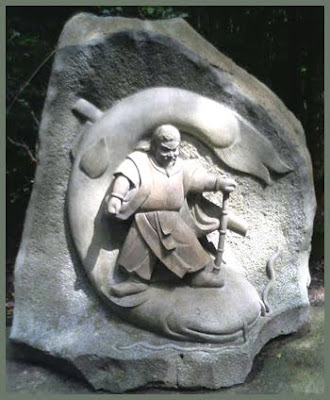
Tekemikazuchi standing on a catfish
the "rough spirit" (aramitama) of Amaterasu ōmikami
He holds down the God of the Earthquake, here in the form of a huge catfish, and sits on the famous "key stone" "kaname ishi 要石".
A giant catfish (namazu) lived in mud beneath the earth. The catfish liked to play pranks and could only be restrained by Kashima, a deity who protected the Japanese people from earthquakes. So long as Kashima kept a mighty rock with magical powers over the catfish, the earth was still. But when he relaxed his guard, the catfish thrashed about, causing earthquakes."
Hatsumi Sensei once explained to us how old Japanese architecture was designed without fasteners, rather it had joints that were lashed together with rope so they could flex and give.
"Jishin mushi 地震虫 (じしんむし) earthquake bug
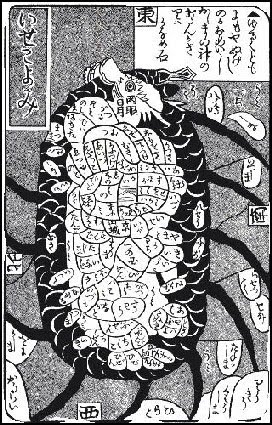
This mythical animal is mentioned in the Nihon Shoki volume about Suiko Tenno 推古天皇紀.
In the year 599 there was a huge earthquake in the region of Nara, so the Tenno ordered the "God of Earthquakes" Nai no Kami「地震神」(なゐのかみ) to be venerated in the country.
The name refers to the attribute of the deity, like the "god of the fields 野の神", or the "god of the sea 海の神".
This deity was later venerated at the shrine Kashima Jingu."
I saw video of the giant stone Torii gate at Kashima toppled over by last week's quake.
In Bujinkan training it is often unwise to meet force with force, because there will always be someone bigger or stronger. I think the earth has made that lesson clear.
Some idiots here in the U.S. are making jokes about Godzilla. They obviously have never watched or understood the tone of the Godzilla stories. Here are a couple quotes from the Godzilla series:
"Just as you distrust us, so we distrust others as well. It's wrong. We're all human. As humans we are responsible for each other. We are related. Refuse us and you abandon your brothers. We must learn to help each other."
--Ichiro Sakai
“Nature has a way somehow of reminding Man of just how small he is. She occasionally throws up terrifying offspring of our pride or carelessness, to remind us how puny we really are, in the face of a tornado, an earthquake, or a Godzilla.”
Some old wisdom tells us that the best place to be during an earthquake is a bamboo grove. Because bamboo is flexible yet very strong. It will bend and sway without breaking.
Huge earthquake, a deadly and destructive tsunami, hundreds of aftershocks, and a looming nuclear meltdown. A hellish week has passed, yet my heart and spirit are across the Pacific with my friends in Japan.


…