15 Comments. The secret to martial arts is that there is no secret. It continues to amuse me that there are so many products and programs out there that claim to be something special, something secret or never before taught or the ?real thing?.…
We can learn a lot from the Kamae in our art. For example, there are three Kamae that are often associated with hanbo that Takamatsu Sensei called 三心の構 Sanshin no Kamae. These three simple looking kamae contain important insights about the nature of fighting and combat that can change everything about the way you understand Kamae and Bujinkan Taijutsu.
Hatsumi sensei says these Kamae are "three phases:"
型破の構 Kata Yaburi no Kamae – form breaking
無念無想の構 Munen Muso no Kamae – no intention, no thought
音無しの構 Otonashi no Kamae – silent posture
The stances betray no outward signs of readiness for action, offensive or defensive. You stand exposed, weapons lowered, and your body square to the opponent. This emptiness makes these kamae positions of pure, unlimited potential from which all manner of henka can arise. These kamae all pass rapidly from stillness into motion and motion into stillness. Offense and defense are one and the same. Emptiness and reality are embodied in the stances with kyojitsu tenkan ho being a primary strategy.
With 型破の構 Kata Yaburi no Kamae you move in a way to break or destroy the opponent's form. Whether that be the form of his attack or breaking the "form" of his spirit. But this also suggests the destruction of your own form. Or the erasing of your own ego. Which leads us to,
無念無想の構 Munen Muso no Kamae, sometimes referred to as mugamae (non form), is the intention of no-intention, no-thought throughout your body or any weapon you hold.
So with 音無しの構 Otonashi no Kamae, you are lying low; saying nothing and waiting for an opportunity. It is critical to use space, without showing your weapon, the form, the shape, or the sound. Use it in the unguarded space to take away the opponent's fighting power.
Soke describes this,
"you stand silently in otonashi no kamae (the silent posture) with both hands lowered. Even against a strong opponent you maintain this form. The cross style of this form has a secret meaning that includes both desperation and sacrifice."
The power of this stance often appears in cinema and theater. Sawada Shojiro returned to Tokyo with Daibosatsu Toge, 1921-1922). In this performance Sawada played Tsukue Ryunosuke, a ruthless and nihilistic swordsman who goes blind but his swordsmanship does not diminish. Ryunosuke's "soundless stance" (otonashi-no-kamae) sword-fighting style inspired many chanbara heroes that followed including the blind swordsman Zato Ichi.
The role of Ryunosuke Tsukue was reprised in the movie "Sword of Doom" by Tatsuya Nakadai in 1966. In this clip we can see Otonashi no kamae at work (WARNING graphic sword fight):
I recently got some new training tools from Mr Gary Phillips from Budo Buki, and I can’t wait to start using them. Not seen on the picture was also a Hanbo in the same colour. I chosed the colours, I guess you can get them in any colour you want.
Budo Buki is committed to providing quality handmade, affordable, padded training tools for the martial arts community. Through a great deal of research, we have developed strong, lightweight, durable products for Budo training. Seeing a lack of safe training tools on the market, we decided to fill the need with our line of covered and padded swords, staffs and long tools.
This 82 minute video is from a seminar Holger taught at the Kaigozan Dojo in April/May 2011. On this video he teaches the Bujinkan Dojo Budo Taijutsu fundamentals. If you know the fundamentals...
I was talking with Paul Masse about recent events in Japan. We were contemplating the appropriate "safe" distance from these disasters. Hatsumi Sensei often suggests to us that we evade by the width of a piece of paper. He gives us this image as a hint to take a small evasion, or, just as much space as needed. I have even heard him say that it should be the width of air. Now that seems risky for sure!
But there is another way to evade that isn't evading. And Sensei does this but it is not easy to see. To open our eyes let's look at one example from nature and one from Hatsumi Sensei.
While talking with Paul, I was reminded of a different kind of distance from a favorite poem. I shared this idea with Paul and he seemed to enjoy the feeling of it:
The Little Duck ----- By Donald C. Babcock
Now we are ready to look at something pretty special.
It is a duck riding the ocean a hundred feet beyond the surf.
No, it isn’t a gull.
A gull always has a raucous touch about him.
This is some sort of duck, and he cuddles in the swells.
He isn’t cold, and he is thinking things over.
There is a big heaving in the Atlantic,
And he is part of it.
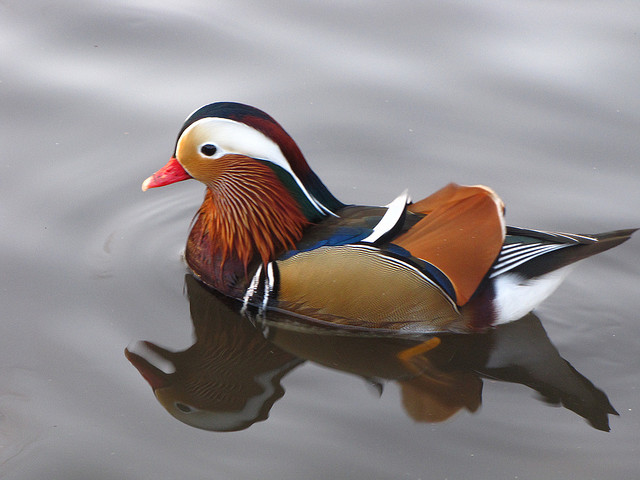
He looks a bit like a mandarin, or the Lord Buddha meditating under the Bo tree.
But he has hardly enough above the eyes to be a philosopher.
He has poise, however, which is what philosophers must have.
He can rest while the Atlantic heaves, because he rests in the Atlantic.
Probably he doesn’t know how large the ocean is.
And neither do you.
But he realizes it.
And what does he do, I ask you. He sits down in it.
He reposes in the immediate as if it were infinity—which it is.
That is religion, and the duck has it.
He has made himself a part of the boundless, be easing himself into it just where it
touches him.
Paul said this is like Fudōshin 不動心. Which is often translated as "immovable heart." But another reading of it could be Fudōshin 浮動心 "Floating Heart."
Well we had our conversation about The Little Duck a couple of weeks ago, and today I came across Hatsumi Sensei suggesting what seems to be the same kind of distance for muto dori:
Understanding muto as "Like a boat floating on water." Whether the waves are gentle or rough, it is good. Hicho no ken (the sword of the flying bird). Regard the opponent's attack as natural. This is Niten Itto, Niten Ichi-ryu. Board the floating boat, and stop the attack. The boat's motion prevents the opponent from moving freely.
I am humbled at this connection that appeared today. And it opened up some ideas for me that I have felt in Hatsumi Sensei's classes but been unable to get my mind around. I can't wait to explore this feeling in class tonight!
Without surprise, the last month has been a very real and true experience in Budo. Japan to many, has always been a perceived safe place, with the recent events changing that somewhat. The perceived danger still lingers, but as in all things ...…
The theme of this year was Roppo Kuji no Biken. All of the instructors had already been in Japan this year and got the feeling of this years theme. This is a 2 Disc set with total 4 hours of...
One of the hiden 秘伝 (secret teaching) ideas of the sword is that life and death are just flip sides of the same instant. The reason this is a secret is not because no one talks about it, but because you must discover its mystery for yourself. Hatsumi Sensei is always reminding us that just as we can end life with the blade, we can also protect life or what he calls, the "life giving sword."
So what about this secret and how does this translate into sword technique? When you are in kamae, and about to cut or thrust to your opponent's suki, there is a Seimeisen 生命線, or an invisible lifeline between you. If your sword is on this line, it is "live," if not it is considered dead. This line is very fine and there isn't room for two blades there. So only one blade can give or take life. This is also an aspect of Shisen 死線, the point between life and death.
To truly understand this lifeline requires a state of fudoshin. That is the only way you can stay on the line without being diverted. And when you are in that place it gives you a mysterious perspective that allows for some useful sword strategy:
後の先 Go no sen when you know where your opponent will strike so you let them strike there before you counter.
先の先 sen no sen is where you know what your opponent will do so you strike him first before he can move. Similar to tai no sen.
先々の先 Sen sen no sen where you sense what the right strategy is by intuition alone and subtly guide your opponent's strategy so that you may win.
Sen 先 and Saki share the same kanji but one meaning is future and one is previous. So Saki no Saki may be a more familiar feeling to anyone that has taken the Godan test.
99 people from 8 countries participated at the 7 th Kaigousuru, sponsored by Bujinkan Kaigozan Dojo in Stockholm, April 2003. Elias taught Kihon Happou with Juppou Sesshou feeling. Dean...