From Bujinkan Santa Monica by Mats "Toryu" Hjelm
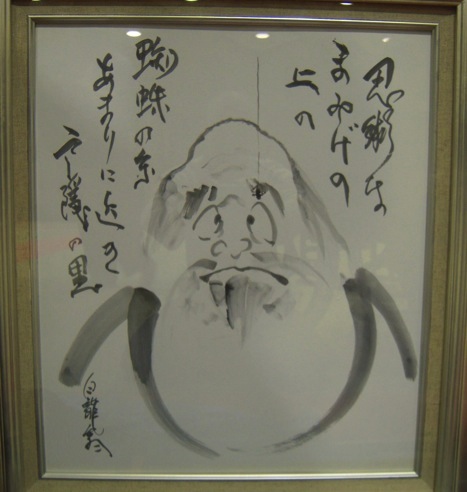
This last year, some of us have heard Hatsumi Sensei make reference to a spider's web dangling down from heaven. As usual with Soke, there are many layers to this idea. One idea that Sensei put out there for us was in his painting of Daruma with a spider descending a web and alighting on Daruma's eyebrow. As
Paul Masse explains:
The Inscription reads, “ Ninjustu is on your eyebrow.... the spider`s thread, so close, the village of Togakure”. Sometimes things are so close to us that we can not perceive them.
Hatsumi Sensei has continued to reference this web from the heavens. If Ninjutsu is on one's eyebrow, or there is a thread to heaven dangling down but we do not see it, how can we use that in Budo?
Maybe it will help if we look at another story that Hatsumi Sensei described to us.
"The Spider's Thread" (蜘蛛の糸, Kumo no Ito) is a 1918 short story by
Ryūnosuke Akutagawa, first published in the children's magazine
Akai Tori:
ONE
One day, the Buddha was strolling alone along the edge of a lotus pond in Paradise. The blooming lotus flowers in the pond were each pure white like jewels, and the place was filled with the indescribably wondrous fragrance continually emitted from each flower’s golden center. It was just morning in Paradise.
After a time, the Buddha paused at the edge of the pond and from between the lotus leaves that covered it saw a glimpse of the state of things below. Now this celestial pond just happened to lie directly over Hell, and peering through that crystal-clear water was like looking through a magnifying glass at the River of Death and the Mountain of Needles and such.
The Buddha saw there, in the depths of Hell, a single man writhing along with the other sinners. This man was named Kandata, and he had been a notorious thief who had performed murder and arson and other acts of evil. In his past, however, he had performed just one good deed: one day, when walking through the deep forest, he saw a spider crawling along the road. At first he raised his foot to crush it, but suddenly he changed his mind and stopped, saying, “No, small though it may be, a spider, too, has life. It would be a pity to meaninglessly end it,” and so did not kill it.
Looking down upon the captives in Hell the Buddha recalled this kind act that Kandata had performed, and thought to use his good deed as a way to save him from his fate. Looking aside, there on a jade-colored lotus leaf he saw a single spider, spinning out a web of silver thread. The Buddha carefully took the spider’s thread into his hand, and lowered it straight down between the jewel-like white lotuses into the depths of Hell.
TWO
Kandata was floating and sinking along with the other sinners in the Lake of Blood at the bottom of Hell. It was pitch black no matter which way he looked, and the occasional glimpse of light that he would see in the darkness would turn out to be just the glint of the terrible Mountain of Needles. How lonely he must have felt! All about him was the silence of the grave, the only occasional sound being a faint sigh from one of the damned. Those who were so evil as to be sent to this place were tired by its various torments, and left without even the strength to cry out. Even the great thief Kandata could only squirm like a dying frog as he choked in the Lake of Blood.
But one day, raising up his head and glancing at the sky above the lake, in the empty darkness Kandata saw a silver spider’s thread being lowered from the ceiling so far, far away. The thread seemed almost afraid to be seen, emitting a frail, constant light as it came down to just above Kandata’s head. Seeing this, Kandata couldn’t help but clap his hands in joy. If he were to cling to this thread and climb up it, he may be able to climb out of Hell! Perhaps he could even climb all the way to Paradise! Then he would never be chased up the Mountain of Needles, nor drowned in the Lake of Blood again.
Thinking so, he firmly grasped the spider’s thread with both hands and began to climb the thread, higher and higher. Having once been a great thief, he was used to tasks such as this. But the distance between Hell and Paradise is tens of thousands of miles, and so it would seem that no amount of effort would make this an easy journey. After climbing for some time Kandata tired, and couldn’t climb a bit higher. Having no other recourse, he hung there from the thread, resting, and while doing so looked down below.
He saw that he had made a good deal of progress. The Lake of Blood that he had been trapped in was now hidden in the dark below, and he had even climbed higher than the dimly glowing Mountain of Needles. If he could keep up this pace, perhaps he could escape from Hell after all. Kandata grasped the thread with both hands, and laughingly spoke in a voice that he hadn’t used in the many years since he had come here, “I’ve done it! I’ve done it!”
Looking down, however, what did he see but an endless queue of sinners, intently following him up the thread like a line of ants! Seeing this, surprise and fear kept Kandata
Kandata
Though the thread had been fine until just then, with these words it snapped with a twang right where Kandata held it. Poor Kandata fell headfirst through the air, spinning like a top, right down through the darkness. The severed end of the silver thread hung there, suspended from heaven, shining with its pale light in that moonless, starless sky.
THREE
The Buddha stood in Paradise at the edge of the lotus pond, silently watching these events. After Kandata sank like a stone to the bottom of the Lake of Blood, he continued his stroll with a sad face. He must have been surprised that even after such severe punishment Kandata’s lack of compassion would lead him right back into Hell.
Yet the lotus blossoms in the lotus ponds of Paradise care nothing about such matters. Their jewel-like white flowers waved about the feet of the Buddha, and each flower’s golden center continuously filled the place with their indescribably wondrous fragrance. It was almost noon in Paradise.
(16 April 1918)
As I read this story I remember Soke talking to us about connection. He said you have to see beyond the surface to see what the possibilities are. He told us that his teacher Takamatsu said "Don't ever sever the connection."
One way to explore these connections is through Juppo Sessho. This refers to ten directions. What are these ten directions? There are eight directions of Happo which are really infinite and can be said to be part of the Sanjigen no Sekai (3 dimensional world.) As Paul Masse says about the Daruma in Soke's painting,
The Daruma`s eyes are staring inward. This is a form of “Happo Nirami” or “Staring in Eight Directions” . It is also a form of “Ma Yokei” or “warding off evil”.
But the Daruma doesn't see the spider. That's because the spider is coming from another direction. The other two directions are Tenchi. Heaven and earth or (hell). This is another dimension. If you can connect to this with Juppo Sessho, then you really will be a Bujin!


…