Skip to content

Hidden Teppo

From Paart Budo Buki by buki stolar

The other night when I brought this new " toy" to training, everyone was surprised,
 which is my main goal, a comment was again "you're crazy", perhaps the best compliment you can get,
only Sensei said, "I thought that was a real gun, but by the smell of lacquer I known that is not"
What to say, for now, this is about the highlight of my armorer skill,
after all, during my military service I was trained as a mechanic of infantry weapons, gunsmith.

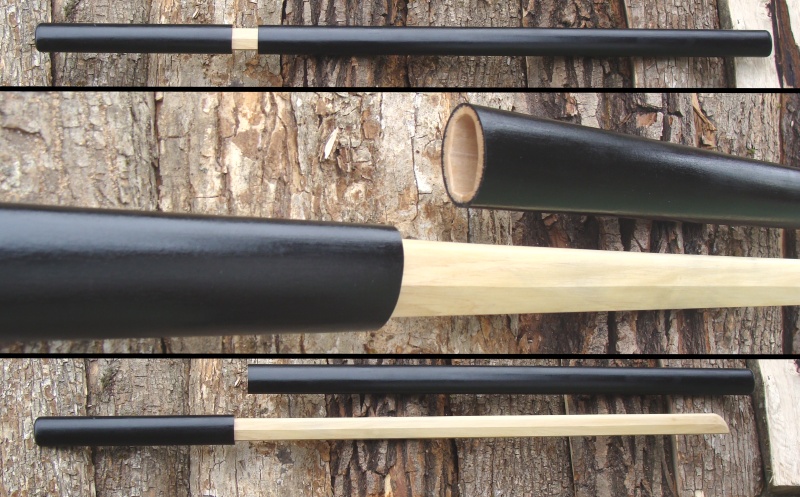
So you are looking at Hidden Teppo wooden wersion made for practice.

Profession says that it's actually Tanju Aikuchi, or Tanto (depends on the length),

 although you would think that it is really a ninja weapon, but it seems that's not the case.
It was known that Samurai's have rejected the idea to replace their swords with firearms, so it seems that "some" were later accepted the firearm but packed in a familiar look.
By the number of this firearms that can be found in antique shops, it seem to be exactly what was happened, normally they never ​​mass manufactured, but still ...

Ninja like that idea too, for his undercover mission, and probably the only one who has used this tool fully, why?
Because after you use this single shot, you could use it like Jutte too, there were also cases that Jutte was conceal to look like Tanto (I make one too, pic. will be in new topic)

But what is really this?, 
it is Japanese made single shot percussion pistol, disguised in Tanto koshiare,

usually it was Caliber 31,

history of this weapon goes in the middle of 19th Century, after Japan has been open to foreigners, the common types of European pistols types of Curiosa percussion pistols.(according to "The Gun Report")

Some other say that  this is rare tanto pistol was used during the political turmoil in Japan, following the arrival of Commodore Perry's black ships in 1854, political assasinations were so frequent that Daiymo began carrying concealed pistols, giving them some protection
against visiting opposing Daiymo.
Most of these special order pistols are unsigned (but find some which is signed) 
Profession says that this percussion firearm is particularly rare because Japanese firearm technology was suppressed until the mid-1850’s, which is about the time that metal cartridges began to achieve commercial success.

Whatever that was the reason for the development of this weapon, for those of us who practice ninjutsu, is essential idea of hidden, unexpected and element of surprise, which gives us the advantage, in the battle for survival.
So if you ask me why this? here is my answer:
As you all know, Ninjutsu legacy is huge, because it grows in parallel with another great power, Samurai,
means that ninja need same knowledge with additions and special equipment to survive in combat against the Samurai, real number of that equipment we will newer know :-(

There is many Dojo's around the world, but they equipment for training is poor, mostly, you will know better.

So my mission is to create authentic equipment for training, yes today is time of new and modern weapons, but "root" is the same.
I that time it was Tanto pistol, today is cell phone pistol, again idea is same.
Soke used to say,  "explain the feeling", so yes it is all about "the feel", 
 but how can you explain the feeling when you do not have the real thing in your hand?
 it's true you could try  to imagine it, but is it same feel?

I had luck (or bad luck) to spend my best years of life around war and in war (Croatian independent war 1990. -1995.) so I see many things. 
Today's young people who come to train at our Dojo do not know almost nothing about the weapons of that time, twenty years after war,
we, the older ones that train ninjutsu not know much about weapons from the Samurai time, 
all that because we not have the opportunity to see real one and take in hand "to feel".

So now I ask you, how you will learn from history, how you will explain to other that history?
Miyamoto Musashi in "Go rin no sho" book in one chapter  say;
 "it cannot be clearly explained in writing, You must practise diligently in order to understand"


and yes, it will be some more for sale, for lucky on's : )


The Kaname of Ninja Biken with Peter Crocoll

From Bujinkan Santa Monica by Michael

Peter Crocoll Opening a Door
Friday

I went to Coconino National forest for Peter Crocoll's annual campout. We were up at 7500-8500 feet in elevation in the mountains and the forest was beautiful. After our long drive from Los Angeles, I set up my tent quickly so that I could enjoy the wonderful mountain air and scenery.

After a chilly night under the stars, I took a hike early in the morning. I lived in Arizona for most of my life and spent a lot of time hiking and camping all over the state. Returning to this air, this sunlight, this open sky… always feels like coming home and speaks to my body and spirit on a deep level.

Saturday

Peter's training topic for this event was "The Kaname of Ninja Biken." Training in this mountain terrain connected us to the origins of Togakure ryu in the mountains of Japan. I cannot convey all the details here in these notes. But I will present some impressions.

In the morning, we filled the air and kukan with a swarm of shuriken. The use of shuriken and 目潰し metsubushi is a tactic closely linked to ninja biken. This serves to more than compensate for the length of the 忍者刀 ninja-to by filling gaps in perception and rythm of the opponent. He will never know where to defend and the tip of your 忍者刀 ninja-to becomes just another stinger in the swarm he cannot possibly escape.

Peter then connected the shuriken with sword kamae from Togakure ryu. After a review of the basic kamae, we used these kamae to cut and launch shuriken at our opponent's. Very difficult to do this without gaps in your own movement as you search for shuriken on your body. For me the trick was not to go fumbling for them, not to search. But rather to find them or discover them in the movement. They just appear in your hand as you move.

Peter then focused on kamae no waza with 一之構 ichi no kamae. I discovered early on that it was crucial to control the space with the tip of your sword. If you know how to achieve this, from the initial kamae you have already won. Then as you pressure the uke's arms with your blade, the tip presses into his center.

Peter spoke about the important goal in Togakure ryu is not killing or winning, but survival. That may be why it is still with us today, whilst other ninja schools have been lost to history. One tactic of this survival is finding the "hidden door." This can be the hidden opening on an opponent or in a troop formation, but it is also the hidden door of your escape route. Even if you know where this "door" is, you still have to be able to open it!

Next we looked at 正眼之構 seigan no kamae and 中段之構 chūdan no kamae. For me, the kaname of these all involved the control of space, or rather, connecting in the space so that you may live. As Hatsumi Sensei has said, 中段之構 chūdan no kamae is like kukan no kamae, where the mind and body  "are" the space and the space protects you.  This feeling has interesting connotations that led into our night training.

Saturday Night training

Nighttime in the wilderness of these mountains is exhilirating. We had a bright, nearly full moon, and I could deeply appreciate this idea from Hatsumi Sensei: "There is no village on which the moon does not shine, the moon lives in the mind of the gazer." - from Ninpo and Mu: Waxing and Waning Like the Moon

After some quiet and meditative stealth walking through a moonlit meadow, Peter helped us explore our "other" senses by connecting to threats from our periphery and from behind. At first, I fell into the trap of relying on mechanics.

I used tricks that I know to extend my peripheral vision and relied on sound as a warning device. I also focused on the sensation of absence or presence. This is like when you sense that you are alone, or that someone else is near. The problem with these methods is that they are often too slow. By the time you react, the threat is upon you!

I decided that this was a poor way to use the richness hidden in the dark forest surrounding me, and opened myself up to a larger experience. I cannot explain in words how to achieve this, but it is directly related to the experience of the godan test. Once I connected to the space in this way, I had wonderful results.

After this we had a wonderful campfire courtesy of my friend and twisted firestarter Brian. Brian is well aware of current geopolitical dynamics, and he will never be obsequious. We laughed and told stories late into the night.

Sunday

I crawled out of the coziness of my tent into the chill morning air. I went for a quiet hike to watch the birds and do some light rock climbing. I had a enjoyable breakfast with my friends. Normally the mountain air drives my appetite, but this trip all of my meals were light for some reason.

Peter began training this morning with a quick review of the sword kamae. Then he went further into kamae no waza with 下段之構 gedan no kamae. I was reminded of something that Paul Masse and I discussed recently about the idea that "enlightenment is at your feet." Hatsumi Sensei says to assume this kamae with that feeling. Then the kick in this waza is like kicking open a door for your escape. But that door was always there at your feet.

Peter  transitioned to 八方秘剣 happo biken with 飛龍之剣 hiryu no ken and 霞之剣 kasumi no ken. With both he really emphasized this idea of escaping and highlited this necessity by having us face multiple attackers. The flow of these two kata naturally encircle the opponents in the space in a way that they become entangled. If you disappear into the mist of kasumi, they will be fighting each other or only emptiness.

Now, as I begin my week back in civilization, I have that good exhaustion that leaves me refreshed in spirit. I want to thank Peter and all my friends in Arizona, as well as my own students for sharing this experience in the mountains. We are so lucky to have this ninja heritage that connects us back through the mists of history and place, to the mountains of Japan. Hatsumi Sensei's generosity in sharing this gift with the world is really humbling.

Of Note: Shout out to Eight legged Sal, my Aphonopelma chalcodes tentmate.

Kunoichi’s Neko Te

From Paart Budo Buki by buki stolar

Dear ladies,
 
I apologize if it seems that I forgot about you in my work.
This is one of the projects that was a long time in my drawer (there are still plenty of),
 I planned to present it on the first Kunoichi TAIKAI, but unfortunately due to personal problems remained unfinished until now.
 
In front of you is the simplest version of Neko Te for training, it was made of rubber to be safe and prevent injuries
I have a similar version of the metal, on which I still work, to make it easy to adjust the size of finger person which will use it.

According to the book "NINJUTSU History ad Tradition" from Soke  Hatsumi, this weapon of Kunoichi we called "Neko te"
 
Originally, this instrument of female Ninja is made of leather and steel,
Neko te, fingertip weapons, as the book says, turn a Kunoichi's hand into a death- dealing claw,
how you are use it, I live up to you or your sensei's .
 
As for the technical side I can say that this tool requires adjustment to the size of your fingers
 
soon I will explain how you can easily make a measurement of your finger, if you decided ask me to make this tool for you.

Anyway, I will add new info about this project so check this topic from time to time if you are interested.


One week to go – information galore!

From Sweden Taikai 2012 by alexander

Dear all, we’re at one week and counting down! Here’s the latest batch of information:


Staying in the Kampsportcentred Dojo Friday night:
There will be plenty of people staying at Kampsportcentret during both the night between Friday and Saturday, as well as Saturday and Sunday. Just keep in mind not to leave any valuables there, since there are lots of other people outside the Bujinkan who have access to the premises.

Friday pretraining:
You’re welcome to join the pretraining on Friday (5/10) evening, between 7 p.m and about 9 p.m. We’ll keep it casual and anyone who wants to share something are welcome to teach. It will be a nice time to meet up and get to know each other a little and get some insight into what we train in different Dojo’s.

Transportation: 
Bus: Take bus nr 2 from Trädgårdstorget (or any other bus stop on the way that fits better for you) and get of at Kompanigatan. (The trip takes about 10 minutes.) You’ll have to buy your ticket in advance as the driver will NOT accept cash! At Trädgårdstorget there is a green machine called a quickomat where you can pay with all the major bank and credit cards. You can also buy an SMS ticket: send an SMS with the text: LV to 72 365 and you’ll have the ticket sent to you.
When you get of the bus the entrance is right in front of you.

Car: Parking lots are available in the square in front of the building where we are training. It cost’s 40 kronor/day or 5 kronor/hour and you can pay with card or coins.
To get to the entrance, just walk around the building.

Eating:
There are a couple of places around the area where you can get a decent lunch. On Saturday, when the lunch break is a little longer there’s enough time to walk down into central Linköping to get a bite if you want to. There’s also a a couple of convenience stores some 10 min walk from the venue.
We’ll have maps at the venue, and you can also have a look at the map below or at the information page to have an idea beforehand.

We will not arrange a Saturday eventing dinner for everyone, but feel free to ask for suggestions of where to eat before or during the Tai Kai. There’s no lack of nice restaurants in all price ranges in Linköping.

We will be selling some drinks and light snacks during Saturday and Sunday, but no regular food. The tap water is safe and good to drink, so we suggest you enjoy that as your training drink.

Store:
The instructors will be selling some of their own material during the training days. Keep a look out and talk to anyone of us in the staff (red/maoon shirts) or the instructor selling the material if you want to buy something.

Map
With the venue, bus stop, parking lots and some restaurants and convenience stores marked.
https://maps.google.se/maps/ms?msid=213895056288552861940.0004caac0d0504de82c7f&msa=0&ll=58.396405,15.614662&spn=0.022894,0.084543