
Releasing the Power of 力を抜くChikara o Nuku
From Bujinkan Santa Monica by Michael
 |
| 川蝉 Common Kingfisher photo by yamatsu |
He used a phrase "刀を抜くkatana o nuku, 力を抜くchikara o nuku." This has many layers but by dropping the power or the intention out of your technique it becomes effective. Even dropping the technique from technique. But there is a trick to this that many students of Sensei apparently neglect to understand.
Many people think they know what Soke means when he speaks. That night in class, one of Sensei's frequent translators came up to me and told me, "That's not what he said!" Meaning that the current translator had gotten it wrong. So then he explained to me what he thought Sensei meant.
I just listened to his explanation and didn't agree or disagree. I brushed this off as a personality conflict between translators. Or maybe it was due to the extreme difficulty of concise translation of Japanese in the dynamic environment of the Hombu. But when more people complained to me about the translation, I figured there might be more to this.
So in order to participate in the confusion, I will offer my own thoughts about what we were witnessing in that class. I haven't yet seen anyone offer the explanation I will make below. But maybe you all know this stuff already.
You cannot have 力を抜くchikara o nuku if you don't first have chikara. Otherwise there is no power to take out of the technique. One common way that I have witnessed Hatsumi Sensei and the other Japanese instructors do this is by going from 力を入れる chikara o ireru (using force, strength or exerting effort) to 力を抜くchikara o nuku.
I myself have had great results using this in my taijutsu. For a simple example, it is like the children's game of tug o' war. Two teams pull on a rope in the opposite direction. Whichever team is stronger pulls the other towards their side and wins. But when I was a kid, we thought it was great fun to 力を入れる chikara o ireru and pull with all our might, then quickly release the rope for 力を抜くchikara o nuku. Relaxing suddenly and letting go of the rope made the other team fall on their asses.
You will see this concept everyday in the Hombu as the uke seem to throw themselves.
So 刀を抜くkatana o nuku is something I have been practicing for quite a few years. I have a visualization that I use to explain the principle. To get the tip of the sword to the target in an effortless and quick motion, it is like releasing a bird from your hand and the bird flies directly to the target as if it is spearing a fish. But first you must be able to capture or hold the bird.
Hatsumi Sensei described this method of drawing to us that night. He said that with katana o nuku, you are not drawing the sword, you are letting it free from the saya (like my idea of releasing a bird). It is very dangerous, with this motion the sword will kill with no effort at all. The blade finds its target.
This is what I understood from Sensei's class that night. Other people who were there may have different ideas that are valid. I hope that sharing my thoughts helps you to discover your own understanding about our art.
REI
From TENRYU by jorgevaccaro
REI
“In what’s immutable, there’s existence;
In what’s immutable, there’s No existence”
Lao Tzu
Budo must be an example of life, but not of great heroic acts nor magnificent spiritual gestures, but of simple and daily acts of ofering, gratefulness, protect, caring and being, which to my understanding mark us on a human basis.
Rei 例 means practice, habit, custom, example, ilustration. Being able to give the example of constant practice is part of the escense of Budô, thus one must keep individual training and learning without an aparent goal, so this way may leave a print of existence to those who come behind.
Continuing self training and follow the teachings of a master, are fundamental to not get lost in the illusion of the path. In time, the master is aparent, as is the path and the teaching, but they are mostly needed, because they keep connected with one another like a misterious red thread that bonds the pinkie fingers of every people.
To be always thankful also connects us with REI 礼, that in this case means to be thankful. This Rei, must be a real expression of gratitude in a humble degree, by lowing the head on a reverence. In Japan, the sence of. Reverence towards the elderly, the teachers, those who help or by example the clients, are acts of showing respect by lowing the head lower than theirs. This is also a part of the Reigi 礼儀 (behavior manners, courtesy acts).
The Path is apparent, but being able to give the example of moving forward without a real path is the escense of Budo. Believe of an ccomplished path and believe that one can be the path, is just an illusion.
To my understanding, the path relies on Mu 無, so then we can say that one of the Kaname of Budo, is the Mudo 無道 (http://tenryuden.wordpress.com/2011/04/28/budo-mudo/) However, is the Mudo no Kaname is an illusion, Kaname 要 is an non existential point, that only manifests itself by the fact of expressing it over the space. Even though we believe that the Kukan no Kaname is the escential point on the space, we all know that within the Kikan there’s only emptyness, so it’s impossible to find a point of support, a rotation point of even an escential point from within. The mind creates it only by the fact of needing a point of support , a way where it can sustain itself, to not get lost in MU.
Sôke talks to us about Rei 例
“It is said that the martial forms are shown through the daily life and behaviour. That is, through costumes and humanity”.
In the daily life, the present life, is the only real thing we have, but from within, it’s an existential echo from the actions from the past, our own and our ancestors. They only manifest in the apparent path, but is only an illusion for the ego to have the security from where to stand.
In the Zen Budhism we can find the text about the cuestions to the mastern Nansen, which they come from the Nara period.
Nansen was interrogated by Joshu ¿What is the Path? to what Nansen responded: “Your ordinary mind is the path”, Joshu then said: “¿Can you find it?”. To what Nansed said, “Just the you try to find it, It’ll fade away”, Later on Joshu asked “If you can’t find it, How can you know that it is the path ?” Nanses said “The path does not depend on knowing or not knowing. Knowing is confussion, not knowing is to be cheated. If you really were to find the path of no doubt, is like a great void. How can you force this to adapt the categories of confirmation of negotiation?

We can say, that REI 例 are the costumes, practices and habits that we acquire throughout the keiko, achieving the humbleness of being thankful (Rei 礼) to the existence of the ancestors and teachers.
Following the no path, in the individual transformation in REI 零, in which case means “cero, nothing”, and this is the escential part that cannot be understood. Being “Cero”, is submerging the conscience in the No conscience of the “no existence”, to what we can call Mu 無.
Sôke says;
“If you can’t understand, this is normal because is Ninjutsu. If you could undersand, if wouldn’t be Ninjutsu”
Si then our called existential ans spiritual essence REI 霊 (espíritu)”, comes fro the no understanding and the no path. The more we want to use our intellect, the further we are from the true experience. The experience comes from the constant practice inside, and out of the tatami. Inside of the tatami with our Gi moving us and improving the physical techniques, achieving knowledge through distance, the space and time with hundreds of skills, outside of the tatami moving us without the Gi and improving our habilites of generosity, kindness, patience, tolerance, giving and protecting, observing and learning, hearing and caring. All this applied to family, work and society are the instruments that mark our “humanity”.
Inside, as outside of the Dojo, we must also cultivate the ming in the no existence to turne it in the No Mind (mushin 無心). That is, the existence exists, and the no existence also exists, both are connected.
According to a famous martial arts teacher from the Edo period; Yagyu Manuneori:
“In a moment of existence, a Tsuki is thrown to the existense. In a moment of no existence, a Tsuki is thrown to the no existence. Equally, without expecting the existence, there’s an attack thrown to the existence. In that sense, it is said that the existence is existence, and the no existence is also existence”.
Christian

 …
…Keiko32 – Back from Japan Seminar #23 with Mats Hjelm
From New Products from Budo Shop Store by New Products from Budo Shop Store
 | Title: Keiko32 - Mats Hjelm - Back from Japan Seminar #23 On this seminar Mats showed techniques and ideas from the trainings he had been to with Hatsumi Soke and the Shihan earlier this month.He taught Taijutsu techniques, kenjutsu, rokushakubo, yari, naginata, hanbo techniques mixed. To fill out this dvd more we also included techniques from two previous seminars this summer, Naginata and Yari basics. Note: The instructions was in Swedish, but there is really no need to understand exactly what was said. There is not so much philosophical talk, but more more action that you will understand in the movement. This video is also available as download (without the extra bonus material) About the instructorMats Hjelm started training in Bujinkan for the first time around 1983, but it wasn’t until 1986 he had the opportunity to start training more seriously under a Shidôshi. He attends around 20 seminars, go to Japan 2-3 times every year. Since he started training he never had a training break. He takes his budo training very seriously! If you want to sponsor a seminar or course, please don’t hesitate to contact him. For more information see Mats web site http://www.kesshi.com
Skr239.00
|
過去現在未来之術 Kako Genzai Mirai no Jutsu
From Bujinkan Santa Monica by Michael
 |
| Bujinkan Hombu 畳 Tatami photo by Michael Glenn |
That night on the tatami of the Honbu, Soke was giving us a deep lesson. He said that we should keep the past, present, and future connected. Allowing one to drive the next. This happens with or without our participation.
If you can get with the flow of this connection, then you may ride it to victory. But in order to flow and connect with it, you must be able to see it. What does it look like?
Maybe you've had the experience of looking at a newborn child. You see your parents and grandparents in his or her fresh face. You see yourself and your partner reflected there too. And you also see a newness that is in the process of becoming. A new person with a future life stretched out ahead. Of course you see how these are all connected. Maybe you think about how your parents must have studied your own baby face with the same wonder.
Some people would rather forget the past. They may propose a toast to say, 過去を忘れるために乾杯 Kako wo wasureru tameni kampai, Here's to forgetting the past! Or even something like, The past is vile, the present is barely tolerable, but there's hope for the future.
When Hatsumi Sensei teaches, each technique is like a newborn child. He teaches based on a kata or concept that has been passed down through the ages in a lineage he inherited. If you look carefully, you will see the imprints or DNA of this 過去 kako or past encoded in the movement. All of the Bujin, the past Soke, and the warriors who lived and died with our art are contained there. Hatsumi Sensei has told us this directly.
But you also may see Hatsumi Sensei's living expression of the art in the present. This 現在 genzai is vital. It is what allows the art to stay relevant. Truthfully, it is the only thing protecting you should you need to use the art in combat. Hatsumi Sensei has clearly stated that the way he teaches now is what matters. If you are not connected to this current training, you are studying a dead art.
If you are really connected and observe carefully, you may even bear witness to where the art is leading us. As you watch Hatsumi Sensei teach, there is a palpable experience that anything can happen. And it often does. As he follows the unbroken connection in each moment, you begin to glimpse the path ahead or the 未来 mirai in our training. The sense of wonder this gives me as a student is indescribable.
This explains why nothing Hatsumi Sensei teaches is ever the same way twice. You may have seen him do the same kata years ago and thought what he did was a definitive rendition of this kata. But then he will do it again, entirely different, and this version will feel like the definitive version. If you try to hold onto either technique, you will miss the point and be left behind.
That night in Hombu, some people debated what Soke meant by his statements. But I just took in the spectacle with enjoyment. Because Soke did not care.
He simply told us to take ample space. With the proper use of space the attacker is defeated. But you aren't using the space! You just allow for it, and many wonderful techniques are born.
So when you are in actual combat, if you can connect to the three aspects of 過去 kako, 現在 genzai and 未来 mirai, you may enter the world of 幽玄 yugen. Your opponent will be operating in the fog and you may float outside of his influence.
Old look Kunai
From Paart Budo Buki by Mats "Toryu" Hjelm
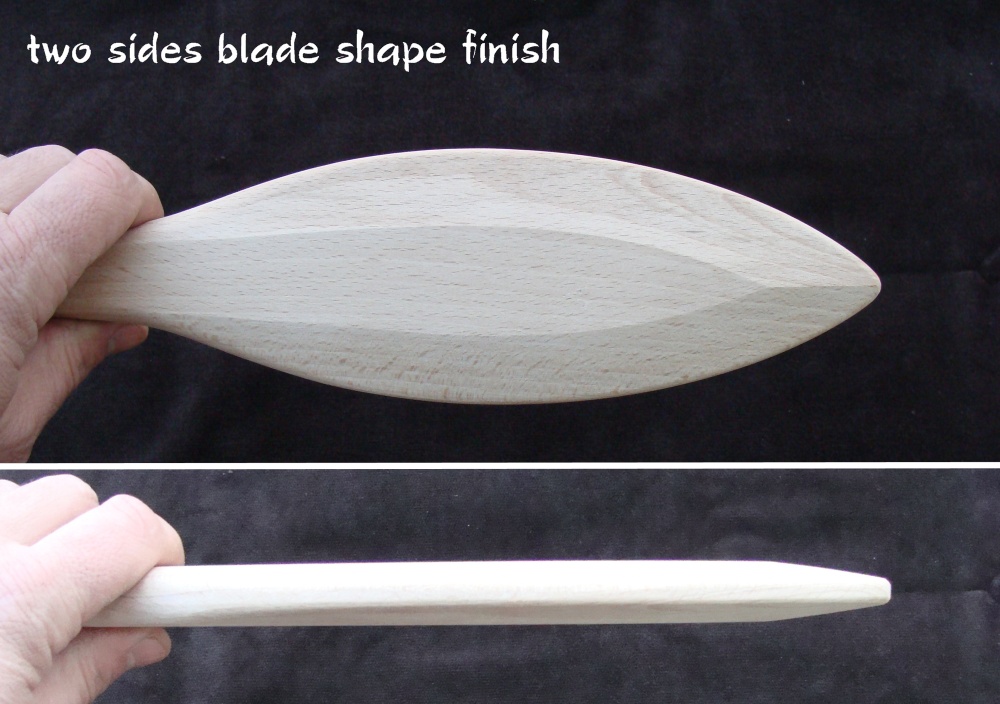
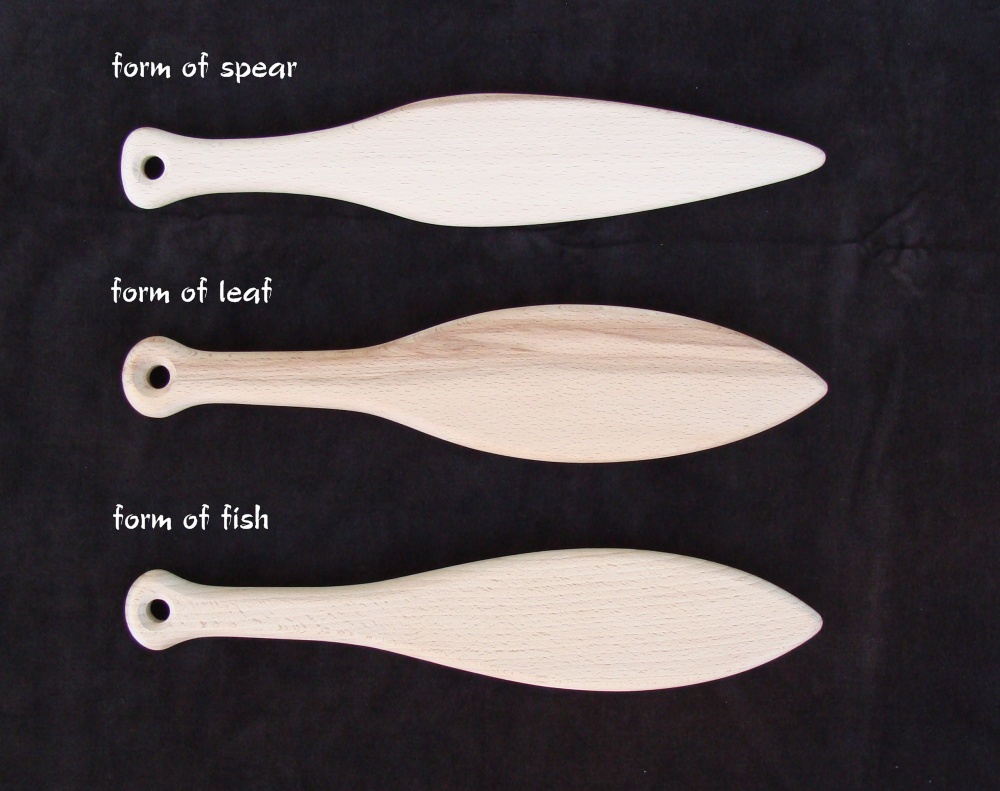
on pic. below you could see my new rustical, old look Kunai, finish on this Kunai is handcut,
idea is that hand cut marks look like hammering traces


so here is few new options of finishing on Kunai for all who like to order




Shi Tennô
From Shiro Kuma's Weblog by kumablog
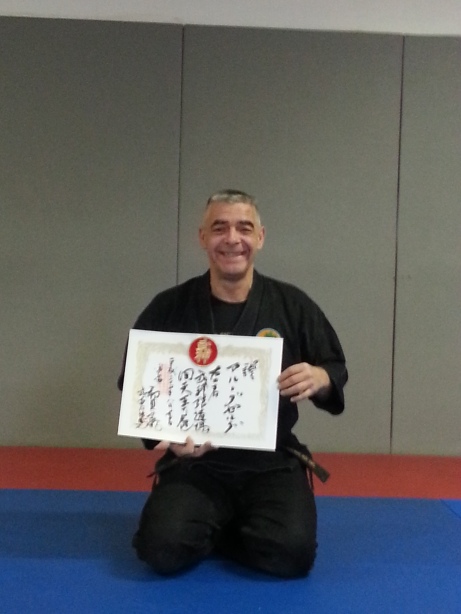 Recently Hatsumi Sensei honored me by awarding me with a diploma of Shi Tennô.
Historically, the Shi Tennô 四天王 were the four “celestial emperors” protecting the four directions of North, South, East, West.
Shi-tenno (literally, “Guardian Kings,” but most often translated as “Directional Guardians”) are deities, protectors of Buddhism, who guard each of the four directions of the compass (north, south, east, and west) from harmful and dangerous influences. Originally from India, the Directional Guardians were transmitted to China during the Tang dynasty (about 600 AD), and from thence to Tibet, Korea, and Japan. The Guardians appear in paintings, such as mandalas, and especially in temple sculptures, where they usually surround and protect a central Buddha image. (…) They are known as: Zocho Ten (South), Komoku Ten (West), Bishamon Ten (North), and Jikoku Ten (East). (source Wikipedia).
In 1993 Pedro, Peter, Sven and me, were the first non Japanese students to be promoted to 10th dan. And we began to give seminars altogether all over the World. Twice a year after these seminars, we would send sensei a postcard to tell him what we were doing.
One night, at Ayase, he referred to us as being the “Shi Tennô” of Europe.
Since then we are known as the “Yûro Shi Tennô”. The Japanese Shihan: Oguri Sensei (+), Nagato Sensei, Noguchi Sensei, Senô Sensei are named the “Shi Tennô”.
This title is not a rank, Hatsumi Sensei is referring to the nickname given by Kano Sensei to his four best students who travelled Japan to spread the Kodôkan Jûdô in the 19th century. Like Kano’s students, we would travel Europe and the World giving seminars and spreading his teachings to the North, West, East and South.
Today the only remaining so called “Shi Tennô Seminar” is the one I organize in Paris every year in July.
Since the 90s’, the Bujinkan has grown a lot. Last dkms Sensei said that the Bujinkan was now 330000 practitioners, 3300 Shidôshi, 330 Jûgodan. Even if I think that these figures are more symbolic than anything, it must be close enough to reality to understand that our organization has now reached a mature state.
My best student and friend Hugues received it for me while I was in Lebanon for the UN, but it was only yesterday that he gave it to me. Over the years, I have received all the diplomas possible from Sensei: Shidôshi (1989), Jûdan (1993), Gold medal of the Bujinkan (1994), 15th dan (2004), Menkyô Kaiden in Tachi Waza (2004), Shingitai (2011), but this one diploma has more value for me for many reasons. First there will always be only 4 “Shi Tennô” and I am really proud of it. Second, this title is coming from the heart more than from any technical ability. And Third like for the Shin Gi Tai Diploma it has the Golden patch on it.
Domo Arigato Sensei for this very special honor.

 …
…Path to the Heart of the Flower (IV)
From The Magick & The Mundane » Bujinkan by Shawn Gray
Finally, some free time to blog again!
In the last blog article I wrote on my early adventures in Japan, I related how I went to Iga in search of Hatsumi Sensei in October 1990, but didn’t manage to find him.
After not having found him, there was nothing else to do but return to Hiroshima and continue with my English teaching schedule. I also went back to my Karate studies, and continued pounding my fists into bloody hamburger against trees.
Back to Eikaiwa!

Back to Blood!
In December 1990, I had the opportunity to travel to the Chito Ryu Karate Hombu Dojo, located in Kumamoto, on the southern island of Kyushu. The Dojo was equipped with two bunkbeds, accompanying four people. When I arrived, there were two guys visiting from British Columbia, Canada, also staying there for training. (I wish I could remember their names after all this time, so that I could track them down. It would be fun to share stories again.) The Soke (Grandmaster) was 40 years old at the time. His father, the founder, had died in 1984. (From what I’d heard, an elder brother had been destined to continue the leadership of the style, but from what I heard, had been disabled in a car accident and therefore unable to continue with training. The younger son, next in line, had been in Tokyo pursuing medical studies, but was recalled to Kumamoto by his father to take over leadership of the lineage.) I stayed at the Dojo for two weeks, and greatly enjoyed the training. I was awed by the skill level of Chitose Sensei and his senior instructors. In the backyard behind the Dojo were two Makiwara punching posts. Wooden covers protected them from the rain, and on the covers were painted a Japanese character which is very familiar to my fellow Bujinkan practitioners. The character is pronounced “Nin“, and is the first character of the word “Ninja.” What was this character doing displayed so prominently at a Karate Dojo? Although sometimes understood in ninjaphile circles to mean “stealth,” the character is more widely used in more mainstream Japanese to mean “restraint,” “patience,” or “perseverance.” It was with these noble ideals in mind that we forged our minds and bodies in the daily training at Hombu Dojo. Kata, Kumite, and Makiwara training were all part of this. By perseverance and austerity in training the body and mind in the way of the Bushido ideal of the Samurai of old, we pushed our mental and physical limits beyond what we thought possible.

Makiwara with “Nin”
Aside from the training itself, there are a couple of memorable experiences from that time in Kumamoto. One was when Chitose Soke took the other visiting Canadians and myself out for a visit to Kumamoto Castle, one of the three premier castles in Japan. Scars from the Satsuma Rebellion of 1877 (when Samurai warriors of Satsuma province rebelled against the imperial forces of the Meiji government) pock-marked the stone walls. It was an impressive edifice. Soke took us out for sushi afterwards.
Another memory was from one night when my two new Canadian friends took me out for a night on the town, Kumamoto style. I had never been out drinking in Canada before, let alone in Japan. I had no idea what kind of town I was in or where we were going. Before I knew it, we were sitting at a table ordering drinks, surrounded by very nicely-dressed ladies from the Philippines. I was from a farming town of 3,600 people on the Atlantic Coast of Canada. It took me a while to catch on that these ladies worked here. Anyway, we kept ordering and my two Canadian friends were on my left, engaging the ladies in deep conversation. Almost as if they’d met before. I felt a nudge on my right and turned to see what appeared to be two of the local Japanese bikers. They seemed friendly enough. The one next to me, I discovered through our broken conversation (my Japanese vocabulary was probably about 30 words at this point), did well in the local boxing scene. At least that’s what he told me, as he kept grinning and pointing to the biceps bulging out from under his cut-off denim vest.
I was starting to feel a little bit uncomfortable, but couldn’t really understand why. I started to think I should ask my friends when we were planning to leave. I turned to my left to ask my friend when we were going to get the check, and then felt a fist slam lightly into the right side of my face. My friend turned. “What?” “I think maybe we should go. This guy just hit me.” “Wait a second.” He turned to confer with the other friend. I turned to my right and smiled nervously at the two grinning Japanese guys wearing black leather. They looked like they were having fun. A moment later I turned to the friend on my left again. “What.” Again a punch from the right hit the side of my face. Harder this time. “Look man, our friend on my right here has now hit me in the face twice. We need to go, now.” “Ok.” My two friends stand up. Both of them were about fix-foot two. Sturdy Canadian farming boys. I turned to my right. The two Japanese dudes were gone.
We paid the bill and headed down the elevator. It came to a stop at ground level, and as we stepped out into the parking lot and the doors closed behind us, we found ourselves on the back side of a slowly-shrinking circle, on the perimeter of which were four or five tough-looking locals. The friend on my right made a quick beeline to the right, down an alley. I was close behind him. Closer than I normally am to other guys. We zig-zagged quickly through some alleys and eventually found ourselves with our hands on our knees, panting and out of breath, outside the Hombu Dojo “bunk room.” There were just two of us. The other Canadian friend was nowhere in sight. It was around 2am. We waited. We didn’t want to wake anyone and cause a scene. We waited some more.
After what seemed like at least 20 minutes, our friend loped quietly out of a side street and over to join us in the shadow of the Dojo roof. “Where were you?” “What took you so long?” “What happened!?” He told us that he didn’t see us bolt away right away, and before he knew it, he’d been surrounded. As the four or five tough guys closed in, one of them had pulled a knife. Our friend had a quick eye and saw the guy start to draw. He jumped on him and punched him to the ground, and then made a run for it. It took him a while to give them the slip and sneak back to join us at the Dojo without being found. We quietly slid into the Dojo dorm and into our bunks, glad to be alive. The next morning Soke asked us how our night had been. We played it cool and made like nothing out of the ordinary had happened. He smiled.
The next day was the day he took us to Kumamoto Castle. On the way in the car he told us that he’d heard about what happened, saying he was glad we got through it ok, and apologized “for those with bad manners.”

Chitose Soke and 2 Canucks
Before I left Kumamoto to go back to Hiroshima for the New Year, 1991, Chitose Soke gave me some training advice for when I got back. Study also Kendo, for speed and timing, and also Judo, for throws and locks. I was a bit surprised to hear this. Martial arts masters aren’t always known for recommending that their students study other arts. Soke’s openness in this way really impressed me.
When I got back to Hiroshima, I asked around about Kendo training. There was a small Okonomiyaki bar in Hiroshima run by a young Japanese woman and her American (Seattle, I think it was) husband. He was very into Kendo, and was proud of doing it in Japan as a foreigner. He had photos of his shop and would brag about being a 3rd Dan, which I think he said was one of the highest ranks of any foreigner in Western Japan at the time. I have no real way of knowing whether that was true or not, but that’s what he’d say. He agreed to bring me along to his Kendo class and introduce me to his teacher, Fujiwara Sensei.

With Fujiwara Sensei

Lesson with Fujiwara Sensei
Fujiwara Sensei was a wonderful old (to a twenty-year old!) Japanese man who always had a huge smile floating across his face. He had a very soft, gentle manner and a kind way of speaking. For some reason he took a real liking to me and, in addition to selling me $1,300 of training gear for $300 and giving me a set of Hakama with both of our names embroidered in it, also refused to let me pay for lessons. This irritated the American guy who introduced me. Fujiwara Sensei had been his teacher for years, but he always had to pay for his lessons. I was unable to explain why Sensei seemed to like me so much. Maybe it was just because I was always so polite. I’d always greet him with the extra-polite, “O-kawari arimasen ka?” (“Has there been no change [in your health, etc.]?”) He’d always smile widely and say, “Hai, arimasen!” (“Yes, there hasn’t!”) My American friend was less than impressed. He’d pound the hell out of me when we were paired up in the Dojo and I would go home with headaches from getting hit on the head so hard repeatedly. I didn’t know what to do. I could not force Sensei to take the money. Out of desperation I would bring bags of fruit to the Dojo and force them on him. The Japanese students would laugh at this, but I didn’t know what else to do. I was never ranked in Kendo, although in addition to the regular Suburi and Randori training, Fujiwara Sensei also taught me 5 Bokuto Kata forms and 2 Shoto Kata forms. I seem to remember that these were for Shodan level, but my memory could be wrong on that.

Kenjutsu Lesson
As far as Karate ranking went, I went to Japan as a brown-belt. Kanao Sensei in Fukuyama wanted to promote me, but said that Chito Ryu had prohibited ranking of foreigners to Yudan grades (black belt grades) in Japan. Apparently some Japan-promoted foreigners had in the past gone back to their home countries and caused political problems by claiming their rank from Japan was worth more than a locally-given rank of the same degree. So I wasn’t promoted during my stay in Japan, but Kanao Sensei did teach me some very interesting Kata that made things interesting when I got back to Canada. 
To be continued…

 …
…Dkms3: Amaterasu Ômikami And The Kôjiki
From Shiro Kuma's Weblog by kumablog
Before detailing what Sensei spoke of during the last day of dkms, I have to tell you that it was very dense. Writing about it I discovered that the complexity of what Sensei said during that day allows us to follow his very particular way of reasoning. This is why I have decided to deliver it chronologically in this article the way it was displayed to us last Sunday. Good luck!
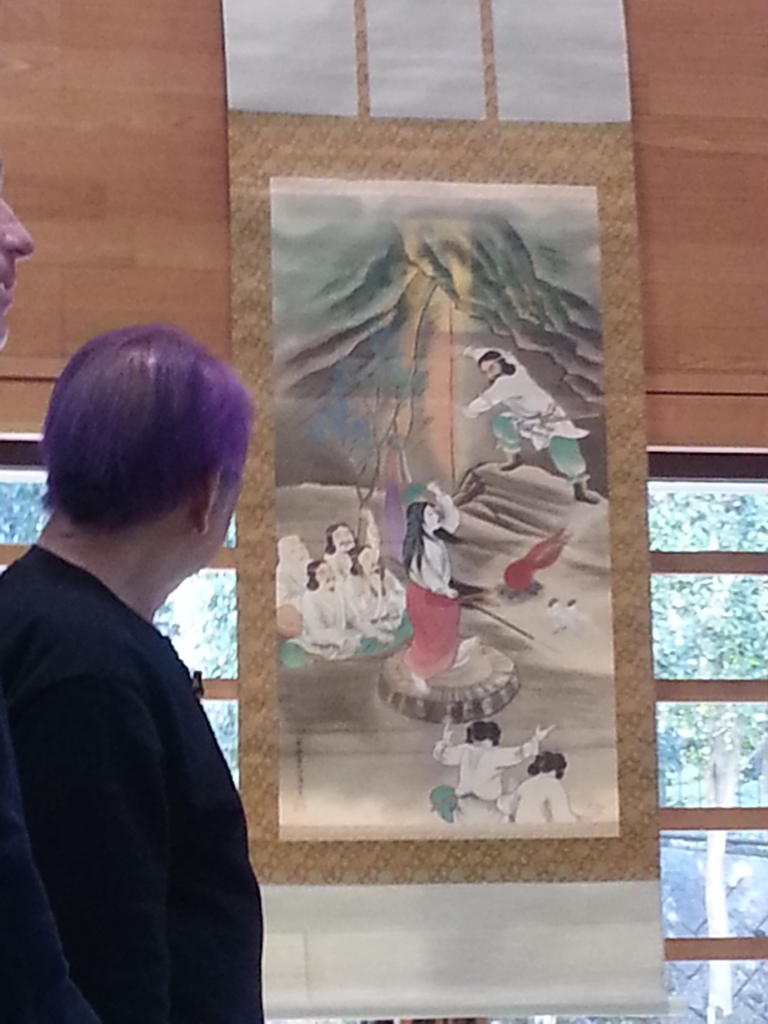
On the last day of dkms Sensei spoke of many concepts and he introduced the day by displaying an old painting on a scroll depicting the moment when the gods tried to force Amaterasu no Kami, the Sun goddess, outside the cave where she was secluding herself.
That was a little too much even for my twisted brain, but I will try to make it understandable. Please excuse me for the apparent lack of logic in sensei’s explanations. But if you are familiar with his “Quantum way of thinking” you will get something out of it. Also do not forget that I might have not get it correctly but that is fine too as knowledge (as you will discover later in the text) is not the only way to understand nature.
For those of you not familiar with the legends and myths of old Japan, here is a short reminder. The Kojiki explains in three volumes (tenchijin) how mankind was established on earth. Check Wikipedia at “kojiki” and “Amaterasu Ômikami” to know more.
What I remember is that the Sun goddess Amaterasu was living amongst the other gods. Each morning Amaterasu would bring light on earth by stepping out of her cave.
Her brother made a hole into the roof and while she was weaving with other goddesses (?), her brother threw a dead goat or dead horse (?) into the hole that created panic. Amaterasu got angry and decided not to get out anymore. Earth was in permanent night. The other gods tried to negociate with her but didn’t succeed. They decided to organize a big feast right in front of the door so that the laughters, the songs and the dancing would attract her outside and restore light on earth. After some time they succeeded.
The scroll presented by sensei on the last day depicts this exact moment where Amaterasu Ômikami is nearly going back to light the world. The door in the mountain (ten) is forced open by one of the gods (jin), we can see the first rays of light going through the door panels (ten). Facing the door, a female goddess (jin) is dancing with a yari pointing to the earth (chi), four gods on the middle to the left (jin) and two other ones are at the bottom center are watching the dance (chi). Two roosters are on the middle right (?).
The sun disappearing on earth is also to be found in other traditions: the Sumerian, the Inca, the Bible. So my guess is that the earth stopped turning at some point and this fact gave birth to many legends all over the world.
Symbolically the scroll shows that Mankind tries to bring down the “light of knowledge” from heaven to earth (another common myth). But what was interesting is that sensei began to speak about jôshiki, knowledge 常識 (I think he said shishiki instead of jôshiki) and he made another shishiki 肢 識 with the idea of kyojitsu (false/truth) as “shi” is “4″ which is death, and “shiki” consciousness.
I think he meant that knowledge is only one side of the practice and that we should also develop our ability to trap uke in his own knowledge (security) in order to use his predicted reactions as tools to serve our movements. Trapping uke in a world of knowledge allows us to use it against him. I remember him telling me one day that we must read and study all the ancient texts on strategy to be sure to come up with a new strategy that had never been done before. By doing something new you are sure that no counter strategy has been prepared. I think this is the same idea he was trying to convey on the last day of the dkms.
He repeated again that we had to be “zero” (no force, no power, footwork, no grab, no intention) and said that we have to find the “lucky 7″ (shichiki) 七 機. Remember the seven deities of good luck in China are 七福神 shichifuku jin.
Then he added the “0″ to the “7″ and we naturally began to speak about James Bond “007″! Shawn was called by sensei to tell us about the historical John Dee who was a spy of Queen Elisabeth 1st of England and who signed his letters with “007″. The “7″ was only a long line above the 00 meaning FYEO. But another reason behind the “7″ is astrological. In the 15th century many decisions were made after checking the sky, the stars and the planets. You can see here a link with the scroll at the beginning of this article.
In the 15th century we knew only 7 planets, therefore “7″ became the symbol of full knowledge, and therefore was chosen by her majesty’s spy as a good luck charm. This planetary explanation allowed sensei to speak about the astrological approach in the martial arts.
Sensei said that the North star Hokushin 北辰 is vastly used in the ancient budô systems. Hokushin is the inmovable center of the sky as everything rotates around it. But the main “satellite” is the big dipper 七星, shichi sei… which is also constituted of 7 stars! In the Kukishin Ryû, the Sun and the Big Dipper are the two major systems in use for day and night combat. The Kukishin men were wako (pirates) and at sea they would use the sun and the big dipper to navigate safely. But when they became the warriors we know they kept their “knowledge” of nature and applied it to a different field of practice: strategy.
For example if you want to get into the defense of the attacker you have to use his knowledge against him. This is mainly what kyojutsu is about. Symbolically the opponent is Hokushin and you are shichi sei 七星, the Japanese name for the Big Dipper. Moving around Uke like the big dipper, your movements surround him. Your target is always at the center, whatever he does. Everything is already defined. And at the right moment you control him definitively.
Sensei said that inflicting pain was not what mattered in a fight, the main objective, what really mattered was to control the opponent, body and mind. This is why we have to get rid of unnecessary force. Remember what he said a week before: “Chikara o nuku”, free yourself from power” to survive. This is done by using only 75% of our abilities in order to always have a margin to react correctly. This new Pareto law is 75/25.
He ended the day speaking of “Bujin wao motte tôtônasu” or “the heart of the warrior revers peace”. A true warrior kills no bad intention and always keeps a compassionate heart.
Sensei said during the dkms that we have to behave like real gentlemen, only then can we get a new kôjiki 侯識, the consciousness of a Lord.

 …
…New DVD: Back from Japan Seminar with Mats Hjelm
From Budoshop by BUDOSHOP.SE
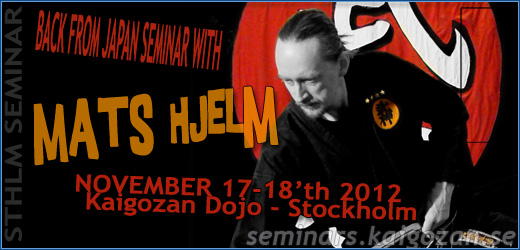
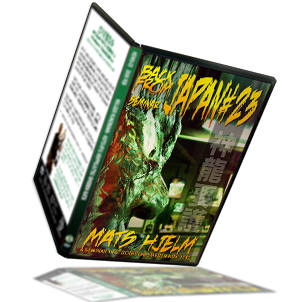 - New DVD from BUDOSHOP.SE – Click HERE to order! (74 min)
- Also available for download (52 min)
On this seminar Mats showed techniques and ideas from the trainings he had been to with Hatsumi Soke and the Shihan earlier this month.He taught Taijutsu techniques, kenjutsu, rokushakubo, yari, naginata, hanbo techniques mixed.
Note: The instructions was in Swedish, but there is really no need to understand exactly what was said. There is not so much philosophical talk, but more more action that you will understand in the movement.
Sample clip
http://www.youtube.com/watch?v=yu1ufgwvLXg
About the download
Click here for more information about our download files and how it works!…