From Shiro Kuma's Weblog by kumablog

Katana o Nuku, Chikara o Nuku
In his last classes, Hatsumi Sensei has developed a new set of concepts, namely “katana o nuku, chikara o nuku”, “iai o nuku”, kakogenzaimirai”. I would like here to dwell into these concepts as they are, in my opinion, defining where the Bujinkan is heading to in 2013.
Each trip to Japan is a fantastic occasion to get a new understanding of what sensei is trying to transmit. For years, because of our lack of understanding, he was mainly trying to get us into the “omote” of movements. Then starting in 2003, we entered the world of Juppô Sesshô.
Sensei began to use deep philosophical ideas linking this “omote” to a type of “ura”. But this was only the “ura” of the physical world.
For me this was the Omote of Juppô Sesshô (2003-2007).
In 2008, we began to consider this physical Ura (Juppô Sesshô of 2003-2007) as another Omote as he began to speak about the Ura of the Ura. This time the physical expression of movement doesn’t count anymore, we are playing with consciousness, shiki (14).
This is what I call the Ura of Juppô Sesshô.
As we explained many times in this blog, it seems that sensei (willingly or not) is following a 5 years pattern:
- 1993-1997: bô, yari, naginata, biken, jô.
- 1998-2002: taihenjutsu, daken taijutsu, koppô jutsu, kosshi jutsu, jûtaijutsu.
- 2003-2007: Juppô Sesshô (omote): sanjigen no Sekai, yûgen no sekai, kasumi no hô, shizen, kuki taisho
- 2008-2012: Juppô Sesshô (ura): Menkyô Kaiden, Sainô Konki, Rokkon Shojô, Kihon Happô, Jinryû no Kaname o Mamoru.
Next year will see the beginning of the next cycle of 5 years, and my guess is that we will focus on Goshin jutsu (as this is the theme of next March Taikai in Japan). But I am sure that he will come up with some more concept to put around. So these new concepts detailed below should be seen as the introduction to next year’s theme.
Note: At the end of this article I put the English meanings for each one of the terms used in this article in order to ease the understanding of the text and at the same time to give you a wider understanding of the image depicted in one single Japanese word.
“katana o nuku, chikara o nuku”; ”iai o nuku”:
When you look at the two kanji: 刀 (1) and 力 (2) you see that those kanji are linked in some way. As you all know, because this is the upper kanji of shinobu 忍 (10), the 刀 represents the saya (11) protecting the blade, and “丿” (12) is the blade. In chikara 力 (2), the blade ”丿” is going through the saya. Chikara (2) therefore can be seen as physical strength, energy; but also as surpassing our own limits.
The old kanji “nuku” (4) is often replaced today by “nukeru” (5) this is why I put both here. Both nuku and nukeru have this idea of releasing or to let go. And this idea of surpassing our limits has been emphasized by Sensei later during the class when he added the idea of “iai no nuku” (6).
You have to let go of everything you know, every form to be in full symbiosis with uke’s inention. When you achieve that you are always “surfing” on uke’s movements and can redirect his chikara against him. Uke when attacking is fully committed to get you, he is using a lot of strength and intention. If you are neutral you follow the movements like the branchees of the willow tree moving freely in the wind. As you have no intention you cannot be read by uke. This was the first thing we learned in 2003 when being introduced to the world of Juppô sesshô through the Sanjigen no Sekai. Uke when attacking makes a decision (intention). This locks him into his “present”, genzai (8), a moment that will become “the past”, kako (7) when he begins to move. Now his intention is focused towards a given target in his “future”, mirai (9).
“kakogenzaimirai”:
This is the “kakogenzaimirai”. Uke is never in the present, genzai (8) as he is trapped by his intention in his future mirai (9) and still attached to his past kako (7). This is like a boat still attached to the pier and going at sea, it will last the time for the length of rope to be fully extended, and the tension will pull it back to the pier or stop it.
Tori having no intention is always in the present and adapts permanently to the changes (like the branch of the willow tree moving freely with the wind). In fact there is no good or bad timing, there is only present.
Last week, Sensei said in class there was no timing. But maybe he meant that time doesn’t exist. the permanent present of nakaima (13), the middle of now only exists. The “now” is only a spark of time renewing itself permanently. When you think; when you prepare a counter movement to what you expect will do, you become also trapped in the dark side of the sanshin of the kakogenzaimirai world.
Be soft and relaxed, stay in this permanent present and you will always be able to surf the positive aspect of kakogenzaimirai.
At the end of the class, Sensei added that we now have to become gentlemen and not to use chikara at all. In fact we should develop a more feminin way of behaving, more subtle, using no strength and above all not grabbing. We simply have to redirect uke’s intention and force.
There is no technique there is only opportunity. This is goshin jutsu.
Get rid of the forms, don’t finish a movement, surf freely.
This is the elegant simplicity, the Yûgen (15) of a true Art.
“katana o nuku, chikara o nuku”
| 1 刀 |
katana |
(single-edged) sword; katana; |
| 2力 |
chikara |
force; strength; might; vigour; energy;capability; ability; proficiency; capacity; faculty; efficacy; effect; effort; endeavours; exertions; power; authority; influence; good offices; agency; support; help; aid; assistance; stress; emphasis; means; resources; |
| 3温 |
nuku |
idiot; dummy; slow person |
| 4抜く |
nuku |
to extract; to omit; to surpass; to overtake; to draw out; to unplug; to do something to the end; |
| 5抜ける |
nukeru |
to come out; to fall out; to be omitted; to be missing; to escape; to come loose; to fade; to discolour; to wear out (to the point of forming a hole, e.g. Clothes); to leave (e.g. a meeting); to be clear; to be transparent (e.g. of the sky); |
“Iai no nuku”
| 6居合 |
iai |
art of drawing one’s sword, cutting down one’s opponent and sheathing the sword afterwards |
“kakogenzaimirai” and other words
| 7過去 |
kako |
the past; bygone days; the previous; a past (i.e. a personal history one would prefer remained secret); one’s past; (Buddhist term) previous life |
| 8 現在 |
genzai |
now; current; present; present time; as of |
| 9 未来 |
mirai |
the future (usually distant); the world to come |
| 10 忍 |
nin |
endurance; forbearance; patience; self-restraint |
11 The upper strike looking like a reverse V symbolizes the scabbard
12 the lower strike: “丿” symbolizes the sword
| 13 中今 |
nakaima |
the present (esp. as a privileged moment in eternity). Nakaima is explained in the “Way of the ninja”, book by Hatsumi Sensei; |
| 14 識 |
shiki |
(Buddhist term) acquaintanceship; vijnana (consciousness); |
| 15幽玄 |
Yûgen |
subtle grace; hidden beauty; mysterious profundity; elegant simplicity; the subtle and profound; the occult |


…

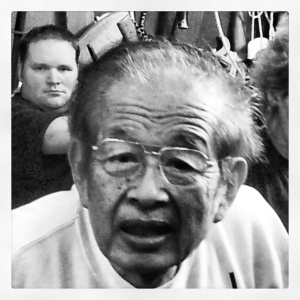 The second day of the dkms was intense with Sensei insisting on very small technical points. This year the theme was kaname (essential points), and the kaname is to be found in many details.

 …
…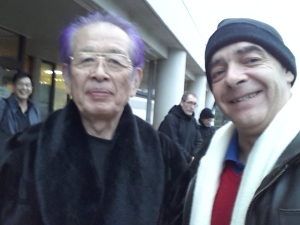 Friday was the beginning of the dkms. The day began well as Sayaka Oguri joined us in Kashiwa on the train going to Shimizu Koen.
 …
… Last week Hatsumi sensei said that we must know fight like gentlemen using no strength but only adapting our body to uke’s attacks but with some kind of high class touch. We do not want to fight but we do not want to hurt either.
 …
…

 …
…


 …
…
 …
…