Skip to content

Norikae: Change Your Mindset

From Shiro Kuma's Weblog by kumablog

hsmarch13

Do you think Hatsumi sensei is reading my blog? we can think so because in today’s class he gave us the next level to understand the Henka article.

I was asked to begin the class with some taijutsu technique. Uke attacks with a fist at short distance and by moving up and down, left and right you pull him down softly at your feet once uke’s balance is broken. Quoting Noguchi sensei in class today I would say it was a juppô sesshô technique. Hatsumi sensei did many henka around that, not using force at all, grabbing the fingers, crushing the nails having uke dance like a fool with pain. At one point he turned to me and said: “Norikae!”. Totally taken by surprised I said the only logical thing: “nani?” (what?). Sensei explained that the new taijutsu he is developing these days the key was to understand the possible changes that could be done and not to be lost in the way.
Softly he did many “henka” taking uke’s balance only by holding a finger and controlling him seamlessly. As my friend Sven would say the technique “is not about power it is about control”. Sensei added ”this is moving like a butterfly”, it was soft and light at the same time but very powerful. To keep the control with these soft movements was the spirit of woman self defense which we will study during the taikai.
乗り換え norikae or 乗り換える, norikaeru is a verb used when transferring trains or changing buses. If you take the wrong track you never reach your final destination. Norikae is the keypoint to develop proper control of the opponent. Once again there is no strength at all (he repeated many times again 力じゃない, chikara janai, don’t use strength). Having no preconceived plan of action you move like a butterfly from one control to the other, never stopping until uke is defeated. But if you make one mistake, i.e. miss a connection, you end up dead. To reach this ability one must have developed a powerful taijutsu and, he added, this is the most difficult expression of taijutsu, .
Let me illustrate this 乗り換え ”transfer, change” concept with an example. Mistakes are always possible and the results can be dramatic. If during your meal you use tabasco instead of ketchup you might get quite surprised after the first bite. On a side note and speaking of tabasco, sensei said that you could put some chili on your nose to peek into the eye of the opponent. This way of thinking is also ninjutsu.
Full awareness leads to instantaneous changes and adaptation to uke’s reactions. Then strength is not necessary. Whatever move you are doing it can be wrong but if you don’t dwell on your mistakes, learn from them, and regain advantage over uke, it is good. In any situation you have to decide fast and often there is no time to think. You have to become so good that you surf on the best possible wave of action.
Ninpô taijutsu is a tool and your choice of action will determine your fate. But as it is the case with any tool there are always several options. A tool does not have 識 shiki, consciousness; you do. A lighter for example is a simple tool: it can be used for the fireplace, cook your food, or burn your house. Because you have shiki you don’t destroy everything. This is norikaeru.
If we dig deeper, 乗り換える norikaeru has also the meaning of “changing one’s mind”. You must be capable of changing your course of action at any moment. The quality of your listening to uke’s reactions makes the correct norikae.
This is why Hatsumi sensei’s techniques are so difficult to get. But the difficulty does not lie in the movements per se. It is based upon the awareness to adjust, in a blink, to uke’s reactions without thinking or using any strength. What sensei has been teaching today is indeed for me a new paradigm. I understand now why he was saying last year that this “goshin jutsu” was the hardest way to learn how to fight.
This is linked with 縁の切身ない, en no kirinai (don’t sever the connection) that we studied a few years ago*. By keeping the control and the contact with uke we are able to move freely and to defeat him. By understanding what sensei was teaching today we become able to 乗り代える, nori kaeru, “ride on the change”; and to 忍びの理科得る, shinobi no rika eru: “obtain the science of ninjutsu”.
*search for it on this blog, several entries

…

Henka: A Poetic Strangeness

From Shiro Kuma's Weblog by kumablog

honbu2

We often use the word “Henka” 変化 when referring to an adaptation of a given waza. But this word is more than it seems. I remember Sensei explaining once that in a Ryûha, a henka is described as a part of the level considered. A henka in a school is like another way of doing the same technique but respecting the 法 hô, principle of the original waza.
The dictionary gives different meanings: “change” or “variation”; but also the meaning of “transition”, as if a henka could be the passage from one technique to another. When one studies a Ryûha he is often surprised to see that the “official henka” links the waza from which it is created to the next Waza coming right after it.
Apart from these “official henka” the word in general refers to the ability to apply a prinicple of action to different situations. The Kanji 変 Hen alone has the meaning of “change” but also the meaning of “strange, curious, funny, unexpected”. When I first joined Sensei’s teachings at the London Taikai of 1987, I had no clue about anything, but even less the word henka. But I do remember vividly that each technique he was doing seemed “curious” and for sure totally “unexpected”!
Many Bujinkan practitioners do not know enough the basics and fundamentals of the art to produce correct henka, but I noticed that things are  slowly “changing” and every time I meet bujinkan practitioner in Japan or abroad I can see a positive evolution in their understanding and performance. Like many of you I don’t speak Japanese but I keep digging in my dictionaries in order to understand Sensei’s budô better. As he wrote in his book “unarmed fighting techniques of the Samurai”, it is important to understand the meaning of the names of the waza.
Hatsumi sensei is not only a fantastic martial artist, he is a philosopher of the martial arts and his teachings can be applied in our daily lives. Like Monsieur Jourdain in Moliere’s theater play, we do henka everyday without knowing it! The Bujinkan is teaching us to adapt our lives to the situations and people we meet, and we are adapting our actions in permanence without really being aware of it.
The world of henka is endless but first you need to know your basics correctly. If “hen” means many things, this is also the case with “ka”. Ka, 化 is the “action of making something” i.e. the perpetual change, the perpetual adaptation. But written differently: 下, it is “under” meaning that change lies under, invisible to our senses. Creating a henka is the action of moving something from the invisible world to the visible and sensitive world.
In my opinion this is the real lesson of this world of henka taught by sensei. Funnily, the suffix 課, ka as a stand alone also means “lesson”. This is a lesson we learn by adapting our lives to reality. It is close to the sentence we all repeat before and at the end of the class: “shikin haramitsu dai komyô”; as each action taken brings a lesson to learn from. And often the lesson is unexpected, therefore it changes the regular understanding of henka 変化 into henka 変課 .
Seeing the world differently is the strength of 歌人 kajin, the poet who plays with the words in order to manifest the beauty that lays hidden invisible around us. I have the feeling that Sensei has transformed us into 変歌人 henkajin, eccentric poets ; or to be in the mood for the kunoichi taikai beginning in a few days into 変佳人 henkajin: unusual beautiful women.
Thank you Sensei to make us 変化仁 henkajin, men of change and adaptation.

…

A Class With Hatsumi Sensei and Chinese Sandstorms in Japan

From Bujinkan Santa Monica by Michael

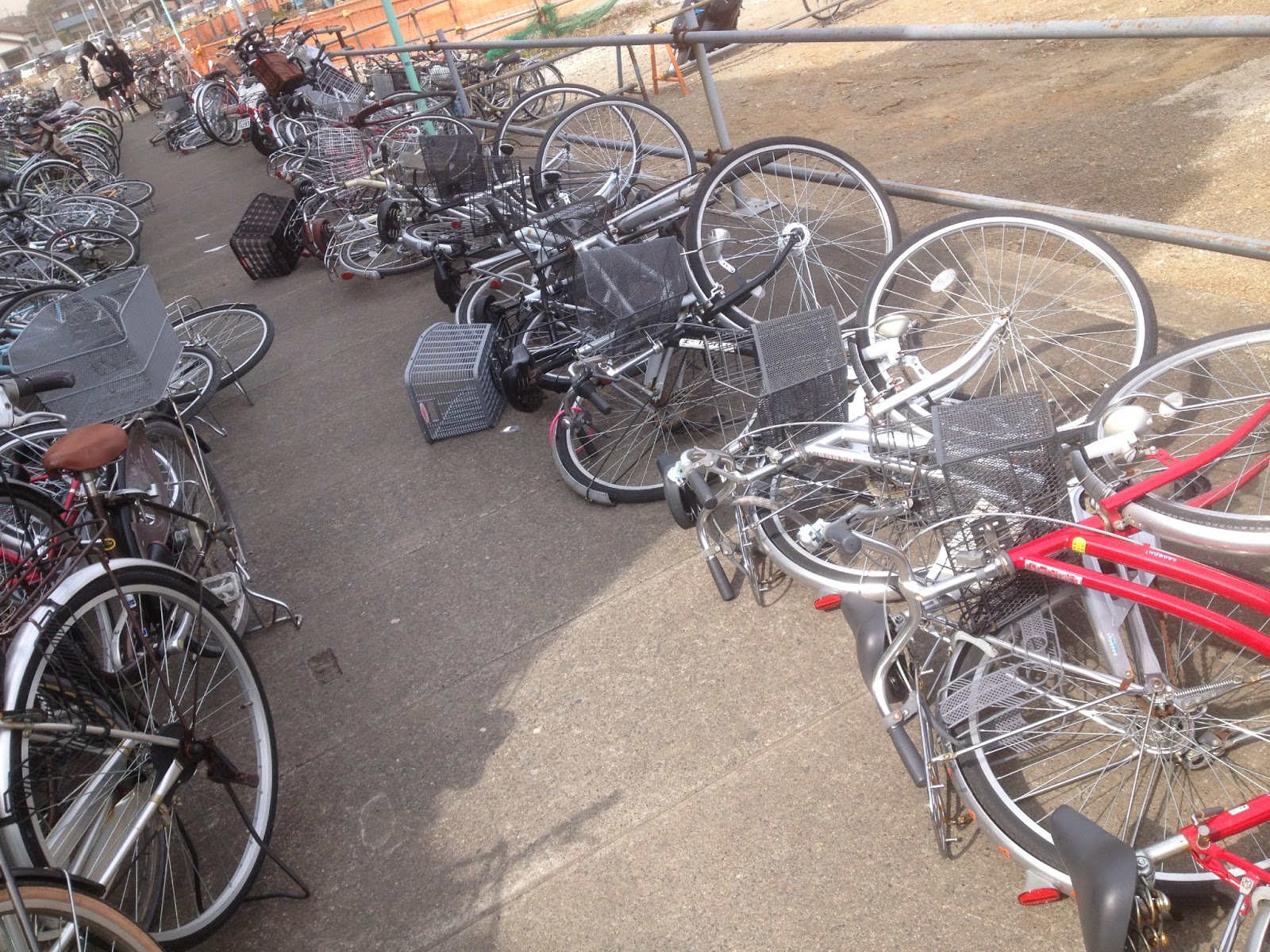
Atago Bikes Blown Over by High Winds, photo by Michael Glenn
Here in Japan the winds have been intense. I've been dodging debris and digging sand out of my eyes and hair. Even the trains have shut down because of high winds.

They say the pollution has increased as it has blown in from mainland China. I've never thought of wearing one of those dust masks that Japanese people often wear, but it could have helped today. None of this has stopped me from training!

I will be updating with detailed training notes and videos for members of Rojodojo. If you haven't discovered everything there yet, now is a great time to help me out and sign up! Maybe then I can buy a dust mask, or at least go to more classes.

Here is more detail on Hatsumi Sensei's class last night: Ken 剣: Class With Hatsumi

Meanwhile I will keep adding great material to this blog as well as my Mosh Pit. So far training has been wonderful and I will find something to hold onto so I don't blow away. Bufu Ikkan!…

A Class With Hatsumi Sensei and Chinese Sandstorms in Japan

From Bujinkan Santa Monica by Michael

Atago Bikes Blown Over by High Winds, photo by Michael Glenn
Here in Japan the winds have been intense. I've been dodging debris and digging sand out of my eyes and hair. Even the trains have shut down because of high winds.

They say the pollution has increased as it has blown in from mainland China. I've never thought of wearing one of those dust masks that Japanese people often wear, but it could have helped today. None of this has stopped me from training!

I will be updating with detailed training notes and videos for members of Rojodojo. If you haven't discovered everything there yet, now is a great time to help me out and sign up! Maybe then I can buy a dust mask, or at least go to more classes.

Here is more detail on Hatsumi Sensei's class last night: Ken 剣: Class With Hatsumi

Meanwhile I will keep adding great material to this blog as well as my Mosh Pit. So far training has been wonderful and I will find something to hold onto so I don't blow away. Bufu Ikkan!…

Path to the Heart of the Flower (V) – Back to Canada

From The Magick & The Mundane » Bujinkan by Shawn Gray

Thanks to everyone who has continued to prod me to continue writing this blog! Life gets busy, and it’s always easy to find other things to do, but … here we go again. :)  (Yes, I promise I will eventually get to the end of this story! (Does it really have an end? Not sure about that one…) )

Last time I wrote a little bit about Karate training in Kumamoto and Kendo training in Hiroshima. Chitose Soke and Fujiwara Sensei were both amazing gentlemen who I’d learned a lot from in the short time I’d spent with them. In Part II, I wrote about my Karate training in Fukuyama with Kanao Sensei, who I continued to visit every weekend for training. In November 1990, he’d used his connections at the Fukuyama Post Office to make me “Postmaster-for-a-day” and weaseled me into being the poster-gaijin. A local TV station and 3 local newspapers came to cover the event. I discovered the old newspaper clippings in my closet and thought it would be fun to post them. :)

Postmaster4ADay3 Postmaster4ADay2 New Years Postmaster

By the time May 1991 came around, it was time to wrap up my time in Japan and head back to Canada. After many heartfelt goodbyes to the good friends I’d met, I got on the plane back to small-town New Brunswick and back to college. I flew from Narita to L.A. and then to Eastern Canada from there. My bags weren’t as eager to get back to Canada right away, and decided they wanted to go to Brazil from L.A. instead of back home with me. It was 2 weeks before I got my luggage back – and, thankfully, all of my Kendo gear was still intact. :)

I worked summer jobs landscaping and mowing lawns to pay for the coming semester at college. The year in Japan had taught me a lot – and one of the things that it had taught me was that I didn’t want to me a missionary. The missionary that I’d been assigned to work with in Japan was so uncultured and racist that it had turned me off completely. I decided to do one more semester at the small Christian college I’d spent 2 years at before going to Japan, and then head to the opposite side of the country to a bigger university with more options when that was finished. But before starting the fall semester, I was interested to see what Karate training would be like at my home Karate club after having spent nearly a year training in Japan. I made a habit of arriving early to class so that I could work on the material that I’d learned from Kanao Sensei before the class started. Not long after I’d been back, while I was reviewing one of the Kata I’d learned in Japan, a senior member of the club approached me and asked me where I’d learned it. When I told him, he requested that I not tell or show anyone else in the club what I was doing. You see, I was still a brown belt, and apparently what I was working on was 3rd-degree black belt material in Canada. Woooo. Wouldn’t want to upset anyone with that now, would we? Wooooo. I rolled my eyes and agreed to keep it quiet. I practiced that material at home in the backyard from then on – along with the Kendo bokken kata that I’d learned from Fujiwara Sensei.

The summer came and went, and I found myself back in the dormitory at college. I roomed with my best friend Jack, who had a habit of sleeping in. I had a remedy to help him with that – it was a bamboo shinai training sword that I’d brought back from Japan with me. It seems one’s shins can only take so much before one prefers to get out of bed. :) Oh well, at least it got him to chapel some of the time. Chapel attendance was mandatory. (Yes, it was a college, not a kindergarten.) By this time I’d been promoted to Shodan (1st degree black belt) in Karate, and started a training club at the college, hoping that it might help people with fitness and discipline, and help me to remember the material that I’d been working on as well. I have a feeling that it fizzled out shortly after I left. Rooming with Jack did have its perks though. Jack was a bit of a computer whiz, and had his computer hooked up via a 2800-baud modem (or something like that) to the phone line. A full four years before Internet service started to really take off in Canada, I saw a picture of a naked woman appear on the computer screen. Slowly, ever so slowly, one slowly-inching pixel-line at a time. I forget just how long it took the image to finish loading, but once it was completed, I wondered if maybe there was something to this computer-network thing after all. It was October, 1991. Nobody knew what a Facebook was. And luckily, none of the faculty found out about the image on the screen, or I might have been demerited, suspended, punished – or just sent straight to hell. :)

Anyway, that semester passed pretty quick, and I was off to Vancouver, 5,000km away on the other side of the country. Although I’d been dumbfounded at the size of Tokyo (around 25 million), Vancouver was still pretty big by Canadian standards, at around one-tenth that size. Still pretty daunting for someone from a town of 3,600. I knew no-one in the city, and found myself in a youth hostel trying to find an apartment and a job before my money ran out. I had no idea what the city was like, and made a quick, desperate decision to rent a place that I went to look at one night. It was furnished. Pretty shoddily, but it was furnished. The first night I slept there I heard a huge crash right behind the wall of my room at about 4:30am. I discovered that my building was literally right next to the port and there was a freight rail line that ran right behind the building. Two train sections had bumped together to connect them, which is what had made the crashing sound. The next morning, I walked out into the sunshine and found myself dodging used condoms and needles on the sidewalk. Apparently Commercial and Hastings wasn’t the best place to be living. I found a job at a local Japanese tourist gift shop while waiting for the summer semester of the Canadian Summer Institute of Linguistics to start. It took me about 20 minutes to walk to work, and on the way I’d regularly be propositioned by drug dealers and prostitutes. After I’d been there a couple of months, a Vietnamese gang broke into a place up the street and killed 4 people to burgle their house. I decided I should probably look at finding a better place to live. Around that time, I read a newspaper article stating that women between age 20-25 who lived in the few-block radius I lived in were 25% more likely to die of homicide or drug overdose than anywhere else in Canada. I accelerated my new home search and found a place in New Westminster. I didn’t see a prostitute there for a full 2 weeks, so it seemed like a much better place to live.

First Bujinkan SeminarDuring this time, I was of course looking for a Bujinkan dojo to train in. I figured a city like Vancouver must have a Bujinkan training group, and I found what I was looking for – a seminar advertisement – at “Golden Arrow Martial Arts Supply.” I was ecstatic – finally a real, legitimate Bujinkan dojo. I called the number listed and made plans to attend the seminar, which was held at a school gymnasium in White Rock, just south of Vancouver. I got the bus out to White Rock and was happy to participate. There were a lot of differences from what I was used to. The group hadn’t been going that long, so most of the students were still fairly junior. I’d been doing martial arts quite seriously now for over seven years and had recently come back from a pretty full-on experience in Japan. But when I looked at the kind of things that were being shown, I was intrigued and could see that this would be a very interesting art once one developed a bit of skill at it. I began to train with the instructor in his regular classes, continuing my Karate training in parallel for the first few months. I had committed a number of years to Karate now, and didn’t want to put it aside lightly.

I was approaching my Nidan (2nd Dan) grading in Karate, which was a pretty big deal. Grades work differently in Karate than in the Bujinkan. The two top people in my Karate style in Canada were both Japanese gentlemen – one was 7-Dan and one was 6-Dan. These were considered very senior ranks in our style, so even a 2-Dan wasn’t anything to sneeze at. But I was becoming disenchanted with the Karate training. I found the local instructor in Vancouver to be unnecessarily stern and overly formal, much more so than the Japanese instructors I’d trained with in Japan. I was forbidden to cross-train in anything else, even though the Soke (grandmaster) in Japan had encouraged me to train in Judo and Kendo in parallel to my Karate training. The training itself was very much geared towards winning points in tournaments, and they were strict about the contact rules – that is, you could easily get disqualified for hitting too hard. Our instructor would pair us up and have one person hold a pencil upright between his thumb and index finger. You had to hit the pencil and whip your hand back without knocking the pencil over – that would indicate that the strike was too hard and would result in a tournament penalty. It really seemed like nonsense to me, and this made it a bit easier to make the final decision to put down my Karate black belt and step out of my white uniform, and step into a black Bujinkan uniform and put on a white Bujinkan belt.

All the while I continued to dream of going back to Japan after completing my university studies. I was now enrolled at Trinity Western University (just outside Vancouver) working towards a BA degree in Intercultural Religious Studies with a Concentration in Linguistics. But most relevant to this particular story, perhaps, is that I was now training in a legitimate Bujinkan dojo that was connected to the Bujinkan headquarters in Japan. I found out that the Hombu Dojo in Japan was in a place called Noda – not Iga where I had gone looking for Hatsumi Sensei a year and a half before. The two places are actually about 500 kilometers apart. I had been way off. Next time I could get back to Japan, I’d be sure to be at the right place.


…

Tanjo

From Paart Budo Buki by buki stolar

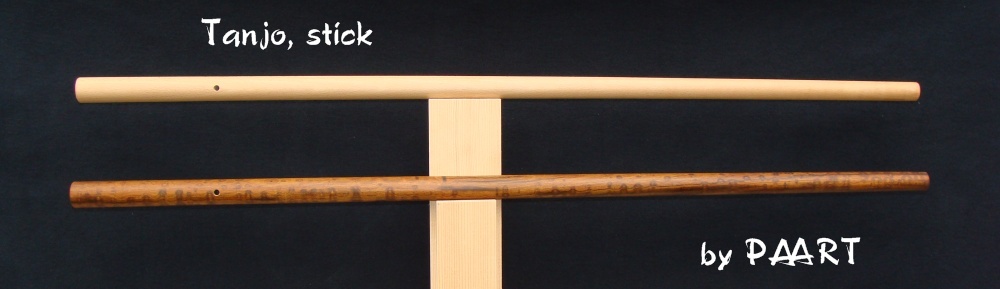
Tanjo stick,

tanjo is something between walking stick and police baton, I think, 
if you have more info about it you could send me, I will publish it here,


may look like Hanbo, but those who know more about it, say that this is the original look, 
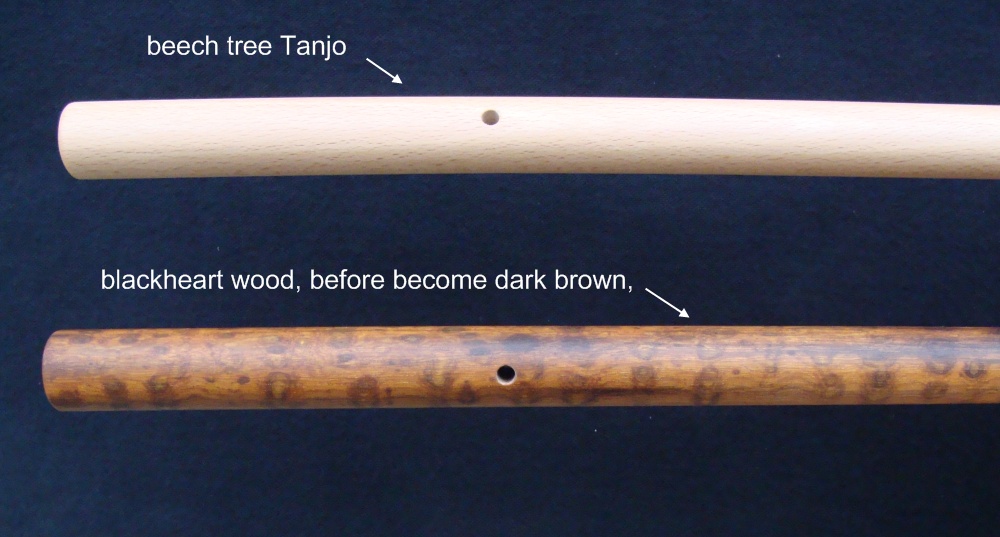
tapered shape with a hole in the handle area


…

Tanjo

From Paart Budo Buki by buki stolar

Tanjo stick,

tanjo is something between walking stick and police baton, I think, 
if you have more info about it you could send me, I will publish it here,


may look like Hanbo, but those who know more about it, say that this is the original look, 
tapered shape with a hole in the handle area


…

Bu Jin Ken

From Paart Budo Buki by buki stolar

Hi to all,

instead to replace pictures on older post,  here is new post ;-)

this is final look of Ken below,
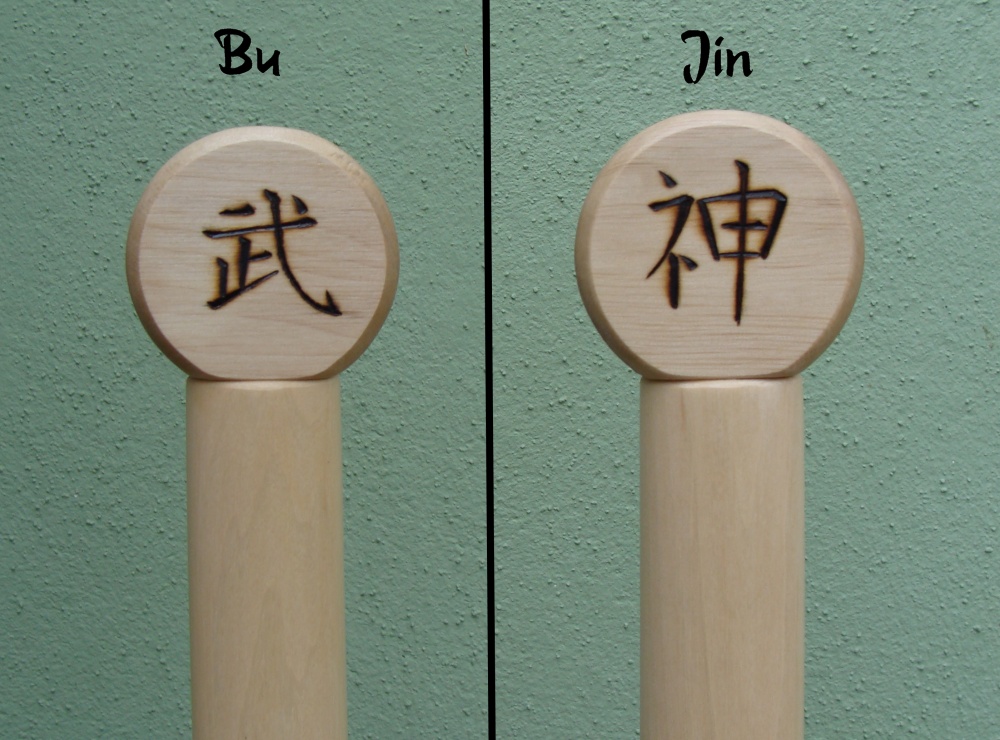
sens this is Soke's design I put Bu Jin Kanji on it, hope that you love it

it is same Ken from Tachi Ken bokken post but this was final touch


…

Bu Jin Ken

From Paart Budo Buki by buki stolar

Hi to all,

instead to replace pictures on older post,  here is new post ;-)

this is final look of Ken below,
sens this is Soke's design I put Bu Jin Kanji on it, hope that you love it

it is same Ken from Tachi Ken bokken post but this was final touch


…

Yama Michi

From Shiro Kuma's Weblog by kumablog

In a recent and interesting article Dan Ordoins quoted Emerson: “Do not go where the path may lead, go instead where there is no path and leave a trail.”
Thank you Dan this sentence made me think a lot!

What does it mean for a Bujinkan practitioner? How can we manage it own trail while obeying to our master?

In my opinion it is possible if we rewrite it as follow: “once you have acquired the necessary knowledge and reached the jûgodan level it is not anymore necessary for you to go where the path may lead, go instead where there is no path and leave a trail”.

In japanese 山道  yama michi (mountain trail) gives this idea of difficulty of trekking but also the importance of 道 michi or dô (the path, the way.

Therefore “leaving a trail” is creating your own taijutsu and this can only be achieved if you reach the level where it creates itself.

In a private discussion with sensei  a few years ago, he told me that all jûgodan were turning into little Sôke…and that it was good because it meant that he had been able to transmit the essence of ninpô.

This is this essence that matters but it can only be found if you have a guide, a master, a “sensei” to teach it to you.

Without a real sensei, without the be respect and obedience you owe him there is no way you can “leave a trail”.

Bujinkan is about survival, so choose wisely your next step.


…