Skip to content

Two of the Best Ways to Hold a Weapon

From Bujinkan Santa Monica by Michael

Japanese Plow (notice grip), 1914-18 photo by A.Davey
There is always a lot of curiosity about how to properly hold a weapon. Different arts and schools have their secret or preferred methods. But there is a simple way to understand gripping a weapon.

You may have seen the practice of linking fingers in shinto (こりてくみ koritekumi, みてわざ mitewaza), or in mikkyo (手印 shuin). Two common variations are 本手 honte for yielding or being gentle, and 逆手 gyakute for vigorous strength. 観音菩薩 Kannonbosatsu often assumes the honte finger position for mercy, while 勢至菩薩 Seishibosatsu applies the gyakute method for wisdom.

So we may apply this to 手の内 tenouchi and holding a weapon:

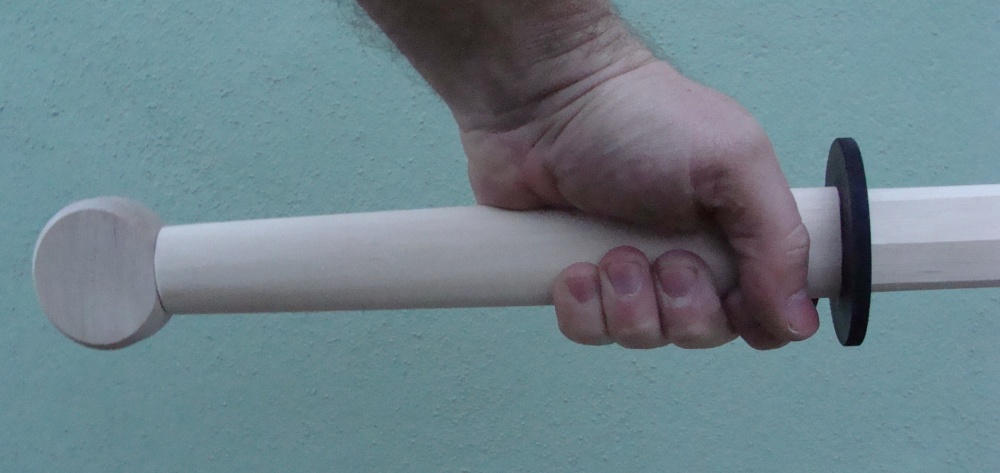
  • If you are gripping honte style, hold the weapon across your palm with the middle finger and thumb coming together. This method is preferred for freedom and flexibility.

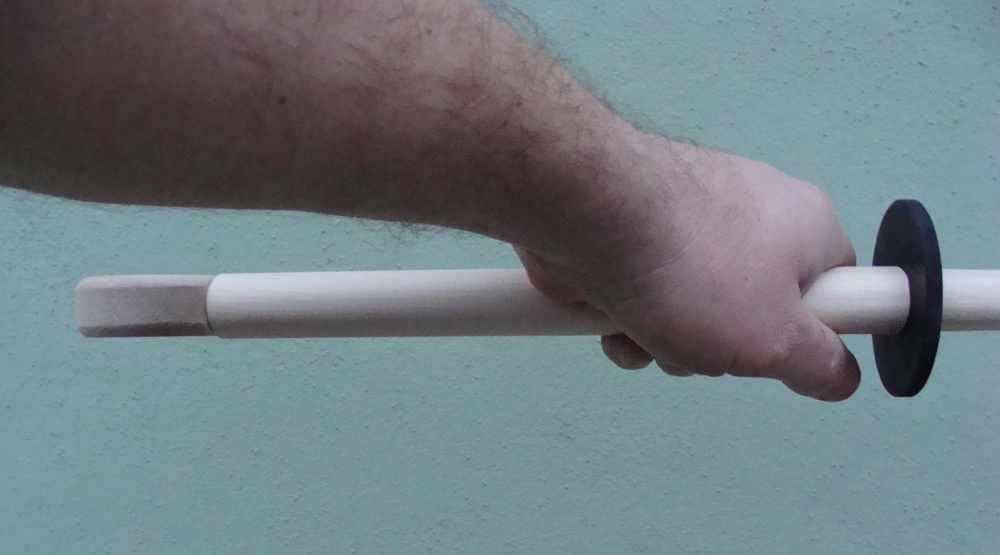
  • With gyakute, you may shift the weapon in your palm so the index finger and thumb come together. Gripping in this fashion shows strength and power.

That's it. Most other variations are specialties for very specific situations or for specialized weapons. You may try to get tricky, but human hands have been holding tools and weapons since our ancestors first grew thumbs.

Of course what I'm not sharing is the knowledge of how or when to use these grips. You must speak to your teacher for that. Only real training can fill in the blanks.

Two of the Best Ways to Hold a Weapon

From Bujinkan Santa Monica by Michael

Japanese Plow (notice grip), 1914-18 photo by A.Davey
There is always a lot of curiosity about how to properly hold a weapon. Different arts and schools have their secret or preferred methods. But there is a simple way to understand gripping a weapon.

You may have seen the practice of linking fingers in shinto (こりてくみ koritekumi, みてわざ mitewaza), or in mikkyo (手印 shuin). Two common variations are 本手 honte for yielding or being gentle, and 逆手 gyakute for vigorous strength. 観音菩薩 Kannonbosatsu often assumes the honte finger position for mercy, while 勢至菩薩 Seishibosatsu applies the gyakute method for wisdom.

So we may apply this to 手の内 tenouchi and holding a weapon:

  • If you are gripping honte style, hold the weapon across your palm with the middle finger and thumb coming together. This method is preferred for freedom and flexibility.

  • With gyakute, you may shift the weapon in your palm so the index finger and thumb come together. Gripping in this fashion shows strength and power.

That's it. Most other variations are specialties for very specific situations or for specialized weapons. You may try to get tricky, but human hands have been holding tools and weapons since our ancestors first grew thumbs.

Of course what I'm not sharing is the knowledge of how or when to use these grips. You must speak to your teacher for that. Only real training can fill in the blanks.

Ken: Sayû Changing hands

From Shiro Kuma's Weblog by kumablog

左右 sayû means left/right (this is the Chinese for hidari/migi in Japanese)

When it comes to changing hand with the ken (from right hand to left hand) one is facing a difficulty as the Chinese blade is heavier than the Japanese regular Katana. It also has a different balance, the weight being more in the head of the blade.

Changing hands is not very common in traditional swordmanship in Japan but it is in the bujinkan and in China too.

The positioning of the fingers on the Tsuba of the Ken allows to orient the blade properly in the movements and this is what we need in order to change our grip from one hand to another. Below is a pictured example on how to proceed.

sayu2
1. Start from a sort of Shizen/Hira no Kamae.

sayu12

The sword is held reverse (kashira to the ground).

The blade is hidden behind the back.

Knees and arms are relaxed.

Gravity is holding the sword in place.


sayu3

2. Do Jûji Aruki

Gyokko ryû type (i.e. toes are perpendicular)

The left leg passes in front of the right leg. The body is going backwards. Keep your balance.

The hands are on both sides of the Tsuka. Watch the positioning of the fingers on the Tsuka. Legs and arms move simultaneously.


sayu4

3. Uncross the legs while pivoting towards the attacker.

The left hand releases the grip,

While the right hand is rotating the blade.

Sword is flat, palm is up.


4. Thrust the blade forward with a full body movement. The left arm is helping the thrust and pulls backward extending the body.  This is some kind of  Hira Ichimonji no kamae.

sayu5

Be strong and balanced on your legs. Push on your back leg. You can pivot on the rear toes to add more distance to your thrust. The blade is horizontal and facing the opponent at all time from the beginning of the change of hand.

左右 sayû means left/right but written 矢優, sayû becomes a “skilled arrow” piercing the defense of the attacker.


Kenwonigiru: Holding The Ken

From Shiro Kuma's Weblog by kumablog

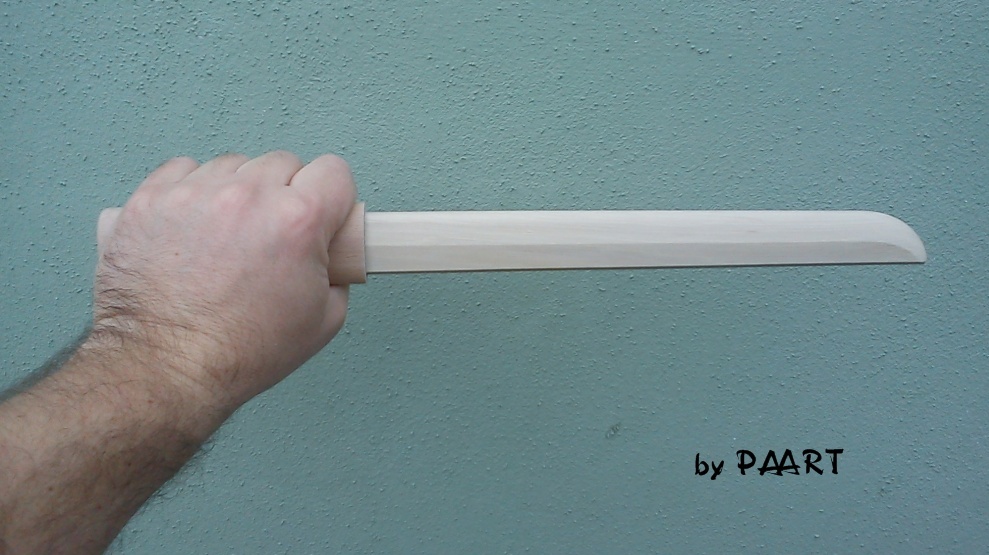
The Ken has no Tsuba perpendicular to the blade. On the contrary the guard is in line with it. Therefore your forefinger often slips on top of the guard and getting close to the blade.

In a recent class Sensei explained that the use of the fingers were of utmost importance in order to direct the edges properly. After hours of training I came up with my own types of grips of this strange guard. I share it here for those who are trying to understand this rather strange weapon. These are my discoveries so they can be totally wrong (don’t trust me).

Problems encountered:

  1. the finger(s) keep covering the guard
  2. the sword is heavy and hard to keep in hand without a proper grip
  3. the grip on the sword can be reverse
  4. the design of the guard allows more grips that in a reguler japanese sword
  5. the momentum of the sword is important
  6. the body is moving a lot and the straight sword is often used like a whip

All the above has made me think on a set of grips. I called these 劍を握る, Kenwonigiru or holding the Ken.

The following are a few pictures showing the most common grips I ended up with, there might be others yet to be discovered.

1. Reverse Grip:

Image

The blade is upside down and your fingers wrap the tsuba. Ideal for  a kind of Kage no Kamae, hiding the blade behind the back. Can be done with left hand also.

Important: depending on the size of the blade, it is possible to bend the arm a little so that the tip of the sword is not injuring your back or your armpit while changing the position of the sword.

This grip allows the body to move freely and/or to change hand easily as the main part of the tsuka is free. Changing hands is important.

You can also use this grip when hitting the opponent with the pommel of the sword. In that case the blade is supported by the arm covering it. It is like giving a Tsuki with the kashira.

2. Thrusting at short distance:

When thrusting with your body behind the blade is flat, palm up. The following pictures show the same grip from above and under. As I have small hands it is easier for me to only use the forefinger but it can be done with a grip 2 fingers and 2 fingers.

Image

Image

Please note that on the pictures above the blade is the extension of the hand. It is like a sixth finger.

You can use either the right hand or the left hand. The Ken is used like a hanbô and change side/hand in the movements.

This grip can also be used to slam uke’s body, head, leg or weapon in turning movement of the body.

3. Yubi Ippon Jûbun:

This is the most common grip that comes naturally because of our habits in Japanese swordmanship. The forefinger usually supported by the Tsuba keep sliding up towards the blade. I thought is was a mistake and tried to correct it until sensei said that finger positioning was important.

Image

The extended forefinger gives more precision and power to your movements when thrusting , deflecting, or blocking.

4. Yubi Nippon Jûbun:

This grip is similar to the previous one but is more stable in case of hard encounter. I discovered that I was using both. Don’t think too much, let your body flow do it for you.

Image

I hope that these notes willficial  help you. I do not think these are the only Kenwonigiru that can be done with the Ken but they cover many possibilities. I remind you that these are not “official bujinkan waza”, but the result of my recent personal training and ideas.

As this is “ji an nen” feel free to develop your own ideas and thoughts during the jyanen dedicated to Jian Nen.*

*for the newcomers please my previous post “Jyanen or Jian Nen”

http://kumafr.wordpress.com/2013/02/12/jyanen-or-jian-nen/


Bujinkan Tasmania

From BUJINKAN TASMANIA by Duncan Stewart

Bujinkan Tasmania

The Bujinkan Tasmania Dojo will commence training from October 2013.
This is a page from the proposed Bujinkan Tasmania Dojo website. The site will be on-line later in the year.
Classes for Adults and Children will be available.
I look forward to returning back home to Tasmania and training in Budo with friends.
Yoroshiku Onegaishimasu.
Duncan


Ken is Mû Kamae

From Shiro Kuma's Weblog by kumablog

ken_shizen

Hatsumi sensei is developing the Ken techniques saying there are no fixed kamae for the Ken.

It was the same when we began the study of Tachi waza.

But we always start from a situational body posture.

When you attend classes these days you can observe some kind of kamae or better said, body attitudes looking like some of the kamae we have ben studied.

I have trained on my own with these “no kamae” and I found them interesting to begin our study of this new weapon.

ken_hira

The Ken moves often like a heavy Hanbô but because of the double edge blade, the Hanbô no Kamae are often not applicable.

For example if we can use the tate no kamae or the munen nusô no kamae, or the kage no kamae; it is obvious that the hira ichimonji no kamae and the otonashi no kamae are to be avoided!

Here are a few “no kamae” that you can study in relation with the Ken.

They “look like” Kamae but they are Mû Kamae 無有構え, inexistant attitudes giving freedom to your taijutsu.

ken_ichimonjiken_totoku_seigan ken_uke_nagashiKen_SanshinKen_hira ichimonji


Jyanen Or Jian Nen?

From Shiro Kuma's Weblog by kumablog

kusanagiThe asian astrological sign for the year 2013 is the snake (black snake or water snake). It is called Jyanen (snake year) in Japanese and the new year just began a few days ago. A few weeks before that sensei uncovered the theme for the year which is the Chinese sword, 劍. The Chinese sword (“jian” in Chinese, 劍) is called Ken (剣) in Japan.

Having followed sensei’s teachings for many years I am used to his interesting way of interchanging kanji and his ability to create deep meanings in an apparent shallow sentence or aphorism. The beauty of Japanese language is that one (often him) can play endlessly with the sounds and say different things while using the same sounds. As you know, Hatsumi Sensei is very fond of puns and interchanging kanji.

If we follow his reasoning or at least his “wicked mind” (another邪念 janen)-  we can say that as Ken is called Jian in China, maybe we should understand the year of the snake 蛇年 (jyanen) as being also the year of the Chinese sword 劒年 (Jian nen).

Until last summer sensei used to say that in 2013 we would be studying yari but then we are studying Chinese sword! So what happened?  Here we can only guess. During the dkms sensei purchased a rare painting of Amateratsu in her cave (see post concerning that on this blog) that he exposed during training. Maybe this is what triggered him for changing the yearly theme and move to the study of the Chinese Ken.

Jyanen (year of the snake) sounds like jiannen (year of the Jian). But do you know that there is a connection between the Jian/Ken and Amateratsu no Kami the sun goddess of the Kojiki (Japanese mythology)?

Kojiki reminder: Because of Amateratsu’s brother, Susanô,  the sun goddess decided not to get out anymore of her cave. Consequence: there was no more sun on earth. All the gods gathered and decided to organise dances and music to please the goddess. They finally succed and Amateratsu came out again, this is why every morning the sun rises and gives light to mankind.

So, shortly after the cave incident Susanô went to fight a hydra with eight heads. Like our Hercules of the Greek Mythology he had a hard time but he finally killed the monster. After his victory Susanô found a sword (the famous “Kusanagi no Tsurugi”) inside the tail of the hydra.  Susanô decided to give it to Amateratsu to settle their dispute over the cave incident. This is why these two events are linked historically or at least in Japanese mythology. But this is not all.

Amateratsu was the grandmother of Ninigi no Mikoto, the first emperor of Japan and gave him this Ken, the mirror and the jewel (the three regalia of the Japanese Emperor) to show everyone that he was supported by the gods. This is the origin of the imperial power, and the proof of the link of the Emperor to the gods.

As a side note, Wikipedia explains that “the Imperial Regalia of Japan (三種の神器 Sanshu no Jingi / Mikusa no Kandakara), also known as the Three Sacred Treasures of Japan, consist of the sword Kusanagi  (草薙劍 Kusanagi no Tsurugi), the mirror Yata no Kagami (八咫鏡), and the jewel Yasakani no Magatama (八尺瓊曲玉). The regalia represent the three primary virtues: valor (the sword), wisdom (the mirror), and benevolence (the jewel).”

When Amateratsu gave the sword Kusanagi to the Emperor she said it was to chase the demons, establish peace and restore unity. This transmission of power from the sun goddess to the first emperor is quite similar to the transmission given to Hatsumi sensei by the late Takamatsu sensei. On the makimono this year at the side of the Shinden is written a sentence of Takamatsu sensei: ”Kami Ori Tatara no Hôken Tamarite Tôyô Ashi ara Rokuni Arabaru no Takamatsu Sensei Tamawari”. Or “The divine protecting sword, is transmitted from Takamatsu to Hatsumi sensei to destroy evil and create peace and unity”.

Myths always carry symbols and we can easily understand here that, symbolically, the gods, by giving Kusanagi to the first emperor were in fact “transmitting their power” to mankind. From this day on, humans were to take responsibility for their own destiny. That was the beginning of our civilization.

When Takamatsu sensei gave the nine schools to Hatsumi sensei he did the same: he transmitted this power to Hatsumi sensei. And we can imagine that this is what sensei is doing now, he is giving us back our freedom of action. And the reason why he is doing that is, once again, hidden inside the kanji. The year of the Ken which is 劒年 (jiannen) can also be written as 自案年  (ji-an-nen – self thought year) or the year where we have to think on our own, i.e. to be the master of our destiny, to decide for ourselves and be responsible for our actions.

All over these years, Hatsumi sensei has created a dôjô to bring us to this level: this is the Bujinden, the place (palace?) for the transmission.

Thank you sensei for your trust. I sincerely hope that many of us will seize this chance to become a Bujin, a true being.


Web site updates

NinZine-iPadI just updated the quote of the day script by Soke (from the old Ura Omote newsletters). If you want to subscribe to it the rss feed is http://feeds.feedburner.com/BujinkanQOTD A new quote will be generated once daily when someone visits the blog (http://bujinkan.me/ninzine/). It is displayed on the right sidebar on the blog.

Every once in a while the syndication feed go nuts and republish hundreds of articles again. Then I have to go in and delete all duplicates. I don’t know how to prevent it from happening again, WordPress and all plugins are up to date. I even installed a plugin that is supposed to stop duplicates from being posted, but it’s not working all the time.

We’re still working on the community (http://bujinkan.me), if you have any suggestions please join and get active in the forums. There is a really simple password everyone in Bujinkan knows to keep out bots from signing up and start spamming.

Logo(vitBG)

Happy Training!

/Mats…