Skip to content

Everybody uses 合掌の構 Gassho no Kamae for Prayer, But in the Bujinkan We Fight With It

From Bujinkan Santa Monica by Michael

Rainy Day Gassho at 霊巌寺 Reigan-ji, Koto, Tokyo. photo by Michael Glenn
In one of my classes we were studying a Gyokko ryu kata that begins from 天略 宇宙合掌 Ten Ryaku Uchū Gassho. Maybe you’ve studied this in your Bujinkan class. But even outside of Bujinkan training, if you are human, you have used gassho at some point in your life. It transcends cultures.

That night, as I recorded a training video about this for Rojodojo.com, I wanted to share even more about gassho with everybody. So what I show in the video is that there is much more to this humble kamae then you might think. But if you want to know what mysteries are bound up with this stance, keep reading.

Gassho is a general term that describes any form that brings the hands together, often in a form of prayer or reverence. In the Bujinkan the symbolism of this kamae runs deep. And the position is even sometimes called 金剛拳 kongo ken and it is used to strike or even conceal weapons.

In Buddhism the right hand represents the Buddha, and the left represents you (or all sentient beings). They come together, and one becomes the other. Some different types of gassho include 堅実心合掌 steady heart gassho, 虚心合掌 relaxed, open minded gassho, and 金剛合掌 kongo gassho (vajra, diamond thunderbolt of indestructible truth).

Each finger represents an element. Gassho no kamae holds the unity of chi, sui, ka, fu, ku in your hands. Then you rip that unity apart as the attacker enters. This feels like a void opens and the attacker falls in. But you are really expanding the unity to engulf the opponent until he is no longer an adversary.

If he continues to fight in this space, he will not survive.

You may not know that one form of gassho often shown in Bujinkan kata is called Baku-in 縛印  or 縛拳 baku ken and it comes from Mikkyo. This is a form of “binding,” tying a spirit body or physical body down so they become trapped in a form of paralysis. But it is also for collecting yourself to bind or set your own resolve.

Then the kamae becomes 子持虎の構 komochi-tora no kamae. Hatsumi Sensei told us to start with kongo gassho, where you are unified with the whole universe. This is not a fighting stance. It is the tiger protecting her cubs. Your opponent will see it in your eyes.

Set your mind on perseverance. But if the attack comes, watch out! It can flip like the child holding the tiger.

Gassho no kamae unifies all of the universe within you. Then when you receive the attack, you tear this unity apart into a duality. Like ripping apart yin and yang, or 陰 in and 陽 yo. And that is the large void that the attacker is sucked into.

But you cannot really divide yin and yang. They cannot ever be ripped apart. That is like making the sound of 忍び手 shinobi te, a type of silent clapping, or bringing the hands together without making a sound. What do you hear in silence?

What really happens from gassho no kamae? It expands the unity within yourself to include even more. The attack, the defense, nature, even Kami… All included within the space. This is Shingin Budo.

As you expand like this, all of your ego, strategy, preconceptions, muscle or force, and technique grow smaller and smaller. The more you expand and allow into yourself, the less important and useful they are. You empty yourself more and more to make room.

During all of my trips to Japan last year, Hatsumi Sensei asked us to allow Shingin Budo to fill up this empty space in the void, in the kukan, and in ourselves. But even Soke cannot show you how. Each person has to find their own path to get to that open place.

Clap your hands everybody, and everybody just clap your hands.…

Hatsumi Sensei Explains 師逢和瀬 Shiawase

From Bujinkan Santa Monica by Michael

Masaaki Hatsumi Sensei Explains 師逢和瀬 Shiawase. photo by Michael Glenn
I had a simple plan to teach 片腕遁走型 Kata Ude Tonsō Gata. But during my preparations for class that night, I was overcome with gratitude toward my teachers. It seems there was a secret power bound up in this kata.

It can be described as 師逢和瀬 Shiawase. Let me tell you how I discovered it.

The Bujinkan has made my life rich. I have made so many friends all over the world. Thank you to my students who come to class and allow me to study with them. Thank you for reading this and for watching my videos or subscribing to my training website. Thank you to everyone who invites me to teach seminars.

I prepare for every class I teach. I feel I owe it to my students to do my home work. But I don’t just owe it to them, I owe something more to my own teachers.

I have studied the kata I was planning for this class with many teachers over the decades. But one of my favorite moments was studying this with Hatsumi Sensei under the Japanese maples during the year of the rat. I wrote a 5 part training series about this for Rojodojo members that begins:
In the ’50’s Hatsumi Sensei met Takamatsu. One rainy morning under the maple trees, Soke bound that connection to all of the Bujinkan… (linked)

師逢和瀬 Shiawase is a play on words. Normally it uses different kanji and means しあわせ shiawase: happiness;  good fortune;  luck;  or blessing. But with the kanji Soke uses it suggests that by meeting a master teacher you will find good fortune and happiness. Or even, that simply finding a master teacher is good fortune in itself.

As Soke told us that day under the Japanese maples, don’t sever your connection with the kukan or you’ll suffocate. His playful admonition is really telling us that the kukan is full of mystery, and it holds all the history, teachings, and connections that I share in the 5 part training series published on Rojodojo. I don't know why anyone would choose to break away from this rich heritage.

For me and my students, the circle is full when I teach something like 片腕遁走型 Kata Ude Tonsō Gata. My own students can trace their introduction to this fundamental form of ninjutsu from me directly to Hatsumi Sensei, and then to Takamatsu, back through the generations. This is the secret power hidden in a simple kata.

We are very fortunate to have these insights available to us. I have to humbly thank my teachers and my students for keeping this connection alive so we can receive this treasure and great history of our art.

If you do not understand what you are missing, then get connected. This is how you cultivate good heart and spirit. Then the Bujinkan will be better with you in it.…

Naeshi for training

From paart budo buki by buki stolar

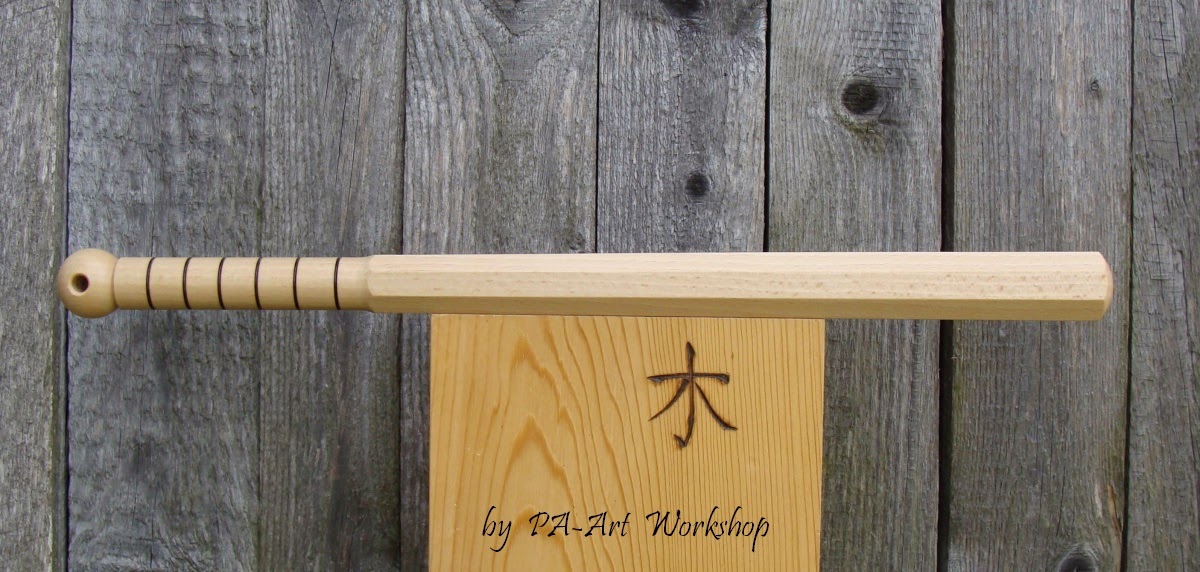
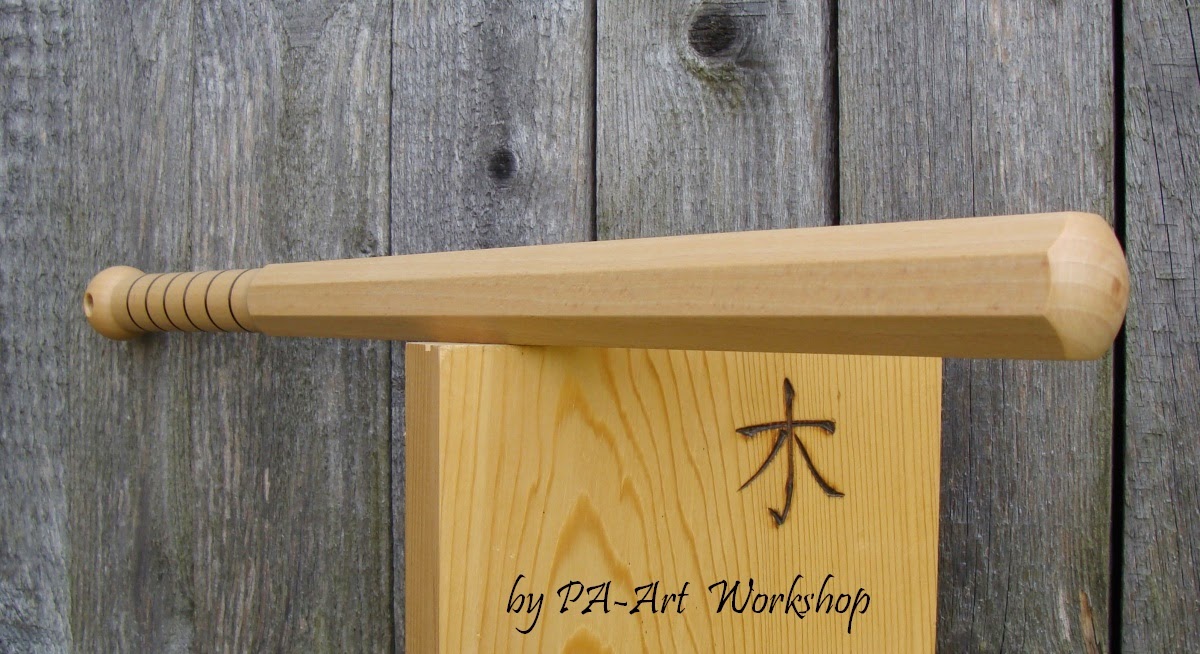
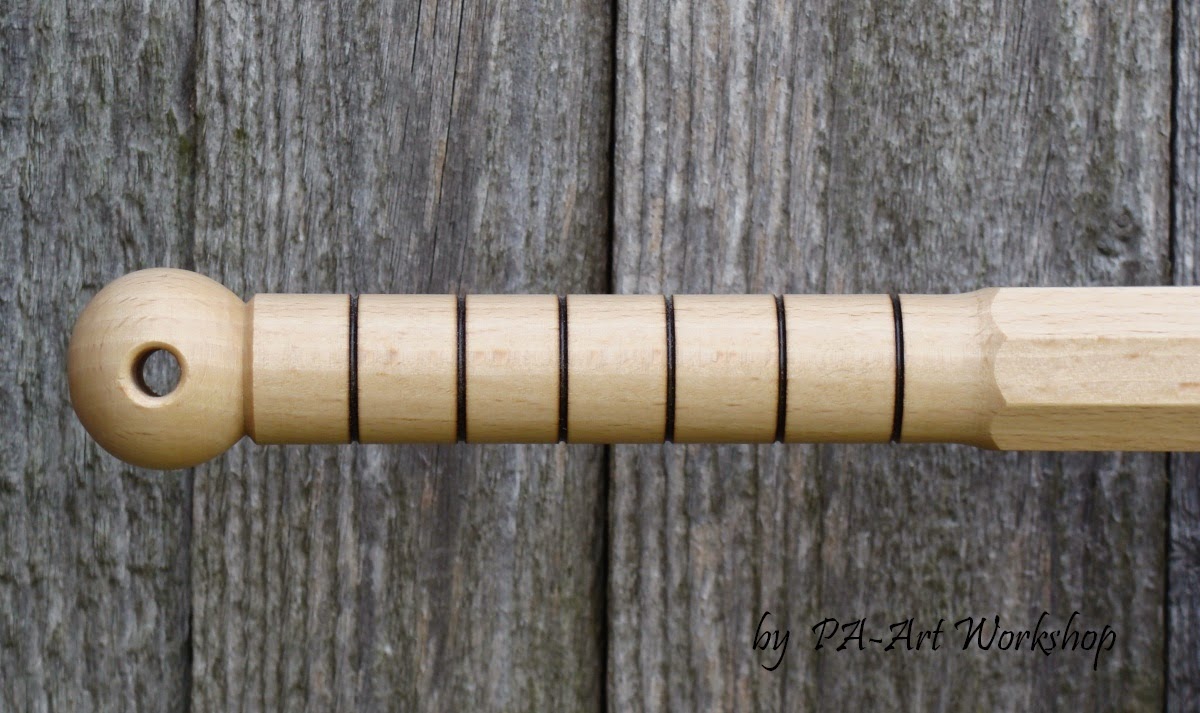
Here is one of possible version of Naeshi for pracice,
made from beech wood, length is 40 cm.
Naeshi  usual is truncheon (metal bar) similar Jutte but without Kagi(hook), in few shapes and this is one of them.
To some Naeshi is 25-30 cm long and 1-2 cm thick in diameter, it could be made from iron, bras or wood.
The cross section could be round, square with cut edges, hexagonal or octagonal.
Naeshi may have a Tenukihimo(cord) with Fusa(tassel) attached on round or heart-shaped ring to keep weapon secure. Sometimes Naeshi refers to any wooden stick shorter than three shaku(90 cm), also known as Nayashi.


…

O-Dachi bokken

From paart budo buki by buki stolar

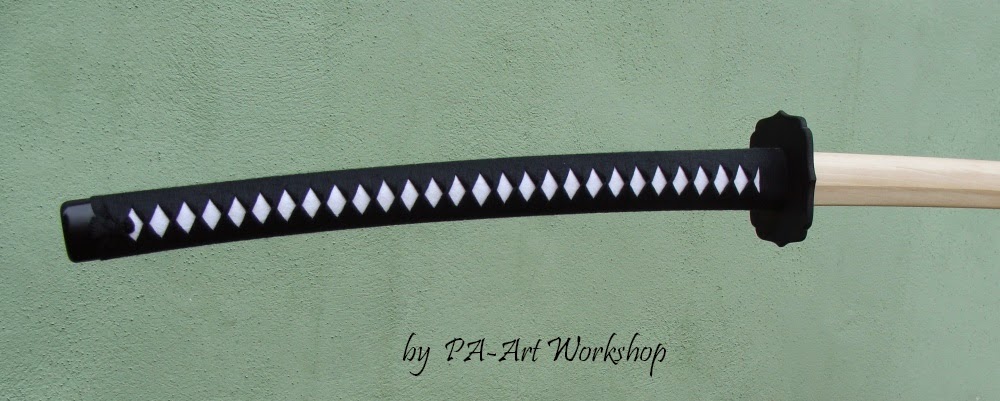
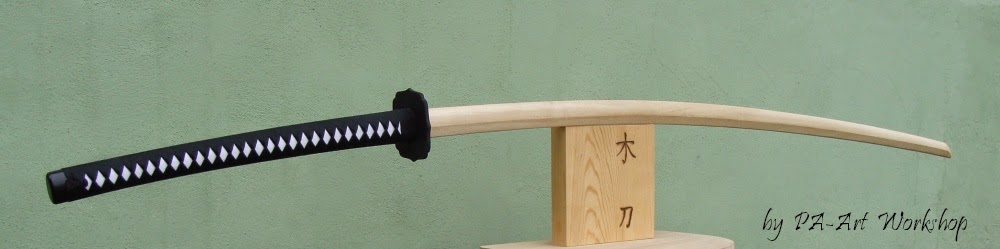
Here is few  photos of O-Dachi bokken, that was made in March 2013,
still work on saya toool for this kind bokkens.
Length of blade is 130 cm, and length of tsuka is 50 cm with 114 hishigami under itomaki


…

Get Natural!

From Shiro Kuma's Blog by kumablog

infinity4
In the Bujinkan every practitioner knows about Shizen no Kamae,  but very few really understand what it means. Common dôjô knowledge tells you that this is a “natural posture”.
But it is more than that, because being “natural” is the hardest thing to achieve on earth.
The Chinese language is more explicit. In Chinese,  Shizen is Tsujan. Shizen is 自然 which is made of 自, originaly nose, indicating “oneself”; and of 然, now meaning “thus”, but anciently meaning “to burn”.
Chozanshi* explains that “By extension it has come to mean “nature”, something existing on its own, having nothing to do with the mind or hand of man. “(It) is done without command, and always spontaneously.”
Spontaneity is the goal of the martial arts, and this is what Hatsumi sensei wants us to achieve. Chozanshi adds “Again, to move with spontaneity, the martial artist must let his chi flow by clearing all choices and premeditation from his mind. Doing so, he will act naturally and appropriately to the circumstances at hand.”
Being “natural” therefore isn’t an easy task to achieve. And still to “act naturally and appropriately” becomes possible only once the basics have been ingrained.
Being natural is close to the buddhist state of Shinnyō (真如), the ultimate nature of all things (तथता tathatā in Sanskrit). Sensei refers to it when speaking of “chō-kankaku”, or infinite consciousness**.
When you become one with nature, you are nature.
Your awareness, your consciousness, moves you, not your mind.
Merry Christmas to all!
____________________
* In “The demon’s sermon on the martial arts”, ISBN9784770030184, Kodansha
** In “Advanced stick fighting”, p38, Kodansha
More on Shizen 

…

Hatsumi Sensei’s 道祖神 Dōsojin NSFW Except in Japan

From Bujinkan Santa Monica by Michael
The 道祖神 Dōsojin at Hatsumi Sensei's House, photos by Michael Glenn
Last month in Japan, I gained a deeper understanding of genitalia. It started with the male form. But luckily Hatsumi Sensei paired it with the female for me.

Before I describe what Soke shared, let me explain my first phallic encounter.  A local guy from a certain neighborhood told me about 鬚神社 hige jinja (beard shrine). I was intrigued because I thought I had seen all the shrines in this neighborhood.

He took me to 聖天島 shōtenjima where (土俗の神様 dozoku no kamisama) a local folk kami is enshrined on the island. The island was surrounded by brown, dried out lotus plants in their ugly fall phase.

I followed him to the edge of a moat. There, across the water, was what appeared to be old ruins. We walked across a small footbridge. He pointed at one statue that looked like a giant penis.

But why was it called hige? He told me I had to look at the back of it. I shimmied on the tips of my toes along the edge of the moat to get a look. The ura side of the statue was a depiction of 役行者 En no Gyōja who usually has a beard.
Phallic 役行者 En no Gyōja statue, photo by Michael Glenn


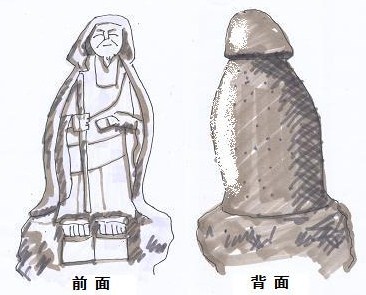
En no Gyōja is the founder of 修験道 Shugendō. In this statue, his pilgrim's cloak is wrapped around his head and shoulders in such a way that from the omote side he looks like a large cock!
Phallic 役行者 En no Gyōja drawing from here
This made me and my guide laugh out loud among the wilting lotus leaves.

He told me that back in the Edo jidai, the neighborhood was known as a place for lovers. There were lots of 出会い茶屋 deai chaya or teahouses that offered sexual services, or where people could have a secret rendezvous with a lover. People may have prayed at the shrine for virility, fertility, or even to protect themselves from disease.

A few days later I went to Soke's house. He showed me the far corner of his yard where there were stones representing male and female genitalia (see top picture). These were examples of 道祖神 Dōsojin, a traveller's guardian deity. You can find these monuments throughout Japan. They often portray a couple in embrace or even lovemaking. But often the stones are in the shape of phallus and vagina.

There is an interesting connection with En no Gyōja. First of all, he was a legendary traveller. Second, he had two servants named  前鬼 Zenki  and 後鬼 Goki. They started out as demons but En helped them become human and now they are a married couple representing yin and yang.

When I look at portrayals of Dōsojin that are of the embracing couple, I am reminded of Zenki and Goki. 前鬼 Zenki means front demon, the yang, like the phallus image I was greeted with on the island. 後鬼 Goki is the behind demon, ura, yin and maybe represented by the parted and open robe or cloak.

So next time you are training with Soke and he paints a big phallus, or a kunoichi with a red vagina on your scroll, maybe he is wishing you safe travels! If you are lucky, no one will ask whose bed you sleep in during those lonely nights in Noda.…

Change Your Attitude

From Shiro Kuma's Blog by kumablog

image

“Progress is impossible without change; and those who cannot change their minds cannot change anything”. This is not from me but from George Bernard Shaw.

In Japanese “change” can be written in many ways. One of them, known to all of us is 変化 (henka).

But the compound word “henka” is much more than the word “change”. Both kanji (hen and ka) have the meaning of “change”, but 変 (hen) is the “beginning of the change” where 化 (ka), is the “end of change”. This gives a much deeper understanding of it,  some kind of Inyo cycle (yin-yang).

In fact we often use it wrongly. A henka is not something you make up,  this is not a variation, this is something that is either:

1) natural, when your adjusts the mechanical waza to the situation at hand,
or
2) listed, when it is part of an official set of possible adaptations in a given ryûha (this is the case for example in the kukishin sword techniques).

A few years ago,  Sensei asked us to understand that, and to avoid calling “henka” any variation we would do. A henka is a henka; a variation is a variation. But to make it a little more confusing, some variations might be called henka.

Shaw states that change is the key to progress. This is why we travel and train in Japan. When you come to Japan you have to be ready to change everything you think you know in order to progress. In a way the Japan trip is defining,  building your future; so it would be a loss of time and effort to go there and to only reproduce the things of your past.

Build the future from 中今 (nakaima) the present*, not from the past. 

Your progression lies on your ability to change your Kokoro Gamae in order to modify, and to the better, your Tai Gamae.**

Change your attitude and remember that “… those who cannot change their minds, cannot change anything.” **

_______________________
* nakaima literally means “the middle, the center of now”.
** Kamae (Gamae) has the meaning of posture, or attitude (as in 身構え – migamae).


…

I Missed The Class Last Night

From Shiro Kuma's Blog by kumablog

image

It is Friday 1pm and I’m back to Europe.
Hatsumi sensei’s Friday class at the honbu just finished.

Each time I’m back to Europe, I have this strange feeling. I wish I could still be there and train with him at the honbu.
Each time I’m back I try to figure out what is it that I’m missing from his trainings when I’m not there.

Sensei’s Budô is not something you can learn in a book,  it can only be learnt by being there physically. Over the last 25 years I have been quite many times to Japan to train with Sôke, and I am happy for that. But still, I missed all the classes he taught when I was not there.

If I do the math,  I attended only 7% of the classes he has given in this period. And I sometimes wonder what would I have been able to acquire, if I had been attending those missing 93%? A lot I guess.

The path of Budô is an endless one, and one life cannot suffice to learn all that it is to learn. So 7% is really far from enough. This is why personal training is so important. Over the years I noticed that the “magic” of Japan doesn’t last more than two weeks, but if I train the things and feelings that I got while at the honbu, then this “magic” can stay alive a little longer.

But since we entered the essence of things, things get more complex. In the latest themes of the year, there is nothing mechanical to reproduce. Things were much simpler when the themes été covering schools or weapons.

Since we moved to highest expression of Juppô Sesshô,  there are no techniques to train,  only feelings. And being away from the source,  the  betterment of our taijutsu is more and more difficult every year.

When I look back at this last Japan trip,  I have a hard time figuring out in which direction I have to go. Sensei’s movements are non existent. There is nothing because he is doing nothing,  but this nothing is everything. His taijutsu has reached such a high level that mimicking what he does – or in this case, what he doesn’t do –  becomes nearly impossible.

Yes it is sad to know that I missed the class tonight.


…