Skip to content

Yoga Class and Nihongo Class by Tomoe Gozen (May 5th – 7th)

From Kasumi An Study Center  霞庵 スタディセンター by Kasumi An Study Center

11078220_852928698107197_6707676600218780262_oLet’s get together, have some fun, and improve ourselves in Kasumi An Study Center!  The purpose of the Class is to bring people together, enjoy practicing yoga/Japanese and to foster our connections to nature and those around us. You can expect to laugh a lot, meet new friends, and, with a little luck, discover something awesome! Classes are for all levels. Newcomers to yoga/Japanese are most welcome, as are seasoned practitioners! You do not need to bring a yoga mat.

*If you take more than two classes, I will give you 10% discount.
*If you are staying in Kasumi An Study Center, the fee will be 1,500yen/class.

【May 5th】 Garden Yoga Class
Time : 11:00am – 12:30 pm
Fee : 2,000yen

*If it rains on the day of the class, we will have a class inside.

【May 6th】 Nihongo Class
IMG_0319To understand Japanese Shihan’s instruction in Japanese, we will focus on Bujinkan terms at this class. I will choose the phrase which Hatsumi sensei often says, and we will practice saying phrases. The class will be held both in English and Japanese.

Time : 11:00 – 12:30 pm
Fee : 2,000yen


【May 7th】 Garden Yoga Class
Time : 11:00am – 12:30 pm
Fee : 2,000yen

*If it rains on the day of the class, we will have a class inside.

I speak English & Japanese and the class will be held in both languages. I have been practicing Bujutsu mainly with Paul since 2012.

I look forward to sharing a wonderful time with you all!

Posted by Tomoe Gozen

11174346_852929054773828_8714842828217630962_o

鬼角拳 Kikaku Ken Makes Me Laugh

From Bujinkan Santa Monica by Michael

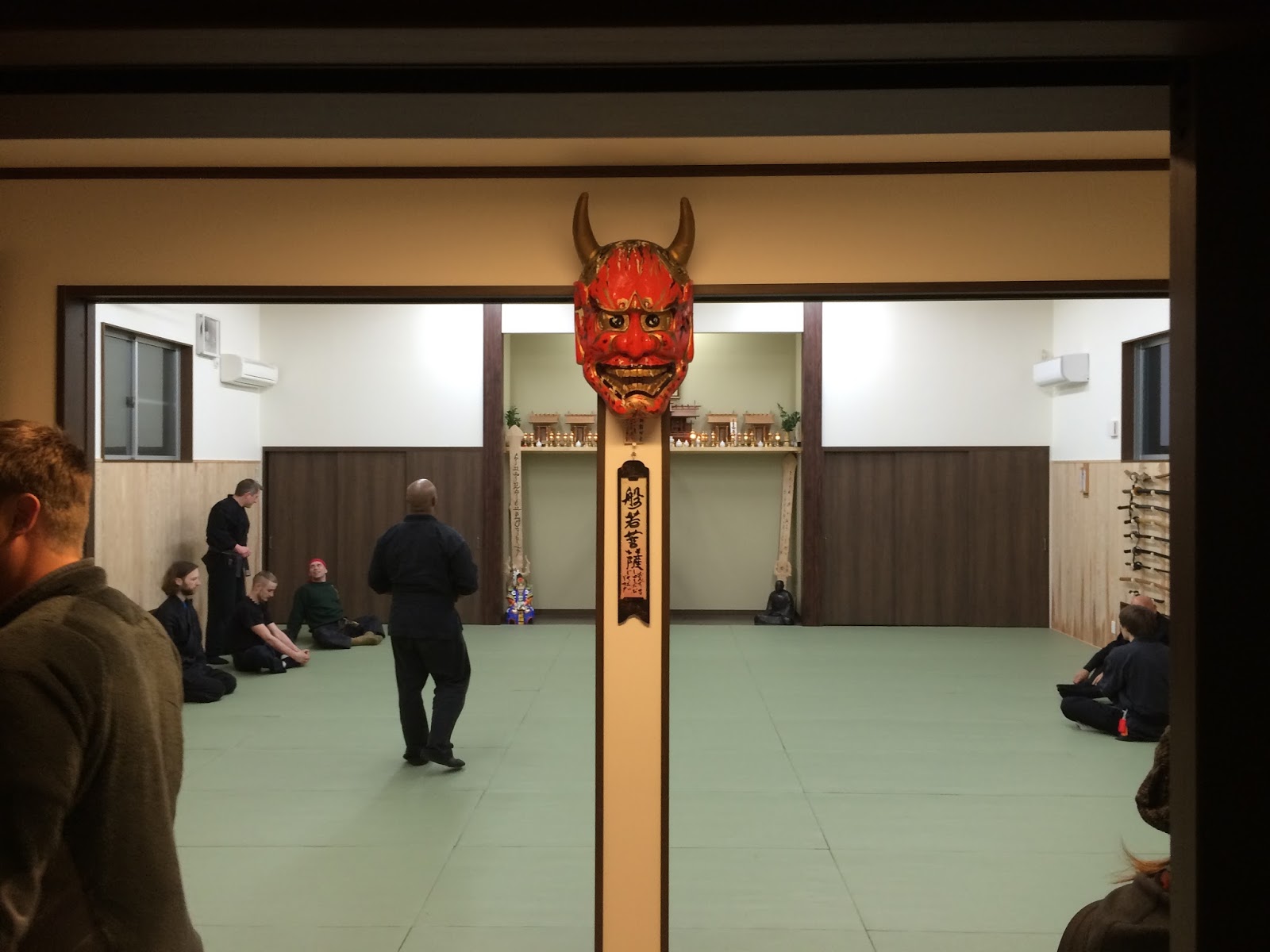
Demon greeting in the new Bujinkan Hombu Dojo, photo by Michael Glenn
The other night, I gave each of my students a Glasgow kiss. They didn’t like it. This is a slang term for a headbutt.

If you subscribe to my training notes (if you aren't a subscriber yet, you miss a LOT of free Bujinkan notes), you know that we are currently studying 宝拳十六法 Hōken Juroppō in my basics class. These are the 16 striking treasures of the Bujinkan curriculum.

The Bujinkan name (or slang) for headbutt is 鬼角拳 Kikaku Ken. To help everyone visualize why this strike has the name that translates as demon horn fist, I brought a small oni mask for everyone to see where his horns are located. It may even be technically correct to grimace like an oni while delivering this strike.

The 鬼 Oni, or demon is not the same type of demon that westerners fear. Oni are associated with wild energy and bodily strength. They can be positive or negative.

You will see many people in the Bujinkan who embody both qualities. Like the Japanese expression, 鬼面仏心 kimenbusshin, the face of a devil but the heart of Buddha. This is the stern expression you see on a warrior while his heart is tender and compassionate.

Hatsumi Sensei said that
“In the Bujinkan now we have really reached the time of demons (oni). When you say demon many people think of an image of something that is very wild. But it is not like that. Oni are very important creatures in Japan given to us by the gods to protect justice. I am sure that there will be more demons in the future of the Bujinkan to look after the world.” 
This why I laugh out loud every time I headbutt someone. One year, when Hatsumi Sensei set the yearly theme as Kukishin ryu, he wrote a scroll to hang in the (old) hombu. It read 九鬼大笑 kuki taishou... 9 demons, hearty laughter.

Most depictions of Oni in masks, sculpture, or painting show them with a very large and scary smile. This is because they know a secret. Laughter is the only thing that will defeat our biggest enemy... ourselves. The inner demons float away on a smile.

Bujinkan 妙音術 Myō-on jutsu, a Mysterious Sound in the Kukan

From Bujinkan Santa Monica by Michael

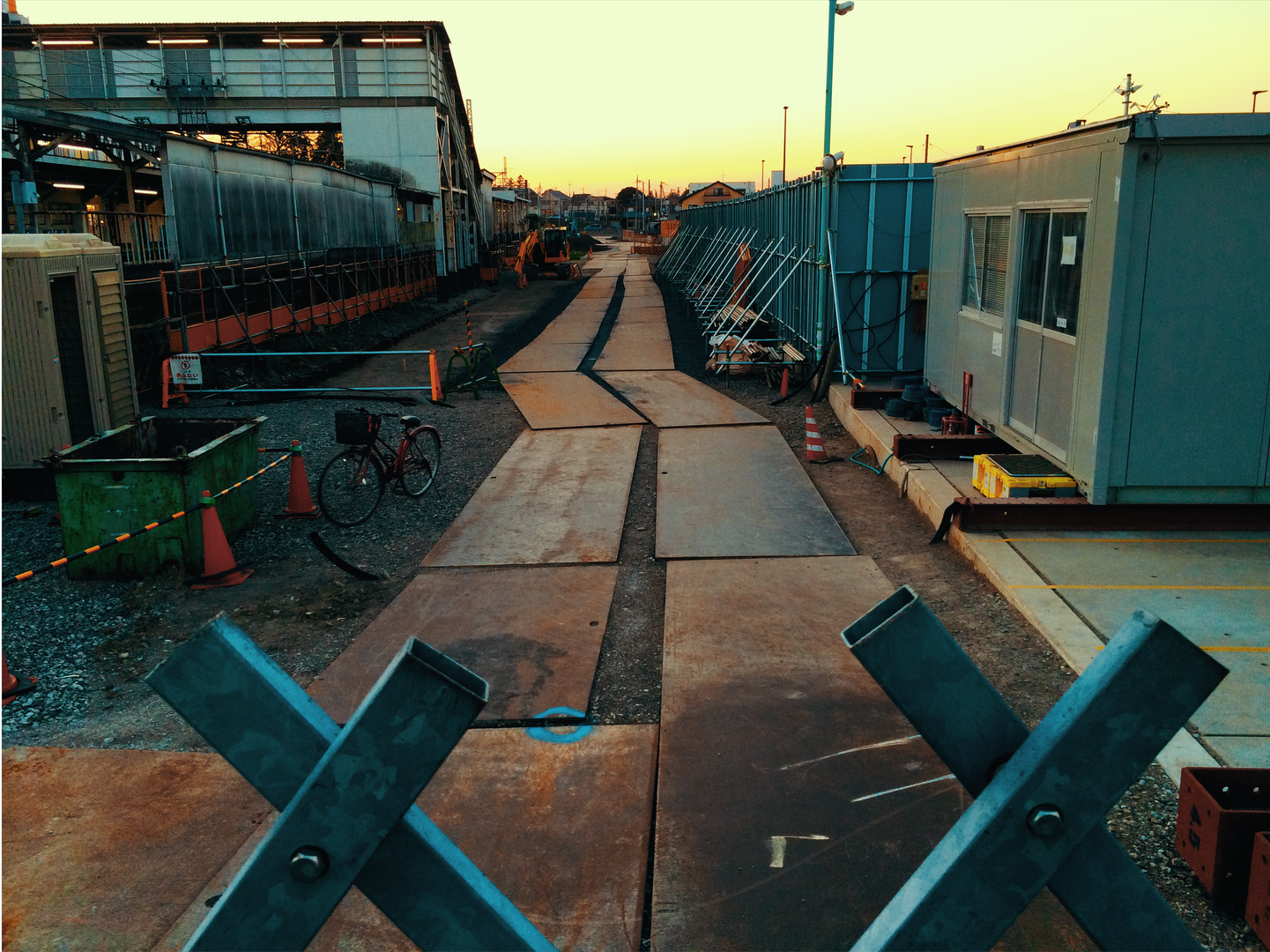
The old bike path to the Bujinkan hombu dojo is gone, photo by Michael Glenn
Last week we were making a video of 折倒 Settō for my Bujinkan class. This is a simple Kotō Ryū kata that many have experienced. But this time the expression of it was different. My opponents were collapsing and flying away as if by an unseen force!

I was fortunate to study this kata in Japan last month with more than one teacher. They were generous with the pain. Below I describe how when I did it with Hatsumi Sensei, he gave me a gift that has opened up a new understanding of taijutsu.

Everyone knows that proper taijutsu is not supposed to be muscled or forced. You should drop the power out to do it well. I wrote about that here Releasing the Power of 力を抜くChikara o Nuku

The key in that idea is expressing power or force, then releasing it. But the surprise for me was what Hatsumi Sensei said last month. He told us to put your intention in the kukan, then remove it (空間と退かす).

Maybe you’ve heard the expression that nature abhors a vacuum. In Physics this means that empty space will quickly be filled. When you remove your own muscle or intention from the technique something will replace it.

Hatsumi Sensei has suggested this year (and last) that we power our taijutsu with shizenryoku or the power of nature. Natural forces will rush in to fill the gaps we leave in the kukan. He even gave a name to one force that can appear when you remove your intention: 妙音術 Myō-on jutsu.

I won’t try to explain 妙音 Myō-on too much. Except that it is a vibration of mysterious sound that comes from what Soke calls 自然観 shizenkan. This view of nature or natural philosophy is connected to mythology and 五行 five element theory 

In religion it is associated with 妙音樂天 heavenly music from サラスヴァティー Sarasvatī who in Japan is expressed as 妙音弁才天 Myō-on Benzaiten holding a biwa (traditional Japanese lute).

This kind of metaphysics gets really esoteric. But one practical result for our training arises from this. In the very next sentence after using the word 妙音術 Myō-on jutsu, Soke said,
万物すべて武器 banbutsu subete buki
This means everything is a weapon. Don't be stuck on the idea that only weapons are weapons. In this way the mysterious sound of the Kukan can be your weapon.

A short interview with Hatsumi Sensei

From Kasumi An Study Center  霞庵 スタディセンター by Kasumi An Study Center

On Friday, April 10 2015, a German television crew came to film a segment on Hatsumi Sensei. After training, they did a short interview with Hatsumi Sensei for which I translated. It is always fun to watch interviewers get flustered and a bit bothered by Sensei`s unconventional and seeming simple responses. it was a short interview with brief responses but I found such depth in them and enjoyed them so much, that I thought I would take the liberty of sharing them with all of you here.
Because I know must of you don’t have access to German television!

I am paraphrasing the conversation, but keeping it as close as possible to the actual responses. It is difficult because when you translate something on the spot, often you forget much afterward. That being said, I think I captured the essence of the responses for you here. I hope you enjoy this short interview as much as I did. All the best, Paul.

Interviewer: What did you feel when Takamatsu Sensie made you Soke of the nine schools?

Hatsumi Sensei: When Takamatsu Sensei handed over the linages to me and said “Now I leave everything up to you”, I really had no idea. I didn`t know anything.

Interviewer: Did something come to fruition because of your training with Takamatsu Sensei?
Hatsumi Sensei: No nothing. Nothing came to fruition. in fact I went backward, I returned to zero. you see if something comes to fruition, it then has to rot. And if something has to rot, it would be better to make (German) beer out of it! (Laugh)

Interviewer: Do people come for the techniques of Budo or the spirituality?
Hatsumi Sensei: It can`t be technique because I don’t do technique. It is something beyond technique, transcending technique.

Interviewer: “so it is spiritual side that they come for?”
Hatsumi Sensei: I would not say that, I don’t think about it, when you stop thinking about it, when your thoughts fall away. maybe something like this.

Interview: How do you see the future of the Bujinkan?
Hatsumi Sensei; I don’t think about it. You know every day is different. Everyday things are always changing. just like for you too, every day is changing, right? it is like this.

Interviewe: Did you receive any results of your training?
Hatsumi Sensei: The result is that good people from all over the world come together. People who single mindedly mastered this one thing, they have all come together here.

Translating at the Honbu Dojo.  A big thank you to Michael Waschak for his fantastic photography.

Translating at the Honbu Dojo. A big thank you to Michael Waschak for his fantastic photography.

Straight Circle

From Shiro Kuma's Blog by kumablog

straight circle2

One evening in Abu Dhabi, I was teaching outdoor the concept of mienai waza (見えない 技) next to the Laguna. With the light fading away, the whole mienai concept made more sense. I don’t know why, but it reminded me of the gecko lizards I keep observing in Bangalore. When in India, at night, on the balcony, I spend a lot of time watching the gecko lizards* stuck on the walls and the ceiling. They call each other with a very sharp yell because they are often on different planes, they don’t see each other until they are face to face on the same level. For them, the world is always flat. There are no angles, no up and down, no horizontal or vertical. Everything is flat.

It is the same in a Bujinkan technique, and we have to train to change our perspective. Only then can we adjust our moves to what the encounter is requiring. There is no beginning, and there is no end as long as we keep going. It is uke who gives the time and space of his downfall.
There is always a solution waiting ahead. “Ahead lies paradise,” says the Takagi Yôshin ryû, but ahead can be anywhere because we move in the world of Juppô Sesshô, in the ten directions. We have to transform our perception of reality in order to overcome the attacker. And rushing is never the answer. Time and space are everything, and if you move forward to early you will miss the opportunity that proper timing has to offer because you will not be in the slave where victory was waiting for you. Waiting for the good moment impose the ability to stay out of danger.

Like Sensei, I’m not a great fan of Sunzi’s “Art of war”** that I found quite primitive when compared to the anonymous “36 strategies”. But some chapters are interesting and can help us understand the simple complexity of Hatsumi sensei’s vision of Budô.

Sunzi said, “The good fighters of old first put themselves beyond the possibility of defeat and then waited for an opportunity of defeating the enemy.” The Bujinkan teaches to protect oneself first. So why is it that many practitioners are rushing toward their death? Your priority is to stay alive in order to defeat the attacker. Reverse this natural order, and you will meet your creator.

I’m always fascinated when I see Bujinkan practitioners using strength and power when the obvious answer is to relax and to wait. The enemy always come up with the solution to defeating his attack.

Sunzi adds that “to secure ourselves against defeat lies in our hands but the opportunity of defeating the enemy is provided by the enemy himself. Thus, the good fighter can secure himself against defeat but cannot make certain of defeating the enemy.” In order to give time a chance to unfold the opportunity for you to defeat the attacker, you have to keep going. The attacker’s intent brings the solution.

This attitude of letting things follow their way is what sensei means when he wants us to become zero. Surfing on the permanent unfolding of events, you can understand and follow nature’s will.

Keep going! Never give up and walk at the right pace the circle of life. When you follow the circle (ura or omote), you are always walking on a straight line.

There are no angles, no up and down, no horizontal nor vertical. Everything is flat.

Being “zero” is the path of the straight circle.

____________________________

*http://en.wikipedia.org/wiki/Gecko

** Back in 2009, I was telling Sensei that after studying extensively the “Art of War” for a lecture for HP, I discovered that the book that had accompanied me since I was 18, was quite empty. His answer was: “yes indeed, in fact this is also what Takamatsu Sensei told me”. I felt better.


The Stunning Effect of 気分 Kibun in Hatsumi Sensei’s Class Last Week

From Bujinkan Santa Monica by Michael

The lotus bearer from 金龍の舞 kinryu no mai. photo by Michael Glenn
Hatsumi Sensei did not move. The attacker with the sword missed him completely. I watched the next demo more carefully. His feet literally did not move at all. Yet he was not cut.

Maybe some of you have witnessed this strange event in person. If you have, you know how weird it can be when you try the same thing with your training partner. Most of us cannot repeat this.

After Soke demonstrates, you try it, and you get cut every time. Or, you must leap out of the way. But never can you repeat what he did.

I have seen him demonstrate this in class many times over the years. And I have to be honest, I always thought it was fake. I just chalked it up to a bad cut from the attacker.

But after last week’s training, I’m not so sure anymore. Soke shared something with me personally that I did not consider when I judged the previous demonstrations. I’ll try to describe what he showed me.

Here is what Soke told us that night. He said that normally when we evade, we do so with our minds gauging the distance or the angle of the attack. We’ve all been learning this since we were born. Our eyes process the physical properties of the incoming attack, and we duck or dodge.

But Hatsumi Sensei said That if you think about trying to evade, it’s already too late. Instead, he was using a kyojitsu of the kukan. The whole space and everything in it is controlled with kyojitsu. He controls the attack before it occurs, and there is no need to evade.

How do you do this? Well, what I felt when he asked me to attack him was a blankness or an absence. It was bizarre. Like having your memory erased. He just was not there. Yet I was thrown quite hard.

Hatsumi Sensei then said, you are being controlled by 気分 kibun rather than anything physical. Kibun is the mood or atmosphere. You may even translate it as the spirit of the moment.

This is the kyojitsu he applied on me, or rather, the entire kukan. And if his attacker with the sword experienced the same thing, I can understand why he missed. How do you cut absence or emptiness?

Instead of judging the bizarre appearance of what I witnessed in Soke’s classes, maybe I should realize I didn’t have all the information. I was lucky that Hatsumi Sensei chose to demonstrate on me personally to show me this part of the puzzle. Now I have a lot to work on at home to harness this power of moody kukan.

The Ura Side of Bujinkan Sakkijutsu

From Bujinkan Santa Monica by Michael

金龍の舞 kinryu no mai, 浅草寺 Sensō-ji, Tokyo. photo by Michael Glenn
This is one of those Bujinkan training trips where I will be sore for the entire trip. Besides the normal beatings at the hands of my training partners, Hatsumi Sensei, Senou Sensei, Noguchi Sensei, and Nagato Sensei have all seen to it that they personally roughed me up.

For members of Rojodojo, I made a video: Bujinkan Japan Training Report: Kinryu Edition  Because...

Yesterday, I went to see 金龍の舞 kinryu no mai. Dance of the golden dragon. This is a rare sight… the sensoji temple also has the name 金龍山 kinryuzan. According to legend. the fisherman who founded the place saw a golden dragon swoop down out of the sky and create a forest in one night.

Eight guys carry the dragon and the 9th guy carries a lotus flower. This is symbolic of the dragon's dual nature. Although the dragon is fierce while attacking, it also protects.

Hatsumi Sensei has been saying the same thing for many years. In fact, on Tuesday night, he showed us this dual nature against his attackers. During one throw, he said he was trying to protect, but those who do not accept it defeat themselves.

He also shared what he called the ura side of 殺気術 sakkijutsu. This exposes the dual nature of sakki and requires a feeling of sutemi. Hatsumi Sensei used a baseball analogy where instead of going for a home run, you bunt.

When you bunt in baseball, you receive a fast moving ball and deaden it with your bat to slow it down. Your opponents chase a slow rolling ball while the runners advance at fast speed. It's a way of controlling the tempo of an attack.

Hatsumi Sensei said 勝負 shoubu, victory or defeat, is already decided before the fight begins. Then everything moves in slow motion for the opponent. He cannot stop it from happening. All he can do is witness his own demise.

This may come as a shock or surprise. And that is what defeats the attacker rather than any physical technique. Soke said he is like the monkey who puts his hand in the jar to grab the food, but then can't pull his fist out.

This is why Soke told us to release, or set ourselves free from 技術 gijutsu or the technical qualities of fighting. Technical skills are like the monkey trap. Soke said,
People think that they perform techniques with their own power, but they don't know that it's the kami that drive their bodies.
If you move with your own intention, then you can't use the power of kami.

And this power, this ura side of sakki, allows you to dissipate any attack. Imagine the arrows turning to flowers before Siddhartha. What Soke did in one class this week was cause his attacker to defeat himself by trying to help the attacker or even protect him.

Hatsumi Sensei told us this was for the "jugodan" test. When I became a 15th dan, I began to feel Soke's warning that the jugodans are constantly taking the sakki test. Anytime, anywhere. It does not only exist in the dojo. This is why we need to discover the ura of sakkijutsu that Hatsumi Sensei was teaching at Ayase.

The Golden Dragon (kinryuu son 金龍尊) is often mentioned in the Suvarna- prabhasa-sutra "Golden Light Sutra". This is where the idea of the 四天王 shitenno comes from. Soke has referenced this with 4 Japanese shihan and also used it as a nickname for some European shihan.

These four kings are supposed to protect the head of the kingdom. But only if the ruler is just. This is why Soke tells us to only teach people with a good heart. If you do not have a good heart you will never be able to harness the power of the ura side of Bujinkan Sakkijutsu.


悟光護心 Gokou Goshin

From Kasumi An Study Center 霞庵 スタディセンター by Kasumi An Study Center

20150306_185942-1Kannon Sama drawn for my friend Jess with the characters Go Kou.

悟光護心 Gokou Goshin

Many of my Bujinkan friends have asked me to write on the topic of this year`s theme of the Bujinkan dojo as written by Grand Master Hatsumi. First and foremost, perhaps this is better not thought of as a theme for the year, but more of a guiding principle for your martial arts and indeed life. The characters, as written, are Enlighten, Light, Protect, and Heart. Short and succinct but deep and profound as many of life`s simple things are. It reminds me of the Heart Sutra. It is said that in the heart sutra, the whole of Buddhism, it`s essence, is boiled down to a mere 260 chinese characters or 16 english sentences.

In many philosophies it is said that, at first, the Master speaks but in the end falls silent and in this silence, a transmission occurs. Words become no longer necessary. In the silence, in the space between master and student, communication happens. In the course of twenty years living and training in Japan with Hatsumi Sensei, it seems that he too, at one time kicking and striking like a tiger and leaping and spinning like a dragon, he has now become more and more subtle, graceful in movement. One could say softer, smaller and even delicate, yet heavy with that which can not be weighed. At one time his poems of the gokui (極意ーinner secrets) long and flowing become more and more abbreviated, condensed. Yet this compactness and simplicity, like a zen painting, adds weight and beauty. For me, these four characters, Go Kou Go Shin, remind me of the longer poem Sensei often says before class. Chihayaburu Kami no Oshie wa toko shie ni tadashiki kokoro mi wo mamoru ran. 千早ぶる神の教えは永遠に正しき心身を守るらん.
A poem which can be translated roughly as `the teachings of the divine forever protect the pure (correct) heart.` And as Takamatsu Sensei once told Hatsumi Sensei, `it is only the pure heart of man that has a connection to the divine`. Go Kou Go Shin, you understand? With age, the long poem becomes compacted, and boiled down to its essence, like a fine wine or fine whiskey takes many years in the barrel. And as Sensei approaches his 85th year, his teaching are becoming more and more elegant, seemingly simple yet heavy with experience and wisdom.

In an ancient Indian text, it says that in the center of the body. there is a little shrine surrounded by a wall with eleven windows. Hidden within this shrine is a lotus blossom. And within the lotus blossom is a tiny tiny room. Spark. Most seek outward for enlightenment. But perhaps it is something that already exists within us. It just needs to be uncovered, discovered, dug up. You must be like an archeologist. This is what we do in our training, whatever training you do. We strive to understand ourselves and uncover this treasure. The tears and sweat of our training act to soften the ground and wash away the unnecessary, the dirt, and give us a glimpse into ourselves, our hearts, this treasure within – Nin Po. (忍宝ーtreasure of nin) (Nin=perseverance). In training we are plowing the field of our hearts. Plowing is simply creating space (ku- 空間)in the ground for life to more easily thrive. Training plows our hearts, giving room for the spark in your heart to catch and burn bright in the vastness of space inside us. Like the sun which gives freely of itself to all beings and makes all life possible on the earth. Burning bright in the vastness of space, the sun creates and protects all life without bias on earth. The sun does not care the color of your skin, or the beliefs you hold. It shines unbiasedly on all life. All colors, all religions, all countries.  No Borders.**

And the sun asks nothing in return. It burns itself to give you life on earth. The sun never sends you a bill and the sun never negotiates prices and times with you. It never says `I gave you 24 hours of sunlight yesterday so today you work for me for 12 hours`. The sun always burns 24 hours a day for us. Without the sun, all life on the earth perishes. Without a sun, there is no life. There is also a sun in you, (hikari 光、or also pronounced kou). Uncovered and free, it too, will also create wondrous life and protect those upon which it`s rays shine.

In training, at the upper levels, just as there is the Satsujin Ken and Katsujin Ken, the killing sword and sword of life, we must train on how to bring the opponent to life. The killing aspect of martial arts is easy, even children can kill trained men. Once this killing aspect is mastered, one must then turn the other way, to change directions. 180 degrees. Now you must learn how to create and support life. By losing, as Sensei says, the intention of attacking and killing, we give opportunities for our opponent to live, to maybe experience a blossoming. Moving with compassion and the heart of the gokui (inner teaching) Amo issun no tama mushi, we gently envelop the opponent to protect not only ourselves but also to protect them, even from themselves. If we move from fear and anger, we kill and stop life, But if we build an awareness in ourselves, we can move with compassion and thus truly protect life allowing the next to flower. As Sensei has said, `there is no opponent, the opponent is ourselves`.

** Perhaps you might remember when Hatsumi Sensei first went overseas, he remarked, `I am UFO, I am borderless`. To become borderless, we must continually watch ourselves and throw away the unnecessary. to see thru beliefs, to understand that we have been indoctrinated by our by our cultures, education, religions, politics, ect.. Seeing thru them, can you realize the connectedness and power of supreme nature?