Anmälningsformuläret för festen
From Bujinkan 40 år i Sverige TAIKAI by Bujinkan 40 år i Sverige TAIKAI
Anmälningsformuläret för festen är nu upplagd, klicka här!…
From Bujinkan 40 år i Sverige TAIKAI by Bujinkan 40 år i Sverige TAIKAI
Anmälningsformuläret för festen är nu upplagd, klicka här!…
From Bujinkan Santa Monica by Michael
In a recent class we studied Bujinkan uke kihon gata. I demonstrated how to physically do a jodan uke. But here is what I wrote in the training notes that I send out to my subscribers:"performing jodan uke begins with an attitude. Remember, uke comes from 受けるukeru which means to receive. There are three important moments when I have to remind students of this: during ukemi; when performing uke nagashi; and even when being an uke."But the fourth moment for this attitude is the MOST critical for your Bujinkan training. It is so important that I made a video about this word that you can watch below:
the most adaptive word in the Bujinkan?
Is this the most adaptive (and important) word for your Bujinkan training?
Posted by Rojodojo on Wednesday, September 9, 2015
From Bujinkan Santa Monica by Michael
![]() |
| Bujinkan Honbu Dojo and Summer Grasses, photo by Michael Glenn |
From Bujinkan Santa Monica by Michael
![]() |
| Michael Glenn, Bujinkan Honbu Dojo, Last Month |
From Bujinkan Santa Monica by Michael
![]() |
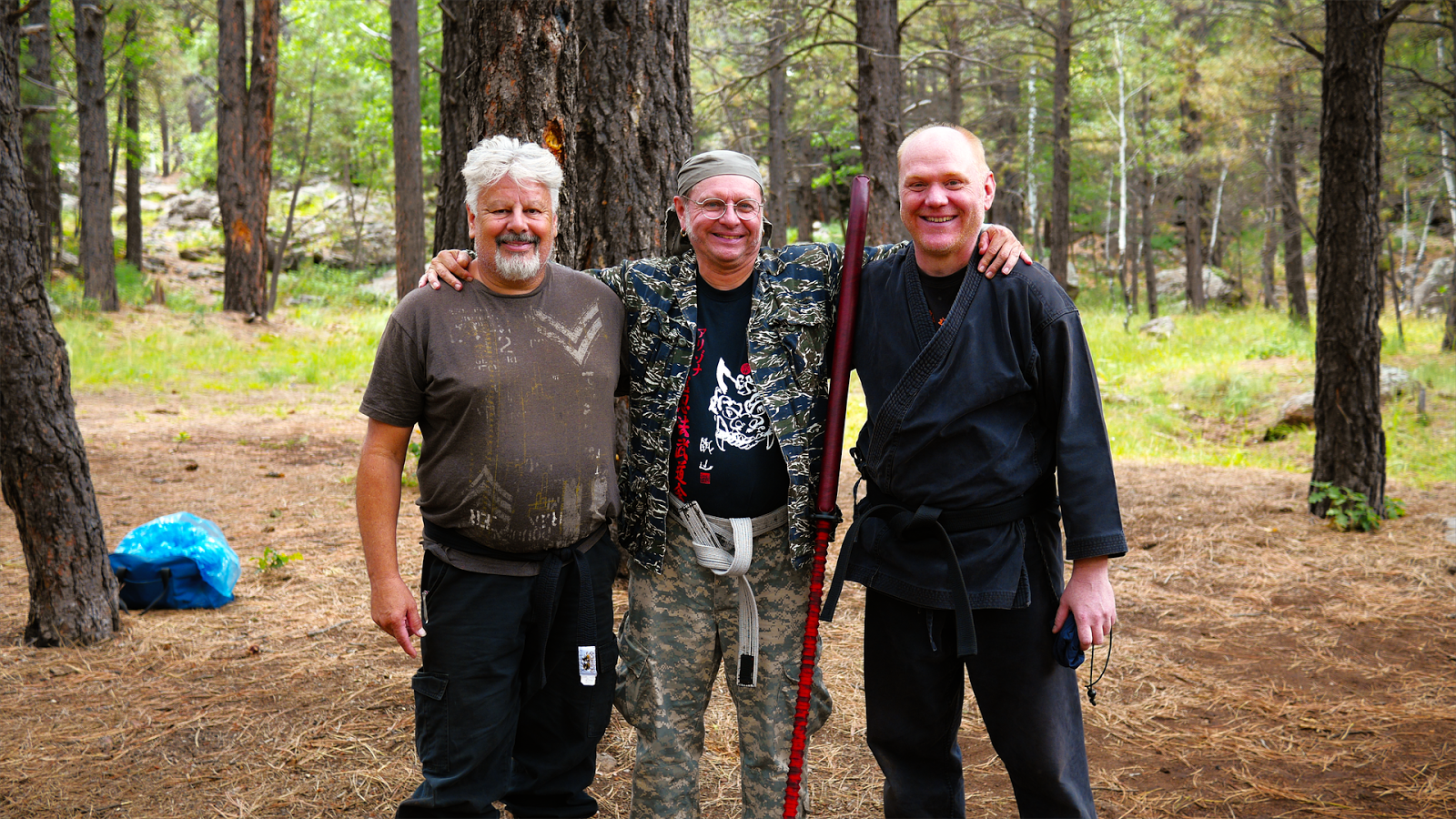
| Robert, Peter, and Michael in the Forest of AZ |
From Shiro Kuma's Blog by kumablog

I left Japan for India a week ago, and I gave my first class here after the trip.
When you are in Japan training with Sensei and the Shihan you are not aware of how much your taijutsu evolves. But when you begin to teach again, you can appreciate the number of new things you have acquired. That was the case in class. Needless to say that the students were lost.
When in Japan I behave like a regular student. I try not to teach my partners as I want to get the most of each class I’m attending to. After a few days at the honbu my brain is totally fried and I feel completely lost.
When you’re in Japan, do not try to do “your taijutsu” simply copy what Sensei and the Shihan are giving you. When you are back to your dōjō, train what you learn there.
Sensei told me once “Arnaud train what you have to train, and teach what you have to teach”. When in Japan don’t teach, train!
Teaching is easier than being taught which is why so many are not doing what the teachers are doing in class. If you trained properly then the teaching will come easily as long as you have good basics.
When I opened the class, I had no clue about what I was going to teach. So I asked Eugenio to begin the class.
But then the “magic” happened. Suddenly every new feeling I had experienced, and didn’t get while at the honbu, everything was there in my taijutsu. The tsunagari, the awaseru, the mutō dori.
It was amazing to watch my body unfold naturally the same movements I was unable to do before at the honbu.
This is what I call the “Japan effect”. The benefits of training in Japan need a few days to emerge in your taijutsu. It is not about trying to do what you learned in Japan, but to let this new knowledge sink into your body.
You have to appropriate it naturally, and this is only possible with strong foundations. Without a deep training in the tenchijin, what you do is fake. You have to have trained your basics so much, that your body moves by itself. Thinking is not at play. This is the taihen kuden Shinden of learning.
When you get to this level then you can copy Sensei’s movements. What Sensei teaches is beyond the form. It is so subtle that your brain cannot understand it. A long experience, kuden, is needed.
Often people ask me why, as a Dai Shihan, do I need to travel to Japan three times a year?
I’m going there to get the “Japan effect”.
From Shiro Kuma's Blog by kumablog
Today at Senō sensei’s class more people were attending, and we had two hours of taijutsu. It was pure delight.
We trained the F. A. S. T. principle in slow motion.
F. A. S. T. is my acronym for “Fix And Softly Turn around”.
Uke launched a left Tsuki, and you wait until his fist is nearly touching you. At the last moment possible, you pivot to your left, living his fist with your left shoulder. It creates a sort of arm lock as you lock his elbow with your other shoulder. Your body is in line with his arm.
Replace your right shoulder by your hand and bring him down with a step forward.
The body moves softly and then around the fixed Tsuki. If it doesn’t work, grab the left hand and rotate the body around the arm, creating some omote. Lift the arm; hit the throat, the face, and then the neck with sunken.
From there either you apply:
A) a Ganseki Nage like movement bend the torso forward to bring him to the ground. If Uke’s left arm gets out of the lock and slides out, your left arm is there to outstretch him and continue.
B) a Ganseki Oshi like movement by stepping over with your right leg to off balance uke. Uke’s right arm is pulled horizontally and outside while your left arm lifts his left arm up in Ganseki.
Everything is very soft, only done with body footwork. Uke’s body reaction decides on your choice between the two movements.
The principle here is the usual concept from the kukishin ryû known as “teko shiten”. (1)(2)
梃 teko is the lever and 支点 shiten, the fulcrum.
What I found remarkable is that the same concept is applied in two distinct ways.
In movement A, the teko and the shiten are applied on the same point, here the arm. It is the usual application of the concept.
But in movement B, Senō sensei dissociated the two. The lever is still on the arm, but the fulcrum is done by Tori’s right foot, placed on the ground next to the right foot of uke to hinder his movements.
I have been playing a lot with this principle, but I never thought of using them in a double location. The applications for it are endless.
These small discoveries are why it is always refreshing to come and train in Japan with the best. (3)
_____________________
1. 梃/teko/lever
2. 支点/shiten/fulcrum
3. The “refreshing” part does not concern the heat that was too much.
From Shiro Kuma's Blog by kumablog
Hatsumi sensei was in a superb mood yesterday, and he gave us a high-level training. He often says that he is teaching for the Jûgodan, but yesterday night I think his teachings were advice that rank.
I opened the class with some taijutsu but rapidly he put the level so high that we were all lost in a minute. And that includes my partner Kenji and I. The more the class advanced, and the more I had the impression that my brain and body were stuck as I was trying to swim in water full of seaweed. Each movement being hindered by hundred invisible hands.
We did many applications with taijutsu and ninja biken, but I was so lost that I can only remember one kaname for this class: “ignore the opponent”.
It seems to be for me the next step of my Budō evolution.
As in every class, Sensei moves in a very simple but strange way. There is no thinking, no intention, no force, only natural body motions. Until yesterday, we kept watching uke. Not that time. Even that has been taken from us!
Ignoring uke is easy to understand, but prices to be quite difficult to achieve.
Sensei said that we have to move as if not at all concerned by the attacker. Not paying attention to uke, not trying to avoid the attack, you just move forward in the attack and deflect the weapon or the fist, only because you don’t focus on it. I’m sorry, I know that it is hard to get it with words, but this is the best I can do to explain what it feels during the class. I went to him a few times to “feel it”, but there was nothing to feel until he dug his nails into my face or my finger joints.
Sensei is teaching a higher level of Mutō dori this year. Each class he insisted on it. But sometimes words are not enough to grasp it. Our senses are limited and their inability to feel the invisible creates a permanent fog in which we get killed. When you are uke, there is nothing. When you watch him do the technique on somebody else, there is nothing to see.
It is like there are nothing and all of a sudden there is too much pain. His uke Nagase, Shiraishi, Paul, Yabunaka, were destroyed by his non-actions. It looked like there was no pattern, no form, no movement. It is not magic, Sensei did things, but as he was impersonating the mutō dori it was like some kami (divine power) was doing it instead of him.
Once again the “tsunagari” (connection) and awaseru (matching) where the key of this class.
Mutō dori is the next big thing to master, and I begin to consider it to be the ultimate level of taijutsu. Mutō dori when completed with “ignore the opponent” is so powerful that fighting is useless. In fact, there cannot be any fight. Uke attacks and die, and he doesn’t know why.
After the class, I went to his house, and he gave me a 桃 momo, an enormous peach (1) coming from Togakushi.
So, trying to find some logic there, I can say that he wants us to be 藻も, momo, “moving like some seaweed”. That means to have no intention, no strength, and only following naturally the water flow and the tide.
Seaweed ignores the water; it follows the flow.
______________________
1. Momo: 桃/momo/peach; prunus persica (tree)
2. Mo: 藻/mo/algae; waterweed; seaweed; duckweed
3. Mo: mo/also; too; words of similar weight|about (emphasizing an upper limit); as much as; even|more; further; other; again
From Shiro Kuma's Blog by kumablog
Since he was promoted to Dai Shihan last year, Nagato sensei has been teaching directly from the densho.
His powerful taijutsu re-encountered the basic forms of the ryûha and helped us deepen our taijutsu. This summer apparently, he is going back to his regular way of teaching and I must say that it is a renewed pleasure.
I have been following his classes since the opening of the old honbu in 1997, and I can see a new depth in his movements.
I had the same epiphany when I taught the tenchijin, the ryûha and the weapons to Shiva’s students in India. I noticed that my body moved in a more subtle and powerful way after reviewing with them, all the techniques of the Bujinkan.
During the class, Nagato sensei used a technique done by one of the high rank attending his class and taught his “ri” (1) vision of the Ganseki principle. It was simple and soft and terribly efficient.
Efficiency had never been an issue for him, but I felt that he improved more, if possible, his general understanding of taijutsu.
Speaking of Ganseki he said that we do not have to do it like in the basic form, but adapt it seamlessly to Uke’s attacks. The basic forms are there to teach beginners the general body mechanics. It is another thing to make them useful to survive an actual fight.
We did many variations around Ganseki, changing from the basic form to many non orthodox ones. Sometimes only his arm, totally bent, would be used as a lever to throw his opponent; sometimes, he would simply hold lightly the top of the fingers of uke and, with a shoulder and full body movement, would throw him in a variation of Ganseki Nage.
Each time his distance and busy angle would adapt to the openings of his partner. It was brilliant.
Following exactly what Sensei is teaching in his classes these days, his movements are all connected.
The tsunagari (2) matches exactly (3) the intentions of uke. There is no thinking, only a natural reaction of his body.
If I had to summarize this fantastic class I would say that if Nagato sensei’s taijutsu was good, it just got better. And again, I think this is because he matters his basics and spent a year reviewing them through the densho.
If you are a teacher, please review your ryûha regularly because there are still many gems for you to find there.
If you are a student, be happy to be training these basics, because they are building the strong foundation of your future.
Please try to let go of the cosmic movements. They are often unrealistic and will give you a wrong feeling of security. Your survival is hidden in the quality of your basics.
______________________
1. The last level of Shuhari
2. 繋がり/tsunagari/connection; link; relationship
3. 併せる/awaseru/to match (rhythm, speed, etc.)|to join together; to unite; to combine; to add up|to face; to be opposite (someone)|to compare; to check with|to cause to meet (e.g. an unpleasant fate)|to place together; to connect; to overlap|to mix; to combine|to put blade to blade; to fight
From Bujinkan Santa Monica by Michael
![]() |
| Two shishi dogs and goshoguruma in the new Bujinkan Honbu Dojo. photo by Michael Glenn |
“I’m giving you some hints so that you can practice on your own. Don’t worry if you can’t do it right away because you won’t be able to do it right away.”Well, maybe this wheel is a hint of some kind. I asked Senou, Noguchi, and Nagato Sensei about it and they all said 御所車 goshouguruma. Which is the ox-cart the wheel comes from. In the Heian period, noblemen rode in ox carriages. By itself the wheel is sometimes called 源氏車 genjiguruma.
“You’re not actually using the fingers. You’re using them as a point, a fulcrum to move around.”This is like the hub of a wheel! And the fingers could be spokes. I never considered it this way before so I will study it when I arrive back home.
“Anybody can just attack, but it takes more skill to control. Everyone tries to attack and that’s why they make mistakes. If you just try to control it leads to the next one. I keep teaching this year that it’s connected to the next move, the next one. Because if you stop right there that’s when you die.”He next did muto dori against a rokushakubo strike. He told us,
“It's all connected. You have to use the kukan and move in it. It has to be all connected and continuous."And then he took up 澄水之構 Chōsui no Kamae against a sword. That’s when he revealed,
“Because it’s all connected like this, you take his will, his desire to fight. It’s not about attacking men or dou or specific kyusho. Know the importance of the intervals in the kukan and the connection between those.”Well, I would add, that you should know the importance of visiting the Honbu dojo and your own connection between you and your teachers. Every trip makes me happy that I have set my wheels on this road. I hope you can travel along the path with me.