Skip to content

10th Dan To 13th Dan In A Minute!

From Shiro Kuma's Blog by kumablog

image

It takes more than just a good body. You’ve got to have the heart and soul to go with it. Epictetus

Today Sensei was late for the class, so I was tasked to begin without him. It’s not the first time it is happening to me, but I must admit that I’m always proud of his trust. 
When he arrived, he continued with the Mutō Dori feeling and we played unarmed techniques, and sword and Bō variations. Some movements included Sannin Dori . The dôjô was packed, so long weapon moved were quite difficult to put into practice, but we managed. 
Sensei was moving his body in a way that always let his uke mentally unable to counter. As he explained since I arrived,  Ninpō Taijutsu is not only physical, it is also mental. One of his uke’s of today said it quite well: “when I attacked, my mind was focused on his right hand applying Omote Gyaku. When his left elbow hit me, I didn’t see it coming.” 
Sensei’s movements are so subtle that we put our intention on one point, and always get destroyed from another angle.

But the Kaname of the day was not the class but what happened during it. At some point he invited a student to attack him. Apparently, it was the first time for him to Sensei’s uke. At first, he didn’t move. Then after Sensei asked him again to join him in the center, he turned twice to see who was being invited. Finally, still hesitating, he stood up. You could see the surprise and disbelief in his eyes. 
Still wondering,  he attacked and was easily defeated. When he was required to share his feeling with us, he said that “I was so surprised, that I couldn’t attack properly.” 
I spoke with him after the class and he told me that never, in his many years of training, he thought that he would be Sensei’s uke one day. That was cute.

But the story doesn’t stop here. Maybe ten minutes later, Sensei seated at the other end of the dōjō, stopped the class, and asked him for his rank,  country, and number of years of training. “Uke” still moved by his experience, looked lost again, and with a small voice. said “19 years, Germany, Jūdan “.

The training resumed, then sensei sat next to him, and called Furuta San in. Furuta San came with pen and paper. Sensei turned to “Uke” and said: “13th dan! Furuta San, get his name and details”. You should have seen his eyes when finally he understood that he got promoted from tenth to thirteenth Dan in a few seconds. He was more lost than when he was invited to be Sensei’s uke. I’m always wondering what Sensei and the Japanese Shihan see that we don’t.

This is the beauty of Hatsumi Sensei’s grading system. Ranks have little value if you don’t live up to them. But to be promoted in such a way by Sōke is a big honor. I’m sure his teacher will be proud, as I would be. When in Japan, when my students are promoted by Sōke, I always see it as some kind of acknowledgement of my teaching work.

At the end of the class,  Sensei rewarded three Jūgodan with the title of Yūshū Shihan and one with the Shingitai . (2) Then he spoke about ranks and rewards. “In the Bujinkan”, he said, “the title and ranks you received, are not given after but before you deserved it.” Too many practitioners seem to forget it. Ranks and rewards are given “a priori” not “a posteriori”. This is up to you to level your proficiency to be worth it.

Last August,  Sensei told Daniel Hernández, that there will be only twelve Dai Shihan. (3) All the others, will receive the Yūshū Shihan,  “important Shihan”. (4) 
As you know,  like the majority of the “jurassic ninja”, I have received all of these titles, I use to say that I have the whole collection. (5)
But the Shingitai diploma is the one I prefer. The Shingitai rewards the three levels of development of the student: Soul, technique, and body. (6) If it is quite easy to get Gi and Tai,  Shin is the hardest.

This is why I fully agree with Epictetus: “It takes more than just a good body (and technical skills). You’ve got to have the heart and soul to go with it.”

image

_______________
1. In Latin “a priori” means before; and “a posteriori” means after. 
2. Yūshū Shihan: Marcelo Ferraro (ARG ), Juan-manuel Gutiérrez (ARG ), Paul Fisher (USA). Shingitai: David Palau (COL). 
3. Dai Shihan: Noguchi (JAP), Nagato (JAP), Senō (JAP), Pedro (SP), Paco (SP), Sven (SWE), Peter (UK), Arnaud (FR), Phil (USA), Par (USA), Jack (USA), Daniel (ARG).
4. Yūshū: 優秀/yuushuu/superiority; excellence. My understanding is that those two titles only differ in the level of potential responsibility.
5. Check www.arnaudcousergue.ismyreal.name.com
6. 心技体/shingitai/(sumo) three qualities of a wrestler: heart, technique, physique. 技, Gi, is also read as Waza.


…

Fuyû, Asobi: Suspension and Baseball

From Shiro Kuma's Blog by kumablog

image

What I love about the classes with Senô sensei, is that I always learn new ways of doing what we do.

Like all the students who’ve been here for 25 years, I’m quite aware of the forms. What I still need to learn is hiding in the details. Life is about learning, and his classes are full of insights. The point of visiting Japan three times a year is to improve my abilities.

Today I learned two things:
1. There is more than the “1, 2, 3” sequence in a waza;
2. That we have to create a Fuyû (1), a point of suspension where uke is trapped by his own force.

Senō sensei explained today that in a given technique “1, 2, 3” there is more than those steps. Between “1 and 2” , and “2 and 3” , there are numerous hidden technical points.  Details that change everything,  and make your Taijutsu effortless and powerful at the same time.

The body reacts as a whole because distance, angles, and rhythm are trained slowly to become perfect. Like what has already been said this trip by Hatsumi sensei and Nagato sensei, it is necessary to move slowly in order to unfold the possibilities.

His Uke attacked with a Gyokko ryû like attack. Right fist attack followed by a right kick. Senō sensei went back in line with the opponent’s fist, simply making a light contact on the hand.  It was a simple double shuffling step in slow motion, that put him out of reach (Juppō Sesshō). The target being still reachable,  this triggered uke to continue with the kick in the same side. Effortlessly,  Senō sensei pivoted sideways, he spoke about Kosshi (2), and took the leg with his right leg. At the same time he was controlling the attacking hand by driving it, softly, to the left. This ended with uke falling on his back. From the outside it looked like uke stepped on a banana peel. It was simple and efficient. 
After a few tries,  uke began not to give away his body weight and therefore was able to keep his balance. This is when details are everything.

When this happened, Senō sensei would put the hand on his belt, turn close towards uke, barring the elbow with his right forearm. There was no grabbing, simply body pressure. We then spent a long time on this control. He explained that by rotating the bones of his forearm slightly, it was possible to get uke’s balance without force. It worked. 
I know that it might be difficult to visualize it, but I invite you to try it on the mats during your next training. Try many angles and hopefully you will understand it.

The other interesting point today was Fuyû, suspension. (1)
Senō sensei explained that our body reactions should create a state of suspended gravity. When uke begins to think he is sorted by your body (technically, he thinks he is getting you), this is when you let go. This is the true meaning of Kokû (3). 
Each time it is possible, break contact with your opponent in order to create this vacuum. Hatsumi sensei said that this is the real meaning of Nin, persevere. (4)
To persevere is not to resist but to be brave enough to go at the last possible second. This is the essence of Mutō Dori, the theme of this year. Positioning your body slowly at the exact distance, and at the last second, you create an in-between state. Uke is unaware that he is losing his balance and uses more strength to recover it when he sees it to late.

This is Fuyû.

Senō added that we have to play (Asobi) with this Fuyû feeling. But when you look at the kanji you discover that Fuyû is composed of “Fu + Asobi”, float + play (5).

In baseball, Asobi is “to intentionally throw a ball to lower the batter’s concentration”. This is exactly what Senō sensei wants us to do,  lower the attacker’s concentration by creating a state is suspension. 
___________
1.  浮遊/fuyuu/floating; wandering; suspension
2. Kosshi is the backbone and symbolizes the pivoting vertical axis of the body. (Gyokko ryû) 
3. 虚空/kokuu/empty space; empty sky
4. 忍/nin/endurance; perseverance; forbearance; patience
5. 遊ぶ/asobu/to play; to enjoy oneself; to have a good time|to mess about (with alcohol, gambling, philandery, etc.)|to be idle; to do nothing; to be unused|to go to (for pleasure or for study)|(baseb) to intentionally throw a ball to lower the batter’s concentration


…

Ninpô Taijutsu Gen

From Shiro Kuma's Blog by kumablog

image

Jack began sensei’s class with a mix of Katame Dori, ending in a sort of Omote Gyaku / Ganseki Oshi. Sensei used it to develop the concept of Kyomu, nothingness, which is at the core of Ninpô Taijutsu. (1)

This Ninpô Taijutsu Gen (2) is a holistic fighting. The physical is reinforced by the spiritual. Uke is not defeated by the body movements, but rather by his wrong perception of reality. His mind is played by Tori’s attitude. Again the class yesterday class was about illusion.
It is interesting to see that “Kyomu” bears the same kanji as Kyojitsu (3), the alternating stages of truth and falsehood.

image
Ninpô Taijutsu Gen

Sensei did many henka on Omote Gyaku, showing tens of variations. The Omote Gyaku Waza imposed itself at some point in a natural manner.

I find interesting to study it again, after the class we had with Nagato sensei on the same subject. It looked like “the next step” that sensei keep speaking about.

When you move with this natural reaction,  everything is soft and looks quite slow. But the key point is to awaseru, to meet the opponent’s attack, fearless. It felt like going back to the year of Kuki taishô (4) I guess it is hard for the new generation to comprehend what sensei is doing these days,  because everything is based upon the teachings on Juppô sesshō that we began in 2003. In fact,  he said that because of Juppô sesshō,   there was no left,  right,  fast,  slow,  win,  lose. Everything that he did is logical with the understanding of the situation he is facing. And it looked logical, soft and natural.

He illustrated this Juppō Sesshō with some sword techniques. As the theme this year is Mutô Dori,  he began unarmed and then moved to two swords, which is also mutō dori (5). In Koteki Ryûda Juppō Sesshō Hibun no Kami (6), theme of 2003, the eight directions of the happō are completed with the vertical axis of heaven and earth. Heaven is ryûda, the flying dragon; and koteki is the crouching tiger. In the encounter you are dragon and Tiger alternatively, soft and hard, slow and fast. In the sword techniques  sensei explained that you do not try to cut but apply multiple hits like if uke was attacked by a swarm of bees. This reminded me of the Amo Isshun no Tamamushi. (8) Uke is defeated by the many micro attacks he receives. In unarmed defense the sword his are replaced by Yubi Kudaki.
This holistic movement is what sensei calls zenten (7). The body adjusts naturally to the suki (openings) of the attack / of the attacker.
In both situations (with and without sword), you are soft and react naturally to the attack. Because of zenten,  you move either in one direction or another like a skipping stone. Uke is the wave and naturally surf on his intentions.

Last class was really magic and helped me to grasp the essence of Ninpô Taijutsu Gen.
_________
1.  虚無/kyomu/nihility; nothingness
2.  忍法/ninpou/ninja arts
体術/taijutsu/classical form of martial art
幻術/genjutsu/magic; witchcraft
3. Kyojitsu vs kyojutsu: there is often a misconception about this two terms. Kyojitsu 虚実/kyojitsu/truth or falsehood, and kyojutsu is 虚/kyo/unpreparedness|falsehood + 術/jutsu/art; means; technique. Therefore,  kyojitsu is the concept used in kyojitsu techniques.
4. Kuki taishō (theme of 2007): 九/kyuu/nine,  気/ki/spirit; mind; heart|nature; disposition|motivation; intention|mood; feelings|atmosphere; essence,  大勝/taishou/great victory; crushing victory
5. Reminder Mutō Dori is not only defending oneself unarmed facing a weapon. It is above all, having the courage to face a potential death. I wrote a few posts on that last year in this blog. Check them.
6. My book on ” Koteki Ryûda Juppō Sesshō Hibun no Kami” can be found at http://www.budomart.eu and will soon be available in ebook at Amazon.com (January 2016).
7. Zenten is 全天/zenten/all heaven,  but can also be understood as 全店/zenten/the whole (store).
8. Amo isshun no tamamushi 中一瞬 の 吉丁虫
中 amo:center, inside, during
一瞬 isshun: one moment
吉丁虫  tamamushi: jewel beetle, bee


…

Ten Ways to 清澄 Seichou

From Bujinkan Santa Monica by Michael

Shibuya, photo by Michael Glenn
A few nights ago, Hatsumi Sensei was trying to give us clarity (澄明 choumei) when he changed the kanji in juppo sesshou to 清澄 seichou which means clear and serene. The idea is that when you have this kind of clarity, you cannot be harmed by any attack. And he has often told us that the Bujinkan can only be understood with a clear, pure heart.

But not many of us in the dojo were clear that day. I think some people may be confused about what Soke is doing with his current line of training. This is understandable, because it is really hard to keep up with Hatsumi Sensei's progression.

This will be the first of several articles about the training I am currently doing in Japan, to receive all of them, please subscribe here.

It's like that feeling when you see your train pull in to the station but you're on the wrong side of the tracks. You know you can run, through the gate, up a flight of stairs, across the overpass, down another flight of stairs… you might even make it before the hiss of the doors closing.

Then again, you might fumble with coins at the gate, your suica card might be tapped out, you might trip on the stairs, maybe you drop your hat, even then you have to swim through a flood of people going the other way as they get off the train.

That's how training feels right now. It's a sprint to catch a train leaving the station. Soke's budo is as high level as ever. It has always been a challenge to comprehend or physically connect to Soke's training. But now, his budo seems to be leaving the station.

Some people seem to think they know where this train is headed, but they are probably wrong. That is what is difficult as a student. We can't understand where Soke's budo is headed because I think Soke is along for the ride too.

From my perspective, Soke's current budo is not fixed, it is searching. He himself has made every effort to let us know about the coming changes in the Bujinkan and the world. He says that he has taught us everything in the Bujinkan, and now he is searching for the "next one."

I get the feeling he himself doesn't know what that is. How can anyone? He has been a shepherd for the schools he inherited, and for us, his students. But the next phase will be out of his hands.

But budo has survived centuries despite the people who practice it. Some people add to this wealth of knowledge and understanding. Other's seek to destroy it.

Yet it keeps going. And anyone with a pure heart can catch a ride. May your journey be clear and serene (清澄 seichou).…

Gyokko Ryû vs Noguchi Ryû

From Shiro Kuma's Blog by kumablog

image

Noguchi sensei is good with many ryû, but his understanding of the Gyokko ryû is the best. If I’m not mistaking, I think that his whole taijutsu is largely influenced by the depth of the Gyokko ryû.

During his last class, we covered (again) the first level of the Gyokko ryû: Kokû, Renyō, Gyaku Nagare, Dan Shu, Dan Shi,  etc. Once again, it required a lot of attention from my part to read his movements. His taijutsu is so far from the forms of the densho that, often, I am incapable of recognizing the original waza.

Every basic waza is “exploded” into something different. Only the Kaname (1) remains. The form is gone.

Nothing is “finished” and uke cannot rely on his sensations. Uke is defeated by his illusions. In a way, it was the follow-up of the last class we had with Hatsumi sensei for his birthday. The way Noguchi sensei is moving is a double-bind. When he announces the name of the technique, we expect a given form. When he does it, something different pops out, that is so far from the basic form, that we are captured by what we are expecting. This is a pure manipulation,  similar to what magicians do when they are doing their tricks.

Funnily, things would be easier for us, if we didn’t know what he was doing next. I guess that beginners,  thanks to their lack of knowledge, have less problems than us.

And this is why I really love his classes, because they question my understanding of the art. I’m lost and happy at the same time. What Noguchi sensei is showing is the famous “next step” that Hatsumi sensei was telling us again during the last class. Being able to see novelty in techniques we have been repeating for years is the reason why I’m training three times a year in Japan.

During the second part of the class,  we moved to Bō jutsu. We covered the chûden level of the Kukishin ryû. At least this is what he wanted us to believe. But his interpretation was definitely Gyokko ryû oriented. The young Bujinkan members might not be aware of it, but in 2005, we studied the Bō jutsu of the Gyokko ryû, using the Kukishin techniques to illustrate it. (2) (3)

As I said in the introduction, Noguchi sensei is the man of Gyokko ryû and this lightens his whole taijutsu in a very particular way.

It makes sense. As sensei wrote in “unarmed fighting techniques of the samurai”,  the Gyokko ryû is the origin of all Japanese Budō. Therefore, mastering this specific ryûha, gives access to the understanding of all Budō.

I really enjoy the Noguchi ryû. (4)

_______________
1.  要/kaname/pivot|vital point; cornerstone; keystone
2. In 2005, we studied Kasumi no hō and Gyokko no bō. This was the third year of the Juppō Sesshō series. The main difference in the use of the long staff is that the hands are often positive at the mid section instead of the last inch of the weapon. There is no densho of bō jutsu in the Gyokko ryû. 
3. Please note that, my friend Marcelo Ferraro on his way back to Argentina, will be giving a seminar on stick fighting in Dubai, next weekend. Marcelo has been used by Noguchi sensei a lot during this class and I’m sure that everyone attending this seminar will learn of lot from him. The seminar is organized by Juan Pablo Napoli, from the Bujinkan UAE. More information at [email protected]
4. One day,  I asked Hatsumi sensei the following question: “when I come to Japan,  I have feeling that I learn the bujinkan with you,  but also the Noguchi ryû,  the Nagato ryû, the Senō ryû, and the Oguri ryû. Am I correct?” His answer was: “yes!”


…

Kansoku To Kankaku

From Shiro Kuma's Blog by kumablog

image

The human observer constitute the final link in the chain of observational processes, and the properties of any atomic object can be understood only in terms of the object’s interaction with the observer.” ― Fritjof Capra, The Tao of Physics

Even though I’m not a scientist, I see more and more connections between our Budō and the world of Quantum physics. During Nagato sensei’s class this was obvious, once again, as every movement is a natural reaction to uke’s intention. The way you “observe” the situation, influences the outcome of the fight.

We can rewrite the previous sentence as follow: “Tori is the observer, that constitutes the final link in the chain of observational processes, and the properties of any  movement, can be understood only in terms of the movement’s interaction with the observer.

Rachel, a new Shidōshi from the USA, opened the class with Sōke kind of Omote Gyaku and Nagato sensei broke it down in numerous henka. When he used her as uke, each attack she gave was slightly different from the previous one. But each time,  Nagato sensei, sensing the subtle changes, was able to turn it into some kind of Omote Gyaku.

Clearly, he was observing without any intent, and therefore was able to react according to the new situation. Hatsumi sensei often says that he “never repeat twice the same technique.” we witnessed it yesterday.

In the fight, Tori is “kansokusha”, the observer, meaning that he is passive and has no intention. (1) Tori moves slowly and unfolds the possibilities offered by uke. Nagato sensei spoke again about the importance of not using strength (2), and to move slowly. 
This is why, if Tori’s movements are Kansoku (観測) a simple observation; they are also Kansoku (緩速), slow speed (3)

The technique we use doesn’t matter. It is determined by uke’s attacks. There cannot be any preconceived choice. Slow motions paired with proper distancing will unfold our possibilities.

To illustrate further this,  Nagato sensei applied the same body flow with a Hanbō. The original Omote turned at time into Oni Kudaki,  and at other times into Musha Dori. But he kept calling it Omote Gyaku.

“There are no waza” did Hatsumi sensei recently, “only a natural movement adapted to the situation. ”

These days, I see “Waza” as the worst weakness of the Bujinkan practitioners. Because we want to do, we stop observing and cannot interpret the subtle changes happening before our eyes. Willing to do a waza, we cannot observe anymore. Not observing, there is no awareness. And without awareness, we cannot adapt freely to the situation.

Hatsumi sensei’s Budō is not about techniques, it is about life. Only when we become 観測者 (kansokusha), an observer; we can turn into 感覚者 (kankakusha), a man of feeling. 
______________
1.  観測者/kansokusha/observer
2. 力/chikara/force; strength; might; vigour (vigor); energy
3. 緩速/kansoku/slow speed
4. 感覚/kankaku/sense; sensation; feeling; intuition


…

Genzō: Creating Illusion

From Shiro Kuma's Blog by kumablog

image

Albert Einstein said that “The distinction between the past, present and future is only a stubbornly persistent illusion.”
Yesterday was my first class with Sensei since last August. I just arrived the night before, so I was happy that he added an extra class Wednesday afternoon for his birthday. The class was special.
After he asked me to open the class, Sensei did many variations with taijutsu,  sword, Bō, and kunai. He also spoke about illusion. 
Illusion is created when “kago, genzai, mirai”, (past, present and future) are not three, but when they become one. (1)
To uke’s perception there is nothing, as we don’t move away and do not seem to fight back or to counter his attacks. There is no intention, only Genzō, illusion. (2)
At some point, after launching a sword attack,  Nakadai sensei commented that “sensei was there, but then he was not”. Later, my friend Juan-manuel Serrano, attacking sensei with a tsuki with a kunai, thought he was going to stab him: “I really thought I was going to stab him, and it put me off balance”,  he said afterwards.
Every time,  sensei’s movements were slow and soft. He compared this to the feeling of the Sakki test. You move naturally without even trying to avoid the attack. When you do not try to avoid the attack, and move slowly, uke’s perception is wrong. It forces the attacker to stop, slow down, or move away. That was quite impressive to watch.
When “kago, genzai, mirai” are not separated anymore,  uke is unable to prioritize his actions, therefore, he is trapped in his illusion of reality. Sensei said that it takes a full cycle of 42 years to manifest this confidence. Being 84 year-old since yesterday, he already lived two cycles.
At the end of the class,  we had a half hour discussion with him. He said that since he met Takamatsu Sensei and trained with him for 15 years,  he never stopped training in the following 42 years, that is until now. (3) The new cycle of development of the Bujinkan beginning now, will be different. The study of body mechanics ended last year (2014), and we are now moving at the mutō dori level. (4)
Uke is “blinded” by our lack of intent, as if he is walking in pitch black. His original intent is modified by his illusion of reality, because he is attached to his fake perceptions. To him,  Tori appears like a phantom. (2) Genzō (幻像), illusion,  becomes Genzō (幻増) as our natural attitude increases his illusion. 
What we do is not what he perceives, and what he perceives, is not what we do.
過現未,  kagenmi, the three temporal states of existence, are unified,  they are one, so that to uke we are zero. For uke, “the distinction between the past, present and future is only a stubbornly persistent illusion.”
________
1. 過去/kako/the past; bygone days; the previous|a past (i.e. a personal history one would prefer remained secret); one’s past|past (tense); preterit; preterite|previous life
現在/genzai/now; current; present; present time; as of
未来/mirai/the future (usually distant)|future tense|the world to come
2. 幻像/genzou/phantom; vision; illusion
3. Takamatsu Sensei left us in 1972. This was 42 years ago in 2014.
4. Mutō dori: 無灯/mutō /without lights (ie blind) / mutō dori was also the theme for 2015.
5. 像/zou/statue; image; figure; picture; portrait
増/zou/increase
6. 過現未/kagenmi/past, present and future; three temporal states of existence


…

Hatsumi Sensei Expands Into A Ninpo Type Feeling

From Bujinkan Santa Monica by Michael

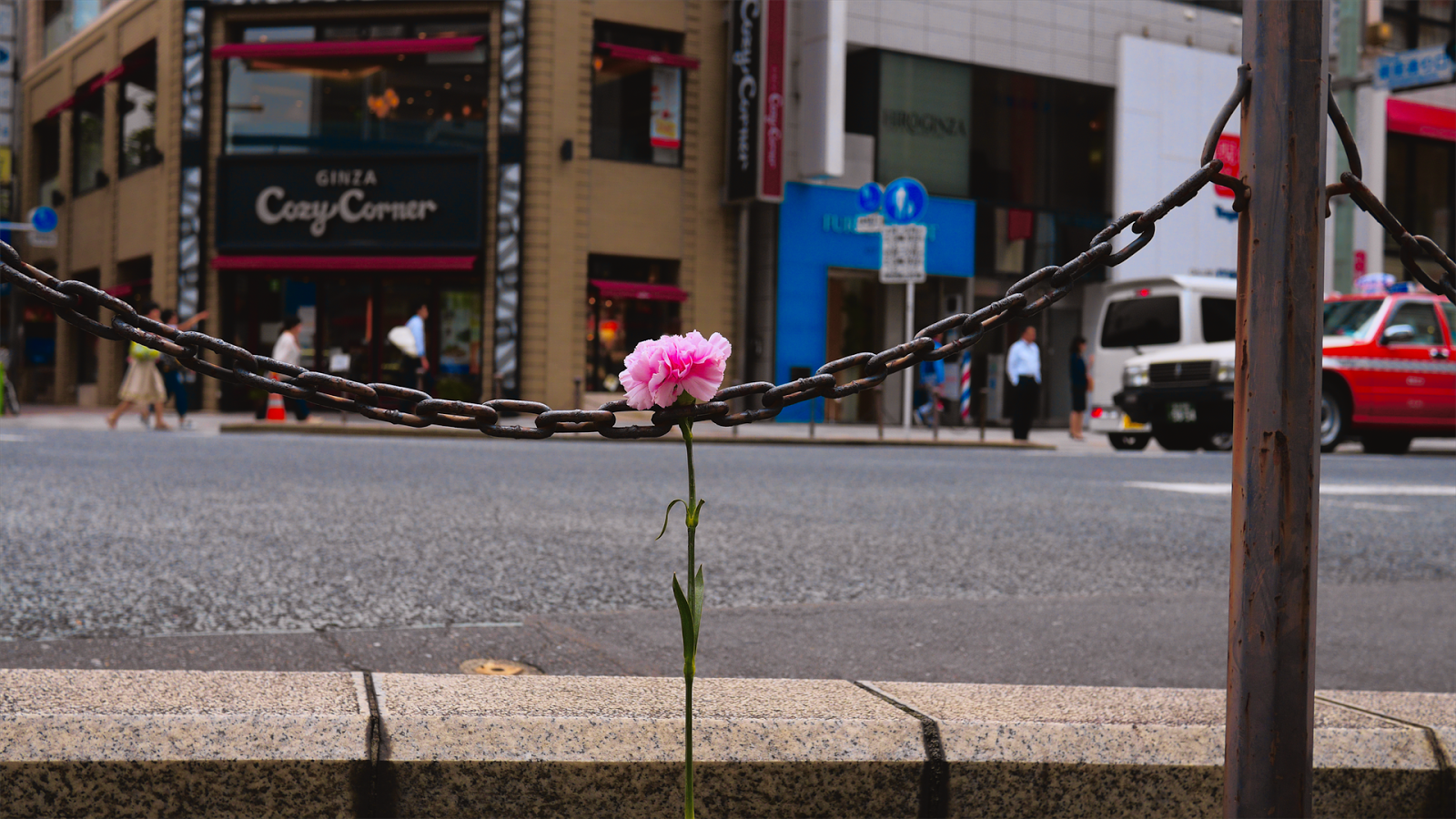
flower across from the pillar of Kyōbashi. Photo by Michael Glenn
Next week I will travel again to Japan for Bujinkan training. My 3rd time this year. That may seem excessive, but the experiences I enjoy each trip help me discover the “secrets” of our art. For example, here is a lesson from Hatsumi Sensei that taught me how to be a lucky ninja.

One Friday night Hatsumi Sensei was showing us ninjutsu. Sometimes people who don’t understand our art ask, “when is Hatsumi Sensei going to teach ninjutsu?” Well he teaches these secrets all the time. But the secrets are hidden in plain sight… If you understand what you witness.

He began by striking with a koppo ken. But the koppo ken doesn’t arrive directly. It is hidden within the pattern created in the kukan. Soke said,
“Don't strike in one pattern. Expand into a ninpo type feeling.”
Then he called me out to demonstrate. I punched. He started to perform what I thought would be a ganseki nage. But that evaporated. And as the form disappeared I was thrown by something else.

Then Hatsumi Sensei said that we cannot hold onto form. Don’t let what you are holding become an obstacle.  He continued to say that もっけさせる mokke saseru is a きまり句 kimari-ku of ninpo taijutsu.

Well, this saying of ninpo is quite deep. It has layers of meaning. Mokke is something unexpected, like a mysterious apparition. But, to keep it simple, we can just consider that doing the unexpected in a fight can lead to victory.

But “mokke” can also refer to getting lucky, like a sudden windfall. Except here you create your own luck. In another class I had with Hatsumi Sensei many years ago, he said,
“you have to be the type of person that lucky things happen to” 
So how did Soke create his own luck when he threw me? He made the form of ganseki, then let it go. In that gap, that space that opens up when the form is abandoned, freedom occurs. And the opportunity to “get lucky” appears.

Many martial artists struggle with this. People who are attracted to martial arts tend to want to control a fight, control danger, control themselves. But, if you are holding onto form or seeking to control a situation, there may be no room for luck.

You should make room for own luck. Just add your email to get the details about my latest Japan training. …

The 生き様 Ikizama of Bujinkan Sanshin and Mutō Dori

From Bujinkan Santa Monica by Michael

日本庭園 nihon teien in Aoyama. photo by Michael Glenn
You might learn one thing in class, and then another time, you learn the opposite. Ura and Omote. These are not contradictions, but rather they are part of one another. Like 陰 in and 陽 yo.

In my own classes, we recently studied 隼雄 shunū and 隼足 shunsoku. For these mutō dori, Hatsumi Sensei has suggested that we don’t try to catch the opponent’s sword. Instead we should entrap the sword’s very existence (生き様 ikizama).

This means you don’t focus on the weapon as a physical object. You focus on it’s entire existence in space and time. What is the weapon’s potential in any moment? Soke says,

“in mutō dori, the past present and future, the time before drawing the sword, after drawing, or when the sword has been re-sheathed., what may be called the nature of the sword’s existence(生き様 ikizama) … one entraps that.”

This is because the nature of the sword itself is not a threat. One moment it may be tucked in a corner or sitting on a rack gathering dust. In a different time it is red hot metal being hammered into shape by the smith. In all of the sword’s existence, how much of its life is spent in violence? Maybe just the space of one breath.

While this gives us some insight and philosophical strategies for mutō dori, there is a flip side. Last week I taught the opposite of entrapping the sword’s existence. What is this ura of mutō dori?

In this class, we were drilling 居合間合 iai maai using Gogyō no Kata. You have all heard how important sanshin is in Bujinkan training. And this is one example why. When you truly embody sanshin, you can do it with any weapon.

But people can’t. Someone who knows perfectly well how to do sui no kata... you give them a weapon and suddenly they fumble. This is where the ura side of mutō dori can help.

The opposite of entrapping the sword’s existence is to set it free.


For example, instead of trapping the sword’s existence, we set it free. This is the way to “use” any weapon. Let the nature of the weapon itself free as you move through space and time. Then the patterns of the weapon’s existence can emerge to protect you.

This is what sanshin teaches. It is 自然観 shizenkan, an insight of nature. Soke said that Takamatsu Sensei told him that having 自然的度胸 shizenteki dokyou (natural courage) was the most important. This is what arises out of the sword’s existence when you set it free. This is what you can learn from the 生き様 ikizama of sanshin.

If you want to study sanshin with me, here is the seminar schedule: Upcoming Bujinkan Sanshin Seminars…

A Guide to Happiness – Kōfuku No Shiori(幸福の栞)

From The Magick & The Mundane » Bujinkan by Shawn Gray

Kofuku No Shiori - JapaneseA couple of weeks ago I posted a few of observations about Kōfuku No Shiori on Facebook – posting a longer follow-up here at the suggestion of friends.

Kōfuku No Shiori (幸福の栞), which translates as “A Guide to Happiness“, is a short text by Takamatsu Sōke. In seeing the Japanese original again recently, a number of things came to mind and I thought it might be good to post an English translation that will perhaps breathe some new life into this well-known and meaningful piece. Here’s the Japanese original:

幸福の栞
皆さん、互いに憂を捨てて幸福を得ましょう。皆さん、幸福は人生最高の満足です。悲しみとか不満とかを捨て、思い直すのも幸福です。災害、病害を前知して覚り改めることも幸福です。皆さん、幸福は眼前に持って居ります。これを掴むと掴まぬにより、不幸とも幸福ともなるのです。何人もお聞きになり、お尋ね下されて、幸福の栞を拾おて下され。
Let’s break it down and see what we can find …

1) 皆さん、互いに憂を捨てて幸福を得ましょう。

The first thing that strikes me when I read the Japanese is the use of 皆さん (“Mina-san“), which means all or everyone. It begins the first sentence, and you can see that it appears at the beginning of two other sentences in this text as well. This is interesting because it indicates that Takamatsu Sōke was consciously addressing a group of people – all of the readers. The original context may have been such that it was intended for his own students, or for a specific group, such as a group of Hatsumi Sōke’s students at the time. Nevertheless, when we read it today, we can read it as if it’s addressed to us, the readers, as well. Why is it significant that the text is addressed to everyone? The rest of the first sentence sheds more light on that, beginning with the next phrase, 互いに (tagai-ni), which means together, mutually, or with each other. The opening sentence ends with the verb 得ましょう (emashou), meaning to obtain or to attain, with the verb ending (~shou) being used to further suggest togetherness in the same way that we use the word “let’s” in English (tabemashou = let’s eat; ikimashou = let’s go). So, in writing about Happiness (幸福, kōfuku), the author isn’t simply saying, “Be happy”, he’s saying “Everyone, let’s attain happiness together.” That’s quite a significant difference. There’s more here, too. He also refers to the throwing or casting away (捨てる) of sorrow (憂, urei – also translated as grief, etc) in this same context of togetherness. An accurate rendering of the first sentence in English would thus be, Everyone, let’s together cast away sorrow and attain happiness.

2) 皆さん、幸福は人生最高の満足です。

Once again, he begins with 皆さん, Everyone, and simply states that happiness is the most satisfying thing in life (a more direct, literal rendering would be, happiness is life’s ultimate satisfaction).

3) 悲しみとか不満とかを捨て、思い直すのも幸福です。

Ultimate satisfaction sounds great, right? Everybody wants that! The author recognizes that it’s not that simple – human beings struggle with feelings of sorrow and discontent. The author urges us to find Happiness by discarding those negative feelings and taking another look at our situation. Sorrow (悲しみ, kanashimi) and discontent (不満, fuman) are pretty straight-forward to translate, and although 捨てる (suteru, used above as well) has a wide range of possibilities (such as “throw away, “leave behind”, “discard”, “abandon”, “dispose of”, etc.), I thought “cast away” fit well in this context.

What I found interesting here was 思い直す (omoi-naosu). Omoi is from Omou (思う), “to think“. Naosu (直す) is interesting here because not only does it have the meaning of doing something again (repeating something), but also because it carries the sense of “fixing”, “correcting”, or “repairing” something in the process. For example, in addition to having the sense of repeating something, Naosu is also commonly used to say things like “I’ll fix the chair” or “I’ll correct the issue”.

I’ve rendered Omoi-naosu as “re-thinking” to convey the sense, which I think is implied in the original Japanese, that Happiness is achieved here not only by simply looking back upon sorrow and discontent in life, but by actively choosing to discard sorrow and discontent and re-think (re-frame or “correct”) our perspective on our life experiences. I think Takamatsu Sōke is observing that Happiness doesn’t come from our external circumstances but from the perspective that we choose to take on those circumstances: Casting sorrow and discontent away and re-thinking is also happiness.

4) 災害、病害を前知して覚り改めることも幸福です。

Like the previous sentence, this one is simple, direct, and to-the-point in the Japanese. The first two terms are 災害 (saigai – calamity, disaster, or misfortune) and 病害 (byogai – disease or blight). Saigai can perhaps be understood as the calamity itself, and Byogai as the bodily effects of the calamity. 前知 (zenchi) refers to foreknowledge or anticipation, 覚り(satori) means understanding (but also with the sense of enlightenment or spiritual awakening), and 改める (aratameru) refers to correcting, rectifying, or improving – similar to the idea expressed by Naosu above. Once again, Happiness isn’t a product of our circumstances, but a product of our perspective. Anticipating and correcting one’s understanding of the ravages of calamity and disease is also happiness.

5) 皆さん、幸福は眼前に持って居ります。

Again, 皆さん, Everyone. Again, short and to-the-point: Everyone, happiness is waiting there before your eyes.

6) これを掴むと掴まぬにより、不幸とも幸福ともなるのです。

There are a couple of interesting points here as well. The first is the use of これ (this) at the beginning. What does this refer to? Does it refer to happiness? It could, yes. It could also refer to the previous sentence as a whole, which gives a different sense to what follows: whether you grasp (掴む, tsukamu) this or don’t grasp (掴まぬ, tsukamanu) this. So the phrase could mean a) whether you grasp happiness or not, or b) whether you grasp the point of the previous statement (about happiness waiting there before your eyes) or not. Maybe they’re both the same thing. ;-)

Another interesting point here, I think, is the mention of 不幸 (fukou, unhappiness) as the alternative if you don’t grasp it: Whether you grasp it or not determines your unhappiness or happiness.

7) 何人もお聞きになり、お尋ね下されて、幸福の栞を拾おて下され。

I like the way that Takamatsu Sōke ends this piece. He doesn’t say, “There’s my advice, take it or leave it” or, “That’s the word on finding happiness, there you have it.” He encourages the reader to go out and find the guide for Happiness for themselves by asking (お聞き) and inquiring (お尋ね) of everyone (何人も). Ask others, get opinions, and find it for yourself: Ask everyone, inquire of them, and find the guide to Happiness.
I think these together form a pretty accurate translation of Kōfuku No Shiori:

Everyone, let’s together cast away sorrow and attain happiness.
Everyone, happiness is life’s ultimate satisfaction.
Casting sorrow and discontent away and re-thinking is also happiness.
Anticipating and correcting one’s understanding of the ravages of calamity and disease is also happiness.
Everyone, happiness is waiting there before your eyes.
Whether you grasp it or not determines your unhappiness or happiness.
Ask everyone, inquire of them, and find the guide to Happiness.


20151022_010046

‘Kōfuku’, by Hatsumi Sōke


Takamatsu Sōke led an adventurous life, but in hearing and reading stories over the years, “happy” isn’t always the first word that comes to mind – at least not when one looks at the external circumstances of his life. But as the wise Ninjutsu master teaches us here, it’s our internal perspective that matters. Looking back over painful or unfortunate circumstances, re-considering, re-thinking, and re-orienting our perspectives can allow us to lead fuller, happier lives. In a recent message I received from Shiraishi Sensei, he referred to ‘the study of Ninjutsu, which creates happiness’. I’m willing to bet that he’s read Kōfuku No Shiori a couple of times.


…