On Enthalpy by H. Weill
From Shiro Kuma's Blog by kumablog

Dear Arnaud sensei,
Thank you for sharing your thought with us. The idea of enthalpy is interesting, as a chemist myself I appreciate your vision.
I would like to suggest also my opinion.
Hatsumi Sensei speaks firstly on the idea of high sensitivity that is mentioned in the words “all of the Uke’s actions are immediately felt once they are expressed.Then it is easy to defeat the attacker as long as we are “zero””.
The concept may come from the idea that it is by far simpler to recognise a small signal when the level of the noise around it is near. It is a physical concept for signal identification that is called signal to noise ration (SNR) (1). In practice, this is the reason one can hear the weakest whisper in the silence of the night. Or why fluorescence spectroscopy (that looks for a light signal in the dark) (2) is orders of magnitude more sensitive than UV-vis spectroscopy (the looks for the reduction of an intensity of light source) (3).
To my opinion, at least in part of Hatsumi Sensei words, he talks about creating a subdimension of spacetime (4), a silent mini-universe in which one traps his opponent separately from the noisy universe we exist in. Thus enabling him to feel Uke’s actions immediately even when the sensory signatures that he makes are infinitesimally small (5). Somewhat similar to the way a spider while being totally motionless feels the action of its prey that was caught in its web.
Also, I feel that Soke speaks about controlling the reality that Uke perceives.
One should remember that what we call “reality” is a processed reconstruction of spacetime that is built upon the information collected by our sensory system (6). In other words perception (7) and what we learn with time. To do something (e.g. strike with our fist) we calculate the needed force and the length of time of its application to create the correct trajectory in spacetime. During the performance of the action, our brain receives feedback information from the sensory systems and tries to calculate any needed corrections at that given period of time.
Here we go back to the term of SNR. The sensory system is eventually a collection of sensors that each one has its one unique SNR – the ability to determine statistically if a reading received is a meaningful signal or just an unimportant noise (1).
To my opinion Soke teaches us to make our signal to be as close as possible to zero to the visual and somatosensory systems (6) of Uke – this idea is manifested through the concepts of Ku and Kozushi. The first deals, mainly, with Uke’s visual system and the latter with the somatosensory system (touch and proprioception). When one masters the two concepts, he is able to avoid the Uke’s sensory systems thus creating a new reality for him, an illusionary one. An illusion that the caster disappears altogether or appears where he is not. Thus disabling Uke from calculating the correct trajectories needed for his actions. With that, we can go back to Sokes words: “all of the Uke’s actions are immediately felt once they are expressed.Then it is easy to defeat the attacker as long as we are “zero””.
This is in my opinion what stands for the kanji of Bujinkan – the term Bu Kami – the warrior god/god of war, a god that creates a new universe at will in the context of the art of war.
______________________________________________
(1) https://en.wikipedia.org/wiki/Signal-to-noise_ratio
(2) https://en.wikipedia.org/wiki/Fluorescence_spectroscopy
(3) https://en.wikipedia.org/wiki/Ultraviolet%E2%80%93visible_spectroscopy
(4) https://en.wikipedia.org/wiki/Spacetime
(5) http://www.dictionary.com/browse/infinitesimally
(6) https://en.wikipedia.org/wiki/Sensory_system
(7) https://en.wikipedia.org/wiki/Perception

 …
… Gyokko Ryû is an excellent school, profoundly related to the new theme for 2017 of “controlling the space”.
 …
…

 …
…

 …
…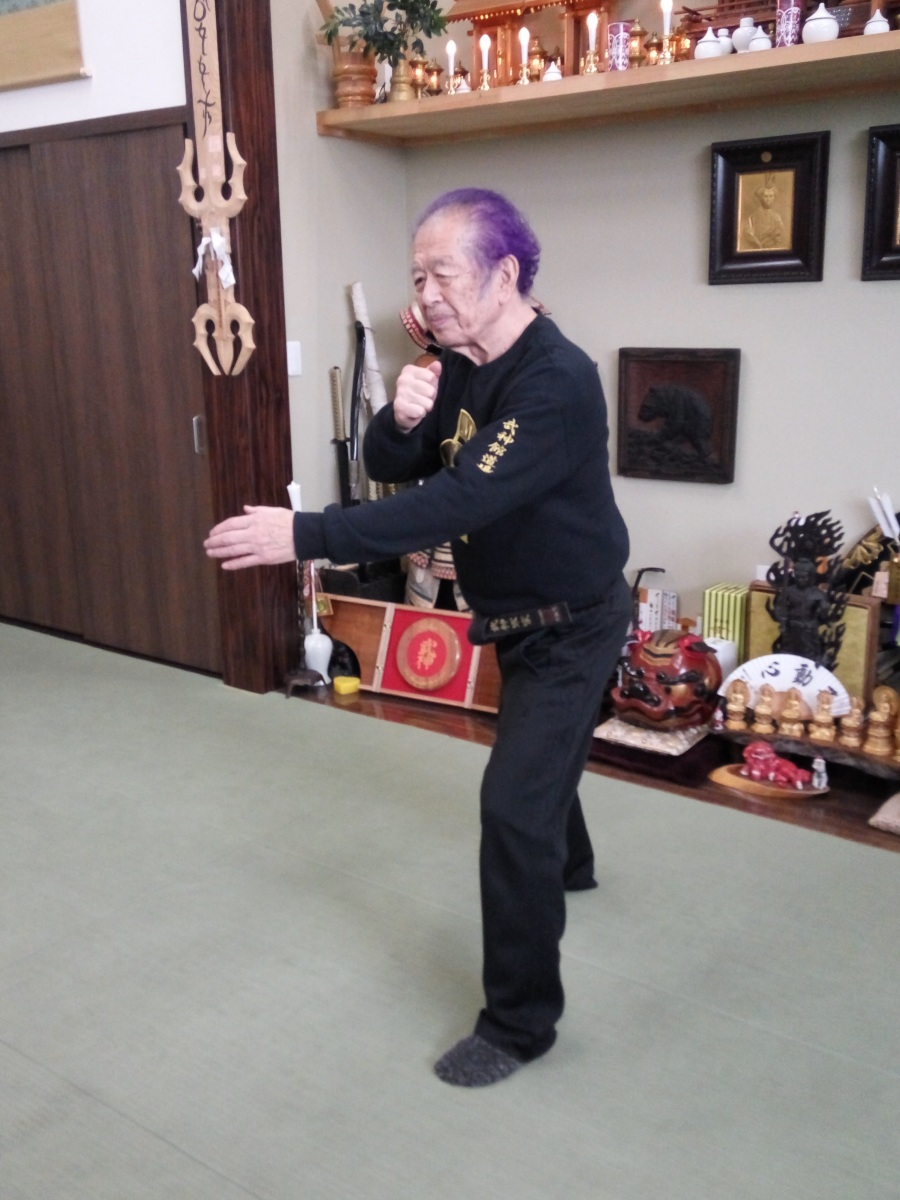 Hatsumi sensei said in class that “you cannot be good doing Bujinkan, if you’re good, you are not doing Bujinkan”. It reminded me of Salvador Dali’s quote: “Don’t be afraid of perfection, you’ll never reach it”. This quote could summarise what we are training these days. Don’t try to be perfect.
 …
… After a recent class with Hatsumi sensei, we were on the train to Kashiwa with Adonis and Harry Mitrou, the twin brothers from Greece. We were speaking of the training we just had, trying to understand the profound insights that Sensei shared with us.
 …
…

 …
…
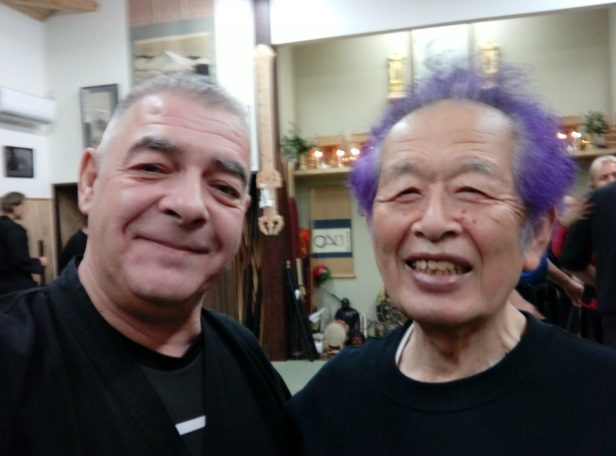 Sensei speaks a lot about controlling these days (see previous entry in this blog). But during his last class, he detailed it a little more.
 …
…

 …
…