Secret Transmission,Togakure Ryu Ninpo!
From Kasumi An Study Center 霞庵 スタディセンター by Kasumi An Study Center
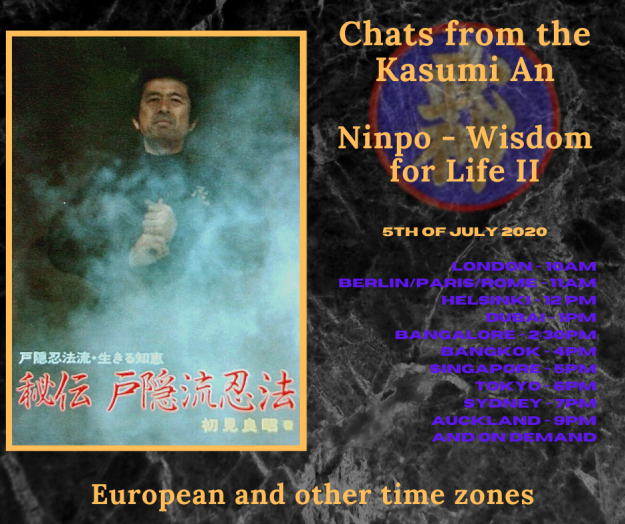
To thank you all for your generosity during this pandemic. To show my great appreciation, I will try to translate bits of this book by Hatsumi Sensei that stand out to me. This is one of my favorite books by Hatsumi Sensei and continues to shine bright even after 40 years or so. Wisdom has a timeless beauty and this book is packed with gems.
This is the very first passage in the book and sets the theme and tone of the book. Therefore I have decided to start at the beginning. If this brightens your day or gives you some new inspiration in your training and study, it will most certainly brighten my heart as well! Feel free to join our chats as well. Now, lets jump in!

Philosophy of the Martial Way, Philosophy of the Way of Nin
This chapter forms the basis and main theme of this book. Therefore I would be delighted if you read it several times to capture the essence of it.
The Philosophy of Budo, the martial way.
In a grander view, the martial arts are used for the protection of ones` country. In a smaller view, they are used for the protection of the people and for the protection of oneself.
It could be said that striking with a sword using technique and artistry is martial arts. If you were to say that simply striking relying on brute strength in the arms and body is martial arts, then one could foolishly assert that chopping wood is a marital art!
The art of the sword is the study of the proper place, timing, truth of the, way to strike. Just as knowing the manner of wood or way in which a log can be split would be considered true wood chopping.
Using technique is an art. And the basis of art is in the heart. If the heart is not correct, there can be no progress. If the heart is not developed, there can be no understanding (of a proper way, greater truth). This understanding (of a proper way, greater truth) is similar to art. If actions are not proper (aligned with a greater truth and understanding), there can be no art.
True victory lies not with oneself but with the opponent. The opponent will naturally offer us the key to victory. Do not seek victory yourself but allow it come naturally to you. For it will come to you as surely as a spark is born when metal strikes flint.
It matters little if you are an Eighth degree black belt or a Master, it proves nothing. You must only taste deeply the essence of the most beautiful, subtle, and mysterious technique; If you think it exits, it does not. If you believe it is not, it is.
When the energy of the heart and the sword become one, this is the origin of the martial way.
I hope you enjoyed this! Thank you for all your support! and if you would like to make a contribution for the continuation of this work, please click the link below.