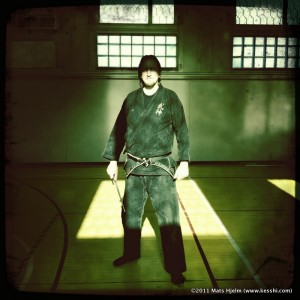
Sanshin no kata with Mats H (Riga February 2011)
From Uploads by YouTube Help by budoshop
…From Uploads by YouTube Help by budoshop
…From Budoshop by BUDOSHOP.SE
On this video Mats was teaching the Sanshin no kata. He taught the basics, and more self defence and real responses. Without weapons and with weapons. There is five different ways of receiving an attack, and five different ways of counter attacking.
地 CHI (earth)
水 SUI (water)
火 KA (fire)
風 FŪ (wind)
空 KŪ (void)
The techniques is called…
The video is 45 minutes, and 640 x 360 pixels, h.264 and AAC.
Recorded in Riga, Latvia February 2011
www.youtube.com/watch?v=tN4XcGbDsm8
For a longer article about this seminar, see Mats blog.
Click here for more information about our download files and how it works!…
From Uploads by shugyou by shugyou
|
This video is from a seminar in Riga, Latvia in February 26th 2011. This is day one of two. The first day the theme was Sanshin no kata and the second day Juttejutsu. Sanshin no kata and Kihon-happo is the most fundamental and important techniques in the Bujinkan Dojo. Buy and download it here... www.payloadz.com For more information click here... budoshop.se |
From:
shugyou
Views:
654
![]() 4
ratings | |
| Time: 00:49 | More in Education |
From Shiro Kuma's Weblog by kumablog
Dear friends,
I hope that Hatsumi sensei, the Japanese Shihan, and all our friends training and/or living in Japan are in good health after this major earthquake (8.9 on the richter scale).
Stay tune with facebook as many of our friends in Japan communicate through this network.
Arnaud
From Bujinkan Santa Monica by Bujinkan Santa Monica
There is a Buddhist idea that when we kill another being we assert the radical difference between us and them. And this would ultimately be an incorrect assertion. But killing is all around us. It is part of the very fabric of nature. So what do fighters do with this?"Good weapons are unfortunate instruments.But Hatsumi Soke doesn't suggest we become pacifists. Wrapped up in the mysterious sword of shinmyoken is also a strategy for combat. Shinmyoken is used for judging the crucial point on the body and it can be where the tip of the sword settles and finds its target.
People hate them. So someone with Tao does not rely on them . . .
Weapons are unfortunate instruments, and not the wise man's instruments.
When he uses them because there is no other choice,
he stresses straight-forwardness and, in victory, does not praise himself."
Lao Tzu, Section 31
"Hell gapes beneath the upraised sword... Step in! And Heaven is your reward!"That's nice to think about, but how do you step in? With shinmyoken! Entering with
"If you want to strike at your opponent, let him strike at you first. The moment you succeed at having him strike at you, you have succeeded in striking him."This really gets to the heart of the idea of no separation between attacker and defender. You kill him and you are killing yourself. Something Hatsumi Sensei often reminds us. The shin of shinmyoken can refer to the divinity, core or spirit of the combatants. This shin gives rise to the mystery, or myo, of the outward appearance of the clashing swordsmen. Even if you slice him open you will not find his shin.
From BUJINKAN TASMANIA by Duncan Stewart
http://www.youtube.com/watch?v=rvdE0fHFvdc
I am slowly working on a DVD set based on the Ten Chi Jin Ryaku no Maki. It is not instructional, but will give brief demonstrations ( my interpretation on the day ) of the waza within the Densho.
From blogurl:tazziedevil.wordpress.com - Google Blog Search by Duncan Stewart
http://www.youtube.com/watch?v=rvdE0fHFvdc I am slowly working on a DVD set based on the Ten Chi Jin Ryaku no Maki. It is not instructional, but will give brief demonstrations ( my interpretation on the day ) of the waza within the Densho.…From blogurl:tazziedevil.wordpress.com - Google Blog Search by Duncan Stewart
http://www.youtube.com/watch?v=rvdE0fHFvdc. I am slowly working on a DVD set based on the Ten Chi Jin Ryaku no Maki. It is not instructional, but will give brief demonstrations ( my interpretation on the day ) of the waza within the ...…From Bujinkan Santa Monica by Bujinkan Santa Monica
![]() |
| Edo Wonderland Sword Fight, photo by -ratamahatta- |
"Crossed swords; neither permits retreat.This advanced koan shows both the problem presented by a fight and the solution. Tesshu sums up his problem here:
The sword-master, like a lotus in the fire,
Has a heaven-soaring spirit."
"In the world of martial arts, one should not stick to strength or weakness, softness or hardness; rather one should transcend physicality and understand the void, 'ku,' regarding the body also as empty."Hatsumi Sensei goes on to explain how to use this gokui to win without drawing your sword,
"...prepare your body and show courage, the true gokui is the mind. Win without without drawing your sword. If you draw, do not cut down; bear patiently, and know that taking a life is a grave thing."

Årets träningsläger sponsrat av Svenska Bujinkanförbundet hölls i Gävle den första helgen i mars 2011. Arrangemanget sköttes av Patrik Johansson och medlemmar från Bujinkan Gefle Dojo. Inbjuden instruktör var Sveneric Bogsäter som varit bosatt i Holland de senaste 20 åren.
Det kom ungefär 75 träningssugna deltagare från hela Sverige för att träna och umgås. Årets Bujinkan-tema är Kihon-happō. Sveneric öppnade med att säga att temat för lägret är Kihon-happō med shūtohanpa principer. Vilket betyder att man gör tekniker halvfärdigt. På så sätt övar man på att överge sitt ego som vill hålla fast i det som man redan kan, och istället gör något fullständigt oväntat. Det är ett abstrakt tänkande och aningen svårbegripligt, vilket också är meningen.
Kihon-happō består av åtta grundtekniker som vid en djupare analys blir åtta grundprinciper. Man kan ytterligare dela upp dom i två, ura och omote; förenklat, att fälla uke bakåt eller framåt.
Sveneric började med att låta någon frivillig att visa grundutförandet av omote-gyaku den första tekniken i toride-kihon-gohō i Kihon-happō. Sedan utgick Sveneric från denna teknik och visade detaljer och principer obeväpnat och med olika vapen.
Efter att ha sett oss (några?) ha alldeles för bråttom men ändå missa detaljer citerade Sveneric Wyatt Earp, “Fast is fine but accuracy is final. You must learn to be slow in a hurry.” Att vara snabb är okej, men ni måste lära er att skynda långsamt (fritt översatt). Med rätt tajmning och positionering behöver man inte vara särskilt snabb bara man gör rätt.
En sak till vi fick kritik för med all rätt (jag håller fullständigt med) var att våra attacker, slag var ganska pinsamma. Jag har själv upplevt många gånger att man känner sig ganska säker på att inte bli träffad när man tränar här hemma, och man blir lite för avslappnad. När man som instruktör ber en Holländare, Tysk eller Kroat till exempel leverera en attack så är det en helt annan känsla. Flyttar man inte på sig så kommer slaget att träffa hårt. Träningen blir på en helt annan nivå. Så när Sveneric på ett vänligt sätt förklarade detta för oss hoppas jag att vi tar åt oss detta och tar attackerna på lite mer allvar.
Personligen tycker jag att man kanske bör attackera nybörjare lite mer försiktigt, men är det ett svartbälte man attackerar så bör slaget så länge det är rakt vara fullt ut för att båda två ska kunna träna mer realistiskt.
Ett stort tack till Patrik och grabbarna i Bujinkan Gefle Dojo, jag tänker på mannen (och hans flickvän) som bakade och bjöd alla på semlor. Det var en riktigt trevlig överraskning som blir svår att toppa för den som organiserar nästa års Bujinkan Sverige-träningsläger.
Grattis också till Jim och Hasse, det var verkligen på tiden!
För mer bilder från lägret se min hemsida.
/Mats – Kaigōzan Dōjō…