Freedom & Happiness
From Shiro Kuma's Weblog by kumablog
This is Daikomyo sai time again and I cherish this moment of the year more than any moment.
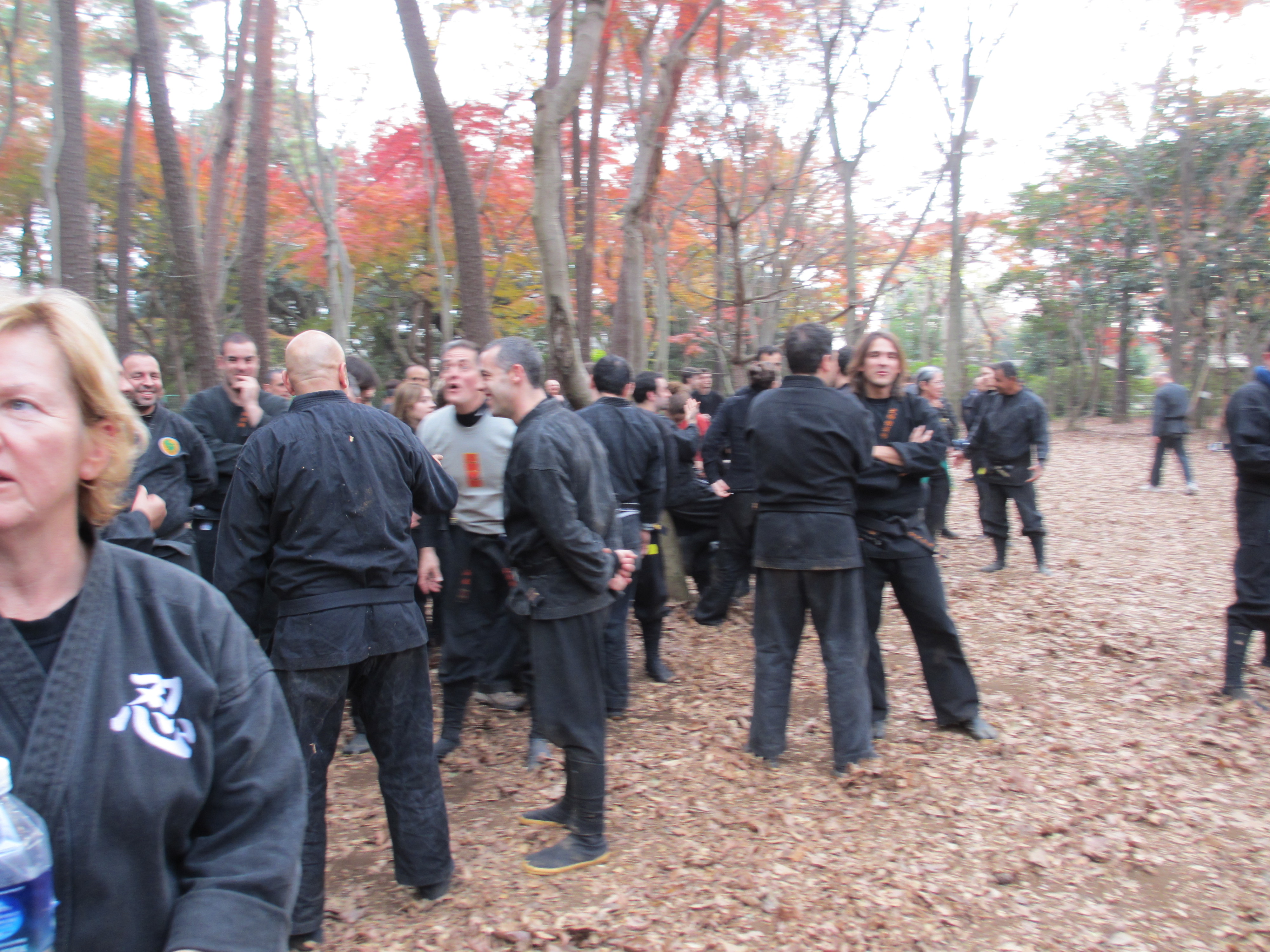
I arrived yesterday afternoon for another Daikomyo sai in Japan. After a fex hours I alrready met with Hugues, Cédric, Philippe, Indrek, Peter and Sheila. It is always a very nice moment and brings me a lot of happiness.
Being happy is what Hatsumi Sensei has been teaching us since the beginning but many bujinkan followers don’t get it and it is sad. Freedom and happiness is the core teaching of the bujinkan. As Epictetus said “those who are looking for power and money will fail, the only objective of human beings is to find freedom and to be happy”.
Everything in Life is changing, as it is said in the I ching, change is the only permanent thing on earth. But why is it that we are always looking for permanence when change is everywhere? Bujinkan followers often get lost on their search for power and money. Instead of focusing on the things we can influence, we often force things that are not in our power to serve our own selfish interests. By doing so we lose our freedom and become unhappy.
Epitectus said: “What bothers humans is not reality but the judgments we make on reality”. Then stop judging others try simply to be happy with them. We have to train only for ourself with no expectations and then freedom will be achieved and we will find happiness. Each time we replace personal actions by selfish desires we get lost. Our desires, our attachment (power, money) are enslaving us. Be what you are and stop trying to be someone you are not. Everything is created in our brain. This is not reality this is an illusion.
An Indian sage called Ashtavakra wrote:
It is true what they say:“You are what you think.” If you think you are bound you are bound. If you think you are free you are free.
Choose to be free and Happy. Being happy is a personal choice and nothing can give it to you if you don’t make this choice.
I really think that Hatsumi Sensei is a philosopher more than a martial art teacher. His martial art classes are only an excuse and a tool to help us get the proper attitude in Life that will make us happy.
This year of kihon happô was dedicated to the start of a new cycle. Decide now to be what you are, choose to be happy, walk the path of freedom.
So enjoy these magic days of Daikomyo sai and start anew in this new cycle by taking the good decisions and being open minded.
“You are pure Consciousness— the substance of the universe.
The universe exists within you. Don’t be small-minded” Ashtavakra
Be Happy!
五行の型 Goygō no Kata – five movement forms
The aim is to isolate specific areas such as Te sabaki, Ashi sabaki, and Tai sabaki ( Sanshin ) and develop a working knowledge and better ability/control of these areas. The three areas are then unified to form the fundamental movements/kata that we practice normally.
Good repitition is the key to improvement. There are many Kihon within these Kata. To make them natural, one has to learn them ( shu ) to forget them ( ha ) before using them from a state of Mu ( Ri ) - absolute naturalness free from thought. )
This Dvd is available at the Toku Bu Ryu Sui Dojo in Japan only.…
Show the Truth in Your Training
From Bujinkan Santa Monica by Michael
![]() |
| The Robbery photo By gcfairch |
I screw up often when I teach. I get things wrong, I slip, stumble, misspeak, let myself get hit by my students, use the wrong words, or misremember facts. If a mistake can be made, I've made it. But I always do my best to acknowledge and recognize this humbly. My mistakes are my most important teachers. Training is not real if there are no mistakes. Teachers are not real if they don't allow themselves this honesty.
I've met many martial arts instructors who are terrified by this. They must always project some kind of superhuman perfection to their students and others. They only demonstrate with uke's who make them look good. And they won't try anything that could make them look bad in front of their students.
Show truth in your budo. The only way your budo can be effective is for you to train honestly. Be honest with yourself and with your training partners or students.
Kan Junichi told us this story about a visit to a U.S. military base with Hatsumi Sensei:
"Near Albuquerque there's a military base. We all visited that base with Sensei and as we were walking in there were cameras everywhere. Sensei said, "Don't speak with words, speak with your eyes." And then Sensei was giving us directions without speaking but by using his eyes.
There were many people watching and Sensei asked us to do a demonstration. Then a military instructor came and stood three meters behind Sensei and pulled out a gun, then asked, "What would you do in this situation?" . Sensei replied by putting his hands up and saying, "I can't do anything. I leave my life up to you."
Then everybody watching began to clap. The instructor told Sensei that many other martial arts instructors had done demonstrations before and they all tried something like a back kick or grabbing dirt off the ground to throw it. The gunman said to them, I am much faster on the trigger than you are with that kick.
So then he bowed to Sensei and said, "Thank you. You are real."
He continued on to say, "There are three ways to make martial arts teachers from Japan happy: One is with Sake; Another is by letting shoot exotic guns; And the third is by having pretty women there." But Sensei turned down all of these.
They had all manner of weapons and machine guns available. They brought a bunch of ammunition, rounds… They said here, go ahead shoot all these guns. Sensei said, "I don't need that." I don't need women. I don't need Sake."
The truth is like this. It's really nothing. At three meters here, of course the gun is faster. You try to throw sand or kick, you're finished, right? And so Sensei showed the truth here in his gesture. And I thought that was very important when I saw this."
Show the truth in your training. Show it to your students, but more importantly... to yourself.
The Kyūsho 五輪 Gorin: Sun Crossing the Belly
From Bujinkan Santa Monica by Michael
![]() |
| Navel Lady photo by Candida.Performa |
Let's consider the meaning of the kyūsho 五輪 Gorin.
I thought I was comfortable using this kyūsho until I read what Hatsumi Sensei wrote in his Advanced Stick Fighting book,
"The kyūsho known as "Gorin" means to point at "chi-sui-ka-fu-ku."I was confused but curious about this statement. This inspired me to examine 五輪 Gorin more closely.
Gorin is normally explained as five vital points around the navel. That seems simple enough. But what are the five? and what about the variations of 五輪月影 Gorin Tsukikage and 五輪稲妻 Gorin Inazuma?
You will be hard pressed to find any Bujinkan teacher to explain more than the name and general area of 五輪 Gorin. But what does it represent? What does it do exactly? Why are there five points? And what about Hatsumi Sensei's reference above?
Usually 五輪 Gorin is translated to 5 rings. If you search for it online you will get the rings that symbolize the Olympics. Not too helpful for our study of ancient Japanese kyūsho.
In Mikkyō or tantric buddhism 五輪 Gorin is often symbolized by the Gorintō 五輪塔 which you will find all over Japan commonly used as memorial markers for the dead. These stone markers have associations with the five elements.
from JAANUS:
"Each piece in the five-story pagoda (Sanskrit = stupa) corresponds to one of five elements. The bottom story is square and corresponds to the earth ring (Japanese = Chirin 地輪). Next is the spherical water ring (Japanese = Suirin 水輪), surmounted by the triangular ring of fire (Japanese = Karin 火輪). Above this is a reclining half-moon shape (Japanese = Fūrin 風輪), representing the wind, and topmost is the gem-shaped ring of space (Japanese = Kūrin 空輪)."Now we are getting somewhere! Hatsumi Sensei also made reference to these five elements. But where do the directions come from and why does the stone monument look nothing like 5 rings?
To go deeper we have to dig into the source of this imagery. The morpheme -rin can mean “wheel,” “circle,” or “ring,” but in this usage it translates as cakra (chakra) in the yogic sense of the five power centers of the subtle body. The gorin no tõ shows each of these power centers as having a different shape, and each of these shapes indicates a different great element. From bottom up these are: 1) square for earth, 2) round for water, 3) triangular for fire, 4) semicircular for air, and 5) a crescent moon-shaped jewel for space (or the three-dimensional equivalents of these shapes).
Historically the source of these 5 elements goes back to India, then through China and Taoist ideas and into Japan as often seen with the influence of Mikkyō. Some of the earliest references in Japan of these ideas come from 五輪九字明祕密釋 The Gorin kuji myō himitsu shaku (Commentary on the Secrets of the Five Cakras and Nine Syllables) composed by Kakuban 覺鑁 (1095-1143AD). In this text the five cakras 五輪 of the body are correlated with the Taoist theory of five viscera 五藏.
What does five viscera have to do with Gorin? Kyūsho are points to be struck, poked, prodded, stabbed or otherwise disturbed to have an effect on our uke's body and spirit during a fight. The five viscera in the Chinese system are: heart, lungs, liver, kidneys and spleen.
How does poking someone in the stomach affect the heart? Well, just have someone try it and you might find out! But this also connects to traditional Chinese taoist medicine: "Blockage of the six bowels causes imbalances of the five viscera." I've been hit in the stomach myself and I could well imagine striking these kyūsho around the belly contributing to this sort of imbalance.
The five phases of the chinese: wu hsing 五行; or Japanese: gogyõ are also correlated with these five directions: Earth is considered "north"; Fire is "south"; Ku is "center"; air is "east"; Water is "west".
![]() |
| 五輪 Gorin above the navel |
These directions are related to the path of the sun, rising in the east, passing across the southern sky, overhead or centered at noon, setting in the west, then travelling under the earth through the darkness of the north at night. We can see this path represented on our kyūsho chart and as Soke Hatsumi has shown in his drawings.
I'm glad I found all these connections to help me understand Hatsumi Sensei's simple instruction about Gorin. Of course this rabbit hole I climbed into is deep and twisty. The information in this post is what I discovered out of my own curiosity and may not at all represent what Hatsumi Sensei had in mind in regards to Gorin. I'm sure I missed something or even could be completely wrong but that's what makes learning in the Bujinkan fun!
Our training is constantly evolving so we cannot be attached to any definitions. In fact, Sensei recently said he had written the kanji of Gorin五輪 with a different reading as Gorin 五臨. He said it was to encourage people to find and re-establish a dialogue and speak from their essence, face to face and dealing with the truth head on.
It is so important to train with good teachers and experience their truth directly in person. This is what I strive for in in my own classes and in every class with Sensei or with any of my teachers in the Bujinkan.
New videos worth mentioning on the intertubes
From 8þ Kabutoshimen by admin
//www.youtube.com/watch?v=_KZm5bHKnl8
1980 – US Embassy demo in Tokyo
//www.youtube.com/watch?v=oSlU7XmyPTM
2008 – Bujinkan Kashiwa Demonstration
//www.youtube.com/watch?v=Nhv4x5xdHSQ
1989 – München Taikai
//www.youtube.com/watch?v=chmbgrhkGB0
1991 – Daikomyousai Japan
//www.youtube.com/watch?v=qQkIIDNCyyQ
Why we don’t break boards
The post New videos worth mentioning on the intertubes appeared first on 8þ Kabutoshimen.…
Kihon Happou – infinite life

Kamae renshu is very important. It is in the Ten Chi Jin Ryaku no Maki. This is the Bujinkan Taijutsu Densho. Please study from it. There is a lifetimes study in this Densho.
The Kihon Happou combines everything we need to know to study the schools of the Bujinkan.
We need to study these well and consistently for the length of our Martial Arts life.
I never think I have understood the Kihon Happou. Everytime I do them I learn more and more and become aware of the depth of each movement. the Kihon is truly a living collection of martial arts.…
basic training dvd
At the Toku Bu Ryu Sui Bujinkan Budo Dojo in Kashiwa, I often cover some basic exercises to help students and myself gain a better understanding of our Shin Gi Tai.Recently I filmed a DVD briefly outlining and demonstrating some of these routines.
Each exercise aims to increase body awareness and skill level in Ashi Sabaki, Te Sabaki and Tai Sabaki. Together these three aspects are like a Sanshin and form the base movements of our Budo.
I do not sell the DVDs on-line or at any other dojo. I only sell the DVDs of my training to those that attend my classes and see value in the routines as practised at the Toku Bu Ryu Sui Dojo or at Bushinden Kai throughout the world.
If you intend to purchase a DVD, please let me know when you let me know of your intended attendance at my Dojo.
Thank you.
…
Daisho
From Paart Budo Buki by buki stolar
However, when you're in the dojo, and if you respect Budo, then I think it deserves at least one good bokken or bokuto.