Skip to content

Fushaku Shinmyō 不惜身命: Mind and Body Like Diamond

From Bujinkan Santa Monica by Michael

Diamond Corridor photo by dickuhne
Hatsumi Sensei's classes are often too crowded to do "large" techniques. Or, to train with weapons that need "large" distances. Recently I was lucky enough to be in a class that was small enough for Sensei to have us using Bo, Yari, and Naginata. Along with the big weapons came some big ideas for training.

He was attaching these weapons to his uke's body or clothing, then moving in a way where the weapon seems to develop a life of its own. He explained he was using a reflection of the attacker. That was a big idea that reminded me of another time when he described 辛抱 Shinbo to us.

 One other large idea he put out there for us came at a moment of evading a yari thrust. He used the phrase 不惜身命 Fushaku Shinmyō. Roughly translated in this context it means sacrificing one's life to accomplish its resolution. It can be related to concepts of Sutemi and throwing away the self.

The roots of this idea come from Buddhism and the Nyorai Juryo Hon chapter of the Lotus Sutra: teaching of devotion that spares neither body nor life.

Some other translations for this phrase read: not sparing one's life for a worthy cause; courageous and selfless dedication; Self-sacrificing Dedication; or to place the cause above one's life.

How do you get to that selfless state? The state where the tip of the spear is no longer a threat and you can move undeterred against the slash of a sword?

One clue I found may come from the study of Goshin no kata. This is when you do a continuous, non-stop repetition of one of the (Sanshin, Gogyo) five forms endlessly without an attacker until one of two things occurs.  The form naturally and spontaneously shifts or changes to one of the other forms, OR you reach satori (a flash of enlightenment).

I found an interesting reflection on this in an essay from Chōjun Miyagi (founder of Goju-ryu) published in 1942. In his style they have a "Sanchin no kata." He writes,
"Kongoshin Fushaku Shinmyō no Kyochi

If you could attain Enlightenment or Satori through practicing
Sanchin, you were beyond life and death, and your mind and body
would become strong enough like Diamond."
Well I think a yari tip would break against diamond armor such as that.


Sweden Tai Kai 2011 – Sveneric Bogsäter & Rob Renner

From New Products from Budo Shop Store by New Products from Budo Shop Store

You can order this video now, but it will be shipped in mid October after all the pre orders (from the seminar) is done

Sveneric Bogsäter from Holland together with Rob Renner, Duncan Stewart and Steve Olsen from Japan was invited to teach at this Swedish Tai Kai organized by Mats Hjelm and Svenska Bujinkanförbundet. There was two DVD's and two download videos released from this seminar. This Video is one part of this set.

At the Taikai all instructors had three classes each, one class with the whole big group, one class with all Shidoshi (5'th dan and above), and one class with Mudansha & Yudansha (beginners up to fifth dan).

On this DVD - Sveneric Bogsäter & Rob Renner

This two hour DVD is packed with good demonstrations and instructions from Sveneric Bogsäter and Rob Renner. Sveneric had recently been in Japan, and Rob Renner has lived in Japan for many years, so what they taught was very much the feeling from Japan trainings with Hatsumi Soke and the Japanese Shihan.

Sveneric taught Kihon-happo variations against one or two opponents to the whole group. At the Shidoshi-class he taught Taijutsu and Hanbojutsu. At the Mudansha & Yudansha class he taught Taijutsu

Rob taught how to understand the distance and footwork with unarmed and with a Hanbo to the whole group. At the Shidoshi class he taught how to do the Kihon-happo techniques against someone who is resisting, directions, balance breaking and distance. Against one and several opponents. Rob's Mudansha and Yudansha class is available on download file only (click here!).

The instructions is all in ENGLISH. The DVD is Region Free and NTSC (US/Japan format, works on modern DVD players)

Skr239.00

Sweden Tai Kai 2011 – Duncan Stewart & Steve Olsen

From New Products from Budo Shop Store by New Products from Budo Shop Store

You can order this video now, but it will be shipped in mid October after all the pre orders (from the seminar) is done

Sveneric Bogsäter from Holland together with Rob Renner, Duncan Stewart and Steve Olsen from Japan was invited to teach at this Swedish Tai Kai organized by Mats Hjelm and Svenska Bujinkanförbundet. There was two DVD's and two download videos released from this seminar. This Video is one part of this set.

At the Taikai all instructors had three classes each, one class with the whole big group, one class with all Shidoshi (5'th dan and above), and one class with Mudansha & Yudansha (beginners up to fifth dan).

On this DVD - Duncan Stewart & Steve Olsen

This two hour DVD is packed with good demonstrations and instructions from Duncan Stewart and Steve Olsen. Both Duncan and Steve has lived in Japan for many years, so what they taught was very much the feeling from Japan trainings with Hatsumi Soke and the Japanese Shihan.

Steve taught Taijutsu to the Shidoshi class and to the class with the whole big group. The Mudansha and Yudansha class is available only as download video (click here!).

Duncan taught drills how to learn the correct distance to the opponent, and Taijutsu techniques with or without small concealed weapons. To the whole big group he taught and demonstrated Taijutsu with devastating efficiency. Unfortunately there was no footage of his Mudansha and Yudansha class.

The instructions is all in ENGLISH. The DVD is Region Free and NTSC (US/Japan format, works on modern DVD players)

Skr239.00

How to Grow Your Own 器 Utsuwa

From Bujinkan Santa Monica by Michael

敲玻璃器 Break on through, photo by .HEI
Did I learn anything? Sometimes I wonder. I watch Hatsumi Sensei teach and then he does something or says something that I find fascinating. So I look around the Hombu to see how other people are reacting. Did they see what he just did? Did they understand what he just said? Did I?

That's the real question. What is my own capacity to understand?

Is everyone at the hombu dojo having the same training experience and are they getting as much from it as I am? Will I understand or experience the training as deeply as someone like Oguri Sensei who has been training more than 40 years and actually trained with Takamatsu Sensei?

The answer is no. We are not having the same experience or learning the same thing. No one there is. We all have different levels of understanding. As for myself, I can only experience training to the fullness of my capacity.

In Chinese they say, 大器晚成 it takes a long time to make a big pot. This suggests that great talents mature late or the idea of being a late bloomer.

The character for pot may look familiar to you 器. A few years ago, Hatsumi Sensei made it one part of the yearly theme with the idea of 才能魂器: ability/talent (Saino, 才能), spirit (tamashi/kon, 魂), and capacity/vessel/container (utsuwa/ki, 器)

That is an interesting idea: capacity.  It may seem like the capacity of a container, pot, or student is set at a certain level. But this capacity may expand or shrink depending on what it is being filled with.

Imagine Bujinkan or teaching like a flowing river. You may have a big glass or a small glass. Both will be full after being dipped in the river.

But you get to decide from what source you fill your container. This is a simple secret.

It is like an ura side to the concept of utsuwa/ki, 器. When we study budo, our capacity to understand, grow, or fill up is set by the size of the glass we drink from.
Did you get that? That is simple but powerful. Drink from a larger source and your own capacity will grow.
From my own training I have discovered just how powerful this is. For example, we might rate the size of various learning opportunities: On a scale from no training; to reading books; watching videos; attending a seminar; attending regular classes; teaching (yes this is part of learning too); visiting Japan to train with the Shihan and Hatsumi Sensei; Living in Japan and training regularly; Learning from Bujin or divine insight…

Or, finally, off the scale and beyond all is learning from or opening to the source that Soke often speaks about. Just recently I heard him say to invite nature into your training. He said if you are having trouble, let nature into your technique and let it take over.

You can discard your container's limitations and toss it away (捨身 sutemi) by connecting to the deepest source of knowledge. Opening yourself up to nature itself instantly makes your capacity limitless. Any training or experience then becomes rich with joy and insight.

I personally have had surprising results from this process in my training. But it is easy to feel overwhelmed and some days I crawl back inside my old jar. When I return to my old home it isn't as comfortable or as big as I remember.

You may be familiar with this concept if you've ever returned to your childhood home. It seems smaller and less vibrant somehow. Your experience and capacity has grown to encompass so much more of life.That is the same wistful yet amused feeling many people experience after going to Soke's classes.

Hatsumi Sensei tells us not to get caught up in thinking. Throw that away. Release yourself from it. Have this 生命反射 seimei hansha, or  reflection of life in your training.


Keiko & keiko

From Shiro Kuma's Weblog by kumablog

Sensei displaying the densho at dkms 3

Even though a few days have passed since the last day of the daikomyô sai the memory of this last day is still vivid in my mind.

Densho: The morning session was replaced by the exposition of many densho from the old time, sensei displaying in front of us invaluable makimono, techniques, and heihô concepts of many ancient fighting systems from the feudal times of Japanese warfare. Some of these scrolls had been rebuilt and consolidated and were 3 to 4 centuries old.

While displaying these treasures sensei insisted a lot on the value of these old documents and he explained that our budô was not a simple martial art (like a sport martial art) but that we should see it as a transmission (densho) of old warfare. As he said, even if you don’t understand or cannot read them, the simple fact of breathing the same air is already impacting our abilities to the better.

The techniques described in these scrolls have survived actual combat and have been transmitted by the ones who used them in fight. Unlike writers such as Nitobe who emphasized the values of the warrior, these densho are the living proof of their inner truth. They are not the romantic vision of an hypothetical fight but the result of their true efficiency. If these techniques had not proved their value in actual combat nobody would have survived war and therefore would not have been able to write them down on paper.

Sensei also added even though they had been the result of true fighting experience, they have been written down during peace times so they were written from memory by old men that didn’t fight for a long time. This is why we have to respect these forms but adapt them to the modern world and to today’s conditions of fight in order to ensure our survival.

As I often point remind the students: “remember that the best fighting manual will never fight for you except if you hold firmly with your hands and hit the opponent with it!”.

Personal training (keiko – 稽古 ) is more efficient when backed up by the knowledge of history (keiko – 経緯 懲 i.e. learn chronology by experience ). The solutions of today are to be found through our knowledge of the past. We should not do those techniques of yore exactly as they are described in the densho but use them as optional parameters or insight to take into account when in a real combat.

Therefore keiko (稽古) is deriving from keiko (経緯 懲)

After the brain training of the morning, we moved to body training in the afternoon. Through the various techniques and movements demonstrated by the jûgodan, sensei explained that genjutsu, the magic of art (幻術) was god given where ningenjutsu (人間術), human technology (human technique) is only man made. Art comes from the heart but technique comes from the brain and therefore is limited and not of such a high value.

This is something sensei has been repeating during the last week in his classes. Knowledge is easy to get in this media age but art is coming from within our Self. From this I understood that we should develop the kanjin kaname (eyes and mind of god) more than any type of intelectual knowledge. Back to the densho he repeated that even though we had to respect these historical truths, it was today and with our own abilities that would have to survive. Jû taijutsu deals with being flexible physically but also to give us the ability to survive any dangerous situation through our adaptability (jun nô ryoku).

A few days ago sensei was speaking of tenmon, chimon and gakumon, where gakumon was knowledge. And we explained that we had access to two types of knowledge. This is here the second knowledge (read the post) that we have to nurture and not the first one that is only biomechanical. Too many practitioners collect techniques instead of living them and develop only their biomechanical skills. Truth has many aspects and you will have to find yours in order to approriate these techniques for yourself as you are the one fighting.

“your ignorance alone creates the universe.
In reality One alone exists.
There is no person or god other than you” Ashtavakra Gita (15.16)

You train for yourself and your interpretations are as good as any other, but this can become a trap if you are sure to be right. Remember that “for who is holding a hammer, everything looks like a nail”.

On the technical side we continued to develop the gan shi nankotsu trilogy and sensei developed a new aspect to it. He used his thumb (shito ken) as he would a katana. He said that cutting through the opponent flesh was important. This shito gatana (指頭 刀) or yubi gatana (指刀) (he used both terms) is adding to the feeling of danger felt by uke.

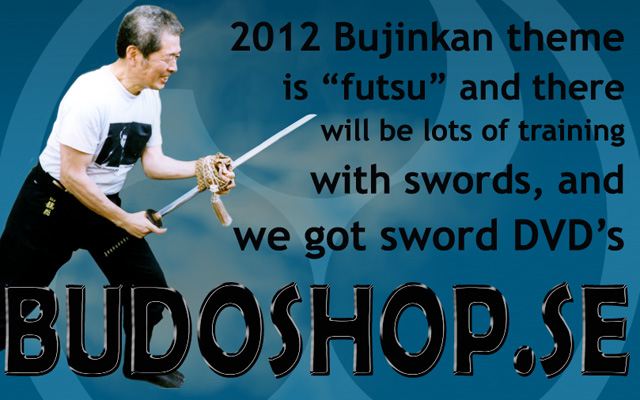
At the dkms party sensei announced the theme for 2012 being “katana” and I think that this yubi gatana was already a hint on how we will use the sword next year. The sword techniques (densho) of kukishin ryû, togakure ryû, shinden fudô ryû being known (keiko), it is now time for us to free ourselves from these forms and to put our adaptive taijutsu into motion through the use of the sword and the mutô dori. Mutô dori is the highest level of weapon fighting and the proof of true mastership.

So please study (keiko – 稽古) and review your sword kata from the past and train them thoroughly (keiko –  経緯 懲) in order to be fully prepared when  Hatsumi sensei will be unveiling the shinken gata in a few weeks.

ps: On Sunday morning he confirmed the theme for 2012 as being “Ken” (all of them). He also precised that in 2013 we will be studying Yari and naginata. ;-)

Be happy and enjoy the christmas and new year time!