Skip to content

Searching for Toda, Sensei

From Blog – Bujinkan Kokusai Renkoumyo 武神館國際連光明道場 by bkronline

When I sat with Soke on the 21st and shared my research with him, everything was still hot off the press and only in English. I needed to explain everything I had found to him.

27628809_1481584878621056_1609936000718160481_oHe was very excited about the finds and insisted that I get everything translated over into Japanese for him right away.

That has been my priority number 1 since I returned on Monday heavy with a bad hangover and severe jet lag.

Today I have completed translating all 31 pages of the most important aspects of the research I have done over the past few months. They are off to him now both digitally and by postal mail.

Now I can focus on getting down to writing the full book.

Glad this initial stage is finished.


Let’s know in the comments. Please, if like what we are doing, click “Like,” “Fellow”, give us “Feedback” “comments,“ and get a notification about a new post.

三光稲荷 Sankō Inari

From 8þ Kabutoshimen by admin

On the second training this year Sōke improved an old painting with a fox. He painted white hair on the Fox and added the kanji. Then he put it up on the left side of Shomen wall in Honbu Dōjō.

三光稲荷 SANKŌ INARI
(Three light rice load)

G00g1e translate isn’t much help. But I found interesting story on Wikipedia about Inari Ōkami is the Japanese kami of foxes, of fertility, rice, tea and sake, of agriculture and industry, of general prosperity and worldly success, and one of the principal kami of Shinto. In earlier Japan, Inari was also the patron of swordsmiths and merchants. Represented as male, female, or androgynous, Inari is sometimes seen as a collective of three or five individual kami. Inari appears to have been worshipped since the founding of a shrine at Inari Mountain in 711 AD, although some scholars believe that worship started in the late 5th century.

By the 16th century Inari had become the patron of blacksmiths and the protector of warriors, and worship of Inari spread across Japan in the [[Edo period]. Inari is a popular figure in both Shinto and Buddhist beliefs in Japan. More than one-third (32,000) of the Shinto shrines in Japan are dedicated to Inari. Modern corporations, such as cosmetic company Shiseido, continue to revere Inari as a patron kami, with shrines atop their corporate headquarters.


Inari and their fox spirits help the blacksmith Munechika forge the blade kogitsune-maru (Little Fox) in the late 10th century. This legend is the subject of the noh drama Sanjo Kokaji.

The fox and the wish-fulfilling jewel are prominent symbols of Inari. Other common elements in depictions of Inari, and sometimes of their kitsune, include a sickle, a sheaf or sack of rice, and a sword. Another belonging was their whip—although they were hardly known to use it, it was a powerful weapon that was used to burn people’s crops of rice.

Inari is a popular deity with shrines and Buddhist temples located throughout most of Japan. According to a 2007 report from Kokugakuin University, 2970 shrines are dedicated to Inari.

If you find one or usually many red Tori gates it is most likely a shrine dedicated to Inary deity.

So what does this mean for Bujinkan? I don’t know, it is an interesting part of Japanese culture. Maybe he just want us to look it up.

The post 三光稲荷 Sankō Inari appeared first on 8þ Kabutoshimen.…

First blog post – Web Designer

From Blog – Bujinkan Kokusai Renkoumyo 武神館國際連光明道場 by Charles Onaje Lucas

Hello everyone:

I am the web designer for Sean Askew’s new Bujinkan Kokusai Renkoumyo 武神館國際連光明道場 website.  Thank you for your patience while we build the website and post the new content.


Let’s know in the comments. Please, if like what we are doing, click “Like,” “Fellow”, give us “Feedback” “comments,“ and get a notification about a new post.…

Coming this spring… The Hidden Lineage

From Blog – Bujinkan Kokusai Renkoumyo 武神館國際連光明道場 by bkronline

In search of the history of the Togakure Ryu

I definitely do not want to cause an issue with anyone regarding the cover of the book. In fact, the picture that was up was just a temporary one. The final cover is a surprise as I have been given the approval to include photographs of Hatsumi Sensei and the Shihan from the 1960’s that have never been published before. They are from the collection of Anthony Netzler and Steve Tansley. I owe them some big thanks. The pictures were taken for the book on the ninja by Andrew Adams (1970). Steve Tansley’s father was the photographer to that project and left Steve and Anthony with a beautiful collection of never before seen photographs. I will include a few of the best and hopefully one will don the cover.

The previous photo, the “Kama Mon” is the symbol of the divine at Suwa Shrine (諏訪神社) in Shinshu. It is the symbol of the “Bujin” (武神) enshrined at Suwa. Yes, the same “Bujin” as in the Bujinkan. Due to the close proximity and tribal relationships, the shrine at Togakushi where our Togakure Ryu comes from also uses the “Kama Mon” as its shrines symbol. The “kama” or a sickle is a farmers tool that held high spiritual importance in the rice-based communities. Once the harvest was over each year, the Togakushi region would hold “kama” festivals 「鎌祝い」, to celebrate and give thanks to the shrine’s deities for a good harvest and to pray for another next year.

Also, please enjoy my clip from yesterday’s Taijutsu session


Let’s know in the comments. Please, if like what we are doing, click “Like,” “Fellow”, give us “Feedback” “comments,“ and get a notification about a new post.…

Trouble with the Swedish?

From Bujinkan 40 år i Sverige TAIKAI by Bujinkan 40 år i Sverige TAIKAI

No problem, I got a question from a friend abroad and thought maybe more people was interested, so here is some necessary info. 

Hello, nice to hear from you again. The website is http://taikai.se

I haven’t had time to translate the website and information to English. Maybe you can use google translate… https://translate.google.com/m/translate

If you want to attend the party you need to sign up before October 10th here… http://taikai.se/bujinkan-40-ars-fest/

It says you must pay to, but you can do that when you come (if you don’t live in Sweden!). They need to prepare the food one week before. 

For the training, you sign up and pay 500 SEK at the door Saturday morning. 

We have extra training at Kaigozan Dojo on Friday. 

http://kaigozan.se 

You can sleep for free in the dojo if you want. If you choose a hotel it is only 10-20 min train/metro west of Stockholm C. 

Don’t hesitate to pump me for more information!

Hope you can make it 😊

🙏

Mats H…

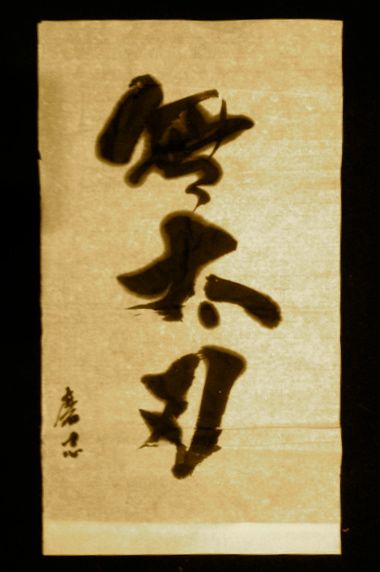
無太刀 No Tachi!

From 術心悟 by goshinarts

無太刀 No Tachi!

If you practiced martial arts or zen, perhaps you recognize these Chinese characters. The first one, Mu is a negative and can mean among a vast array of meanings, nothing, not, no, nothingness and more. The second and third characters are a pair, pronounced Tachi, meaning just that, a Tachi is a type of curved sword usually worn hung at the waist blade down that was used during the warring periods in Asia.

This year in our martial arts training we are exploring movement while wielding a Tsurugi, another type of double edged sword that predates the Tachi. But notice the emphasis is on movement and not on the using the tsurugi itself. This is a very important point. Perhaps related to another recent post, Mu Tou Dori, you will enjoy this pun (which was originally painted by Hatsumi Sensei but I did not photograph it. So you must suffer my brush!). It is a simple pun but made thru the use of three different languages! The characters are Chinese, the expression itself is a Japanese expression based but based on the English language!

At first glance it looks like Nothing Tachi. But when we change the Nothing to No, it becomes “No Tachi”. Pronounced this way in the Japanese accent it becomes English, “No Touch”! This Japanese expression is use for situations that are perhaps dangerous, so “No Touch”, or maybe we distance ourselves from them. Perhaps it can imply a lightness of approach. What does it mean to you? If you have been training for a long time or even just beginning your journey, may this pun, in conjunction with the prior post, Mu Tou Dori, inspire and enlighten.


From 無刀捕り(Mu Tou Dori ) to 無闘捕り

From 術心悟 by goshinarts

Having returned to Japan after spending some time training in the yogic arts in India, it is wonderful to see old friends and my martial arts master, Hatsumi Sensei.  How fortunate we are to be able to train with living masters, whose presence can be as a great fire.  In Eastern thought, fire is the element charged with the power of transformation.  It has the power to transmute the other elements and bring vast change.  Perhaps you have felt the fire of a great master?

The common Characters for Mu Tou Dori are 無 (not,no,) 刀 (sword) 捕り(to trap, catch) and is often translated as unarmed sword trapping/defense. It is perfectly reasonable  to translate it in this manner.  And in the beginning of our training journey, it is natural to be concerned with the dynamics and techniques of taking a sword unarmed. But as we progress on our path, and our feeling of the art deepens, perhaps our Mu Tou Dori couldImage transform to 無 闘 捕り。No Fight Catching.  A brilliant play on the Chinese characters by Hatsumi Sensei.

As we progress perhaps we should seek this Mu Tou Dori feeling in not only defense against the sword but as a guiding principle in our art and heart.  This idea of the Mu Tou feeling is essential part of Hatsumi Sensei`s teaching and one that is crucial for all practitioners to aspire.  From “No Sword Trapping” to “No Fight/Struggle” and perhaps we can change trapping to more of an image of enveloping or wrapping your opponent in that intangible yet undeniable presence or spirit.   When this takes root in you, it is as the dew drop that returns to the ocean.  You may start spontaneously dancing!


Kukishinden Ryū Happō Biken – article translation

From Wanderings in Budo by bujinshugyo

九鬼神伝流八法秘剣

後醍醐天皇の守護についていた薬師丸蔵人隆真を始祖とする。後に功により九鬼姓を賜わった。棒、槍、薙刀、手裏剣、体術などの8法に剣術が加わる。剣が特に素晴らしい。当時は戦争の時代だったから殺人剣が多かったが、後に平和な時代になるとそれが活人剣になる。九鬼水軍が船の上で用いたため、腰を低く落として安定した構えが基本になった。
kukishinden 6

Kukishinden ryū happō biken

The founder Yakushimaru Kurando Takanao was a military governor (shugo) under Emperor Go-Daigo. The Kuki family name was an honour granted later. Kenjutsu is added to the eight methods that include bō, yari, naginata, shuriken and taijutsu. The sword (technique) is especially wonderful. At this time it was an era of war and many people were killed with the sword. Later in the period of peace it became the life saving sword. The Kuki naval forces worked on board ship so the fundamental became dropping the hips for a low stable stance.
Kukishinden 1

九鬼神伝流八法秘剣 Kukishinden ryū happō biken – nine demons divine transmission style, eight methods, secret sword.

The 鬼 ki of kuki is generally translated as demon, however could also mean spirit or ogre (read Oni), more importantly this does not have the evil connotation that the word demon in English (or Judeo-Christian languages) does.
Shinden can variously be translated as ‘teachings of the gods’ ‘teaching conveyed from the gods’ ‘transmitted to the soul’.
Happō can be eight methods, laws or principles, bearing in mind that eight can imply ‘numerous’.
kukishinden 2

薬師丸蔵人隆真 Yakushimaru Kurando Takanao

薬師丸 Yakushimaru – medicine man, chemical expert
蔵人 Kurando – keeper of imperial archives or a sake brewer
隆真 Takanao – noble truth – the same kanji can also be read as Takamasa, Takanori, Ryūma, Ryūshin and various others – as there is no furigana in the article to indicate the pronunciation I’ve left it as Takanao.
kukishinden 4

守護 Shugo – military governor in the Kamakura and Muromachi period
kukishinden 3

後醍醐天皇 Go-Daigo Tennō – the later or second to bear the name Daigo, equivalent of saying Emperor Daigo II. Tennō – heavenly emperor/Emperor of Japan. Lived 1288 – 1339 and reigned from 1318 – 1339.
Go-Daigo in 1336/7 (transition from Kamakura to Muromachi period) set up the southern court and so began the period of two courts Nanboku-chō (Southern and Northern)

1185 – 1333 鎌倉時代 Kamakura jidai
1333 – 1336 建武の新政 Kemmu no Shinsei
1336 – 1573 室町時代 Muromachi jidai
1336 – 1392 南北朝時代 Nanboku-chō jidai (a subdivision of the Muromachi)
kukishinden 5

The lineage chart shows Kukishinden ryū, originating with Yakushimaru Kurando, passing through Ōoka Kihei Shigenobu to Ishitani Matsutarō Takakage who then passes it on to Takamatsu Toshitsugu to arrive at Hatsumi Masaaki. Note here that in the Japanese article 大岡鬼平重信 Ōoka Kihei Shigenobu is written – usually this person is 大国 Ōkuni Kihei Shigenobu – this may be typo from when the chart was edited for the magazine…
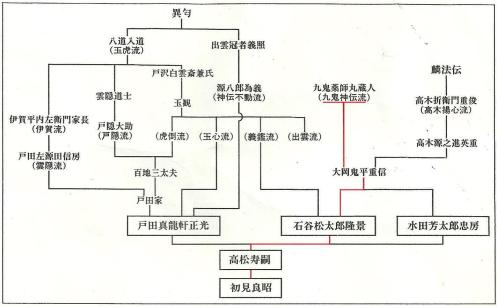
hiden togakure kukishinden genealogy


Shinden Fudō Ryū Dakentaijutsu – article translation

From Wanderings in Budo by bujinshugyo

神伝不動流打拳体術
出雲冠者義照の伝えた骨指術の流れを汲み、源八郎為義が12世紀の中頃に創始。構え自然体ひとつしかないのか特長。ただし、実際わ心の中で映像を作って構えている。

Shinden Fudō ryū dakentaijutsu
Legend has it that Izumo Kanja Yoshiteru was the first to understand the flow of koppojutsu, Minamoto Hachirō Tameyoshi was the founder in the 12th century. The principal feature is the natural body posture. However, in actual fact I have an image (of a posture) pictured in my mind.

神伝不動流打拳体術 Shinden Fudō ryū dakentaijutsu – Divine transmission of immovability style striking body-technique or art.  Often referred to simply as Fudō ryū by teachers in Japan.

出雲冠者義照 Izumo Kanja Yoshiteru – Izumo (province), young man (coming of age), shining justice – A young man from Izumo.

In mythology the entrance to Yomi黄泉, the land of the dead, is to be found in Izumo province. An interesting link to the ‘natural hell methods’ of the Shizen Shigoku no Kata in Shinden Fudō ryū…

源八郎為義 Minamoto Hachirō Tameyoshi – Minamoto (clan), eighth son, source of justice. An eighth son of someone in the Minamoto clan, of which there were many…

In the 12th Century 3 major families/clans vying for supremacy were the Fujiwara 藤原, Minamoto (aka Genji 源氏 Gen clan) and Taira (aka Heike 平家 Hei family).

The genealogy for Shinden Fudō ryū is fairly straightforward – from Ikai to Izumo Kanja Yoshiteru, Minamoto Hachirō Tameyoshi founded the style that was passed down to Toda Shinryūken Masamitsu to be passed on to Takamatsu Toshitsugu and then Hatsumi Masaaki.


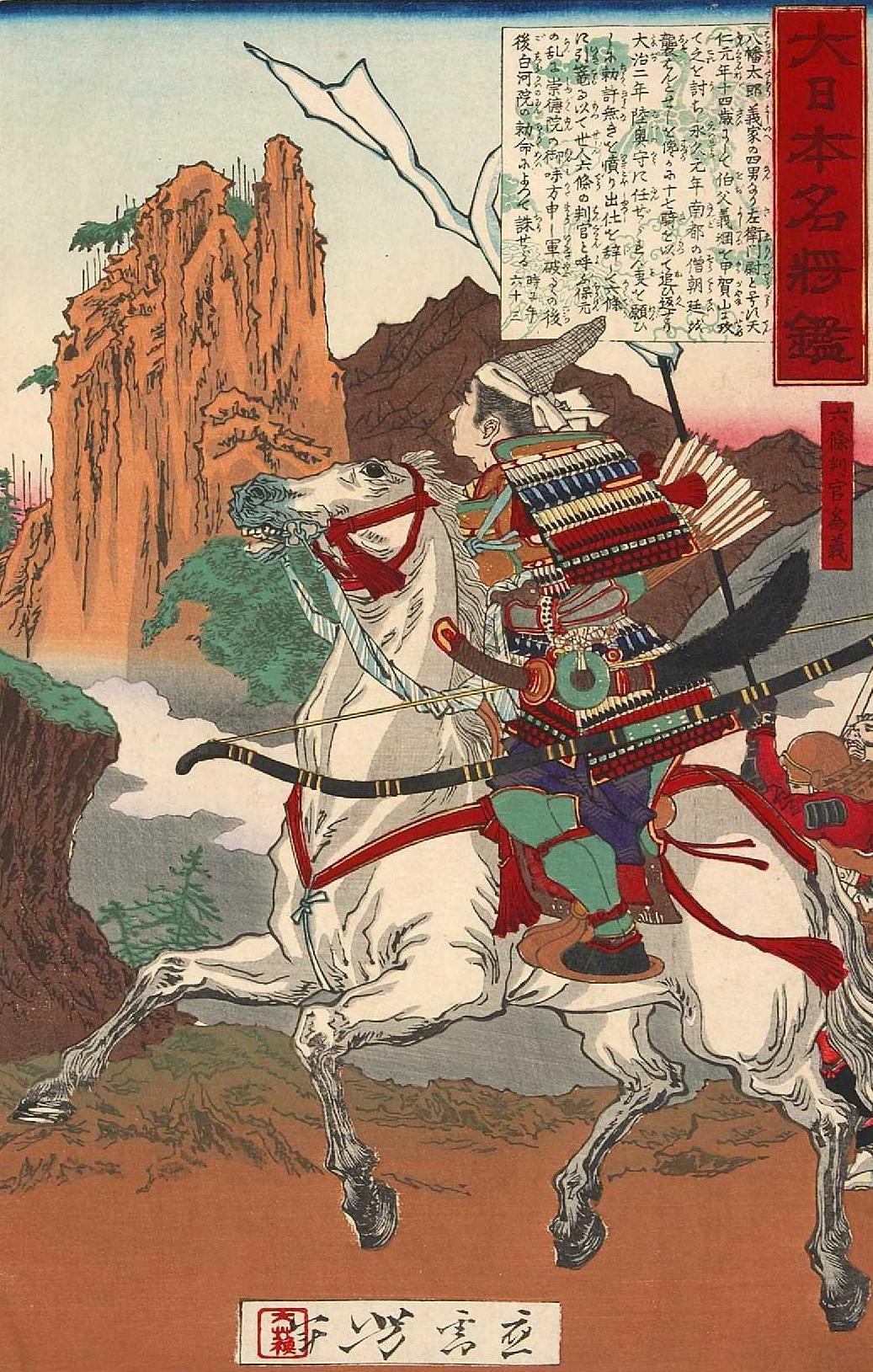
There is a historical Minamoto Tameyoshi 源為義 – also known as Mutsu Shirō 陸奥四郎 sixth (rank) of the interior, fourth-son, with the position of Rokujō (Hangan) 六条判官 sixth-rank judge (under the Ritsuryō system mentioned in a previous post).

Minamoto Tameyoshi became the head of the Minamoto clan and supported Fujiwara Yorinaga in trying to place Sutoku on the throne in 1156, opposing Go-Shirakawa who was supported by Fujiwara Tadamichi, Taira Kiyomori, Minamoto Yoshitomo (the son of Minamoto Tameyoshi) – a mix of both Minamoto and Taira. This became known as the Hōgen war or rebellion (保元の乱 Hōgen no ran). Go-Shirakawa’s faction was the victor, with Minamoto Tameyoshi becoming a monk and consequently executed by his son. This begins the struggle between the Minamoto and Taira (源平 Gempei), with the Taira initially gaining dominance to then be defeated by the Minamoto at the battle of Dan no ura no tataki 壇ノ浦の戦. Minamoto Yoritomo was to became the first Shōgun of Japan.

(This is just here for interest – in no way to indicate that this person is the same as the founder of Shinden Fudō ryū!)