Courage is better than skills
From 武神館兜龍 Bujinkan Toryu by admin

Courage is more important than skills, if you don’t have courage to use your skills, what’s the point?
The post Courage is better than skills appeared first on 武神館兜龍 Bujinkan Toryu.…
From 武神館兜龍 Bujinkan Toryu by admin

Courage is more important than skills, if you don’t have courage to use your skills, what’s the point?
The post Courage is better than skills appeared first on 武神館兜龍 Bujinkan Toryu.…
From 8þ Kabutoshimen by admin

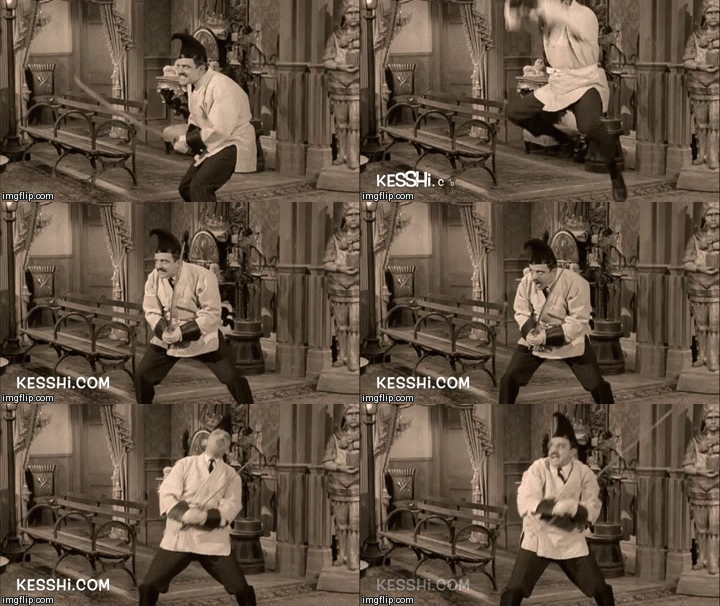
This summer like most summers we train a lot more with long weapons since the dojo is too small to really use long weapons properly. This summer we train Bojutsu against Kenjutsu (long staff against sword). I think I teach and train a little different than most Bujinkan teachers out there, but I can’t really say maybe there is those who approach the training like I do. Let me explain.

First of all you learn how to use the staff, spinning and striking etc, this is mostly solo-training. Then you learn the Keiko Sabaki Kata (movement practice techniques) in my dojo we only practice one technique for the whole two hour class. Some students really have problems with coordination, others capture it quicker. In this first step I don’t mention distance, timing or anything except which strikes and blocks to make. This can also be solo-training and done alone against an imagined opponent.
Second I take the sword and we focus on how to handle the situation the best way with a sword. If he is attacking me with the staff I immediately counter him by stepping forward. I’m not gonna step backwards defending myself all the time, when he steps in to strike me in his preferred distance out of my reach; I boldly step in at the same time and block the staff and get even closer into my preferred distance so I can cut him with the sword. As I see it this is the only chance I have against a longer weapon, there is no point of running backwards.

Thirdly I take the staff again. I attack the kenjutsu-ka fully (not really, but almost) and make sure he does a good block, and as he block I don’t stay frozen or try to push harder on him. As I strike I’m already prepared for the next movement when he comes in and try to cut me, I move out to my distance and do the next strike.
Then I take the sword again and try to avoid being hit from this point in the technique, by blocking and countering again. I’m not really gonna give up or run away. If I can cut I will cut.
Then again I take the staff and try to deal with this really difficult opponent, I avoid his cut and counter him until the end of the technique where I make it impossible for him to do anything. Then the technique is finished without changing the sequences of the strikes, the only thing that is flexible is the distance and the timing. And this is where the true training comes in.
Then at the end of the class we record a short demo to video which will be available for download later. This is how we spend our two hour trainings at Kaigozan Dojo this summer.
No henka, no variations, true to the technique.

I always thought quality is better than quantity. It is amazing how cleverly these techniques is made up, it is so much more than executing the strikes rapidly against a rather passive opponent. If the opponent (sword-guy) is good and understand how to use the sword there is really not many options to change the technique and do something different, the possibility for henka becomes very narrow, what you can change is very small details. For me this is what henka means, you failed your initial technique and need to adapt because of miscalculation.
I know there are those out there only doing henka-training, but how do you do henka training only, henka of what? If you try to train yourself into intuition without basic foundation you are doing something I don’t understand. You weren’t born out from nowhere, someone did something very basic with someone and you was born. How do you henka anything into existence?

If anyone is interesting I’m doing three more one day Bojutsu mini-seminars this summer.
Happy Training!
/Mats
The post Bojutsu vs Kenjutsu vs Bojutsu vs Kenjutsu… appeared first on 8þ Kabutoshimen.…
From 8þ Kabutoshimen by admin
If you don’t understand this, I question your whole reason for training martial arts! We are supposed to be role models and smarter than common people, at least that is what we are telling each other with varying confidence. Most people in Bujinkan seems to be caught up is some kind of romanticised imagination of being some kind of ninja warrior, far from today’s reality. It is fun dreaming away fighting with swords and shurikens. We talk about defending against what can not be seen, but have you even thought about what that means?
I don’t like to bring in politics and religion into training because we are all free to believe what we want. But when the politics stray from democracy and becomes tyranny I have to speak up against it. It is easy to see what is happening in USA with all these crazy events. I’m not talking about the two brothers bombing the Boston marathon, I’m talking about the media blowing things out of proportion scaring people and 9000 police army closing a whole town busting into innocent people’s homes taking away their constitutional rights. At the press conference the police say that we should not look at any other pictures than those they approved, telling us to only trust them. Now media is criticising themselves for jumping into conclusions and imply that in the future they will stick only to the official story without questioning. To me that is a strong sign on tyranny taking over.
You must understand that there is a lot of money to be made keeping people scared, just follow the money and you will understand.
And now we got CISPA coming, Obama said he will veto it, we’ll he said that about NDAA (indefinite jail without court or jury!) to and then signed it anyway New Year’s Eve 2011/12 in “secrecy”…


The post What good is your martial arts skills against a government tyranny? appeared first on 8þ Kabutoshimen.…
From 8þ Kabutoshimen by admin

I got a question today about these books, if they are important for Bujinkan practitioners.
http://www.coloradospringsninjutsu.com/Shoninki.html
http://www.shoninki.com/home/Welcome.html
For what it’s worth here is my answer.
Hello. I don’t think it is very important today, but probably very interesting in historical view. I know Don lived in Japan for many years and probably discussed the book with the Shihan when he run into problems in translation. I don’t know who the other person is, he might be better in Japanese, but if he haven’t been training he might have missed some things. Both books probably have errors, why not get both?
But I don’t believe it is that important, the knowledge is old. There is better modern books about survival skills, medicine, tools etc today.Thanks for the links, I didn’t know Don also had a translation.
Happy training!
Mats
The post Shoninki books appeared first on 8þ Kabutoshimen.…
From 8þ Kabutoshimen by admin
There are many people in the Bujinkan who claim to teach reality based techniques without any real experience. There is however a few people that can do this, and do it very good. And one of the best one I know is my close and good friend Dean Rostohar Shihan from Croatia. With his experience from the civil war in former Yugoslavia, and as a former police officer he certainly knows what he is talking about.
Dean goes to Japan to train with Hatsumi Soke and the Shihan several times per year. He always train three trainings per day, to make out most of his time in Japan. Hatsumi Soke always put him up to teach about his experiences. When he was there earlier this month even more so, Soke used him as Uke often to teach the real feeling. Soke also awarded him with the Bufu-ikkan menkyo which he only give to his top students.
When Dean doesn’t go to Japan he practice in his own Dojo with over 100 students. He also attend many courses and seminars and further his studies in many areas with instructors outside the Bujinkan. He also practice shooting and military tactics with SPECWOG, and teach many seminars and courses.
In October 29-30′th I’m organizing a seminar with him in Stockholm. I can’t emphasize enough how important a seminar like this is for everyone training in the Bujinkan system. Especially if you want to learn self defense and tactics how to defend yourself against a knife or pistol. Running backwards on a flat floor in the dojo all the time until the opponent overextend himself and fall down is fine, but how reality based is the training, really? Your instructor may say this is reality, and then do something pretty stupid and cover it up with a henka and flow so that you don’t see how stupid the first response really was. OK, sorry! The word “stupid” might be a strong word, I know there is good teachers out there, but far from all. Being “stupid” is also a learning process that we all need to go through, but staying on the stupid level is just stupid
.
I know there is many seminars all the time, and find the time and money to all is difficult. All I ask of you is to ask yourself what do you want from the training? If you think it is fun as it is in your dojo and you don’t care much about reality then fine, good luck! If you on the other hand think that being able to defend yourself is important, then you should really try to attend this seminar (or any other Seminar with Dean)! I promise it will be very eye opening, and you will see your training with different eyes.
Both knife and pistol is very scary weapons, defending against them is very difficult. But it is possible if you also know how to use them as weapons. If you don’t know how to use the weapons properly how can you say that you know how to defend yourself against them.
This is the feeling Hatsumi Soke teach in Honbu dojo all the time. All instructors take what they want and do what ever they feel like for various reasons. By Hatsumi Soke using Dean in Honbu dojo so much, and constantly ask him to teach and explain in front of him, as well as being his Uke must mean that Hatsumi Soke appreciate what Dean is doing. I think also that Hatsumi Soke is learning from Dean as he watches.
So with this I really recommend you to come to this seminar! The web site is in Swedish, but there is translation buttons on top of the web site. If you have problem with the language, you can always contact me, I know the translator is not always 100% correct.
Remember to sign up, because the places is very limited!
The post Modern warrior coming to Stockholm in October appeared first on 8þ Kabutoshimen.…
From 8þ Kabutoshimen by admin

I just found my old web site on archive.org
, and a lot of memories comes back. When I made my first web site (in 1994 or 1995?) there was only one other web site on the whole internets that contained the word "Bujinkan" (I think his name was Shawn (an American not Canadian
)). But before that I operated my own Fidonet BBS called 2:201/2123 Moko no Tora BBS on a computer under my bed between 1992-1996 (approximately, I don't remember exactly). I was also at Compuserve when they got their first modem pool in Sweden. At that time you could not access the internets from your home as a private person. There was no provider that offered a modem pool you could call up, it was only at big companies and university's at this time. Until Ragnar Lönn started Algonet in 1994 offering a connection for private persons. If I remember correctly, I got my subscription around Christmas time, and immediately started learning HTML by making the web site.
There was only the MS *plorer and Netscape browsers, I remember Netscape was better because you could change the colours on the fonts and background. There was HTML programs, but they where buggy, annoying and didn't keep up with the new features that the Netscape browser gave. So I learned typing HTML with a simple text editor. I still do this, but I also use a CMS system (this site is on W0rpqr*ss ).
Over the years I had projects that grew too big to handle. More and more people got Internet and found my web site, I see that in the oldest record on the way back machine at archive.org that in May 2000 I had 154 016 hits since march 1995, I'm not sure if that counts the hits I had before on my Algonet page (yes it still sucks!). In January 2002 I had 426 844 hits, Anyway some of the bigger projects was...
This was link site with thousands of Martial Arts links, driven by a text database, but someone had to manually update with new links, lot's of work. Thanks to Baubak G who helped me with this!
Means polish your sword or skills. With a couple of thousand members it could sometimes get maybe too political, but often there was good discussions. Back then people where new to the internets and was willing to share stuff, even if it wasn't well researched (me included).
NinZine actually started before in my Fidonet and Compuserve days. It was a type of multimedia magazine where you needed a PC with DOS to make it work. Later Liz made Ura & Omote which was more text based articles. I think I only released five or six issues. I tried to find the old zip files but can't find them. If anyone have them, please contact me
. I have planned for a while to use the NinZine name again for the bujinkan.me web site project.
Was a kind of portal for each country that showed links to web sites, clubs and local seminars for respective country. Here is Sweden for example (13 training groups, 23 web sites and 6 seminars registered at the time).
This was probably the most popular segment. Thanks to Peter C who gave me most of the school information in the beginning. I added more and more to the pages without thinking or being able to check it's sources.
At the end I removed most of the ryu-ha history notes because I was fed up with some people who knew better that liked to critizice instead of helping, people who took the information and presented it as their own. But mostly because it became too much work, people expected me to update the web site continually, and I wasn't making any money on it. In 2005 I moved the forum to another web site, and about his time I went from 10 000 hits per month to a couple of thousand.
Sure I miss some of the projects a little, but if it means I have to do all the work and it is too much work or I don't enjoy it I won't do it any more. But I moved some of the projects to the bujinkan.me web site...
My Kabutoshimen / Kesshi web site is more my personal web site and blog, if you are interested in what I'm up to. The Kaigozan Dojo web site is my dojo. I got a bunch of other sites to, I keep it separated (Bujinkan, me, dojo etc.)...
Well I don't know how to wrap this article!
Can't believe I've been doing this for more than 15 years!
I wonder how it will look like in another 15 years?
Anyway... HAPPY TRAINING!
( I think I used this phrase for 15 years to
)
/Mats…
From Kabutoshimen by admin
Here is another old article I had on my web site 10 years ago, enjoy!
- Mats 2010-08-18
---
Background: This article was the result of me asking about the Shu Ha Ri (learn the technique, break the technique and then leave the technique) on a mailing list. And the response was so good that I thought more people should be able to read it. Click on the image on the right and it will explain the meaning of the Kanji. Shu-Ha-Ri is not only a Bujinkan term, it can be found in many Japanese Budô arts. And as Arnaud explains below, not necessarily just Budô, it involves everything we learn and master. Enjoy the article!
/Mats Hjelm - January 2000

Mats said: "I need some more information about that. I think most japanese Budô arts have this saying. Can someone give me a few comments or more information about this?"
The process of learning for human beings (maybe animals too) follows three basic periods:
you learn the new stuff,
you understand the new stuff,
you go beyond the new stuff, making it your own stuff.
If we take the process of learning how to ride a bicycle we have the following steps:
By learning how to ride your bike, you followed the three steps of: learning, breaking and leaving! But this is not the end of the story. You have been riding your bike for a few months and the little wheels are bent upwards because you trained hard. They do not touch the ground any more, but you don't know it. You think you are still using them to balance your bicycle and prevent you from falling. One day, your parents (Sensei?) see that and with a tear in their eyes admire your mastery
Watching you, they even saw that sometimes these little wheels where preventing you from riding properly. Because they love you, because they are proud of you they decide to take out these little wheels that you do not really use anymore, to make you more free of your movements.
Alas the whole process is to be followed again! You have to learn a different way of riding your bicycle. Everything you knew from experience is not good anymore.
And if one day you want to learn how to ride a motorbike, you will have to go through another (yet the same) learning process of "learn-break-leave".
This is the same in Budô. You first learn the body motion trying to reproduce what your teacher is showing. You cannot do it but you try hard to understand the "mechanics" of motion.
Then by training hard with your partners you build YOUR understanding of body motion and little by little you adapt it to your own body and capabilities. You break the forms and use what is good for you leaving what is not. You break every step into small parts so that you can integrate them easily in your body natural movements.
One day, the movement is no more your teacher's movement but it is yours. You reached the "leave the form" step until you get a deeper understanding of it that will put you again through the learning process and the three steps.
Now, if we want japanese names we can give the following names for these steps:
For me this is what Hatsumi Sensei is teaching us. He is not only teaching movements or techniques. He is giving us freedom and this freedom can only be attain through hard practice, sweat and bruises. There is no limited time to get it, this is a whole life study!
I hope this will help you Mats
Arnaud Cousergue
http://kumafr.wordpress.com/
January 25'th 2000…
From 8þ Kabutoshimen by admin
I wrote this article more than 10 years ago and had it on my old web site. Here it is again, unfortunately it is in Swedish. I will translate it to english and update it when I have time.
Mats (August 2010)
Det här är inte baserat på grader utan ska ses som vägen till sin egen personliga utveckling med filosofin 守破離 Shu Ha Ri om att "bevara (memorisera formerna), krossa (ifrågasätta och bryta formerna), samt att överge (glömma formerna)" för att slutligen bli fullkomligt fri och upplyst Budôu-ka. Hatsumi Sensei har sagt att det tar minst 10 år för varje steg. Man kanske bör tänka på att han menar också förmodligen att man tränar hårt och envist under bästa möjliga instruktör. Man måste själv ta modet att vandra uppåt mot upplysning som Budôu-ka, om man vandrar för snabbt genom att fuska sig fram kommer man aldrig att nå slutmålet. Den enda person man lurar är sig själv..
Som ni kan se nedan finns det en otrolig mängd Kata som bäst kan beskrivas som teknik mönster eller former som förs vidare från generation till generation. Dessa tekniker finns beskrivna i Hatsumi Sensei's så kallade Densho's de hemliga dokument som överlämnats till honom från sin läromästare Takamatsu Sensei. Man måste förstå vikten av att studera formerna enligt de tre lärorna
Hatsumi Sensei säger att "det är det som inte står i densho som är det absolut viktigaste och jag behöver väl inte säga att man själv måste ta del av Jitsuden, den verkliga träningen, för att förstå teknikerna."
Jag skulle vilja påstå att träna denna art ställer stora krav på individen själv, detta är och kommer aldrig att bli en sport! Man studerar Bujinkan för sin egen personliga utvecklings skull, och ingen annan. Det finns inga priser, det finns inga vinnare, det finns inga förlorare, det finns inga vi och dom. Man måste gräva djupt ner och rannsaka sig själv för att hitta den sanna viljan, där finns inget ego eller begär. Tillsammans kan vi hjälpa varandra att nå personlig upplysning. Man kan lura andra, men inte sig själv.
Komihåg att det här är min egen personliga uppfattning, jag har förmodligen missat en hel del både oavsiktligt och avsiktligt. Bujinkan är en art man enbart kan lära sig genom 一子相伝Isshisôden (direkt personlig överföring av de hemliga kunskaperna från far till son relation) och det är ingenting man basonerar ut på nätet, fritt för alla att missuppfatta eller missbruka.
.
天地人略の巻 Ten. Chi, Jin Ryaku no Maki (Himlens, jordens och människans principer). Hatsumi Sensei har gett ut en bok som kallas Togakure-Ryû Ninpô Taijutsu, denna bok har länge varit slutsåld. Sveneric Bogsäter har översatt delar och kompletterat med sina tolkningar i sin "lilla vita" bok som finns att köpa genom postorder, eller Budô affärer. Vi i Kaigôzan Dôjô följer denna boks exempel på vad man bör kunna från 9Kyu och upp till 1Kyu. Det här är grunderna inom Bujinkan Dôjô...
ª 真剣型 Shinkengata (allvarliga tekniker) Det första kanji står för verklig, sann och det andra tecknet för svärd eller blad. Dessa tekniker skall tränas betydligt allvarligare, som om det gällde livet kan man säga. Det finns 10 stycken grundtekniker med 10 stycken varianter av tekniker som är ämnade att tränas på när man uppnåt 1Dan och upp till 5Dan. Det sägs att dessa tekniker är plockade ur olika skolor (inte nödvändigtvis bara Bujinkan) bl.a. en hel del ifrån Kukishinden-Ryû. Dessa tekniker ska tränas så nära en verklig fight som möjligt, dom ska vara korta enkla och effektiva. Visserligen stämmer det in på de flesta grundteknikerna i Bujinkans nio skolor, men här ska man träna med en allvarligare feeling.
ª 忍法三十六計 Ninpô Sanjûrokkei (De 36 kampkonsterna som utgör Ninpo Taijutsu) Det första tecknet nin betyder att dölja, att hålla ut, stå ut med. hô (uttalas pou när det är i en ändelse) betyder metod, lag, system eller princip. sanjurokkei betyder the 36 (ancient Chinese military) strategies (of which the best was said to be beating a retreat)
ª 武神館流派 Bujinkan Ryû-ha (Bujinkans nio skolor). När man har lärt sig grunderna i Ten-Chi-Jin Ryaku no Maki är det dags att lära sig att särskilja vad som är vad i Bujinkan. Grunderna är grundtekniker plockade ur dessa nio traditioner/skolor.
ª En traditionell Budôsskola innehåller var för sig många grundtekniker. Skolorna är oftast uppbygda i nivåer, först fick man börja träna 基本 Kihon grundtekniker. Musashi lät till exempel en elev hugga ved för att träna hugg teknik, men kanske viktigare var att han testade elevens tålamod och vilja att lära sig. Takamatsu Sensei (Hatsumi Sensei's läromästare) fick lära sig fallteknik i ett helt år när de äldre i klubben använde honom som kastdocka. Sedan när eleven vunnit förtroende hos sin mästare fick han börja lära sig de första teknikerna ur 下伝型 Shôdengata, den första nivån av tekniker ur skolan. Sedan när man bemästrat dessa tekniker fick man lära sig 中伝型, Chûdengata mellan nivån. Sedan kommer 大口伝型 Ôkûdengata, muntligt överförda teknik beskrivningar. Därefter kunde ytterligare några nivåer finnas som endast ett fåtal personer fick lära sig. Däribland Kaiden.
ª I de högre nivåerna skrev man oftast aldrig ner några teknik beskrivningar på papper ifall de skulle komma i orätta händer. Teknikerna som var nerskrivna beskrevs också väldigt enkelt med termer som ej kan förstås om man inte är insatt i skolans grundtekniker (kihon). Det var utformat så att om man inte hade förstått de lägre nivåerna kunde man ej heller förstå de högre. Kanji i dessa 伝書 Denshô (skriftrullar) blir koder som bara initierade förstår. Graderingsformerna som vi känner dom idag har sitt ursprung från slutet av 1800 -talet, när Jigoro Kano, grundaren av 柔道 Jûdô (allmänt stavat Judo) konstruerade ett graderingssystem som skulle vara mera uppmuntrande för eleven. Innan dess så hade man istället 称号 Shôgô titlar som beskriver vad 宗家 Sôke, skolans mästare ansåg att man var kapabel till. Dessa kunde vara t.ex. Kyôsei, normalt den första titeln man fick som talade om att man bemästrat grunderna. Renshi indikerar att man lärt sig de fysiska aspekterna av traditionen, här fick man oftast också rätten att lära ut arten till andra. Kyoshi indikerar att man kan lära ut de mera spirituella aspekterna av traditionen. Shihan betyder mästerinstruktör. Menkyôkaiden indikerar på att man bemästrat hela traditionen och får föra den vidare. Sôke betyder "familje överhuvud", bara en person kan bli den som för traditionen vidare under samma
ª Sôke (familjeöverhuvud) för de nio skolor som ingår i Bujinkan Dôjô är Dr. Masaaki Hatsumi, här följer en kort beskrivning av dessa skolor...
.
.
Det kanske är lite dumt att lista upp så här men jag har försökt att göra det på ett sätt att det är enklare att förstå hur djup och fullkomlig Bujinkan Budô Taijutsu egentligen är. Se det som tre _väldigt_ stora nivåer man måste gå igenom för att bli en Tatsujin, fullkomlig och fullärd människa inom Budô. Man tränar inte heller dessa konster från a-z i någon speciell ordning. Vissa saker är viktigare än andra, kanske vid olika tidpunker i ens egen personliga utveckling. För att personlig är den verkligen, det är helt upp till var och en att sätta gränser för hur långt man vill komma i sin egen träning.
En del av de ovan nämnda saker tränar man väldigt sällan eller aldrig. Hur många har t.ex möjlighet att träna strid till häst, det finns väl knappast någon hästägare som skulle låna ut sin häst till sånt. Men Bujinkan är en öppen och fritänkade Budô art som inte låter sig begränsas till att bli en art bara för bevarandets skull. Bujinkan är ingen "museum kampkonst" där man måste kopiera sin instruktör för att det var så han lärde sig av sin instruktör, som lärde sig... osv. Därmed inte sagt att man får göra som man vill, man måste först kopiera sin instruktör för att förstå vad han lär ut, sedan kan man lägga till eller ta bort efter egen erfarenhet.
Om ni tycker att jag stavat fel, nja kanske. Tja, hur stavar man t.ex. 武道? Jo man stavar det så som det ska uttalas. Antingen Budoo, budô, eller Budou beroende på vilken romaniseringsstandard man väljer att följa för att stava vokaler som ska "dras ut" (uttalas längre). Jag har följt den senare. Notera också att 武神館 skrivs egentligen bushinkan och att 道場 skrivs egentligen dôjô, men för att inte skapa alltför mycket förvirring har jag valt att skriva bujinkan, Dôjô
Jag har använt mig av Jeffrey's J/E Dictionary för att få fram rätt kanji och översättningar. Om ni är intresserade att studera japanska ska ni ta en titt på den.
Den här sidan var inte tänkt att bli speciellt lång. Men när jag väl hade börjat insåg jag att det går inte förklara Bujinkan på något annat sätt. När jag väl hade börjat ville jag göra det riktigt ordentligt. Jag vill tacka alla som har hjälpt mig och inspirerat mig genom åren, och det är så många att jag inte vågar lista upp alla för rädslan av att ha glömt någon. Men jag vill framför allt tacka följande personer som hjälpt till med just detta dokument...
För ytterligare information om vad 武道体術Budôu Taijutsu är gå till Kabuto's Bujinkan sida , klicka och sök dig fram till F.A.Q. från index sidan. Där får du många frågor besvarade.
Maila mig gärna om kommentarer, hur jag kan förbättra, eller göra texten mera förståelig. Bujinkan är ingen art man lär sig på en handvändning, jag har fortfarande låååångt kvar. Men jag börjar förstå arten mer och mer för varje dag, men jag förstår också hur lite jag egentligen vet. Jag är känd för att vara ganska envis, så jag ger aldrig upp.
PS. Och glöm inte att det här är min personliga tolkning av Bujinkan som Budô art! DS.
がんばって下さい
GANBATTE KUDASAI
(stå fast, håll ut, ge dom vad dom tål, du kan göra det, vinn vinn vinn!).
Sammanfattat av Mats Hjelm under våren i drakens år (år 2000)…
From Kabutoshimen by Toryu
神傳不動流打拳体術 SHINDENFUDŌ-RYŪ DAKEN TAIJUTSU

神 SHIN, JIN, kami : gods, mind, soul
伝 DEN, TEN, tsuta : summon, propagate, transmit
傳 FU, BU : negative, non-, bad, ugly, clumsy
動 DŌ, ugo : move, motion, change, confusion, shift, shake
流 RYŪ, RU, nagare : current, a sink, flow, forfeit
打 DA, DASU : strike, hit, knock, pound, dozen
拳 KEN, GEN, kobushi : fist
体 TAI, TEI, karada : body, substance, object, reality
術 JUTSU, sube : art, technique, skill, means, trick, resources, magic
神傳不動流 Shindenfudō-ryū (the immovable transmissions by the gods) was founded by 源八郎為義 Minamoto Hachirō Tameyoshi in the Hogen Era (1156). The system has its origin from Kosshijutsu that came to Japan with Ikai and later transmitted to 出雲冠者義照 Izumo Kanja Yoshiteru in the Yeikyu Era (1113).
For the whole article click here...
http://bit.ly/shindenfudo…