Skip to content

Masaaki Hatsumi: Dojo Art (Kickstarter Project)

From 8þ Kabutoshimen by admin

Masaaki Hatsumi: Dojo Art will be a professionally designed book of paintings and calligraphy by Bujinkan Soke, Masaaki Hatsumi.

This is a book in the planning by Steve Olsen, he is looking for people backing his book on Kickstarter. If he gets enough backers he will make the book, if not it won’t be a book. It is up to you if there will be one.

BACKGROUND

During break in his martial arts classes at the Bujinkan Hombu Dojo in Noda City, Japan, Hatsumi-Sensei paints for his students. He paints calligraphy and pictures. His art contains advice to his students and historical influence from the nine Japanese martial traditions he is the head instructor of

BOOK DESIGN

7504d495979ea290e9e6588215adb469_largeOur designer, Dan Saal, is a real pro. He’s an award-winning art book designer and he knows how to design beautiful books that bring the essence of topics to life. Dan’s sample layouts already look great and I look forward to working with him to finish the project.

For an idea of the quality you can expect, take a look at some of Dan’s work here:
http://www.studiosaal.com
http://www.studiosaal.com/awards.html

Support the project here… http://www.kickstarter.com/projects/1780878098/masaaki-hatsumi-dojo-art

The post Masaaki Hatsumi: Dojo Art (Kickstarter Project) appeared first on 8þ Kabutoshimen.…

Welcome to the Bujinkan Sweden Taikai 2013 in Gothenburg

From Bujinkan 40 Years in Europe by Christian Appelt

It is with great pleasure that we announce that the Bujinkan Sweden Taikai of 2013 will be held in Gothenburg, October 19-20th. Especially since it is a sort of anniversary since this year it is 30 years since Bujinkan was established in a more formal way in Gothenburg.

The Taikai will be hosted by the two Bujinkan Dojos in Gothenburg, Bujinkan Seishin Dojo and Bujinkan Dojo Göteborg.

We are very happy to be able to present these great instructors to you.

instructors2013


 …

空間 Kukan: More Bounce to the Ounce

From Bujinkan Santa Monica by Michael

Edo-Tokyo Architectural Museum. photo by kanegen
I guess I didn't understand kukan. I was in a class with Hatsumi Sensei, and the things he did and said made that clear to me. For example he said,
 "When he's close, then use a sanshin strike. Let's think that this strike is a strike on the kukan. No one will think you'll do this."
and another time he said to "Bounce the opponent off the kukan." and to "use the kukan as a shield." Hatsumi Sensei then added,
 "you're not "doing" a technique. Being able to control without holding on in the kukan. It's like juggling in the kukan. This is the most important thing for the upcoming kunoichi taikai. Because you don't need strength to juggle."
And the effect on his opponent was palpable. I could see it happening in front of me. He was being "bounced."

OK. So the simple physics don't match up with any western translation of kukan I have heard. For example one dictionary defines 空間 kukan as: space;  room;  airspace. And I always understood it to mean the space between, in and around the fight and the fighters. But this is empty air! How the heck do you strike it? And when you do, what would that accomplish?

Let's look an eastern concept for this idea. The first character in kukan is 空 ku, one of the five elements in our training. It roughly translates to empty;  sky;  void;  vacant;  vacuum.

But in another blog post about bojutsu I described another meaning for kokū 虚空:
We usually think of this as meaning empty space or empty sky. But this word is sometimes used to refer to the mind (which has no form or color) of your opponent. Kokū 虚空 can be read as emptiness or even "false" emptiness. Another way to write kokū is 真空, which is a true emptiness. Or even kokū 心空 emptiness of mind.
So how do you bounce somebody off empty space? Maybe with the mind of the attacker? The space looks empty but it is filled with intentions and thoughts.

Soke ended the class by suggesting that we do it without feeling. Kankaku denai 感覚でない... But isn't that how badly we always do it?
…

Your Vote for My Next Video

From Bujinkan Santa Monica by Michael

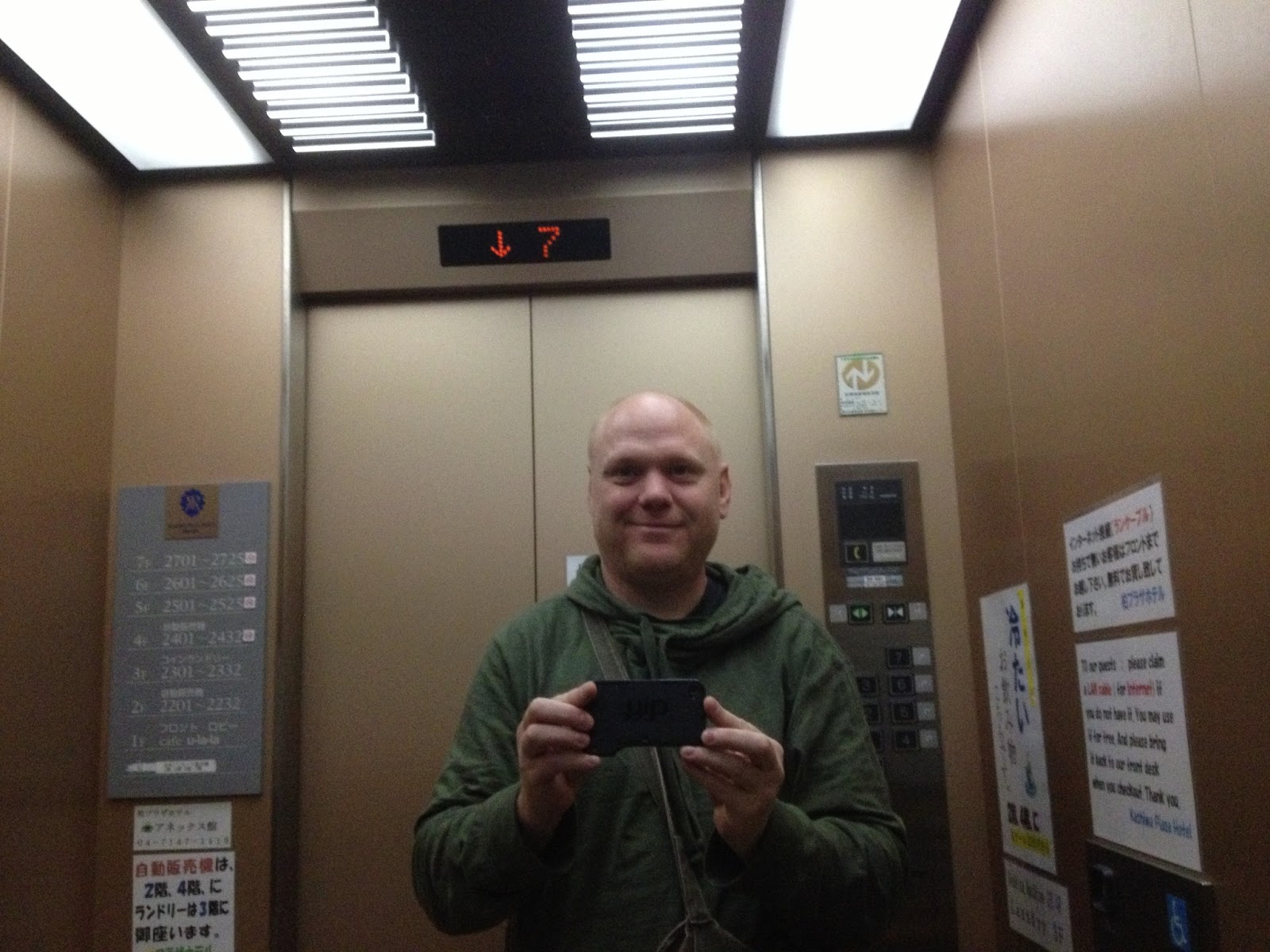
Michael Glenn Somewhere Below 7th Floor Kashiwa Plaza Hotel
I am having a lot of fun making these training videos. But what would be even more fun would be to collaborate with my friends in the Bujinkan. So to get that started, please help me by picking my next video project here: Click here for Your Vote

If you haven't seen any of my videos, you can find them here: Michael Glenn's Bujinkan Videos

 I really appreciate all the support and feedback everyone has given me when I travel, or through all the great emails you guys have sent my way. …

Your Vote for My Next Video

From Bujinkan Santa Monica by Michael

Michael Glenn Somewhere Below 7th Floor Kashiwa Plaza Hotel
I am having a lot of fun making these training videos. But what would be even more fun would be to collaborate with my friends in the Bujinkan. So to get that started, please help me by picking my next video project here: Click here for Your Vote

If you haven't seen any of my videos, you can find them here: Michael Glenn's Bujinkan Videos

 I really appreciate all the support and feedback everyone has given me when I travel, or through all the great emails you guys have sent my way. …

The Theme for 2013 is Like a Dragon Wrapped Around a 劍 Tsurugi

From Bujinkan Santa Monica by Michael

If you want to know how to use the ken, do it like you have a dragon wrapped around the blade. That is my advice after studying this weapon in Japan. Let me explain how I got there.

As part of the theme for 2013 in the Bujinkan we are studying the straight sword 劍 tsurugi or ken. At first, I didn't know what to make of this, since Japanese swordsmanship is largely devoted to curved single edged blades. But after my recent trip to Japan and being exposed to the symbolism AND practical use of this weapon, I am absolutely blown away.

When I first saw Hatsumi Sensei using this weapon this year, it literally seemed to writhe in the space like a snake. This got me thinking. 2013 being the year of the snake, how might these things connect?

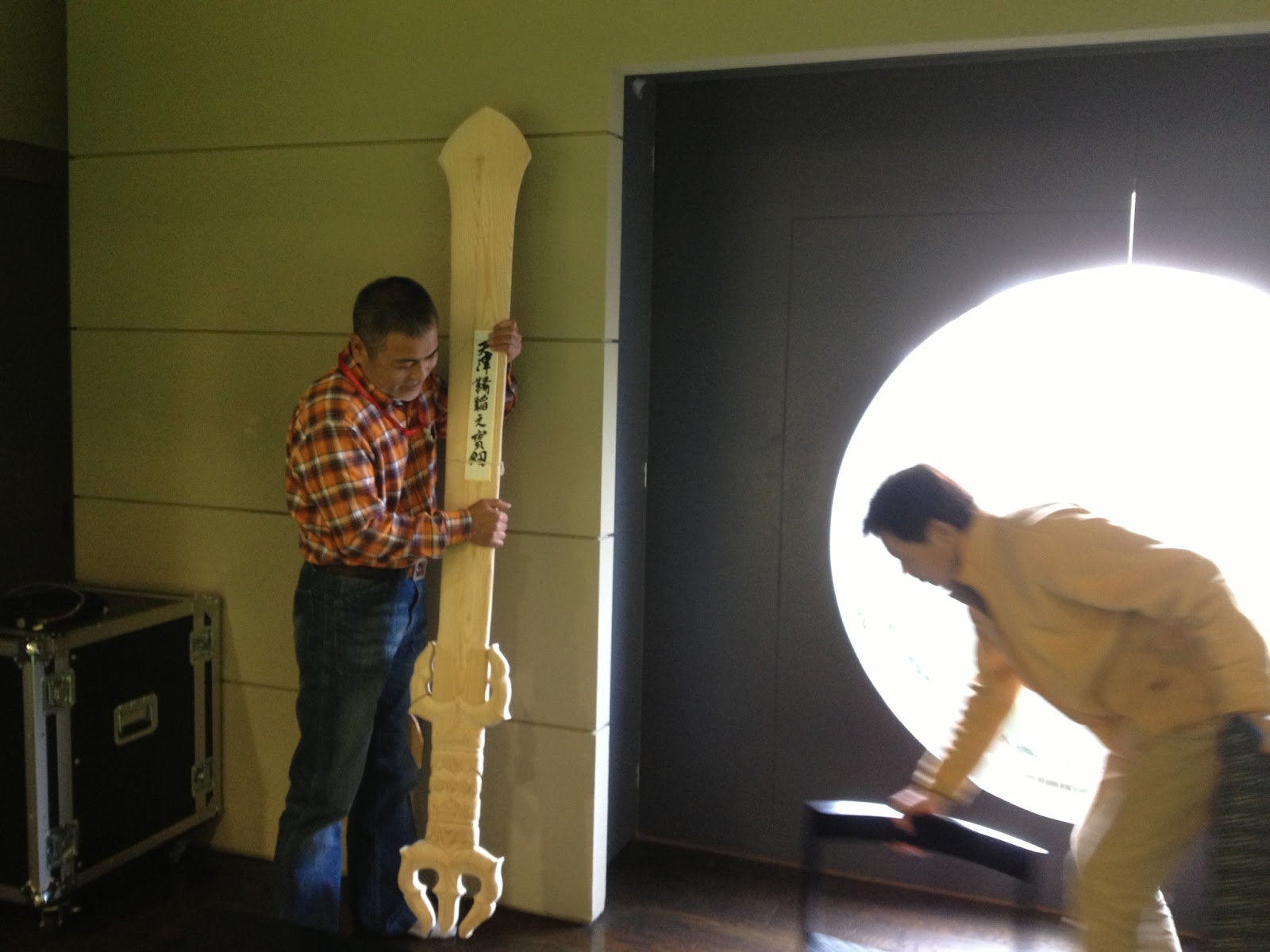
As I looked around hombu, and during the kunoichi taikai at Ayase, I saw many types of ken in use during training. Which one are we studying this year? I think the answer is all of them, but Hatsumi Sensei showed up with an impressive example to put on display:
The Arrival of Hatsumi Sensei's 三鈷剣 Sanko Ken. photo by Michael Glenn
I was told by the Japanese teachers that this type of ken is called 三鈷剣 sanko ken and is not used in combat but for ceremonial purposes. This type of sword, also called a vajra sword (金剛杵 kongō-ken), or treasure sword (宝剣 hōken), has some incredible symbolism, but had its origins in combat. What manner of combat you ask? The slaying of snakes!

For example, one of the origin stories of the vajra comes from India. The god Indra used the vajra as his main weapon. In the Vedas, Indra used this weapon to fight and kill a dragon serpent form of Asura Vritra. Indra became known as the slayer of the first born of dragons.

The five pronged vajra symbolizes the five elements. It looks like six, but the central prong is counted as one. Or, in the form of a sword, this blade was used by mountain yamabushi or mikkyo priests to clear a path through weeds and undergrowth. The blade came to represent cutting away illusion.

In the stories of the origins of Japan, the sword came to Japan as a gift from the gods. Amaterasu's brother, Susanoo, killed an eight headed serpent and cut off one of its tails. Inside its body was the 草薙劍 Kusanagi no Tsurugi which is one of the three sacred treasures of Japan.

You will find this blade held by Fudō-myōō 不動明王, Senju Kannon 千手観音, and Monju 文殊 in their depictions. One of the most interesting examples for us this year might be "The Akafudou 赤不動 of Myououin 明王院 on Mt. Kouya, who holds a sword with the dragon Kurikara 倶利迦羅 wound around it." A couple of weeks ago, I watched Hatsumi Sensei paint snakes and serpents on students' swords and scrolls. So this feeling must be on his mind.

I could not help but think of this symbolism and feeling when in one class at the hombu, we were using the ken to do the kata 飛龍之剣 hiryu no ken. As the flying dragon was coiled around my sword in the kukan, my opponent suddenly found himself wrapped around his own delusions. My sword had snaked around between his arms to wrap and slice into a musha dori.

I bet you've never thought about dragons and serpents when doing musha dori! Me neither, until this year. Should be quite a ride. Hope you hang on with me.…

The Theme for 2013 is Like a Dragon Wrapped Around a 劍 Tsurugi

From Bujinkan Santa Monica by Michael

If you want to know how to use the ken, do it like you have a dragon wrapped around the blade. That is my advice after studying this weapon in Japan. Let me explain how I got there.

As part of the theme for 2013 in the Bujinkan we are studying the straight sword 劍 tsurugi or ken. At first, I didn't know what to make of this, since Japanese swordsmanship is largely devoted to curved single edged blades. But after my recent trip to Japan and being exposed to the symbolism AND practical use of this weapon, I am absolutely blown away.

When I first saw Hatsumi Sensei using this weapon this year, it literally seemed to writhe in the space like a snake. This got me thinking. 2013 being the year of the snake, how might these things connect?

As I looked around hombu, and during the kunoichi taikai at Ayase, I saw many types of ken in use during training. Which one are we studying this year? I think the answer is all of them, but Hatsumi Sensei showed up with an impressive example to put on display:
The Arrival of Hatsumi Sensei's 三鈷剣 Sanko Ken. photo by Michael Glenn
I was told by the Japanese teachers that this type of ken is called 三鈷剣 sanko ken and is not used in combat but for ceremonial purposes. This type of sword, also called a vajra sword (金剛杵 kongō-ken), or treasure sword (宝剣 hōken), has some incredible symbolism, but had its origins in combat. What manner of combat you ask? The slaying of snakes!

For example, one of the origin stories of the vajra comes from India. The god Indra used the vajra as his main weapon. In the Vedas, Indra used this weapon to fight and kill a dragon serpent form of Asura Vritra. Indra became known as the slayer of the first born of dragons.

The five pronged vajra symbolizes the five elements. It looks like six, but the central prong is counted as one. Or, in the form of a sword, this blade was used by mountain yamabushi or mikkyo priests to clear a path through weeds and undergrowth. The blade came to represent cutting away illusion.

In the stories of the origins of Japan, the sword came to Japan as a gift from the gods. Amaterasu's brother, Susanoo, killed an eight headed serpent and cut off one of its tails. Inside its body was the 草薙劍 Kusanagi no Tsurugi which is one of the three sacred treasures of Japan.

You will find this blade held by Fudō-myōō 不動明王, Senju Kannon 千手観音, and Monju 文殊 in their depictions. One of the most interesting examples for us this year might be "The Akafudou 赤不動 of Myououin 明王院 on Mt. Kouya, who holds a sword with the dragon Kurikara 倶利迦羅 wound around it." A couple of weeks ago, I watched Hatsumi Sensei paint snakes and serpents on students' swords and scrolls. So this feeling must be on his mind.

I could not help but think of this symbolism and feeling when in one class at the hombu, we were using the ken to do the kata 飛龍之剣 hiryu no ken. As the flying dragon was coiled around my sword in the kukan, my opponent suddenly found himself wrapped around his own delusions. My sword had snaked around between his arms to wrap and slice into a musha dori.

I bet you've never thought about dragons and serpents when doing musha dori! Me neither, until this year. Should be quite a ride. Hope you hang on with me.…

Nagato Sensei: A Very Strong Nurse

From Bujinkan Santa Monica by Michael

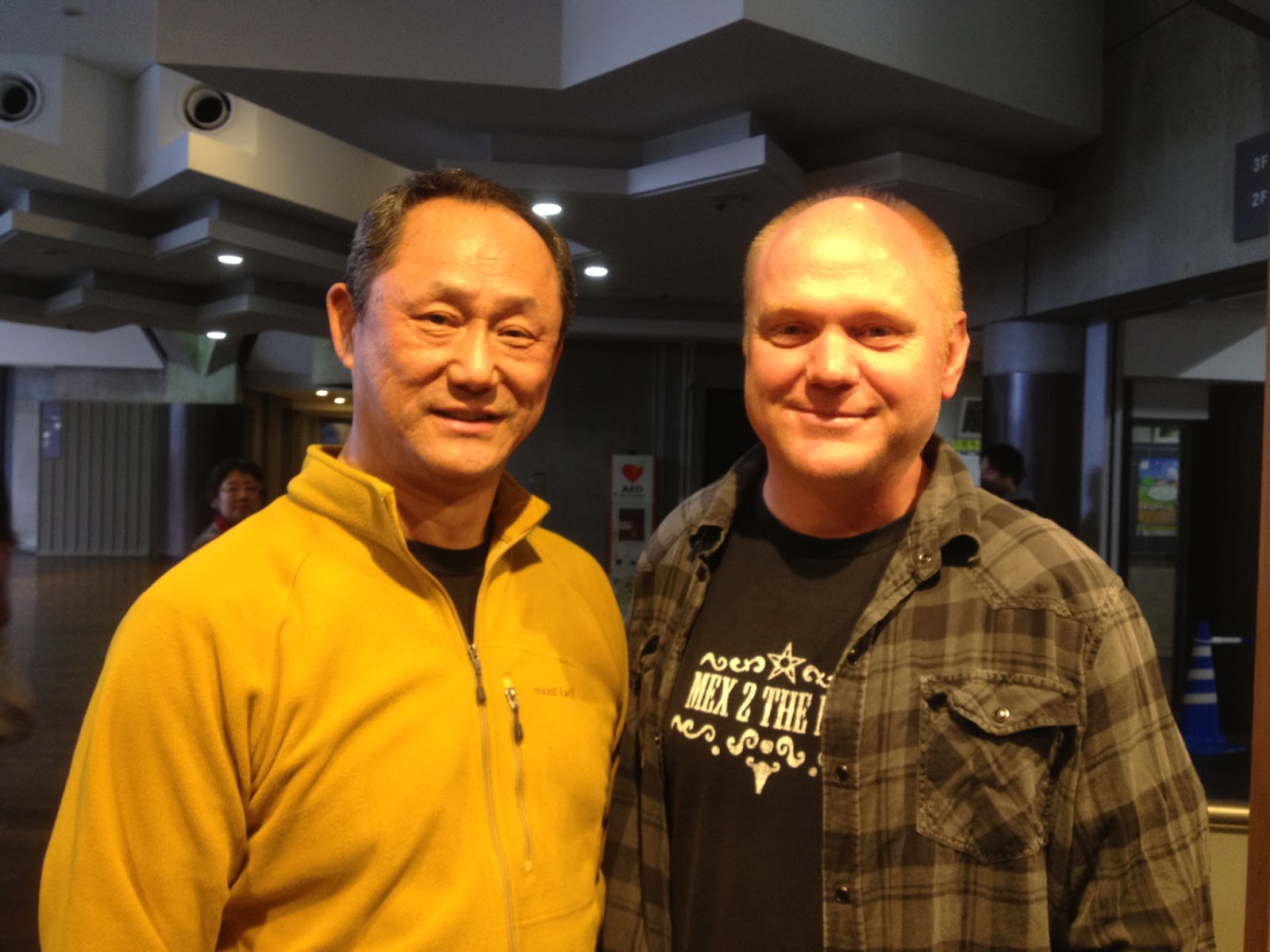
Nagato Sensei with Michael Glenn
During the Kunoichi Taikai, Soke asked Vanessa Adán to show some things from her experience dealing with mentally disturbed or drugged patients at a hospital. Patients are often bigger and stronger than the nurses who have to deal with them. Especially for smaller women nurses.

Patients may act violently and react with aggression. Hatsumi Sensei suggested that we learn to
"Move in such a way that the opponent doesn't resist. He doesn't continue to fight or create more agrression."
Of course in these jobs, one of the key challenges is to calm, subdue, or control the patient without injury to them or the staff. This can be difficult in a chaotic situation where accidents may occur. Another strategy Soke gave us was,
"to move in such a way that it doesn't give the opponent any feeling. Once you feel something, you need to be able to change. Otherwise there will be an accident or something will happen. Move in such a way that you're not a catalyst for an accident."
Sensei also advised us to use our surroundings. For example using a chair to unbalance or as a barrier between yourself and the opponent. He said,
"This is important, because the obstacle… the chair becomes a weapon."
Since there were no chairs on the mats at Ayase, Sensei asked Nagato to be a chair. Nagato crouched down on all fours. This itself was a lesson to everyone.

I've seen Hatsumi Sensei ask his senior students to do things that are somewhat embarrassing or seemingly beneath someone of their stature. Yet, they never seem fazed or unwilling to cooperate. They have so much respect for their teacher, and Sensei always makes these requests without ego or pretense. I don't think Nagato would very likely pose as a piece of furniture for anyone else except Soke.

So Nagato Sensei is posed on the ground as a chair. Soke knocks the "patient" down across Nagato's back and says, "Then the chair picks him up and takes him away."

Nagato stands up with the guy slung across his back and walks away. Hatsumi Sensei says, "he might be a very strong nurse!"…

Nagato Sensei: A Very Strong Nurse

From Bujinkan Santa Monica by Michael

Nagato Sensei with Michael Glenn
During the Kunoichi Taikai, Soke asked Vanessa Adán to show some things from her experience dealing with mentally disturbed or drugged patients at a hospital. Patients are often bigger and stronger than the nurses who have to deal with them. Especially for smaller women nurses.

Patients may act violently and react with aggression. Hatsumi Sensei suggested that we learn to
"Move in such a way that the opponent doesn't resist. He doesn't continue to fight or create more agrression."
Of course in these jobs, one of the key challenges is to calm, subdue, or control the patient without injury to them or the staff. This can be difficult in a chaotic situation where accidents may occur. Another strategy Soke gave us was,
"to move in such a way that it doesn't give the opponent any feeling. Once you feel something, you need to be able to change. Otherwise there will be an accident or something will happen. Move in such a way that you're not a catalyst for an accident."
Sensei also advised us to use our surroundings. For example using a chair to unbalance or as a barrier between yourself and the opponent. He said,
"This is important, because the obstacle… the chair becomes a weapon."
Since there were no chairs on the mats at Ayase, Sensei asked Nagato to be a chair. Nagato crouched down on all fours. This itself was a lesson to everyone.

I've seen Hatsumi Sensei ask his senior students to do things that are somewhat embarrassing or seemingly beneath someone of their stature. Yet, they never seem fazed or unwilling to cooperate. They have so much respect for their teacher, and Sensei always makes these requests without ego or pretense. I don't think Nagato would very likely pose as a piece of furniture for anyone else except Soke.

So Nagato Sensei is posed on the ground as a chair. Soke knocks the "patient" down across Nagato's back and says, "Then the chair picks him up and takes him away."

Nagato stands up with the guy slung across his back and walks away. Hatsumi Sensei says, "he might be a very strong nurse!"…

Tsurugi: The Divine Sword

From Shiro Kuma's Weblog by kumablog

hsajcdh
Sensei taught a lot of things related to the Chinese sword during the last day of the Taikai.
This sword that we call Jian or Ken is in fact Tsurugi.
This is the weapon of the high level warriors.
Even though the Chinese jian / ken does not carry any “social meaning” the Japanese when referring to Tsurugi include their myth of creation in it. As you all know this is Kusanagi no Tsurugi * given by Susanô to his sister, the sun goddess Amateratsu. She later gave it to Ninigi no Mikoto** the grandfather of the famous emperor Jimmu as a proof of his divine origin.
Kusanagi no Tsurugi is one of the three regalia of the Japanese Emperors.***
So where “ken” is a simple sword, Tsurugi is linked to the divine.
Sensei introduced the day by insisting on the fact that it is impossible to understand Japanese warfare if one doesn’t study the three types of sword that created Japanese warfare expertise: Tsurugi, Tachi, Katana. Each refers to a specific period of development of Japan.
The use of the Tsurugi is so old that no written techniques have survived. They were recorded on animal skin or bamboo slivers (thin blades) and didn’t resist the passage of time. These times were chaotic times and Japan was not one country but a group of multiple little clans run by warlords.
The Tachi was the weapon of choice of the Bushi cast he said when permanent fighting was happening. The Katana became popular with the forced peace time set by Tokugawa Ieyasu (1603) and therefore was the weapon of the Samurai.
To make it clear only the Tsurugi and the Tachi were used in fight and Japanese martial arts are the result of using these weapons.
Sensei opened the morning session by asking a few Jûgodan to demonstrate their vision of Chi no Kata; and from there we moved to the Tsurugi. I must say that the Tsurugi is really a fantastic weapon that renders alive our taijutsu. Nagato sensei said in his class that if you don’t have a good taijutsu the Tsurugi cannot be used properly.
To begin sensei explained that the Tsurugi is stuck at the hip level ad that the footwork puts it naturally into the opponent attack. There is no thinking process. The sword pivots from this contact point right into uke’s attack. Deflecting the attack the tip of the blade is immediately pointing to uke’s body. The Sanshin motion of Chi no Kata becomes a natural reaction and no intention can be deciphered by the opponent.
Once again sensei said that this was mutô dori. We all know that mutô dori is a technique where you are unarmed facing an armed attacker. So it took me some point to figure out exactly what sensei was trying to say. I understood that the weapon was simply an added extension of the body. As you don’t think the word and as the sword moves with the body movements, you are moving naturally as if you had no weapon. And that is exactly what I meant earlier when saying that the Tsurugi was making your taijutsu alive. I honestly don’t know what people who didn’t attend the class can understand from what I’m writing here. But if you simply stick the Tsurugi to your hip and use your taijutsu, I’m sure that the majority will get what I’m trying to say here.
During the morning break, my friend Elias who like me had been used by sôke as uke came to me to share what he experienced. The situation we had to face were the same. Sensei asked us to attack and we stopped immediately because the tsurugi was aiming (on its own) towards our face. What Elias said to me was that the way sensei moved the tsurugi from the pivoting point at the hip made it impossible foe him to see it coming. And the reason was that sensei was keeping his elbow low so that no shoulder movement was being perceived. And when you did, it was too late. When hee asked me to attack him sensei modified his movement slightly. Instead og being completely invisible, he did some kind of seigan no kamae and got my attention on the tip of the blade a few centimeters away from y face. Then in both cases, sensei moved his forward foot a little more and stabbed us in the throat.
These two examples are quite interesting because they summarize the essence of fighting with the tsurugi. Elias didn’t see the second step forward because he couldn’t see the blade. I couldn’t perceive it either because my focus being on the blade the foot was hidden by it. Both examples demonstrate a high level of 見えない 技 mienai waza, techniques you cannot possibly see. But in both cases the end was the same, death.
To summarize this sensei said that tsurugi waza followed a specific sanshin: foot, spine, fingers. We already explained in various posts here the importance of the fingers. The fingers are the extension of your leg movement relayed by the spine. You must be able to change your fingers positioning while moving the body so that the blade is arriving straight to the 隙 suki (gap, space, weakness) in uke’s defense.
Another point that was important is distance. Sensei said that the difference between life and death in a fight often resumes itself to the thickness of a sheet of paper. When you master taijutsu the body moves at the exact distance of uke, not too far, not too close. And when you add the tsurugi your body must find the new perfect distance to be far and close enough of uke. A wrong distance will create new opportunities for uke. A correct distancee will stop uke in between two movements.
After thinking a lot about the tsurugi and thanks to this fantastic day I want to share here now two things that make it easier for me to use this sword:
1. You only have to do taijutsu, the blade moves by itself. Forget the blade. For example if you do a basic uke nagashi, do it with the tsurugi in your hand and see what is happening. Do not try to do anything with the sword, let it react on its own (mutô dori principle).
2. I spoke with sensei last Tuesday during training and he confirmed that I was right to think “hanbô jutsu” when training with the tsurugi. So next time you train use a hanbô. When you have the movement correct, replacce the hanbô by the tsurugi and see how similar they move. The tsurugi is not sharp on the major part of the blade so there is no risk for you.
Next week, I will record the basics of tsurugi for Budomart and koimartialart, and I will use all the knowledge I got this time to make it easy for all of us to learn this fantastic weapon.
*http://en.wikipedia.org/wiki/Kusanagi
**http://en.wikipedia.org/wiki/Ninigi-no-Mikoto
***http://en.wikipedia.org/wiki/Imperial_Regalia_of_Japan

…