Nagare Is Important to Nagare
From Shiro Kuma's Weblog by kumablog
The year 2014 began a few days ago and after wishing everyone a happy new year it is time to get back to the dôjô.From Shiro Kuma's Weblog by kumablog
Dear friends,
In this first day of the new year, I wanted to thank you for your support to this blog.
Read here the blog annual report, it is amazing! Thank you.
2013 has been an active year for us at Solkan Europe, www.budomart.eu, and www.koimartialart.com
We have released 18 new dvds with the help of our Indian Connection in Bangalore,
We have revamped totally our website making it more user friendly and more complete,
We have opened our download section, and the first titles are now available, many others will follow soon,
On the streaming side at koi we have uploaded many new dvds to cope with the development of our DVD market,
And we are working on our ebooks section with over twenty books being adapted and written right now!
2014 is the year of the horse and we are already galloping: seminars begin de pile up, trips to Japan, India, Europe, South America, Mexico are being setlled; new products dvds and ebooks are in the making, and a complete reorganization of ALL our platforms into one single one is under construction. We plan to realease it in about 6 to 8 months.
Take a tour of the new website and enjoy!
From The Magick & The Mundane » Bujinkan by Shawn Gray
Greetings!
Back after a _long_ hiatus, with a brief post to explain the theme for two Bujinkan seminars I’ll be doing in January – Vancouver (Jan 4/5) and Houston (Jan 11/12). Maybe writing this will also spur me on to go back and pick up Path to the Heart of the Flower, a story that I began to write in early 2012. I also have some other ideas that I’d like to write about, but it’s hard to find the time. Thanks to those of you who keep asking me to write, as it helps to keep it on my mind and pushes it a little higher up on the priority list. :)
When the seminar hosts asked me about a theme for training, I thought back over some important things that Hatsumi Sensei focused on in Hombu Dojo Keiko this past year. The official theme of training as announced at the beginning of the year was Ken (劔), the straight, double-edged sword, but as often happens with Sensei, the theme had completely morphed by the second half of the year. In fact, we rarely used Ken at all in training for most of the whole second half of the year. I’m not sure the reason, but we somehow found ourselves doing a lot of Muto Dori (無刀捕り) work against both regular Katana (刀) and Bo (棒). Sensei continued to stress the central importance of Muto Dori throughout the end of the year, with much mention of the role of Kyojitsu (虚実) within Muto Dori movement.
I’ve always liked to cheer for the underdog. I like strategies and techniques that enable a physically weaker person to even the odds against a physically stronger person. That’s why I like Gyokko Ryu movement. Sensei emphasized the importance of this kind of movement a lot early in the year, and especially at the Bujinkan Women’s Taikai in March. In fact, Sensei stressed that women’s self-defense was the last and greatest thing that he learned from Takamatsu Sensei, stating that this idea reflects the pinnacle of Taijutsu training. The use of weakness to defeat strength.
This idea is highlighted even further when the opponent has a weapon and the defender is unarmed. Facing a physically bigger, stronger opponent can be daunting enough as it is, let alone an opponent who’s trying to take your head off with a meter-long razor blade. Learning to deal with this type of situation is challenging for even the most skilled martial artists, which is precisely why Muto Dori should be practised with proper Kihon (基本, fundamentals / basics), practised well, and practised often. The lessons learned can be applied not only to classical scenarios with swords, but also to modern situations where an opponent might have a knife, a stick, or virtually any other kind of weapon. Or no weapon at all – Muto Dori principles can just as easily be applied against unarmed attacks.
That brings me to the concept of Kyojitsu (虚実). That’s Jitsu (“fact, truth”) with an ‘i’, not Jutsu (“art, technique”) with a ‘u’. Different words, different meanings, different spellings. The word Kyojitsu is made simply by putting the Kanji for “lie” or “falsehood” next to the Kanji for “truth” or “fact”. False-fact. Lie-truth. How does this make any sense? This is a great term because the composition of the term itself teaches us about the nature of its meaning. That is, that its nature is illogical. By definition, it doesn’t make sense. It’s not supposed to make sense. Sensei often talks about common sense being of no use in a fight – that one needs to throw away common sense in that situation and adopt un-common sense. Fighting is crazy, and war is insane. Why should one human being want to harm another human being in the first place? Perhaps that’s the actually the root of the issue, but standing around philosophizing about it in an illogical situation will only get you cut down by that meter-long razor blade. There’s a time for thinking, and a time for doing. Standing unarmed in front of a sword-wielding attacker is not a time for thinking. People involved in serious accidents or other life-threatening situations often say that in the midst of the craziness, in the midst of the chaos, it was as if their mind shut off and they went on to auto-pilot. That is, they stopped thinking, and just acted. To many people, even the idea of stop thinking sounds illogical. How do you stop thinking? Not by thinking about stopping. Only by doing it. This concept don’t think, just act is essential to Muto Dori. To do this, of course, requires a lot of practise. Your body needs to know what to do when you put it on auto-pilot, and it learns what to do through repetition, training, and practise. A Gokui (極意, mystery / secret) of Muto Dori teaches this importance of doing:
振りかざす太刀の下こそ地獄なれ
一と足すすめ先は極楽Furi kazasu tachi no shita koso jigoku nare
Ichi to ashi susume saki wa gokurakuHell under the upraised sword,
one step forward is paradise
So let me see, this angry guy is brandishing a meter-long razor blade at me, and you want me to … what? Stepping in might sound illogical (not to mention dangerous). On the spot, it might seem to make more sense to turn and run away (when in fact turning your back could be even more dangerous). This daring to step in, this stepping forward instead of away, this doing, is one example of Kyojitsu.
In thinking about these ideas, I realized that there’s a Kanji meaning “fighting” that is also pronounced “To”: 闘. One can therefore write Muto the regular way (無刀), which means “without a sword”, and one can also write Muto as 無闘, “without fighting”. (Wouldn’t you know it – the day after I realized this about these Kanji, I discovered the same use of it in Sensei’s latest book, Ninja Taizen.) This kind of wordplay is another example of Kyojitsu – first the word means one thing, and then it means something else. Or, you think it means one thing, when in reality it means another.
So this is the type of concept that we’re going to be working with at the two seminars I’ll be teaching in January – “Muto Dori – Muto No Kyojitsu” (無刀捕り:無闘の虚実). I guess you could also call it, “Head-scratching non-combative unarmed responses to armed attacks” if you like. :-) I hope this short article has helped to shed some light on the ideas behind the theme. If you’ll be in Vancouver or Houston during the dates listed above and would like to attend, please contact me on Facebook or by email at [email protected], or contact the seminar host directly via the Facebook page.
無刀捕りの極意は無闘捕りの得。
体術の極意は平和の道なりと知る。The secret of Muto Dori is achieving a state of non-combat.
The secret of Taijutsu is to know the path of peace.
~ Hatsumi Masaaki Soke ~
From Bujinkan Santa Monica by Michael
| Santa Claus in 浦和 Urawa, photo Michael Glenn |
I want a grappling hook and a ninja-to and an axe but my mother said that I have to stop throwing rocks and fighting.
Please bring us a new Hombu Dojo, or keep the old one standing.
I would like a throwing star and some nice things to eat. I am very fond of pie.
Please bring a smoke bomb. Uncle Wade said that he would make one but he has not done it yet and I don't believe he will
I want a bank that you can't open so mama won't spend my money.
Please don't put my axe in my stocking for you might stretch it.
Bring my little brother Andrew something or else he'll punch my cat's eyes out.
Give some Christmas spirit to all of the Bujinkan, so we all can be a great family around the world.
I want you to bring me a sword that won't break when my brother Andrew throws it. You needn't bring Andrew anything. He's bad.
I have a cat named "Zachy." Please put some chipped beef and waffles in his stocking for he is a good cat.
Please show me how to travel through chimneys so i can visit and train with my Bujinkan friends all over the world.
For Xmas I want a shikomi, a big red set of yoroi, and some boxing gloves so I can whip Andrew.
Please bring me a few of Soke's videos, and a new baby sister--one that don't squall and make a fuss all the time.
From Shiro Kuma's Weblog by kumablog
Then it was sensei’s class.
Unlike his usual behavior, sensei began the class without asking anyone to demonstrate. He was in a very good mood as it is often the case with him around his birthday.
Muto dori is definitely the expression of natural power.
Please read part 2 and 3
http://kumafr.wordpress.com/2013/12/12/a-fantastic-day-part-1/
From Shiro Kuma's Weblog by kumablog
Last night we had a very good class with Sôke where he spoke a lot about concepts. Seishin no jutsu 精神 の 術 was the general idea he tried to convey.
Seishin means: mind, soul, heart, spirit, intention, and I have to admit that the variety of these meanings are all true.
When sensei moved it look like he was doing nothing, playing only with uke’s mind. I was lucky to be uke a few times and each time I had the feeling I was totally lost. There was no danger, sensei was not violent, on the contrary, he was very relaxed as if not concerned by my useless attempts to get him.
He explained later that this Seishin no jutsu was based on the concept of kyojitsu no Kûkan 虚実 の 空間, or to put it in other words, to understand the 虚実混交, kyojitsu konkô, “a mishmash of truth and untruth, a mixture of fiction and fact”. By “making believe” that reality is not and conversely, Sensei makes his uke react in a way that is always detrimental to his survival. Interacting with Inyo, and time and space at the same time, Sôke destroys our willingness to fight.
We have to develop this ability to act without intention (seishin) and not give any strength to the opponent. When sensei was demonstrating he said that it is done without grabbing but applied with the whole body. The difficulty is to “move” the attacker without really using force.
This is when sensei added one extra level to his Seishin no jutsu by speaking of Zero no chikara ゼロ の 力 or 無 の 力, the power of Zero. The power of zero is what is experience when we take the Sakki 殺 気 test.
In fact after this class I begin to understand the simple complexity of Hatsumi sensei’s vision. The bujinkan is about releasing the “natural movement ” and this is achieved when we are always one i.e. zero at the Sakki level.
Good luck!
From Bujinkan Santa Monica by Michael
![]() |
| Hatsumi Sensei gets into Michael Glenn's head. photo by |
From Shiro Kuma's Weblog by kumablog
This is my second day here and it is time to write about the first feelings discovered so far. Many friends are here from all over the world, but there will be no DKMS, we have enough space to train properly. The feeling these days is very nice. I have been attending the DKMS since 1990 and it is always a special moment in the bujinkan life as this is the birthday of our Soke.
This year no taikai but a nice gathering on Monday night for his birthday at the honbu, like it was the case some ten years ago. The dojo is filled with food and beverages, a keg of sake is positioned under the shinden and everyone is having a good time. A dôjô is not a dead room, it is a place to live in.
Today during Nagato sensei’s class, Beth from Scotland, who had just been promoted to judan by Lubos yesterday, opened the class. For once we avoided the too common Ô soto gake as she did a Nage Kaeshi technique. This Was a nice pick as it gave us an opportunity to better study the feeling of Nage waza used in the bujinkan.
Our Nage waza are different from Jûdô as we use any opening given by the opponent/grabber to finish him right away.
Nagato sensei stressed many times that Jûdô was a sport and that the mutual grabbing of the opponents should never occur in a real fight.
When someone grabs you, grabbing back is the insurance of being thrown right away. Nagato sensei said that in sport there is no risk the attacker will tsuki you but in real fight it is more likely going to happen. This is why instead of grabbing the gi, you should secure the left hand of uke.
Each time Eugenio (Nagato sensei’s uke) was coming close to him for grabbing Nagato sensei’s would:
1) take some distance,
2) fake grabbing back.
Those two steps are important but remain useless if you let the grabber actually grab you. He said that the jûdôka were fast and powerful and that distancing yourself from the grabbing hands was buying you some time to counter the technique. In the bujinkan tenchijin the Nage kaeshi (counter throws) are done at three different moments which are:
1) before the grab,
2) during the grab,
3) after the grab (often with a Ryû Sui Iki technique).
He has been training Jûdô and he said that it was difficult for him to understand the Nage waza of the Bujinkan because of that. Coming from a Jûdô sport background, he added that it took him many years to stop grabbing the opponent back. I trained Jûdô for 17 years myself and it took me at least 8 years to stop reacting like the pavlov dog in these circumstances. I was happy to discover that it happened to him too.
In fact, being a former jûdôka, I found this class full of insights and I guess that we will train these movements the way we learnt them today when I come back to my dôjô.
As it is often the case, there were many small technical points to work with.
Understanding the gokui of Nage waza is understanding that every move is omote or ura, forward and backward depending on uke s way of attacking. Nagato sensei said that you should not know beforehand what you were going to do but simply react to the attack in the most appropriate manner. Once the distancing and the fake grab in action, do your best to react according to uke. And this is why your answer to his question is either omote or ura.
Also you should not grab back but stay relaxed and fake it. The moment you grab your opponent back firmly you fly. Don t grab! This is why he qualified our style of nage of being not Jûdô but jûjutsu.
Speed is forbidden, be as slow as possible. Speed is often the main cause of failure in jujutsu. If you fall the opponent doesn t stop but continues until you are submitted.
This way of reacting works the same whether uke grabs or punches. Only the footwork changes. Bujinkan is about footwork not about technique. We are training a jutsu not a dô and there is no second chance.
As we are used to do, the entry is done through kamae. Our kamae shield the attack and provide the opening in uke’s defence that allow us to counter his attempts efficiently.
Speaking with Eugenio after the class, he explained to me how he felt the throws being applied to him during the 70 minutes he spent in hell. He was asked to attack many times and each time went flying through the dôjô.
I will try to translate his feelings herunder.
The first part of the throw that Nagato sensei did was always getting the balance from the shoulders which created an off balancing from the upper part of the body. Taking the balance from the shoulders (like you would when fighting an opponent with yoroi) was putting uke in a precarious posture. Uke trying not to fall would then give openings allowing him to place his hip and throw. Eugenio who was the Uke for the whole series of variation never had a chance to recover his balance. Once his attack was launched then he was doomed and was thrown each time. There was no recovery possible.
At the end Nagato sensei summarized the Nage waza as follow.
Let the technique happen by itself. In fact he stressed that there were no technique and this is why the Bujinkan is not a sport like Jûdô.
By not doing anything we let the natural flow unfold and no Nage can be applied.
Added comment: my understanding would not have been the same without training with a fantastic partner during that class, “El Juan Manuel G”. Gracias.
From Bujinkan Santa Monica by Michael
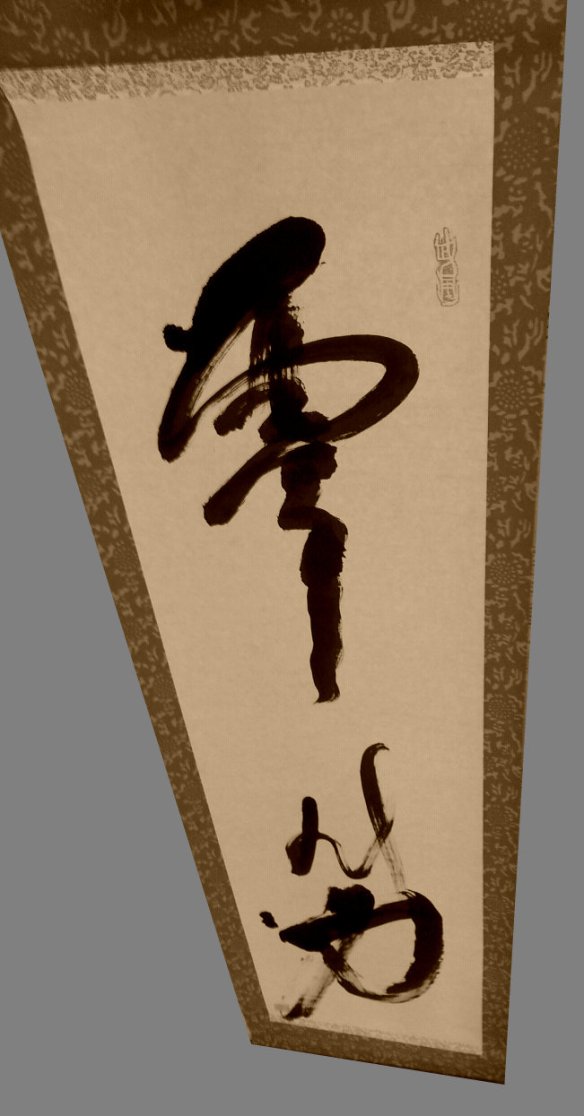
| 無 mu near Kitasenju, photo by Michael Glenn |
From Shiro Kuma's Weblog by kumablog
While teaching in India it occurred to me that the Tenchijin is a set of RyaKu not techniques. The Japanese language makes a difference between the way a, 技 (technique) and the Kata 型 (model, arrangement of techniques).
Ryaku 略 has the meaning of “abreviation” or “outline”. This means that the Tenchijin is not about techniques but is a group of outlined forms and model, leading to the understanding of the essence of techniques.
This is maybe why at the end of the Tenchijin it is said that “there are no fundamental techniques” in the Bujinkan.
Thinking deeper in the system we can also see that the three parts composing the programme are in fact defining a new Sanshin:
The Ten represents the learning of footwork;
the Chi exposes the biomechanical aspect of waza;
the Jin then being the mix of the first two parts and displayed in the form of Kata taken from the 9 ryūha.
The concept of Ryaku makes it much more easy to reach the natural flow shown by sensei.
Don’t make dead forms from the techniques and models of the Tenchijin, let them free to adjust naturally to the flow of things.