Skip to content

Tōtoku Hyōshi, Protect Your Self

From Shiro Kuma's Blog by kumablog

image

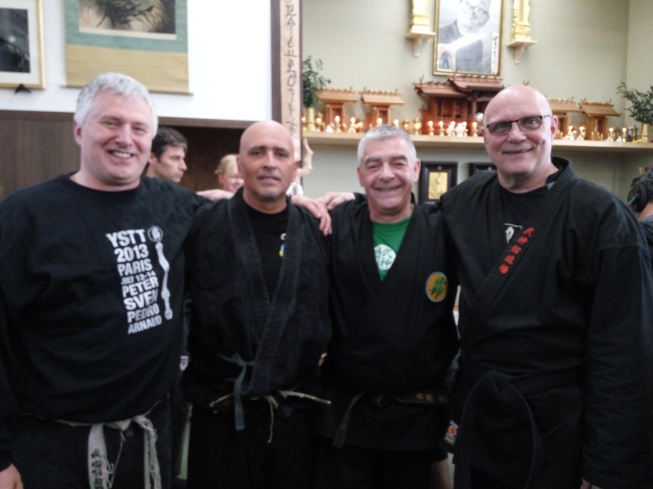
To say that yesterday night, the Honbu was packed would be an understatement. There were so many people that my camera couldn’t focus properly. :mrgreen:
And there are still new people pouring in every day. Next Friday, I guess that some might have to train outside!

Sven, who arrived the day before, opened the class with a movement (grab + tsuki), that allowed sensei to dwell into the Tōtoku Hyōshi and many other concepts.

We all know Tōtoku Hyōshi, a biken jutsu Kamae where, in Hanza, we (supposedly) protect the body and dodge a Shuriken, with the blade put vertically in front of us. (1)

But yesterday, Sensei, teaching Mutō Dori, simply used his shoulder. Lifting his shoulder, he was deflecting the tsuki by turning in, and applying a kind of Omote Gyaku on the grabbing hand. This subtle lift of the shoulder acted as a Ô Sode (the shield on the Yoroi) and protected him, even though he was getting closer.

The movement was so slow and relaxed that uke was falling into a Kûkan. There was no opposition, no intention at all. Once again, he insisted on not putting any strength (Chikara janai), and on not grabbing. Then Sensei added a few times that we have to use “Nuku”, to slip into the distance.

Using Moguri, Sensei lowered his hips, throwing his elbow towards the face of Uke. There was no physical contact, but the attacker reacted with his whole body, which gave the opening for Sensei to apply a sort of Omote Gyaku. (3) 
This was not the regular Omote Gyaku as Sensei pivoting in,  grabbed the forearm and drove his four fingers deep into the flesh to reach the tendons.

I asked him to feel the movement, and you can see the result in the picture. It felt like being crushed by the claws of an eagle. While the pain was building up when he dug deeper and deeper into my forearm, I noticed that the rest of his body remained totally relaxed. Impressive … and very painful. Remember that pain is your best teacher.

Hatsumi sensei said, this grab was Shishin ken. (4) Too often, practitioners think of “shishin” as being only the pinky. In fact, each finger can be used to do it. (5) He also illustrated it by using his “claws”, with double digging on the face, the ears, and poking the eyes. (6)

image

During the rest of the class, Sensei showed how to apply all of these concepts against sword or knives. Being zero is the hardest thing to do. The brain understands what being “zero” means, but it is hard to express it with the body. In order to achieve it, you have to let go of the forms that built your taijutsu, and free yourself of any intent. As Yamaoka Tesshû said, even if you’re facing certain death, don’t hesitate and move forward.

After the Sakki tests, I spoke to Rico,  a new Shidōshi from Delaware Bujinkan Dōjō, who did a nice test. He said that “at first I had a lot of fear,  then I let go, and my body did it. I only knew that I succeeded when, standing up, I heard the people applauding”. The Bujinkan is about “letting go” and “not being afraid”, this is Kuki Taishō.*

On the mats, you will get pain. But each time you freak out instead of facing the opponent, you lose a chance to improve yourself. Training is useless if you don’t use it to develop your inner strength. Dōjō training allows you to learn concepts such as Tōtoku Hyōshi, Nuku, Moguri, Shishin Ken, and to apply them in your daily lives. If you don’t get that, then I think you are losing your time on the mats.

Don’t be a “nuku”. (7) Train harder with sincerity, and work to become a true human being by using the protection of Tōtoku Hyōshi !
___________________

1. 表紙/hyōshi/front cover; binding
2. 抜く/nuku/to extract; to omit; to surpass; to overtake; to draw out; to unplug|to do something to the end
抜ける/nukeru/to come out; to fall out; to be omitted; to be missing; to escape; to come loose|to fade; to discolour|to wear a hole (e.g. clothes)|to leave (e.g. a meeting)|to be clear; to be transparent (e.g. of the sky)|to be stupid; to be absentminded; to be careless; to be inattentive|to exit (a program loop).
Note: there’s also another “politically incorrect” meaning for this word.
3. 潜り/moguri/diving; diver|unlicensed (doctor, driver, etc.); unregistered; unqualified
4. 指針/shishin/needle ; indicator; pointer; index|guiding principle; guideline; guide
5. I think that this is because in the Tōgakure Ryû Ninpō Taijutsu book (published in 1983 by Sensei), the technique is only shown with the pinky. I have to repeat here, that this knowledge can only be acquired here in Japan when you train with Sōke. You have to experience it directly from the source. 
6. Sensei was always using two fingers,  one inside the eye socket, one inside the ear. Fernando, Pedro, Oliver and others can show you their marks. 
7. 温/nuku/idiot; dummy; slow person
* More on Kuki Taishō at http://www.koimartialart.com


Yoko Or Jûji Aruki?

From Shiro Kuma's Blog by kumablog

image

Koto Ryû is Yoko Aruki, in the same way Gyokko ryû is Jûji Aruki. (1)
Each fighting system of the Bujinkan has its particular details. In these two systems, because of the initial distance, the way to cross your legs while fighting, is logical. But this logic has to be enforced in your habits. And, believe me, is not that easy to get it right. (2)

We did some Koto Ryû taijutsu with Noguchi sensei, and I had a hard time crossing my legs correctly on each movement. I am more a Gyokko man.
I got it right only when I began to train more slowly and kept my feet facing the same direction. Slow speed in the acquisition process, is very important to get this footwork motion right.

As often in the Bujinkan, this is not the upper part of the body that matters, but the legs. You know that Bujinkan is about aruki. It couldn’t be more accurate than during this class.

Last Friday, Hatsumi sensei spoke about the difference between the levels of omote waza and ura waza. His point, was that omote is physical, and is mental. But depending on the fighting system you train in, and of your technical level, there are other interpretations.
Omote waza / arms, upper body – ura waza / legs, lower body 
Omote waza / simple – ura waza / complex 
Omote waza / standard teaching – ura waza / secret teaching 
Omote waza / beginner level – ura waza / advanced level 
Omote waza / obvious – ura waza / complex 
Omote waza / hands – ura waza / feet

On Sunday, Noguchi sensei’s movements were refreshing, and the lines of his legs defined a very nice Koto ryû space. The straight footwork of the Koto ryû have the correct distancing m and he could get his partner off balance without any strength.
At one point, he insisted on going beyond the form, destructuring the original waza, in order to adapt it to uke’s reactions. It was a nice warm up that made sense when the class with Sōke began right after his.

When in Japan, do not focus on the way Sensei and the Shihan unfold the techniques. Whatever they do, it will never be exactly what the original text say. Instead, try to “read between the lines” and learn how to “read” their movements. This is the best way to improve your taijutsu. Obviously, it requires that you already know quite well the waza of every fighting system of the Bujinkan.
Free flow comes from good basics. How do you want to adjust a movement if you don’t know it in the first place? Is impossible. Learn the waza, train the waza, then go to Japan and learn the flow of natural movement. This is why you train ride basics in your dōjō. The tenchijin leads to the ryûha (taijutsu and Buki). Ryûha lead to the honbu. There’s no shortcut. Excellence is based on the correct training in the fundamentals.

Often I hear practitioners complaining that classes are not for beginners. Maybe that is why Sensei keeps repeating that he is teaching for Jūgodan.
Understand me well. It is ok for beginners to come and train in Japan, but it will not be easy. At least they will have good memories.
Beginners should come for the omote waza, advanced practitioners for the ura waza. 
________________________
1. Reminder to beginners: Yoko aruki and Jûji aruki are two different ways of cruising the legs. Toes and feet facing the same direction = Koto ryû ; toes and feet perpendicular = Gyokko ryû. 
2. Koto ryû having an initial distance of 2m, the movements are more aligned than in the short distance Gyokko, where twisting the body up and down is more logical (distance 60cm)


Shinobi Is Kokoro

From Shiro Kuma's Blog by kumablog

image

The class with Senō sensei was as impressive and precise as always. With micro details such as rotating the bones of the forearm, and folding the wrist slightly during the uke nagashi, we are able to take Uke’s balance before he could feel it. I could write about it, but it will never describe the beauty of his taijutsu. The best is to come here and to train. What I want to write about today is about one thing Senō sensei’s commented before the end of the training session.

At the end of his class, Senō sensei spoke about the meaning  of the kanji for Shinobi. Honestly, I didn’t get everything (I still don’t speak Japanese), but what I got,  made me think about the many hidden meanings of this kanji. I would like to share my thoughts with you.

Everyone in the Bujinkan knows that Shinobi is composed of 2 kanji: sword (Tō) above heart/spirit (kokoro). (1)(2)(3) So nothing new there.

So, to me, what was new in the way Senō sensei explained it is that he said that “the blade is hidden in the heart/spirit”. The usual and common understanding is that we must “have a spirit as sharp as a sword”. This is why Senō sensei’s interpretation acted as an eye opener.

What I understood is that, linked to what Hatsumi sensei said the day before, we have to hide our intention, and be ready to terminate the opponent when the occasion arises. A Waza is intention, this is why there can be no waza in a real fight.

A waza by definition is a drilled exercise repeated thousands of times until it is ingrained in our mind / body. (4) To get this level of ability, one must repeat his basics during many hours, months, and years. At some point, there is no thinking, only a natural movement. This is what you did when you listened to ride a bike,  or when you learned to swim. Even if you don’t it regularly you can ride a bike, or swim the minute you do it again.

When you have acquired this ingrained state, the mind / body reacts and the only thing you do is to witness what is happening. You’re not actor, but spectator of your actions.

In a real fight, you have no time to think. Thinking is possible only when you train. When you fight it is to late.

If your basics are bad because you didn’t spend enough time studying the tenchijin and the fighting systems of the Bujinkan, you will never be able to adapt your taijutsu to the situation.

On the contrary, if you did your homework, your mind / body will slash the opponent naturally.

When you put intention in your movements,  it is because of a lack of mastery of the basics of the Bujinkan. Many dōjō are developing a mix martial art approach of the Bujinkan, instead of respecting Hatsumi sensei’s path of the natural movement because of these weak basics. In sport, nothing is natural, it is mechanical.

How many time did I hear Sensei say “chikara janai”, don’t use strength ? Or use your “karada”, your body? The problem with us, Westerners, is that we cannot fathom how we can be efficient without thinking thoroughly, and using strength. For many,  “Mushin” is only a nice philosophical concept. (5)

At the beginning of the year, Hatsumi sensei spoke about Yamaoka Tesshû (1836-1888, famous swordsman, calligrapher, and Zen master). Yamaoka developed the “sword of no-sword” concept. This is another definition of Mutō Dori. (6)

When the sword is hidden in the heart/spirit there is no sword visible, and therefore there is no intention. And because there is no intention, only the heart / spirit remains. “be slow and relaxed” said Sensei on Sunday, “and the movement will reveal itself”.

The sword but visible, only the kokoro is there. Maybe this is why Takamatsu Sensei wrote about “kokoro no Budō”, the heart /spirit of Budō.

Next Saturday we celebrate Takamatsu sensei’s memory. Please think about it.

__________________
1. 忍び/shinobi/stealth|travelling incognito (traveling)|ninjutsu|ninja|sneak theft; sneak thief|tolerance
2. 刀/tō/(single-edged) sword; katana|dagger; knife|scalpel
3. 心/kokoro/mind; heart; spirit|the meaning of a phrase (riddle, etc.)
4. I use “mind / body” as being one and not two. There is no duality. Inyō is unity. 
5. 無心/mushin/innocence|insentient (i.e. plants, inanimate objects, etc.)|free from obstructive thoughts|to pester someone (for cash, etc.)
6. Reminder: mutō dori is about facing the attacker with no fear, even if it is lethal. [for more, check mutō dori in this blog]

Sidenote: For those wondering. Stephen Hayes, moving away from the Bujinkan, called his system Tōshindō (sword+heart+path = Shinobi path). But that has nothing to do with the bujinkan.


Zen Tai 全体

From Kasumi An Study Center  霞庵 スタディセンター by Kasumi An Study Center

When you come to Japan, you may often hear the expression `zen tai`.  Simply translated, it means 全 whole/complete and 体 body/essence.  In the dojo, Hatsumi Sensei uses this to describe the movement to which we should aspire in our taijutsu, moving with our whole body, integrated and one.  In the beginning it is natural that we move our hands and feet in a disconnected and often awkward manner.  Think of it as puberty!  We are always a bit embarrassed when your family pulls out a picture of us from our awkward years.  So it is natural to go thru an awkward puberty again in taijutsu! Maybe this is what keeps us young on the path.  It seems I am constantly going thru puberty in my taijutsu trying to keep up with my teacher! But once we pass thru puberty, we begin integration.  Learning to move as an adult, as a human, from the essence of humanity.

In my dojo in Japan, Kasumian Study Center, I often use a trick my teacher taught me.  I strap the arms of my students to their sides to force them at first to move physically from their center and whole.  Look at the word holy, when you are moving from the whole as one, from your very essence, you become holy.   Your movement can take on a sacredness.  But don`t get caught in religion here.  Think of it more naturally, when standing near a waterfall, small droplets of water hitting your cheeks can feel refreshing.  They are individual drops separate from the stream, they have broken away and become separate.    Now stand under the waterfall and feel the crushing force of all the drops that are moving as one.  Even a small waterfall can effect enormous  power because it is moving wholly.

onamiThis reminds me of a zen parable about a great wrestler named OoNami (Big Wave)  He was of great build unstoppable in practice, throwing all opponents with ease. Even his teachers could not keep up with him during training, such was his ability and stunning techniques. But before every match, without fail, he would get so nervous and cowardly that he could barely stand and he would lose every competition. He would even lose to his students. He was fractured, not moving as one, he was disconnected. Just a bunch of moving parts, not crystallized as one.  He was so frustrated that he went to a Zen master for help.  The Zen master told him, “if your name is big wave, don’t think of yourself as a cowardly wrestler. But imagine yourself to be a great huge wave! A tsunami that engulfs and washes away all in your path! If you can see that, you will become instantly the number one wrestler in the country. You will beatable!”. In the temple that evening, he tried hard to envision himself a wave but his thoughts were disturbing him. Then slowly he started to feel the wave growing in him. As it grew later in the evening, the wave grew too, washing away the flower vases around him. The wave grew stronger still and washed away the statues of the deities in temple. And yet it grew bigger, washing away the temple and finally it engulfed the whole grounds of the temple washing everything away.  At that moment, the master spoke, “You have done it! You will be unstoppable like this wave now.”. From that day on he moved as the ocean, with the force and power of great waves, like a tsunami.  He became the number one wrestler in the land, sweeping away his opponents with ease.  He became the tsunami.  He became integrated and whole, each cell and fiber moving as one.  Hatsumi Sensei would often tell us to become like a tsunami. A series of unconnected attacks or techniques will not defeat an opponent. But a connect whole, a flow, a wave like a tsunami will fell the toughest opponent.  Zen Tai, whole essence, whole body, imagine you are the tsunami, and flow with natural power and rhythm!

Heijōshin vs Heijōshin And Other Considerations

From Shiro Kuma's Blog by kumablog

image

Every time I’m here, I have the feeling that Sensei’s Budō is getting more subtle.

The theme this year is multiple (like it is always the case) and revolves around Mutō Dori, the Katana, and the concept of zero. 

Hatsumi sensei precised that “zero is not nothing, it is a point”. It’s not empty. I understand it as another form of inyō. (1) 
Because there is nothing, there is everything. Inyō represents the cosmic dual forces, but it is not dualistic. There is no opposition, there is only 真心, reality. (3)

Sensei exclaimed this apparent paradox speaking about 平常心, Heijōshin, “one’s presence of mind”. (2) 
In the encounter with the opponent, one must not show his intention, one must have no feeling. Having no feeling, Tori simply surfs on Uke’s intention. The situation is read and answered naturally. 
Because you don’t have any intention, you can react naturally, which is why Sensei that Heijōshin is in fact Heijōshin 平常真心, with “shin” being “magokoro”, sincerity or reality. (3)

Being zero,  you can adjust to reality and defeat the attacker with no intention. Uke is trapped by his actions. 
This is why, he said, there’s no waza. Waza will get you killed in a real encounter. A waza is a form, it is not zero. If you remain zero and shows no feeling nor intention, you can use uke’s the against him. 
This is Kyojitsu tenkan hō (虚実転換法), and Kyojitsu tenkan hō  (虚実転換方). Alternating strength and weakness, intention and lack of intention, you force uke to stay in his waza state. Uke reacts to his own movements and cannot see defeat before it is too late for him. This is the essence of Mutō Dori,  whether you have it haven’t a weapon.

Like with Ishitobashi, the skipping stone of last year, the various kûkan created between the contacts with water, unfold possibilities invisible to uke’s intentions. (5)

Tenkan Hō is like Henka. The beginning of change (hen/tenkan) and the end of change (ka/hō).

At the beginning, I wrote that the theme of this year “revolved” around Mutō Dori. Amazingly, Tenkan also has the meaning of revolving, and defines your ability to alternate intention and no intention. 
Therefore, we must see Heijōshin, (平常真心) as the true essence of Mutō Dori. 
I told you that sensei is getting more subtle, didn’t I?
______________________
1. 陰陽/inyou/cosmic dual forces; yin-yang; sun and moon, etc.
2. 平常心/heijoushin/one’s self-possession; one’s presence of mind
3. 真心/magokoro/sincerity; devotion; reality
4. Kyojitsu tenkan hō
虚実/kyojitsu/truth or falsehood
転換/tenkan/convert; divert
法/hou/law; act; principle|method|mood|dharma
方/hou/direction; way; side; area (in a particular direction)|side (of an argument, etc.); one’s part|type; category|field (of study, etc.)|indicates one side of a comparison|way; method; manner; means|length (of each side of a square)
5. Ishitobashi 
石飛ばし/ishitobashi/skipping stones (on a body of water); skimming stones
6. 転めく/kurumeku/to spin; to revolve; to twirl|to be dizzy; to feel faint|to bustle about


Kūkan (空関): The Empty Gate

From Bujinkan – The Magick & The Mundane by Shawn Gray

When I was asked for a theme for three upcoming Bujinkan seminars (details below) that I’ve been invited to give in April, the concept of Kūkan immediately came to mind. Kūkan is a term that gets thrown around a lot in the Bujinkan, and Chris Taylor, host of the Vancouver seminar, asked me to elaborate more specifically on how we’ll be approaching it…

When Hatsumi Sōke uses the word Kūkan in the Dōjō, it’s most often simply translated into English as “space”, but as is often the case when Sōke speaks, there is frequently a deeper sense than can be conveyed in a single word, and the translator is often pressed to succinctly express the full meaning of one idea as Sōke quickly moves on to the next. For instance, there’s another word that Sōke uses from time to time that’s also translated as “space”: Kokū. In both Kūkan and Kokū, the same character for ( 空 ) is used, which has the meaning of emptiness or void. When this character is pronounced Sora, it means “sky”. It can also be pronounced Kara, as in Karate ( 空手 – “empty hand” ).

But while both Kūkan and Kokū are often simply translated in the Dōjō as “space”, they have quite different meanings. Kokū refers to boundless, limitless space, space that has no borders or boundaries. This term thus often refers to the heavens, the cosmos – outer space. Kūkan, on the other hand, could in one sense be rendered as inner space – it refers to space that has borders or boundaries by which it is outlined or enclosed and by which the shape, dimensions / size, or range (distance) of the space are defined. The character normally used for the Kan of Kūkan is 間, which depicts a sun ( 日 ) in the space between the two doors of a gate ( 門 ). The doors define the space or interval that the sun’s light shines through. This character for Kan can also be pronounced Ma, and it is used in this form in another term often used in the Dōjō – the term Ma-ai ( 間合 ), meaning “distance”, the interval between two points.

In thinking about the theme for the upcoming seminars, however, I decided to play with the characters a bit. Instead of the Kan normally used in Kūkan, I thought of another Kan – the character used in the word for “joint”, Kansetsu ( 関節 ). This came to mind because the skeletal joints are an example of Kūkan within the body structure. The little spaces between our finger joints, for example, are what enable us to use our hands with a dexterity that wouldn’t be possible if our fingers were each formed from a single, solid bone. (Similarly, the links in a chain employ empty space for flexibility – and even a rope derives its suppleness EmptyGatefrom the small spaces between the strands of which it is composed.) This Kan ( 関 ) is used to convey connection and relatedness. Budō ni kan-suru ( 武道に関する ) means “related to Budō”, for example. So Kūkan written as 空関 has the sense of “related to empty space”.

Additionally, the character 関 literally means “barrier” or “gate” (a gate being a wall or barrier with an opening in it). Thus, Kūkan written as 空関 also has the sense of being “void of impediment or obstacle” in addition to the sense of relation to empty space, and it’s this idea that I’d like to get across in the Taijutsu techniques that we’ll be working on in the upcoming seminars. Creating space allows one to pass through obstacles without impediment, resulting in smooth, effortless, and efficient movement in the same way that one passes through the empty space in a wall created by a door or gate. An opening is an opportunity that may look like nothing – and it is! That’s what makes it useful. I sum up this paradox with the phrase Nai ga aru ( 無いが有る ), meaning Nothing (or more accurately, nothingness) exists. The theme of these seminars thus refers to finding and creating empty spaces, and using those openings to one’s advantage in Taijutsu. I look forward to seeing many of you in Stockholm, Brussels, and Vancouver!

Kūkan Ikkan!

Shawn Gray
Ryūun (龍雲)

160430 Seminar T-Shirt
~ Upcoming Seminars (2016) ~
“Kūkan: Nai Ga Aru”

Apr 16-17 – Stockholm (details)
Contact: Kent Thorén (email)

Apr 23-24 – Brussels (details)
Contact: Jan Ramboer (Facebook)

Apr 30 – Vancouver
Contact: Chris Taylor (Facebook)


Shin Shin Shin Gan 神心神眼

From Kasumi An Study Center  霞庵 スタディセンター by Kasumi An Study Center

Shin Shin Shin Gan is an expression you may hear during your training in Japan.  It can be translated as the heart and the eyes of the divine.  Shin 神 (kami, sacred, divine) Shin 心 (heart) Shin 神 Gan 眼 (eyes). Shin Shin Shin Gan.  shinshinshingan

Your eyes can be easily deceived.  In fact, all of our limited senses can be easily deceived.  Just think of the magician that makes a tiger appear in an empty box.  The tiger is not appearing out of the air, it is skillfully hidden in the unseen compartments of the box or stage.  But we are very surprised.  We pay a lot of money to see magicians fool our eyes and senses.  Sometimes it is pleasant to be fooled and sometimes not so pleasant.  The ladyboys in Thailand love fooling the love hungry military boys coming in off the ships! Maybe it is best they never know the truth!

It reminds me of a story.  In the honbu dojo in Noda, Hatsumi Sensei has a picture in the dojo of a woman putting on makeup.  He once told me it represents Yamato Takeru No Mikoto, a Japanese legendary prince of the Yamato Dynasty. To kill a very powerful enemy, he once dressed as a woman maid attendant at a drinking party and successfully assassinated his opponent.  Yamato_Takeru_at_16-crop

Even a picture in the dojo fooled me. You can be looking at something directly for many years and not know what it is!

A true ninja cultivates the heart and eyes of the divine.  Not seeing with just the eyes, not listening with just the ears, not tasting with just the tongue, not smelling with just the nose, not feeling with just the hands.  If you don`t cultivate yourself, you will be fooled over and over.  You will continue to chose poorly and find yourself at the point of your opponent`s blade.  This is true for choosing teachers as well, if you choose wisely, you will have a wonderful experience. Choose poorly, and you will find yourself on a dark and perilous road.  But don`t worry, in the end, both will die!

Those that have cultivated the heart and eyes of the divine are like sunflowers.  They don`t choose any more.  They just move.  When the sun rises in the easy, they turn their faces to the light, when the light moves to the west, they turn their faces westward.  Moving with the light, they don`t choose, they just move in the direction of light naturally, without thought.  A true ninja is like a sunflower, it is hard to judge him because we are always fooled choosing this or that, but he is always moving naturally with the good.Sunflower-Sunset-HD-Images-Wallpaper1

Chikara wo Nuku 力を抜く

From Kasumi An Study Center  霞庵 スタディセンター by Kasumi An Study Center

In the dojo, you often here the expression, Chikara wo Nuku.  Chikara 力 means power or force.  Nuku 抜く means to pull out or withdraw.  You may hear for example `katana wo nuku`, to pull out (unsheathe) your sword.  This concept is not only important in martial arts but the married life arts as well.  Married couples can appreciate the importance of knowing the timing of pulling out the sword!! There is also an expression when a fighting couple makes up, moto no saya ni osomatta 元の鞘に納まった.- the sword is re sheathed in it`s old (original) scabbard. But enough of my sukebe (lewd) talk!

Chikara wo nuku is the ability to drop or release power in a proper manner and timing when you feel resistance in an exchange with the opponent. In taijutsu, you can either create a tension and release it or you receive tension from your opponent and skillfully misdirect and release it. Properly executed, you can create moments of great surprise for your opponent.  like accidentaly stepping off a curb, or when an airplane hits an air pocket and the plane suddenly drops. Those moments when you catch your breath in unexpected shock.   As we progress in our taijustu, we must start to create these air pockets for our opponent to fall into.  When the opponent is surprised, his power is often disrupted and creates moments of receptivity in him where he can receive more easily.  When you are surprised, you gasp or breath in.  This is when the opponent is receptive or soft and can be more easily controlled. Try pushing a heavy object when you are breathing in.  It is almost impossible! So when the opponent is tense with power, think of letting air out of a tire, it gets softer and softer. We create moments of letting the air out.  satottaskull_1024

Maybe this original composition I painted yesterday can help you let some air out.  It says`Finally I am enlightened.`!

Good comedians are like ninja as well. They lead us down a path and at the last moment take us somewhere unexpected which makes us laugh.  Hatsumi Sensei does this all the time in conversation.  A good ninja will have this ability in not only his taijutsu but his daily interactions as well.  So when you are up the creek without a paddle, having a struggle, Chikara wo Nuku and let the river carry you home!


無の力学、 Mu no Riki Gaku

From Kasumi An Study Center  霞庵 スタディセンター by Kasumi An Study Center

Previously, we discussed, Datsu Ryoku or the the release of tension.  Recently, Hatsumi Sensei has been using the phrase Mu no Gaku Riki, or the Science (study of) the Power (dynamics) of Nothingness. 無の力学。Zen Monks often draw an enso (round circle in ink) to represent nothingness.  This is an enso with some bamboo inside with the inscription, `pure wind`. I drew it based on an old painting by a well know zen monk.

paulenso

It reminds me of a story about a useless tree.

Lao Tzu was traveling with his disciples and they came to a forest where hundreds of woodcutters were cutting the trees. The whole forest had been cut except for one big tree with thousands of branches. It was so big that 10,000 persons could sit in its shade.

Lao Tzu asked his disciples to go and inquire why this tree had not been cut. They went and asked the woodcutters and they said, “This tree is absolutely useless. You cannot make anything out of it because every branch has so many knots in it – nothing is straight. You cannot use it as fuel because the smoke is dangerous to the eyes. This tree is absolutely useless, that’s why we haven’t cut it.”

The disciples came back and told Lao Tzu. He laughed said, “Be like this tree. If you are useful you will be cut and you will become furniture in somebody’s house. If you are beautiful you will be sold in the market, you will become a commodity. Be like this tree, absolutely useless, and then you will grow big and vast and thousands of people will find shade under you.”

When you are strong or beautiful, or technically proficient, you can be used. You can be a commodity. The opponent can use you too.  If you embody nothingness, nobody can use you. You are free.

We often forget that in nothingness or no use, there is great power. Often when I am uke for Hatsumi Sensei, his complete lack of interest in the opponent is very surprising.  It disarms you. Often he does not even look at you.  I find that whatever I try to do to him,  there is no resistance. He does not resist the opponent.  It is like when you think a door is locked and  you push on it with great strength but it was actually open and you fly thru to the other side. Or we have all had the experience of walking along the street and accidentally step off the curb into nothingness.  It is an amazing shock as you try to regain your balance.  Only a drop of a few centimeters and it feels as if you almost dropped of the earth!

In  taijutsu as well, harnessing the concepts of Mu-Nothingness and Datsu Ryoku will allow you greater control over yourself, your opponent, and any situation you encounter.


空き Aki: Fill Your Bujinkan Training With the Light of Emptiness

From Bujinkan Santa Monica by Michael

Michael Glenn Holds the Empty Teapot, 深川江戸資料館
Hatsumi Sensei told us about a very scary moment in his training with Takamatsu Sensei. One evening they were relaxing at Takamatsu Sensei’s house. Takamatsu was drinking sake. He poured himself another big glass and held it up. He said, “Let’s go train!” And he gulped down all of the sake, slamming down the empty glass on the table.

They went to the nearby jinja. It was late and cold, but the moon was shining down on the shrine. Takamatsu Sensei took out his sword and said, “This is where you live or die. You must grab my sword.”

Hatsumi Sensei told us in that moment his fear left him. Takamatsu came at him with the sword. He instinctively grabbed the blade. He told us that it was a cold night and his fingers didn’t work very well, so he couldn’t fully grasp the blade. He thinks that is what saved his hand from being cut.

Soke said this fact was testament to how good Takamatsu Sensei’s teaching was. This made me laugh because it sounds more like madness than teaching. But, teaching is not necessarily a rational process. And, that Friday night in the Bujinkan Honbu dojo, Hatsumi Sensei could see us struggling to understand this type of technique. He told us,
“There's nothing to do. Wrap him up. The 空き aki, emptiness or the hole is important. In Spain you say aqui, but aki can also be this kukan this emptiness. you connect to this nothingness without doing anything.”
Soke called this idea shinjutsu. Another way of writing aki is 明き. This is like a bright light that opens up to fill the empty space. You don't think about it, but it's there when you need it. You can feel this connection with this kind of space.

Hatsumi Sensei went on to tell us the secret to make this happen,
“You won’t see any waza or technique here. You have to become nothingness, make your body nothingness (体無いし tainaishi) and stay in that nothingness.  If you don’t have to do anything, don’t do anything. In the end it’s not a physical power that matters. It’s being transmitted through the space. It’s more of an energetic or spiritual thing. “
I bet that Hatsumi Sensei didn’t think about all of that under the cold moonlight so many years ago. Takamatsu’s teaching was an organic process that brought his student Hatsumi to this place of life or death naturally. The sword cut down, and in that moment when his fear left him, that's when he became nothing.