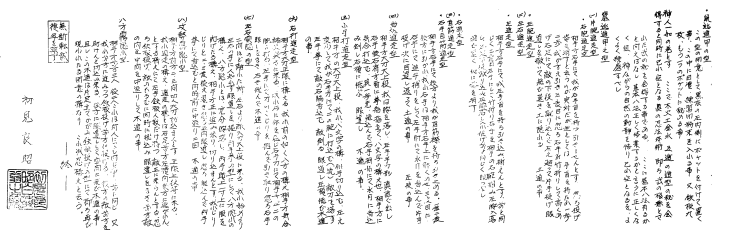
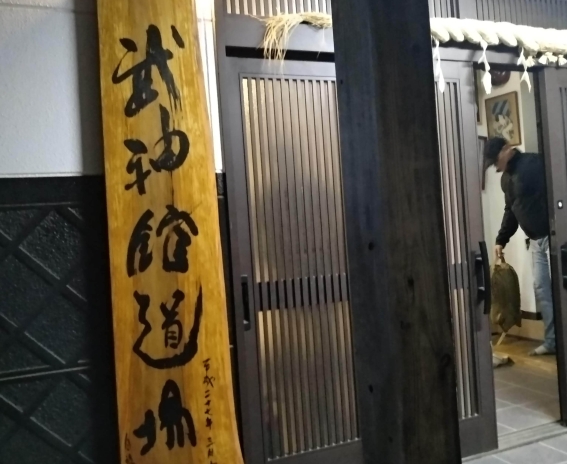
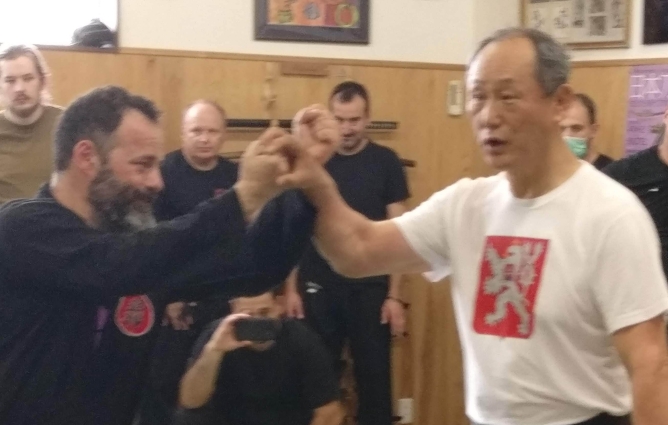
During the break, I asked Sensei for calligraphy to use it as a logo for the Paris Taikai next July.
He made up “Ninkū,” a pun with the word “Ninku,” but written with “Kū.” instead of “Ku.” If “Ninku” exists, and means “endurance.” (1) “Ninkū with a long “ū” doesn’t. It was made by Sensei, associating “Shinobi” and “Kū.” (2) (3) He replaced “endurance” by “stealthy emptiness.” And it is like what Sensei is showing in class. His movements are so empty that Uke falls into the void.
The Mutō Dori of 2019 is now dealing with a lack of presence. There is nothing to see and nothing to feel. The control of the attacker results of a lack of control. In a recent post, I introduced you to Mutōsei, “uncontrolled.” (4) To me, Ninkū is precisely this feeling. Sensei controls you without control. As if he was able to express the emptiness itself.
Like many high-level feelings, it is difficult to express it with words even if you had the chance to feel it from Sōke. Buddhism, says that you can share Satori, only with those who experienced it. I guess this is the same. (5)
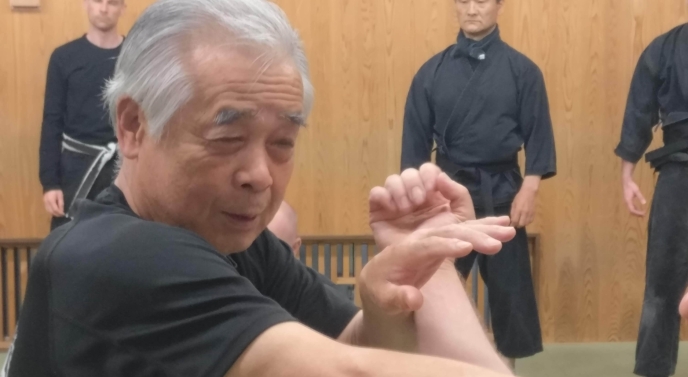
If you watch Sensei from the outside, it looks like magic. This is why he asks his Uke to explain their feeling after the technique.
Ninku, (1) also means Stoicism, it also seems correct. To succeed in Budō, you have to endure a lot of pain and disillusions. The training is about endurance. It has no end. We begin to practice one day for the wrong reasons, and we stay without knowing exactly why. This is pure Stoicism.
Noguchi sensei told me once that in the old days Sensei was quite brutal. He was so violent in training that the wooden floor under the mats would sometimes break! When it happened, they would stop the practice, get the tools, repair it, and go back to train. Sensei repeats that he doesn’t teach us. But it seems that this “non-teaching” of him, started a long time ago. Noguchi sensei said that Sōke used them as Guinea pigs. Sensei wanted to learn the techniques he was receiving from Takamatsu sensei by mail. (6)
Noguchi sensei admitted that twice he nearly quit unable to see the need for so much pain.
When you see how good he is today, I guess that staying in the Bujinkan was the right decision. He “endured” the pain to become one of the best teachers of the Bujinkan. And the same applies to the first generation of Sensei’s students.
We can now see more with clarity that Ninku is the Omote, and Ninkū is the Ura. I will share this new feeling in my next seminars, and at the Paris Taikai in July.
Sōke said recently that it takes 10 years of hard training, passing through a lot of hardship to study basics. So how many years do we need to get to Ninku and Ninkū?
We have to be resilient and cultivate our patience!
1 忍苦, Ninku: endurance; Stoicism 2 忍び, Shinobi: stealth, traveling incognito, ninjutsu, ninja, sneak theft; sneak thief, tolerance 3 空, Kū: empty air; sky, Shunya (emptiness, the lack of an immutable intrinsic nature within any phenomenon). Meaninglessness, void (one of the five elements) 4 無統制, Mutōsei: uncontrolled 5 悟り, Satori: enlightenment; spiritual awakening; understanding, comprehension 6 Sensei was visiting Takamatsu Sensei every two months (and not every two weeks as the legend says). He had the scrolls with him. Between visits, Takamatsu was sending two letters per week with many technical details.
Disclaimer: The class was so dense that this article might be a little too long. Sorry about that.
A class with Sōke these days is a succession of many moments. Relying on the Dai Shihan to show the techniques, he gives his advice from his chair. He only shows when a move requires his expertise.
Also, he often begins the class by showing the new swords he bought for his museum. He recently did a sword exhibition in Noda to explain to the public, the 200 blades he already has.
Friday night he displayed à few interesting Tantō that he got. Some of them had a Kozuka inserted in the scabbard. It was a first for me. (1)
Each time Sōke tells of being aware of the danger of live weapons. And shows the correct way to pass or receive a naked sword from hand to hand. Not aware of the distance, there is a danger to be cut or killed. The translators sometimes get too close to him, and some nearly got cut. When you receive a naked sword from someone, you have to be close enough to take it, but far enough not to be cut.
Sōke teaches us these things because he doesn’t want the Bujinkan Dai Shihan, to look stupid. He said that people training Kendō or other martial arts don’t know the dangers of live weapons. Because they lack awareness. The Japanese wars created our systems on the battlefield, not during peacetime in a Dōjō. (2)
We did some Waza with the Daishō, and Sensei stopped the class to teach us how to wear them. That was interesting as many practitioners do not have a clue there is a proper way of doing things. One thing to keep in mind is that our fighting systems originate from the military. In the military, they keep everything that works fine. They reject what doesn’t. Each time your teacher asks for a precise movement, try to understand the reason to do it that way. When you know the hidden reasons to do things, your Taijutsu improves. Nothing we do is by chance, there is always a reason behind.
How to wear the Daishō? (3) First, insert your thumb into the Obi and put the Kodachi, then put the Katana in this order. (4) Sōke asked us to train this to master it. He said the Dai Shihan, should have real blades to get better the essence of Mutō Dori. (5) We have to understand what is fake and what is real. He added that Takamatsu Sensei always showed him the practical aspects of Budō. The Bujinkan is not Gendai Budō, we don’t do sport. (6)
Sensei moved back to Taijutsu. After the technique, his Uke explained that he was so focused on the pain on his finger, that he didn’t see the rest. This is “Mienai.” Sensei was using his other hand to take Uke’s balance. (7) Mutō dori uses Kakushi waza whenever possible. (8) Uke can see is not what matters.
Against a knife attack, Sensei stopped the attacker and began to speak to us. Uke lost his concentration, and Sōoke peeled the knife from his grip. This is Metsubushi. (9) We use Metsubushi to confuse the opponent and are not limited to Ninja blinding powder. It can be physical or by talking. If you speak, Uke cannot avoid listening to you.
In unarmed combat, we rely too much on the hands. Sōke said that “Sebone,” the backbone, is what does the action. He asked us to try it and insisted on keeping a relaxed body and on keeping the legs unlocked. (10)
In the end, Sensei said that now the Daishihan are in charge. And if they don’t understand it is ok. Because when you get the movement by yourself, you are your own teacher. Let the action be, and do not overthink everything.
Ethics is the backbone of our soul, this is “Kikotsu.” (11) But when you only rely on physicality, you are not a Bujin but another “Kikotsu,” an eccentric. (12)
_________________________________________ 1 Kozuka: This small knife was usually hidden in the Saya of a Katana, close to the Tsuba. 2 War Time vs. Peacetime: The Bujinkan systems are born during wartime (12th to 17th century). One exception is the Takagi Yōshin Ryū, formalized in the 18th century. 3 大小, Daishō: matched pair of long and short swords 4 The original Obi were larger and longer. Because of the length, there were at least three layers of belt. First, you put he Kodachi between the first layer close to the body and the second layer. Then you slide the Katana between the second and the third layer. This is a way to protect the lacquer on the Saya. This keeps the blade sealed in the scabbard and avoid humidity to damage the sword. 5 I have been using a real Katana for more than 30 years. I cut myself as expected. But when you have à real blade, you stop moving like they do in B movies. Never underestimate the danger of using a real weapon. The same goes for firearms and swords. 6 現代, nowadays; modern era; modern times; present-day. 現代武道, Gendai Budō: https://en.wikipedia.org/wiki/Gendai_bud%C5%8D 7 見えない技, Mienai Waza: Invisible technique (that Uke cannot see) 8 隠し技, Kakushi Waza: Technique for hiding; concealing; being hidden; being concealed 9 目潰し, Metsubushi: sand, ash, etc., thrown in the eyes to blind someone. Throwing something at someone’s eyes to blind them. Poking someone’s eyes during a fight to blind them. https://en.wikipedia.org/wiki/Metsubushi 10 背骨, Sebone: spine; backbone; spinal column 11 気骨, Kikotsu: (moral) backbone; spirit; soul; grit 12 奇骨, Kikotsu: eccentric
I am not very fond of spiders, but I like Nagato sensei’s Taijutsu.
Nagato sensei is the master of Mochikaeru, (1) Whatever you do, traps you as if in a giant spiderweb.
Mochikaeru is his particular way to let you in his sphere of movement and to give back pain in exchange. Using his mastery of distance, he puts you off balance. When you think you have him, you end up “glued” into his spiderweb. All his body is playing against you: hands, elbows, legs, eyes. In fact, his entire body is scrutinizing you. Spiders have six eyes, and sometimes I guess him too. When you are Nagato sensei’s Uke, don’t forget his body is his eyes.
Apart from Taijutsu, he also speaks a lot during the long breaks. This Mondō is a special moment of questions and answers. When you ask anything, he will give his take on the problem you are having. It is also a sweet moment where he tells us many details about Sōke and their life before the Bujinkan went worldwide. Being 72-year-old, he is one of the key witnesses of the rise of the Bujinkan. Of how a small dōjō of eight mats, with about a dozen “meat-bags” became this sizeable international organization. (3) (4) (5)
In a recent Mondō, Nagato sensei that the Bujinkan is “blood, sweat and tears” until fifteenth Dan. After that, it is more about being happy. What is difficult is to train alternating hard and soft movements. This balance between hard and soft is challenging to do when you are Uke.
He also said that with age, we have to train softer. The goal of the Bujinkan is to be happy, not to destroy yourself. I can remember the training in the 90s’, and I assure you that Sōke is much softer than before. Life is about permanent change and adaptation.
Nagato sensei said that Sensei evolved a lot because he has been changing all the time. As a result, he is not changing but evolving. Sensei is like the reflection of the moon on the river; always different but always the same. As Thich Nhat Hanh puts it, “The river must be calm to reflect the full moon. (6)
Permanent changes in Sōke’s Budō makes it challenging to follow his steps. We have to catch his tail and go where he is going, letting him lead the way. Nagato sensei added that “Catching and keeping the horse’s tail is easy. But Sōke is a dragon, so it is more difficult to stay attached to the tail.”
In Taijutsu and in life, you achieve happiness and success through changes. And Mochikaeru is part of it.
My best student told me once, “The Bujinkan is like a country led by a recognized leader. The goal is to learn to be happy, and permanent change is giving us this freedom.”
Be Mochikaeru, a “dōjō frog” willing to become a prince of Budō. (7)
Change and be happy!
1 持ち帰る, Mochikaeru: to bring back; to carry home; to take out (e.g., food) 2 問答, Mondō: questions and answers; dialogue 3 Noguchi sensei said that at the beginning training was in Sensei’s clinic, a room with only 8 mats. They emptied it before class, and they had to avoid tripping on a 1-step platform on the side. 4 The first group was: Ishizuka, Tanemura, Manaka, Muramatsu, Kobayashi, Nagato, Oguri, Senō, Noguchi. 5 Meatbags: Each time you speak with the Japanese Dai Shihan, they say that Sensei was using them as “meat-bags.” He was not even trying to teach. He was working to understand the techniques. And it was excruciating. Noguchi sensei said that young Hatsumi weighted over 100 kg, was very bulky, and powerful. 6 Thich Nhat Hanh 7 モチ蛙, Mochikaeru: motivation of the frog (to become a prince of Budō).
With Noguchi sensei tonight we covered the second level of Kukishin Daken Taijutsu. Each Waza was enriched (twisted) to meet his own interpretation and the depth of his taijutsu.
At some point during class, he positioned his right leg between Uke’s legs to do a basic Koshinage. While placing his leg, he said “kick,” but he didn’t do a kick, he put his thigh there. (1) Later, he trapped his Uke was kneeling to the ground, and he captured Uke’s head between his knees, saying “happa.” (2) At another moment, he did a half Oni Kudaki and called it “Musha Dori.” (3)
In these three occurrences, the words he used didn’t seem correct. But they are. It is just that we limit their definition. The Japanese language, like Chinese or Korean processes the information by images. A word in Asia is not “definite,” it is a concept, a general idea evolving with the situation. In the West, our words have a precise definition, limiting their power. Not in the East. These languages do not see the world in the same we do.
Let’s review now what Noguchi sensei said during class.
Kick: This is our definition of Keri. But in fact, it means an “action of the leg.” The kick is one possibility amongst many. In the Chi Ryaku no Maki, there is a set of techniques called “Happō Keri Henka.” There are no kicks in these techniques, but the legs are used a lot to manage the distance to the opponent.
Happa Ken: This is one of the Hōken Jūroppō. Happa is slapping Uke with a flat hand. Here he was using the knees, hitting the head of Uke. Note that in the Takagi Yōshin Ryū, the Kyūsho for the ears is also called Happa. Happa for him is the action of hitting with the sides of the head, with the hands, the knees, or anything else. It is the function that is important.
Musha Dori / Oni Kudaki: It was not a mistake either. At the beginning of the Bujinkan, Musha Dori was the Omote form we know, and the Oni Kudaki was Musha Dori Ura. Both terminologies exist in different Ryū. Also, if you think about it, grabbing the elbow from inside or outside, are two ways to “grab a warrior.”
The Japanese language is not based on Latin, Saxon, or other Alphabet based languages. It is an image. And this image is a concept with blurred borders. If you take the word “Omote” for example and ask anyone to tell you what it is, they will all tell you that it means “outside.” And they will be right, but Omote is more than that. (5)
That is why it is vital to learn your Bujinkan vocabulary. The Japanese use their words not to define an object but because of their function.
In the train to Kashiwa, I remembered reading a book many years ago called “Word and object” by Quine. (6) You should read it. It changed my understanding of languages. In the book, Quine exposes the idea of what he calls “conceptual scheme.” From one language to another, à word doesn’t carry the same concepts. À word is cultural. It explains why a translation is often betraying the author’s initial idea.
Noguchi sensei’s class was as great as always. But if you understand what is above, it will be an essential step on your path to excellence.
1 蹴り, Keri: Kick (dictionary) 2 葉っぱ, Happa: leaf; blade (of grass); (pine) needle (dictionary) 3 武者取り, Musha dori: Grab the warrior 4 宝剣十六法, Hōken Jūroppō: The 16 treasures 5 表, Omote: Outside; above; in front of; exterior; on top; obvious; easy.
But also:
surface
face (i.e., the visible side of an object)
front (of a building, etc.); obverse side (i.e., “head”) of a coin
outside; exterior
appearance
public
first half (of an inning); top (of an inning) Baseball term,
Only 24 people joined Noguchi sensei’s class tonight, so we had a lot of space to train.
I love the “Noguchi Ryū” because I find his interpretation of the Waza disturbing and brilliant. It always seems that we are studying another fighting system. (1)
Tonight we covered a “twisted version” of the second level of Koto Ryū and of the Kukishin Bō. Noguchi sensei has this superior ability to transform the known into the unknown. And I am not the only one to feel that way. Yesterday, next to me, was training Elias from Norway. He is also a Bujinkan old-timer, Dai Shihan, and he often comes to train in Japan. After one “revisited” technique, we looked at each other saying, “did he change the technique again?”
We have been training the Koto Ryū with him since the 90s’. That is almost 30 years, and we are lost. We know each technique, and still, each time we feel like beginners. It is amazing!
Like always, the pace was fast, dynamic, with many henka and full of laughter. But how does Noguchi sensei do it?
Hereafter is three points that might shed some light on what is happening.
First: Noguchi sensei was teaching the second level from the bottom up. I mean that he began with the last technique and went back to the first. To train these Waza in a different order is perturbs our logical brain, it doesn’t help. But, would an attacker launch a predictable hit?
Second: He reads the same Densho he has been studying for years but gives it a twist. It is like he is reading the essence of the technique and not the step by step process. Or to put it better, the Ura instead of the Omote. Every aspect of the Waza is there, but it doesn’t feel the same. It is like a smell of a croissant instead of the croissant itself.
Third: He has been training longer than us, and his sensibility is beyond us.Hatsumi sensei explained that Nagato sensei and Noguchi are now evolving at the Ku level. That would explain the change in the forms.
When we think about the concept of Shuhari, Noguchi sensei is definitely at the “ri.” He destructures the techniques so much that they look different. This is pure genius and excellence. I hope that what day I will be able to reach that understanding. (2)
Sensei said we “shouldn’t do precise things because we become predictable. On the battlefield, being readable kills you as the opponent would counter you with ease.
Being unpredictable is the secret of survival. Last week SEnsei repeated again to have no preconceived thoughts. We have to be zero with no emission and no intent. And added that “often, people who studied at the university are those thinking they understand. But in reality, they don’t. Don’t think! Kankaku is important.” (3)
The Bujinkan Budō is fantastic, and I wish that more practitioners can discover how great it is. And the “Noguchi Ryū” like the “Nagato Ryū” are two advanced versions of this greatness. Come to Japan and get enlightened by these two lighthouses. Because at a certain level, it is not anymore a question of Waza, it is a question of feeling.
Follow the example of Shuhari, destroy the form, so only the essence remains: Kankaku.
____________________________________ 1 Noguchi Ryū: Twenty years ago, I went to sensei’s house after class. I didn’t know what to think because each sensei was different. Actually, I was mad. I asked him, “Sensei, is it normal that I feel that I am learning the Bujinkan with you. The Noguchi Ryū with Noguchi sensei. The Nagato Ryū with Nagato sensei. The Oguri Ryū with Oguri sensei. The Senō Ryū with Senō sensei?” Then with a smile on his face, he looked my eyes and said, “Yes.” Then he laughed. 2 守破離, Shuhari: Shuhari; three stages of learning mastery: the fundamentals, breaking with tradition, parting with traditional wisdom 3 感覚, Kankaku: sense; sensation; feeling; intuition.
After some discussion on the Historic Ninjutsu Research Facebook group regarding an image of the “shinobi” from the Wakan Sansai Zue (和漢三才図会) written in 1712, there had been some disagreement around it.
Wakan Sansai Zue (和漢三才図会) written in 1712
Several people got caught up on the fact that the individual who is leaping over the wall in the illustration is wearing some sort of animal costume. This had been speculated to be inferring a connection to the Katō Danzō (加藤 段蔵, c. 1503 – 1569), a shinobi who was said in folk myth to be able to transform into a rat. One source (currently unavailable for reference) states that he was a rat breeder as his main daily occupation.
Most concluded that it was some form of canine costume, however, when looking at the ears, shape of the head, and tail, it as quite evident that it is a rat, particularly a spotted rat, which was considered special or lucky in the 17th century.
Existence of Spotted Rats
There was some dispute about spotted rats in Japan at that time, as one individual claimed that the spotted pattern came form a popular breeding practice in Europe in the 19th century. However, this was easily disputed with a quick google search, where I found two manuscripts regarding rat breeding. the first, Yosotama no kakehashi (養鼠玉のかけはし), was from 1775, and the second, Chingan Sōdate Gusa (珍玩鼠育草), was from 1787. Both documents provided illustrations of spotted rats. At this point all three documents in regard to this investigation was from the 18th century.
Yosotama no kakehasi 養鼠玉のかけはし was from 1775
Yosotama no kakehasi 養鼠玉のかけはし was from 1775
Chinganso Date Gusa 珍玩鼠育草 was from 1787
The Wakan Sansai Zue also has a section focused on rats, in which we can see a spotted rat in the first volume as well. it has been speculated that the previous two texts drew some inspiration from this text.
Wakan Sansai Zue (和漢三才図会) regarding rats.
Wakan Sansai Zue (和漢三才図会) regarding rats.
Wakan Sansai Zue (和漢三才図会) regarding rats.
Wakan Sansai Zue (和漢三才図会) regarding spotted rats.
Nomenclature of “Shinobi”
An interesting note regarding the term used to refer to the shinobi here has the kanji 游偵 (Yūtei), while there’s hiragana next to it saying しのびのもの (shinobi no mono). This name appears in the Bansenshūkaias one of the names the Chinese had referred to spies by. In the Bansenshūkai, however, it is written as 遊偵 (found in the Q/A section of the preface, still read as “yūtei”), but then written as 游貞 in the first volume of Seishin.
In other sources (citation unavailable at the moment), yūtei has been shown to have several variants of the first kanji, such as 斿, 游, 浮, 遊. All of which expresses a sense of floating, drifting, or roaming. And Tei (偵) means to investigate, spy or acquire protected information. Thus, yūtei means to travel or roam around gathering information.
Note: ukitei (浮偵) also suggests a principle of movement called ukimi (浮身) found in the classical martial arts, that can also be seen in the judo movements of the late Kyuzo Mifune.
Yutei (遊偵) as found in the Bansenshukai, chapter on Questions and Answers.
Yutei (游貞) as found in the Bansenshukai, chapter on Seishin.
Under the heading for shinobi in the Wakan Sansai Zue, there is listed a few other terms:
課者・細作・邏候・探伺・間諜
Wakan Sansai Zue 和漢三才図会 (1712)
Kasha (課者)
The first of these terms is kasha (課者), which was an interesting one to dig into. Dictionaries generally define this first character as “chapter; lesson; section; department; division; counter for chapters (of a book).” But when we break it down, we have “[to get] results (果) with words (言) [in order to obtain results]”; investigation. and with the second character (者), it becomes “those who investigate“.
Saisaku (細作)
The first ideogram can be read as hosoi (細) which means, “work meticulous, fine, delicate, precise,” The second ideogram, (作), means: “to manufacture, make, build, work, or harvest.” One can translate saisaku as, “One who manufactures [creates] with meticulousness [a plan]” or “One who collects what is fine, delicate [quietly perceives essential information].”
Rakō (邏候)
Some very old characters here, and digging did not get me to far; apparently this is connected to Edo period police investigations but I don’t have a reliable source for this at this moment. the first character can be broken down quite far, but for this well only divide it into 辵 “to walk or move” and 羅 “to surround like a net. This I understand to grow to refer “patrolling”, though one dictionary also suggests a borrowed definition of “concealment”. The second character, (候), means: “expectancy, make an attempt, sign, season, or time.” Breaking it apart however starts to suggest something conspicuous or clue-like. in medicine it has been used to refer to “symptoms”. Thus I understand this to mean something like “one who waits and watches clues to grasp the truth like a net.“
Tanshi (探伺)
The first ideogram (探) means: “grasp, grope; deep, intense, to deepen.” the second character is made up of a “person (人) who peers through a hole (司).” Though nowadays 司 is defined as as sort of government administrator, but we can understand that to be someone who oversees things. Thus tanshi means “one who perceives deeply.“
Kanchō (間諜)
One of the earliest names for a spy, the first character means a space between things, and the second character means something “flat” (葉) like a leaf, and words (言); spy ended up being a borrowed definition that has endured to today. Thus, kanchō can be understood to mean “one who acquires words by going between people.” though it also gives the image of being able to slip through small or impenetrable spaces.
Togakure-ryū Connection
It should also be noted that the “San”(of Togakure-ryū’s Santō Tonkō Gata (鼠逃遁甲型) can be read as “nezumi” and means rat. This isn’t the first time that I’ve heard of ninja being referred to as rats, in 2008, I was looking into how these kata could be expressed in a “squirmy” way like a fleeing rat. And then Takamatsu Toshitsugu’s favorite story was said (by Masaaki Hatsumi) to be “Neko no Myōjutsu” (猫之妙術), a story about a rat that fought off all cats except an old cat that had nothing left to live for.
Shinjin Ichinyo no Maki (神人一如), containing the Togakure-ryu Santo Tonko Gata – including usage of the Shuko, Shuriken, and mitsubishi.
The Santō Tonkō gata consists of twelve techniques in response to being grabbed by the arms, back of the neck, and when your cornered or surrounded by enemy (picture a rat being cornered by a cat, and just the same this is depicted in Neko no Myōjutsu). Each of these techniques finish with the statements of using one of the goton (五遁) of escaping using fire, earth, water, wood, or metal, as well as that of blinding powder, throwing blades and so on. True to the teachings of the tradition, they strive to avoid killing, aiming to only distract, escape and hide. As such none of these techniques describe lethal techniques – though they can certainly be made to be.
Yet another interesting connection is the depiction of a falconer just before (to the right) of the entry for shinobi. It has been established rather thoroughly by Sean Askew that the Toda family that had been the head of the Togakure-ryū tradition of ninjutsu for generations, were also well known for their falconry. So within this text we can see three correlations to the same tradition of ninjutsu: 1) Falconry – the trade of the Toda family 2) Connecting rats and ninjutsu 3) Reference to the Goton used by this tradition (see next section).
Chinese Link
The above entry about Yūtei, describes another text called Wǔ zá zǔ (五雜組), written sometime between 1567‐1624 by Xie Zhaozhe, with an additional preface added in 1616, that talks about Tonkeijutsu (遁形术), methods of hiding the form, just like we see in books such as Ito Gingetsu’s Ninjutsu no Gokui. Both these writings describe Tonkei/Tonko (遁形/遁甲) as using the five phases of wood, water, metal, earth, and fire (Ch: Wu Xing, Ja: Gogyo; 五行).
What has been presented here is my own collective knowledge on this subject based on historic primary sources. We can see that the depiction in the Wakan Sansai Zue is quite evidently that of a man in a rat costume (for what reason, I’m not at all sure), the existence of spotted rats and specialized breeding methods go back at least as far as the 16th century (and the same document hints at “ancient times”). w can also see that the author of the same document had a comprehensive grasp of obscure names for spies. We can also see clear correlation to the Togakure-ryū tradition of ninjutsu, and even its hints at a relationship with falconry. And the connection to Goton no jutsu was traced at least as far back as the early 16th century, and surely traces further back.
Sources referenced (chronological)
Wǔ zá zǔ 五雜組 (1616~), by Xie Zhaozhe
Bansenshūkai 萬川集海 (1676), by Fujibayashi Sabuji
Wakan Sansai Zue 和漢三才図会 (1712), by Terajima Ryōan
Neko no Myōjutsu 猫之妙術 (1727), by Niwa Jurozaemon Tadaaki
Yosotama no kakehasi 養鼠玉のかけはし (1775 ), unknown author
Chingan Sōdate Gusa 珍玩鼠育草 (1787), susposedly by “Tei-en-shi”
Ninjutsu no Gokui 忍術の極意 (early 1900~), by Ito Gingetsu
Togakure-ryū Shinjin Ichinyo no Maki 戸隠流神人一如の巻 (mid 1900~), by Masaaki Hatsumi
The Dōjō was packed last night, and Sensei played a lot with the concepts of Kyojutsu and Kyojitsu. Receiving Tezuka San’s fist, Sensei was controlling him holding only one finger. Tezuka san explained that the control was not on the finger we were watching. Sensei was applying light pressure with his other hand on the shoulder blade. This small pressure was enough to take his balance. Tezuka’s attention focused only on the finger, and he was unable to move and to feel the touch on his back. Hatsumi Sensei is like a magician. He sends false information to distract us from where he is applying the technique.
That is when he spoke about Kyojutsu and Kyojitsu. Everything he does is very subtle, and you can hardly see it from the outside. All is “Mienai,” something that you cannot see. (1)
That questions our perception of reality. What is real, and what is not? This is the focal point of Sensei’s Mutō Dori this year.
But are we really familiar with the words Kyojutsu and Kyojitsu? After a quick check, it seems that many Bujinkan practitioners are not. After class, Tracy Nyholt, Michael Tano and I went for dinner. We agreed to say that few people knew the difference between the two expressions. So, let’s spend some time and explain what Kyojutsu and Kyojitsu are. Kyojutsu is the art or the way to trap the mind of the opponent. (2) And Kyojitsu is the “tool” you use to alternate between truth and falsehood. (3) We can summarize that by saying that Kyojutsu is the set of techniques using Kyojitsu.
Last month, Sensei said that “Sometimes it is important to know how to lie, but do it with a pure heart. Lying will help you to guess when something is right or wrong”. The art of Kyojutsu is an essential aspect of the fight. Deception is a powerful technique, and history is full of examples. During world war 1, the General Bugeaud, a French officer, said: “during the war there are rules, but they are very few.” But be careful. As for everything in life, what you do depends on your goals. This is why you must have strong ethics and sound morality.
Two Japanese expressions will help you get what Sensei means by Kyojutsu. The first one is “Kyojitsu Konkō.” It is a mishmash of truth and untruth; a mixture of fiction and fact, creating an opening in Uke’s mind and body. The second one is even better. It is “Kyojitsu Himasu.” “The difference between truth and fiction in art being very subtle; Art abides in a realm that is neither truth nor fiction.” This is the perfect definition of what Sensei is teaching now.
When I say “teaching,” please remember what he says at every class: “I do not need any more students, I teach to the Dai Shihan.” Everyone is still welcomed to class whatever his rank. But he is more showing than actually teaching. Yesterday, he asked us to watch his movements, and it is ok if we don’t understand. Sensei teaches “Ishin shoden,” i.e., through a direct transmission one to one. (6)
So if you wonder what your reality is, then all the above might help you to find your answer. You are the master of your life, and your choices are the good ones. Create your reality because no one can tell what to do.
Sensei is an artist, and the Bujinkan is art. And art “abides in a realm that is neither truth nor fiction.”
______________________________________________ 1 見えない, Mienai: invisible. 2 虚術 Kyojutsu: falsehood + art; technique; means; way; trick; trap; plot; stratagem; magic. 3 虚実, Kyojitsu: truth or falsehood. 4 虚実混交, Kyojitsu Konkō: a mishmash of truth and untruth; a mixture of fiction and fact. 5 虚実皮膜, Kyojitsu Himasu: The difference between truth and fiction in art being very subtle; Art abides in a realm that is neither truth nor fiction. 6 医心正伝: correct and direct transmission from “heart to heart.”
Registration for the Paris Taikai 2019 are good with already over 50 participants from 11 countries. Register today to save 15% and join us! CLICK HERE…
Robin Hood is famous for his archery skills, but when it comes to Bō Jutsu, he is clueless!
Everyone remembers the scene in every Robin Hood movie. Where Robin fights Little John with a Bō, across a river. Well, did you notice that they are only hitting the staff and not the hands of the opponent? This is often what you see on the mats. When two partners fight with swords, they only try to hit the weapon instead of the hands of the opponent. If you want to do that, then forget Budō, and go train Chanbara! (1) The Bujinkan teaches battlefield fighting techniques, this is not a sport.
In a recent class, Hatsumi Sensei said that “Controlling the weapon of Uke makes you control his body.” You control Uke not by hitting the sword, but by controlling the way Uke is wielding it. By doing so, you control all his body movements and can read his actions before he does them. This is another aspect of Mutō Dori.
When receiving an attack, you have three possibilities. You hit the weapon, the opponent’s body, or Uke’s hands. See that as another Tenchijin. On May 5th, Sensei said that “Mutō Dori is connected with the past, the present and the future.” (1)(2)(3)
The past here is the blade (delayed reaction).
The present here the hand (perfect timing).
And the future is the body (overdoing it).
Last year, Sensei explained that putting your blade on the fingers of Uke, you control his actions. You don’t need to cut deep into his flesh, micro cuts will be efficient. The reason why it is better to hit or slice the fingers is that they are accessible. The Yoroi doesn’t protect the tips of the fingers. If you go for the body, you need to enter the distance and take the risk of a counter attack. Also, hitting the body can only be in the unprotected spots. You need to be more precise and aim at the two Suki of the Yoroi: Butsumetsu or the neck (between the Menpō and the Kabuto). (4)(5)
When you place your sword on Uke’s Tsuka and the fingers, the momentum of his attack will get him injured. This is the easiest way to control him. The only thing you have to do is to be slow and lift the tip of your blade to meet the space where Uke will end. Perfect timing is crucial, and speed and strength will not help. They are counterproductive.
The Shintō religion has one word for that specific moment. And Sensei repeats it often, it is Nakaima, the middle of now. (7) Total awareness is being in a permanent present.
You can live in a permanent present can only if you let your body do the movements for you. With no preconceived intention.
Stop fighting like Robin Hood and Little John on the river, train like a professional. This applies to anyone because, in the street, there is no camera, and your nice patch will not protect you.
_________________________________________________________ 1. Chanbara: Check the link and don’t laugh. https://www.internationalsportschanbara.net/video/ 2. 無剣取り過現未繋ぎます, Mutō dori kagenmi tsunagimasu 3. 過現未, Kagenmi: past, present, and future; three temporal states of existence 4. 繋ぎます, Tsunagimasu (Tsunagu): to connect; to link together 5. 面頬, Menpō: face guard 6. 兜, Kabuto: Helmet 7. 中今, Nakaima: the present (esp. as a privileged moment in eternity) 8. 中今, Nakaima: Definition http://eos.kokugakuin.ac.jp/modules/xwords/entry.php?entryID=1447…
The Sakki test is an essential part of the Bujinkan training. But it is wrapped in so many layers of fantasy that it is time to write about what the test is.
At the Madrid Taikai in 2000, Sensei let us give the Sakki test. It was the first time that someone would give the test instead of Sensei. I remember walking with Pedro to the examination room. I was telling him, “it is no big deal, we saw Sōke performing it so many times, it is easy.”
To be honest, I thought the test was only a marketing tool to get the westerners excited. I was so wrong!
Each one of us did the test twice. No big deal. But less than a half hour later, I felt so tired that I had to go to my room to have a nap. I had seen Sensei perform 30 or 40 tests in a row at Taikai, and he didn’t look tired. But me, after only two tests, I was a wreck. It was an excellent lesson. But let’s destroy a few illusions here.
The Sakki is not something you get, you are born with it. Education, life, make it sink deep into your brain. And it takes five to ten years to crack the lock and make it appear again.
When I explain it, I like to use the following analogy. See your brain as a recipient full of dry mud. The Sakki is like a light buried down under, below several layers of dirt. Through consistent training, some cracks appear. On the day of the Sakki test, if you are ready, the Sakki feeling will move upward, and you will dodge the sword. There is no magic! All animals have it, and we are animals. We just overthink and let the feeling of danger guide our lives. Modern society kills this natural human ability.
People refer to it as “to sense the killing intent.” If this etymologically correct, this is not what is the Sakki test. (1)
First, you sit in front of a guy with a sword, knowing that he will hit you in a minute. There is no surprise attack. There is no “thirst for blood” from his part. And if there is, then the guy should see a doctor. Second, the Sakki test concerns both participants. The emitter and the receiver. Many transmitters do not know how to do it correctly, and many receivers expect the gods to make them move. This is not how it works. Third, the Sakki manifests itself only when both participants have a connection. You can see the sword as the link between the two persons. Once there is a connection, the test can be performed. Fourth, the Sakki test is as hard for the emitter as it is for the receiver. In fact, both are taking the test. Failing the test is not always the receiver’s fault, it is often because of a lousy emitter. Fifth, the emitter with his eyes closed “feels” when he has to cut. It is not his decision; the sword goes down by itself. Only the quality of the connection makes it possible. If it is not magic, as I wrote earlier, but at least, it is mysterious.
A friend and student came back from Japan recently. He shared with me Sōke’s vision: “Passing the sakki test is spreading out energy to the applicant. It is not a killing feeling, It is only energy.” He added that Sōke was paying more attention and was evaluating the one giving the sakki test to the applicant.
When last Friday Sensei told me to give the test, I was expecting something particular. After giving the test since 2000, I can say I’m used to it. But on this night, it felt like a test because instead of one or two applicants, they were eleven. (2)
When I positioned myself behind the first one in the series, I needed a few deep breaths to get ready. To my surprise, I was not tired at all after the tests. My Sakki training had paid off.
Today I see the Sakki test as a way to improve our understanding of Sensei’s budō. To the Sakki, “killing intent,” I prefer another “Sakki” meaning “to make your spirit blooming.” (3) After all, the seeds of Budō will bloom one day and transform us into real Bujin.
_____________________________________ 1. 殺気, Sakki: a thirst for blood; bloodlust; determination to kill 2. 8 passed it on the first try, 1 with Nagase sensei. The last 2 got it correctly on Sunday. 3. 咲く気, Sakki (Saku Ki): blooming spirit…
Today Nagato sensei taught a new approach to Mutō Dori. Somehow his Taijutsu has evolved since I was there a few months ago. I shared this feeling with my friend Oliver Piskurek, who agreed. It amazes me that teachers like Nagato sensei can still improve their movements.
Nagato sensei is still moving in the same way, but it looks lighter and more powerful at the same time. In today’s training, I noticed two things. First, there is a new quality in his dynamic distancing. And second, he has increased the angling of his body in the footwork.
This is the new approach to Mutō Dori I was referring to.
Concerning the dynamic distancing. Nagato sensei receives the attacks with tiny backward steps. That keeps him out of reach but still able to get Uke’s balance at any moment. He will move backward to receive a Tsuki with a series of three or four small steps. This allowed him to stay at the limit of extension of Uke’s arm. Controlling the hand/forearm, he can then place his elbow to wrap Uke and throw him with a Ganseki nage or Ō Soto Gake. His typical style (changing hands, using the angles, hitting hard between the moves) remains. The only change is this more dynamic footwork keeping him off distance at all times.
Combined with this distancing is the angling of his body. He is often turning or pivoting his whole body at a 90-degree angle to receive the first attack. This angle forces Uke to twist his upper body. Because a double fist attack is fast, Uke has to launch his second fist at the same time he is turning the torso. The result is an off balancing of the body. This opens many Suki in Uke’s posture that Nagato sensei uses to destroy him. (1)
He said many times is that we have to learn to move like him step by step, and slow. Learning a complex sequence one move at a time is the best way to get it right.
We often train too fast. As a result, our brain and body cannot memorize the moves. Fast Taijutsu is the enemy of good Budō.
During class, Nagato sensei was always referring to his movements as being “Mutō Dori.” And I must say that it showed another facet of it. Each video by Hatsumi Sensei has “martial arts of distance” as a subtitle. That is what we trained today, a perfect illustration of how to master correct distance.