Skip to content

Ryûha: Homework Required

From Shiro Kuma's Weblog by kumablog

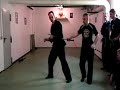
bô vs sword

The last section of the Kukishin Bô is called “keiko sabaki gata” and consists in a series of 25 techniques. As always if you do not look at the kanji but only at the sounds,  many meanings can be found in a good English dictionary.

keiko: training, practice, study

sabaki: deal with, handle; but also judgment, decision, verdict

gata (kata): mold, model;  but also a person.

Therefore, we can understand the “keiko sabaki gata” as the study of how to deal with the other.  But to be able to deal with the other we must learn first to deal with ourselves and this is where the personal training takes place. When we were kids or young students we were used to study “at home” the lessons received during the day. It must be the same in the dôjô. The dôjô like the university or the school is the place where the knowledge is transmitted. Our home is where we learn this knowledge to be able to use it afterwards.

This personal training is very important when it comes with the study of weapons as without a long time of repetition, it is nearly impossible to know how to handle the weapons. Over the last twenty years I have often spend time alone in the woods training with my jo, my, my yari or my naginata. There is no secret if you want to break the wall of the form you have to repeat them endlessly.

To help you in your personal training understand that the waza is only half of the technique, in a sense I consider the waza to be the omote. It gives you only half of the circle. It is your job to reverse the whole waza and to do it from the other side in order to get the ura. This is the way I have been learning on my own all these forms that I received in Japan over the years.

How to proceed?: you take one waza like gohô from the kukishin bô. You do it 50 times facing a tree. Then you reverse it completely by using the other side (here left) and you do it another 50 times. You do the same for each waza in a school. If you do that, I can assure you that your proficiency will increase a lot. At least it worked very well for me.

One last thing. The next day you will have forgotten those 5 to 10 waza that you worked. It is ok as what you are learning here is not to memorize with your brain but with your body.

If you do your homework properly you will learn much faster. But not only are you going to learn the movements faster, you are also going to learn a lot about yourself, your limits, your flaws. So by learning a given set of techniques you will develop the strength of your spirit and get better. Personally I see it as the real benefit of the keiko sabaki gata.

Now that you know yourself you can go back to the study of the ryû and “train the mold to make the decision”, i.e. keiko sabaki gata.

Gambatte! :)


Flexibility?

From Shiro Kuma's Weblog by kumablog

no comment!

Too many bujinkan practitioners are not flexible enough and they should spend some time outside the dôjô to improve their body. The dôjô is where you learn the waza, everything else is your responsability and should be done on your free time. Bujinkan instructors are not body fitness teachers.

At 50, I still smoke*, I eat meat and drink alcohol reasonably* and if I am a little overweight* I still keep my body flexible because in life everything is about balance and flexibility. So, if you are young, if you don’t smoke, if you are a vegetarian and do not drink, and if you have the perfect BFR**, you have no excuse.

You train because you have chosen to do so and no one has been forcing you. So please train your flexibility as it will definitely change your taijutsu.

Be Happy!

* Don’t smoke and eat light meals :)
**BFR: Body Fat Rate

Daruma

From 術心悟 by goshinarts

Below is a picture of a daruma that I drew recently.  The inscription is the single character “cut” kiru 斬. Many often assume this means to cut your opponent.  But in fact, this daruma is telling us to cut through ourselves.  To cut thru our fixed notions and illusions.

My teacher once during training pointed to his head and said, “No Nou!” ; a play on words meaning “no brain” or no thinking.  Then he playfully pointed to his heart and said, “Yes yes!”. Yes is the Japanese pronunciation for christ.  He was referring to our pure hearts.  For the pure heart of man is that which has communication with the divine.

Many people get trapped intellectualizing and spend much time scurrying around like a mouse in a maze.  Like the Ri or Shu Ha Ri, we must eventually separate from our knowledge.  Forget our intellect and let knowledge be. When we can do this, wisdom will rain down.

This year we have the theme Rokkon Shojou.  Wishing you the best on your martial journey!

Paul

Daruma with a "Sai Nou Kon Ki" vase.  Photo by Yabunaka

Daruma with a "Sai Nou Kon Ki" vase. Photo by Yabunaka


Kaeshi Waza: the Ura of the Omote?

From Shiro Kuma's Weblog by kumablog

Bô against biken

When we train the techniques of the different weapons or ryûha we often skip this important part of the training which is the kaeshi waza.

Kaeshi waza is for me the essence of our budô as it is vital to know how to overcome any technique. Countering is always implied in a technique. In a real fight you will have to apply those “aite to kumu kokoro gamae” in order to keep the advantage over the attacker.

In the buki waza dvds (jo, biken, bô, yari, and naginata) I have included those kaeshi waza into the basic forms to give the students a better understanding of them. We did the same for each technique of  the shoden, chûden, okuden, and keiko sabaki gata of the kukishin bô.

Once the forms have been acquired, you have learn the omote, with the ura you enter the hidden side of reality. Those two aspects of waza are intimately intertwined and missing the kaeshi waza is like walking with one leg!

In each technique there is a kankaku (feeling) that you must find. Once this feeling understood, you can use it against the waza and understand the real depth of budô. The developing of the ura side of the waza is the gokui (essence) of the bujinkan as it triggers our creativity and foster our imagination in a new powerful way.

Kaeshi waza is the ura of the omote, the kaitatsu of the waza, the jissen of the jissen.


Friendship & Rokkon Shôjô

From Shiro Kuma's Weblog by kumablog

3 buyu before a trek in the Nilgiri

During my last trip to India,  Eugenio Penna (10th dan Italy) was with us to share the five days seminar we had on kukishin bôjutsu, gyokko ryû kosshi jutsu and nawa jutsu. After coming with Beth Faulds (6th dan) last February, Eugenio came back to India to experience with us these very special (and very painful moments).

Sensei often speaks about friendship but it seems that his words are not really understood by many practitioners. The concept of buyu goes further than simply sharing a few meals together, it is a strong feeling that builds up through hard training and sharing. Shiva (Shidôshi) who was hosting the seminar here in Bangalore and Eugenio are true buyu beyond the limits of their own personal culture, language and experience of life. The buyu friendship is about sharing together a common experience on the mats by learning and learning to understand the other.

Whoever we are, we view the world in our own personal way and are often surprised by the differences emerging in our discussions, but on the mats we are on the same unknown terrain and we have to share with the others in order to survive. It is because of our differences that we can grow faster. For many years I have been travelling the world and in Japan and I appreciate the connections between cultures that the bujinkan offers. I believe that the buyu connection doesn’t know borders and that it is really what sensei wants us to do and this picture illustrates my point perfectly, happiness is inevitable. This is rokkon shôjô. The picture was taken right before a two hour trekk in the nilgiri (blue mountains) to reach an ancient tribal ceremony, in a deeply hidden valley.

The buyu are rich of their differences like the Indian slogan “unity in diversity” which resonates in harmony with the bujinkan .

Thank you sensei!


Danger is a lack of Awareness

From Shiro Kuma's Weblog by kumablog

Team work: Be aware of danger

Be aware of danger!

In the process of training techniques in the dôjô, you should always be aware of the environment i.e. the room or your friends training, as waving the in the air around you can be dangerous.

Outside of the dôjô this awareness can save your life. The technique is nothing if you cannot stay alive. Do not trust the densho or the waza because they never answer the particular situation in which you are caught. The waza have to be trained extensively in the dôjô so that their benefits are acquired by the body. Once acquired by the body, the brain will not think these waza again and adapt your moves according to the situation. Permanent adaptation is what makes you stay out of danger.

Ninpô is about protecting life, yours and the ones around you (friends or foes). Do not count on yourself only but trust your partners to help you stay alive. Danger is not predictable by nature but nature is not dangerous as long as you are aware of the “general picture” in which you evolve. This is why teamwork is so important.

The basics are done for yourself only but the interconnexion with the movements of your partners reveals a more powerful set of possibilities. Alone you are nothing, in a team you exist. The team increases your awareness of danger.

In order to stay alive, Bujinkan practitioners should develop teamwork abilities, and to do so train the basics more intensely.


Yûro Shi Tennô Taikai Paris 2010

From Shiro Kuma's Weblog by kumablog

Another five days to register to the Yûro Shi Tennô Taikai at a special price.

Check the pages of this blog for more info.

Register HERE to be sure to participate.

We are preparing a new website dedicated to the Taikai, it will be online very soon. The address is www.taikaiparis.com :)