Skip to content

Path to the Heart of the Flower (I)

From The Magick & The Mundane » Bujinkan by Shawn Gray

February 9th was the 20th anniversary of my first day of training in the Bujinkan. I mentioned it on Facebook, but was encouraged to write a series of blog articles about a bit of my martial arts history and how I found the Bujinkan and made my way to Japan to train with Hatsumi Sensei – to approach the heart of the flower that is Japanese martial arts, budo. I’ve always found it fascinating to hear stories of the adventures of my Sempai here (Mark Lithgow, Michael Pearce, Mark O’Brien, Andrew Young, and Mike L) and, now in my 17th year in Japan myself, I thought it would be fun to look back over the years, and in remembering, share some of that with the readers of my blog.

Black Belt Magazine – Feb 1984

Like many of us in Bujinkan, I was originally attracted by the ninja image. It was 1984, the same year that I started karate practice. In the small town of 3,600 where I grew up in Eastern Canada, there was a Chito-Ryu Karate club, which I joined after 9 years of ice hockey. I quickly came infatuated with Japanese martial arts and would frequently go to the magazine rack at the local gas station to check for the latest issues of martial arts magazines. It was on one of these visits that I found Black Belt Magazine, Feb 1984 issue. I was young. I was impressionable. I was hooked.

But how was a young New Brunswick lad supposed to access this ninja training? I was in junior high school. I couldn’t go to Japan. I couldn’t even go to Dayton, Ohio. But I could join the Shadows of Iga Society and Robert Bussey’s Warrior International as a correspondence member, so that’s what I did. I also got hold of some Japanese split-soled tabi boots and shuko hand claws and spent a lot of time running around in the woods climbing trees and sneaking up on unsuspecting neighbours and making blowguns from copper pipe. Luckily, I survived. Sometimes that rather surprises me.

I kept up with my karate practice quite seriously, entering and coming home with trophies from a number of provincial tournaments. I was invited to go to the Canadian national championship tournament, but it was held in Vancouver, 4,000km away, and I was in high school. I entered a local college and took liberal arts courses, and in my second year was presented with the opportunity to take a year off my studies and go to teach English in Japan. It was a dream come true, needless to say, and in August 1990 at age 19, I got on a plane and flew to the other side of the world, from a town of 3,600 to a city of 25 million.

I somehow managed to find the people that were meeting me at Narita airport. They had come by car to pick me up, and I remember that traffic was absolutely gridlocked all the way back to Tokyo. A trip that would take an hour by train took us six hours by car. After having already traveled through a 15-hour time difference in 24 hours, it seemed to take forever. We finally arrived at the organization’s Tokyo headquarters in Shinjuku, where I stayed for the first 3 days for an orientation program. Shinjuku is one of the major Tokyo metropolitan centers and one of the biggest train stations in the world, and having come from such a small town it amazed me that I had to look straight upwards to even see the sky. There were so many skyscrapers and so many people and so much concrete and so many wires and lights and sounds – I was at first afraid to even go exploring outside alone because I thought I’d get lost and never be able to find my way back (most of the streets in Japan don’t have names). The city seemed to go on forever. This wasn’t like visiting another city, or even another country. It was like visiting another planet entirely. Planet Japan.

Atomic Bomb Memorial, Hiroshima

After the 3-day program in Shinjuku finished, I boarded a Shinkansen high-speed bullet train bound for Hiroshima, where I had been placed to work as an English teacher. The ride took around 5 hours from Tokyo back then, I think (it might be a little quicker now). The train sailed along so quickly and smoothly it felt like I was riding in an airplane. I was going to be one of the first occupants in a newly-constructed apartment building that was going up near the place I’d be working, 30 minutes out of central Hiroshima by bus. Since construction wasn’t finished yet, I stayed in an apartment in downtown Hiroshima for the first month – right across the street from Peace Park, ground zero for the atomic bomb that had been dropped there 45 years before. I could see the famous bombed dome monument from my kitchen window, and would often go walk through the park to sketch, practice my haiku, or just people and pigeon watch. When I saw something interesting, I’d sketch it or write about it in a journal. (I didn’t blog it. I didn’t Facebook it. I didn’t Twitter it. It was pre-Internet, and life was good.) Peace Park also had an international cultural center where I could get travel and tourism tips in English, and also watch news on TVs with English subtitles. I remember taking the 30-minute bus ride in to Tokyo to keep up with the first Gulf War (the Bush’s first attempt at Hussein) on their TVs. They also had a library with a lot of English books about Japan – but you couldn’t check them out, you had to read them in the library. It was here that I discovered Japanese author, poet, playwright, actor and film director Yukio Mishima, and with my interest in Bushido, the way of the Samurai, I was fascinated to discover that his failed coup d’etat and suicide by ritual disembowelment occurred literally 2 hours before I was born. (The things that fascinate 19-year-old Bushido enthusiasts!) The library also had a copy of Yoshikawa’s Musashi, the life story of the famous samuraiwarrior. It was quite a thick book, and since I couldn’t take it home with me, I went back again and again, gradually working my way through it. I was completely enamored with bushido, the samurai code of honour.

One of my first memories in Japan, while settling into my English teaching schedule and still living across from Peace Park, was of one of my neighbours – an interesting American guy named Richard (no, that’s not him in the photo, that’s me, trying to teach English). After I’d been there some time, Richard announced that he was going on a trip to China and asked me if I’d look after his place while he was away. Turns out while he was in Hong Kong he found out that there was a film production looking for extras and he applied and got a part in the film. The movie was Kickboxer with Jean Claude van Damme. (Richard is the reporter who interviews “the champ” after the match right at the beginning of the film.) I wasn’t much of a movie buff and didn’t realize what a big film it was until later. I later moved out to my apartment in the suburbs and we eventually lost touch, unfortunately. I should look up his name in the movie cast members and see if he’s on Facebook. That would a riot. (I wonder if he signs autographs…) Another interesting memory was the time that he told me that he was going to be away for a couple of days to go talk to someone regarding a misunderstanding that he was having with a gangster who thought he was seeing his girlfriend. I was supposed to call the police if he wasn’t back in 2 days. I hadn’t even been in Japan a month yet and already I was making such interesting friends. :)

I soon got into the swing of things with my weekly schedule of English classes – class size varied, but I think overall I had 90-100 students per week. After the work schedule was sorted, I started getting to know my way around my new neighbourhood bit by bit and began to explore the wonderful, exotic treasures of Japanese culture: go,(the board game), sado (tea ceremony), shodo (calligraphy) and, of course, budo, Japanese martial arts. The first thing on my list for that last activity was to make contact with my karate sensei – and the next was to track down the ninja master Masaaki Hatsumi.

(To be continued in Part II…)


…

Bujinkan Sword: 6 Strategies for 峰打ち Mineuchi

From Bujinkan Santa Monica by Michael

Yoyogi kōen Sword Fighting, Tokyo. photo by Colin McMillen
We had been training with tachi all day. Then I shifted the focus of the class to katana. One of the newer students had not really done much Bujinkan sword prior to that day. So he continued to draw the katana with the same method as I had shown him earlier with tachi.

When I noticed him doing this I gave him another quick sword drawing lesson. I didn't want to slow the whole class down to teach him all of the necessary basics. But as I looked over at him, he would have his sword upside down in his belt.

It was amusing because he would try to emulate the kata I had shown the class, and every time he cut with his sword he was hitting with the back of the blade. He would then glare at his sword as if it was broken.

I told him he was unlucky to have a "backwards" sword.

But he isn't the first student to have his sword wrong way around. Many of us have done this at some point in our training careers. So if you get stuck with one of these "backwards" swords in a real battle, what do you do?

You can make use of the strategy of 峰打ち mineuchi. This is a method of striking with the back of the blade (normally on purpose). So why do this? What are some strategic reasons to strike with the back of your blade?

  • Well, in the heat of the battle, or, if you are a beginner, it could happen by accident. Then just getting your weapon into play is a start and you correct as you go.
  •  When the strategy of mineuchi is done on purpose, it opens up some wonderful options. For one, it can be a speed thing. It may give a slight advantage to strike whatever is nearest without having to turn your blade or adjust your kamae.
  •  Another option is surprise. Using the back of the blade allows you to attack from angles and directions that are unexpected. Then through principles of 引力 inryoku or 押切 oshikiri, you can transition it into a cut.
  •  A third really great reason to use mineuchi, is to open up the space. Striking with the backside of the blade up under kote before do giri is common. Or flipping down onto kote, and after slamming into his hands bouncing off this strike to cut something vital. Also, clearing the enemy's weapon while keeping the edge directed at him.
  •  The curve of the sword itself allows for the tip to wrap around obstacles and build up tremendous speed when hitting with the back of the blade.  The uke may block your strike and still be surprised when the tip makes contact with his temple. Also, this curve creates wonderful effects when redirecting an enemy's strike.
  •  But you may also do this so as not to seriously injure or kill. Hatsumi Sensei shows this all time. There are many important methods of using a sword without cutting or killing.

In 時代劇 (old Japanese plays),  the actors would prepare the sword in advance so the audience could see it was backwards to show they did not have murderous intent.

This principle is even more important with modern firearms. There is a saying in English, if you are holding a hammer, every problem looks like a nail. Meaning you will choose the "hammer" solution just because you have that tool. So with a gun, every threat looks like a target to be shot. Even though it may the wrong choice for that particular threat.

With your sword, give yourself options besides cutting by learning more about your weapon.


…

Venue confirmed

From Sweden Taikai 2012 by alexander

Dear Bujinkan friends, we are happy to announce that we’ve confirmed the venue. We will be at KFUM-hallen at Brigadgatan 20 on the old regimental grounds in Linköping. As you can see from the map, parking is not a problem (even though it is not free), and walking from downtown is about 15-20 minutes.

The training venue for Tai Kai 2012
We have also made arrangements for two hotels downtown, Linköpings City Hotell och Vandrarhem (10 multiple-bed rooms, total of 29 beds) and Frimurarehotellet (a total of 30 double rooms, some with possibility of one and two extra beds). As soon as you’ve registered, we will provide you with the booking codes for the hotels. Please note – there are several conferences going on in Linköping the same weekend as Tai Kai 2012, so don’t be late in booking your rooms.

…

Torimono sandogu

From Paart Budo Buki by buki stolar

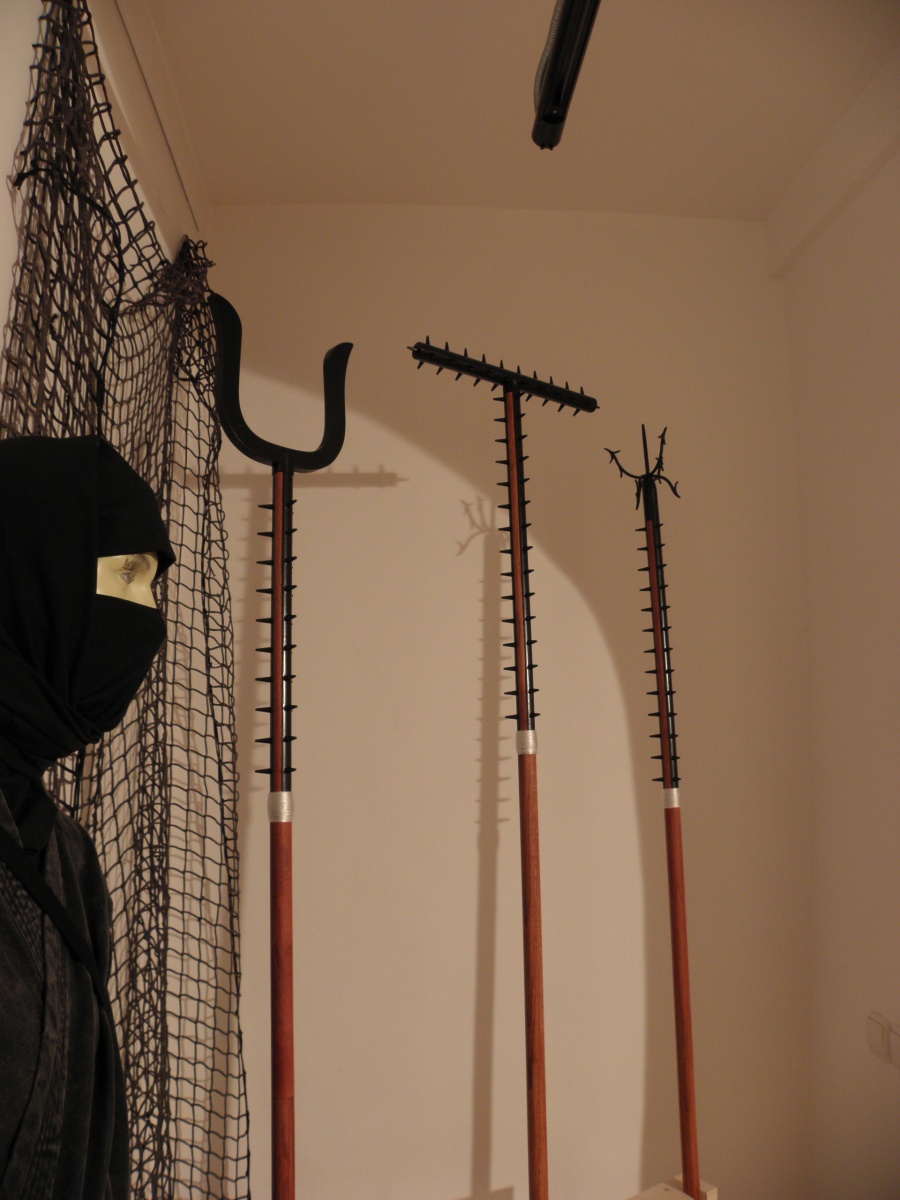
After you see how they look in start one by one, here is final look of all three,
currently exhibited in the Museum of the City of Pakrac, as part of exhibition "Warriors", organized by my Dojo in collaboration with the Museum,
soon more pictures : )


…

Sodegarami

From Paart Budo Buki by buki stolar

My dear  Budo  friends, 
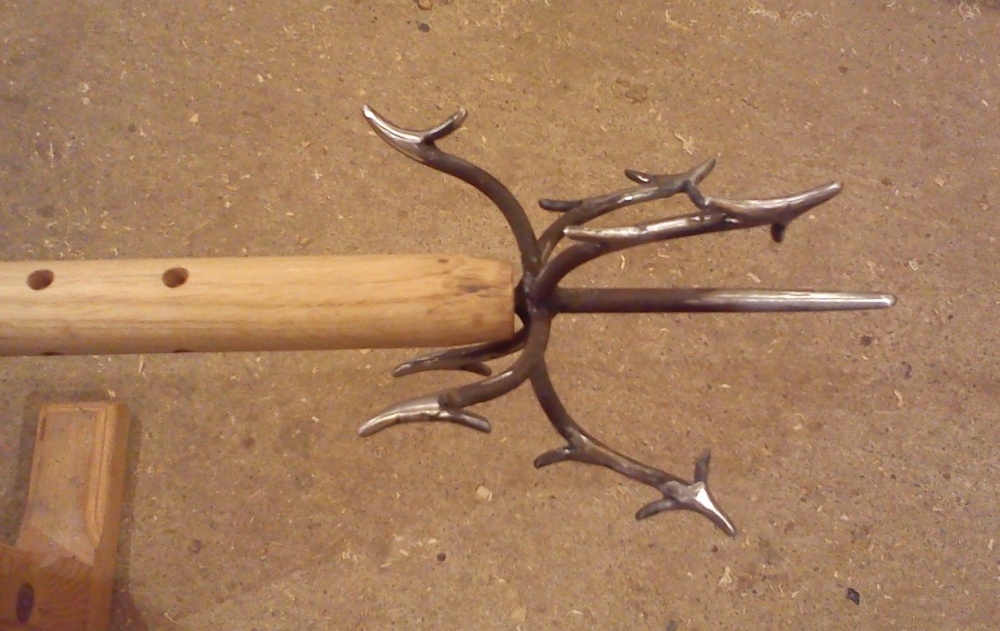
 here is the last of the three main long-handled arresting tools,
 
Sodegarami (sleeve entangler), the most frequently used of the arresting tool set,
this is long pole with many small hooks (KOKAGI) on one end, pointing in different directions.
The thorny Sodegarami was designed to snare a suspect's kimono sleeve or topknot
there is few version's of this tool, but I decide to make one which personally  like the most,
for now enjoy in pics.


…

How You Avoid Being 餓鬼 Gaki in the Bujinkan

From Bujinkan Santa Monica by Michael

Ouch! photo by Harry Sherman
There is a certain type of student in the martial arts and the Bujinkan who is like 餓鬼 gaki. A gaki in Japanese is the spirit of a jealous or greedy person who, as punishment for mortal vices, has been cursed with an insatiable hunger or thirst. No matter how much it consumes, it cannot be sated. Gaki is also a slang word for bratty kids.

Could you be a gaki? Would you even know if you were this type of student? And if you are, how can you leave behind this cycle?

Sometimes we focus on the wrong things in training. It's easy to get lost in the details. Where did Sensei put his feet? Which hand did he strike with? What are the steps of this kata?

After asking these questions we are still no closer to understanding what was taught. Then we try to mimic the teacher and cannot. Or we do mimic but don't get the results. This becomes frustrating for many. Some give up and quit.

Some even adopt a strange strategy of trying to mimic the teacher when he was younger. (how they think they can accomplish this I have no idea… old video? stories from the so called "old days?") Many people sink deeper into details, training on form to the extreme.

We should have compassion and understanding for these gaki. In Japan they even have a special day in August (or sometimes around Halloween) called segaki 施餓鬼 which is for feeding these hungry ghosts. In training, many so called teachers cater to these unfortunate students and sell them anything they wish to consume.

None of this offers a solution. You have to go back to the original problem. What do you focus on in training?

True experts make it look easy and effortless. What does that mean to appear effortless? It means to not show effort. Masters in any art are really masters of what to leave out. What not to do. Mistakes not to make.

They narrow their focus to the absolute essence of the movement. It looks so simple. And in truth, it is!

Soke Hatsumi writes,
"... with the Zen style of painting where anything unnecessary is omitted, and the place where it has been omitted is where the genuine illustration of Zen can be seen."
We should be focusing on what is not shown. What is not attempted. What steps are not taken.

If you can discard what the master left out, you will be left with the essence. Start from this basic, ground state when learning. The teacher shows what he shows for a reason. Don't think you know better than him to go do something else.

In training we only require the ground beneath our feet. Just like Soke. That is where he begins every technique. Connecting to this realization clears away the heaps of junk that are injected into our minds by people with a variety of agendas. Know also that many teachers cater to Gaki students and have an agenda for saying what they say. Their intentions are not to help you learn, but rather "sell" themselves and promote their ability. Your training with them will be full, but you will always be empty.

You have an innate wisdom that expresses an intuitive understanding and clarity that cuts through ego, anxiety, and aggression. Every student I meet has this ability to know what is good when they allow themselves this freedom.

Good training is going into that place in yourself where this exists naturally. You do this over and over until you no longer have to search in yourself for it. You embody it and all you require is the ground. It becomes the body you live in.

When you get to this place and find your spot on the ground, you have a responsibility to reflect it in your life. Bring it forward through personal example and responsible action. This is how to teach without ego, from your own truth.

Look for that teacher or be that teacher. Anything less is like being a gaki.


…

Bujinkan keiko

From 自然行雲流水 by 自然行雲流水

Thoughts on the the future of the Bujinkan and the
responsibility of it`s teachers and students.


Many dojos around the world want to follow the way of training as experienced in the Honbu Dojo in Japan.
Unfortunately, people do this without giving much thought to their actual current ability and, the ability of their students. As a result, we often see people demonstrating skills and techniques that have no “bone”, or “skeleton” to the movements. To develop a sound base is to come to develop a working knowledge of the Kihon within the Kihon and, develop the body. If you neglect good, repetitive training, your body will take longer to understand the movements.
In the Bujinkan, people are talking more than training. At times, the talking is a cover for their lack of skill or actual taijutsu ability. It is time for people to really start training well.
Nagato Shihan has said that many of the older teachers in the Bujinkan are surviving on reputation and not based on their actual skill level. There are many younger people that have passed them in actual ability and, this is not good. If the Teacher continues to train ( and not just teach ) then this should not happen.
Over 30 years ago, Soke used to begin training with a short meditation, junan taisou and then kihon. This kihon was done in a circle and performed solo. Eg: Kicks, strikes, kamae, ukemi, jumping, etc. This lasted for the first hour and everyone would be dripping in sweat. Nowadays in the Honbu, we do not see this. Why?
The Japanese have done this training and are entering old age. They are training according to their age and skill. What is funny is, the younger generation have blindly started to train the same way. This is just foolish and an obvious showing of a lack of understanding. Upon conversing with the Shihan, they say that people are weak nowadays and need to train harder and correctly. Nagato Shihan told me that people cannot even punch or block properly and that teachers around the world are teaching students not to use power too early. It is important to remember that these statements of not using power, kamae,kata etc, are directed to the people that should have already trained hard in the basics.The 15th dans. He is not talking to shodans, green belts or white belts. Up until 4th dan, the student is expected to train hard to develop a sound body and skills. Look at the skills and training other martial arts do. They are fit,strong,flexible,develop sound technique and a strong martial spirit. Many Bujinkan Dojos are like “ social groups “ rather than “ Martial Arts Dojos!”

Look at the Japanese shihan. Their movements are precise, structured and correct. Yet, they are relaxed, and move very naturally, capturing the timing,flow and distance of their uke.
We all want to achieve this same skill but, how do we do it? In my eyes and experience, you do it through looking at how they trained in the past. This will give you an indication of what is necessary to get closer to the ability you desire. If you do not put in the hard work, feel pain, sweat, and taste some blood, then maybe, you are just “playing”?
Soke says to “play”. However, many people take this too literally and just go off and do whatever they like. If their technique fails, they just go and do a henka. Henka is something you do after you can do the technique. Because, henka is based on technique. If it wasn`t, where is it coming from? The void? What void is this? Your void?
This Bujinkan seminar will challenge everything you thought you knew or thought you could do well. After 22 years of training, I was told I had a bad habit in my jodan uke. So, I now train in Jodan uke a lot. You have never fully understood or mastered something. If you think you have, you are falling away from the martial heart and the spirit of a three year old child. Around the world, I see people extremely confident in their abilities that are in fact, quite laughable. In saying that, it is important to always search for your shortcomings. No one is going to show you. You have to find them yourself. If you keep the mind of a student, then you will see your strengths and weaknesses. This is very important. Being in a class is also the best way to “see”. That is why it is important to train under a teacher and not to become a teacher yourself. When you do teach, it is about your learning. It is about becoming better yourself. Your students will see this and become inspired and have more respect for you. Don`t stand there and tell people what to do. If you do, you have to ask yourself, “ can I actually do what I told them to do? Can I actually demonstrate that well?”
Noguchi san said to me that he is training. He is not teaching. He trains at his own pace and flows as he wants. He keeps control of his own training. This is the way training should be. Don`t be a teacher. Transmit from training. Your students will learn that way.
Soke has said the same. “ If you become a teacher, you will become a slave to your students!”

I was in Mexico last year and we did basics. I stood at the front and made people repeat basic movements over and over. People were puffing, and could not do it. I remembered that one of the Japanese shihan said to me that he thought the average Bujinkan godan would loose to a Karate or Judo Shodan. He said no one trains hard anymore. He understands that people around the world would look at many Bujinkan dojos and laugh. I was surprised to hear this, but not really.
People say that this is a real fighting art, but many people have never experienced a confrontation. It is not the art, but the person. Don`t blame the art if you fail. You must look at yourself and your training, your character. Many people are hiding behind their high ranks. There are very few people that actually demonstrate real ability and understanding of budo taijutsu in my eyes.
And, I am not one of them.
Doing what you want because you cannot do basics or feel they are not relevant because you are small and have no strength is, sorry to say, a bad excuse.
Look at the late Oguri Shihan. He was a small built man, however, he had no problems controlling his uke both large and small. Why? Because he followed the teachings of Soke.
Regardless of if you are a small man or woman, etc, we all need to train in the fundamentals and get good at them. Any other way is to fall short of being a martial artist.
The secrets to controlling larger opponents are in the kihon. If you do not take the time to really discover these things, your skill will be lacking and, you will change the training to suit you. But, if you do this, are you really doing Bujinkan, or are you doing your own style based on your lack of ability or desire to endure with the basics?
Persevere with the Kihon and fundamentals of our art. There is much to learn. As a result, you will develop strength, flexibility, techniques, and the warrior spirit. If you still feel weak, you can add a weapon to your taijutsu. This is Bujinkan Budo Taijutsu Happo Biken.
The Bujinkan Shitenno in Japan demonstrate numerous variations, however, you can see their kihon in every movement. They move with structure. They have not left their kihon, they are using it. It is the basis of all their movement. They are our guides. Therefore, please watch your teacher closely.
Just like in Karate classes, we see the instructor at the front training and, training hard. The students follow his/her lead. In Mexico I did the same. The hosts came to me and said “ you are the first teacher that we have seen that actually trains. Everyone else shows a few techniques and then teaches. “
Yes, this is the case in the Bujinkan. It is ok for the Japanese, they are old men now. But still, some of them train in their own classes like this!
As long as the teacher is training, they will maintain a strong leadership in the dojo. But, if they don`t, the students will surpass them in skill level eventually.

This Bushinden Kai ( gathering to honor the teachings of our warrior ancestors ) will be to become more aware and discover ways we can better practice ourselves and therefore assist the future generation of the Bujinkan.

I will do my best to transmit aspects of training that I feel very important. I will be training as much as possible to improve myself as well.
I hope we can enjoy the training together and grasp the “kaname” of many things over the course of the seminar.
…